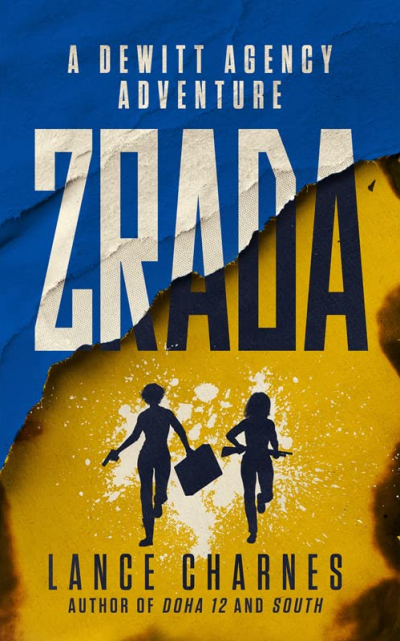
 Lance Charnes and I are Goodreads friends, and I’ve read and liked two of his earlier novels; so he offered me a free review copy of this newly-published book. (There wasn’t any guarantee that I’d also like this one, but he does know my tastes pretty well.) The opener for a projected new series, this tale spins off from the author’s DeWitt Agency Files, and Carson (no first name!), the protagonist here, is an important character in the opener for the first series, The Collection. (This review avoids spoilers for Zrada, but might have some for the former novel.)
The DeWitt “Agency” operates on the edge (and sometimes over the edge) of legality in the world of super-expensive art objects trade, a milieu with a decidedly dark underbelly, which the author has thoroughly researched. But, besides the change from a male to a female protagonist, where I classified the original series as crime fiction, I’d classify this one more as straight action-adventure. The emphasis here isn’t on art, the mechanics of art swindles, etc.; the art in the story is more of a McGuffin, with the emphasis on action, danger, derring-do, weapons and explosions. (This book is set in 2016, the same year the original book was published, and the author establishes that the events in the latter have already happened.)
Ex-cop Carson (she’s divorced, but still uses her married name) is a complex, thoroughly round and very distinctive character, and a highly private person with her share of secrets. (We get to know her here in much more depth than we do in The Collection, though she was also well-realized there.) Abrasive, prickly, potty-mouthed and tough as nails, she works as a mercenary for Allyson DeWitt, and also hires out, albeit reluctantly, as an occasional hit woman for a Russian mob boss, in order to protect family who are under his gun –though she does draw a firm line in the sand against harming innocents. As that suggests, there’s more moral depth to her than you might at first think; she’s actually a person of very real integrity and honor. She’s got a conscience that she listens to; her word’s her bond, and she cares about people, though she doesn’t trust or make friends easily.
This time out, Carson’s mission is legally and ethically unobjectionable. Back in 2009, two valuable 15th-century paintings were stolen in a burglary at a German museum. Now, they’ve fallen into the hands of a Chechen fence, who’s wiling to return them to the legal owner –for 2 million Euros. If he made that exchange in any peaceful, law-abiding country with an honest and functional police force, he’d be arrested in minutes. So, he’s set up the meeting in the lawless, war-ravaged Donbass, Ukraine’s break-away Eastern region, and cut a cash-strapped (but well-armed) rebel militia into the deal as his partners. The DeWitt Agency is handling the swap. Our heroine’s job is to deliver the cash safely, act as bodyguard for the museum staffer who can authenticate the paintings, and bring both of the latter back intact, come hell or high water.
Besides being obviously combat-capable, she landed the assignment because she speaks both Ukrainian and Russian; though raised in Canada, she’s of Ukrainian stock (her maiden name was Tarasenko). As the book opens, she, the museum expert, and the Agency’s local “associate” and his two minions are pulling into the meeting place. Her nerves are on edge; a LOT of wealth is going to be on the table here, and she’s surrounded by hungry, desperate strangers (or people she knows to be morally dubious) for many miles around. (And readers who know Ukrainian won’t be reassured by the book title; it’s the word for “betrayal”….)
Here as in The Collection, Lance writes in the present tense; this takes a moment or two of getting used to if your mind is expecting past tense. But I’ve encountered this technique before in a number of books, so adjusted quickly; and it does create a sense of “you-are-there” immediacy. The plotting has its twists and turns, but it’s mostly quite believable; it’s also focused on one strand, though from different perspectives, and tautly compressed in time, occupying just nine days. Narration is in third-person, but in the vocabulary of whatever character is the current viewpoint one (usually Carson, if she’s present).
For me, it wasn’t a quick read; the author’s prose style is straightforward, but there are a lot of Slavic personal and place names (a character list and real-world map of the geographical setting is provided) and references to unfamiliar-to-me types of guns and military hardware to wade through, and I found myself reading more carefully to pick up details of description and action. However, it’s a very gripping, involving read which quickly engaged me emotionally. The narrative pace itself is quite fast, and while the action isn’t “non-stop” (any book in which it actually is would by definition be pretty shallow otherwise, which this one definitely isn’t!), there’s a lot of it, steadily punctuating the narrative. Vivid, realistic and well-realized action scenes are one of this author’s fortes.
An even more important one is development of nuanced characters who come to life as understandable people, on both sides of the country’s civil war. For instance, the militia characters are not cartoon villains, or necessarily “villains” at all, as such. Some characters definitely ARE villains (though not cartoonish ones), but even they may have an admixture of better qualities along with their sleaze. Fans of action heroines here will have the added plus of meeting another fighting female, ex-Ukrainian National Guard soldier Galina, who’s far from a Carson clone (she’s a developed, distinct character in her own right), but who can more than pull her weight in a combat situation.
There’s no sex here, just some passing references to past sexual activity (Carson’s trust issues and low opinion of marriage and males, which her one try at the former didn’t help, give her the ratchet towards commitment-free flings that you’d expect). A number of characters have foul mouths, often shaped by military culture (both Ukrainian and Russian have an exact parallel to the American f-word, which the author translates :-( ), but that’s realistic for the character types, and, refreshingly, not everybody does.
Despite the cruelty and greed often in evidence here, this is at its core a profoundly moral novel, whose messages (delivered by example rather than sermonizing) encourage readers to be kinder, less selfish, more honest and caring in their treatment of other people. My main quibble was with decisions by a couple of characters that, IMO, served the plot rather than being in character and/or very smart (and Carson’s not stupid!) But that doesn’t keep me from highly recommending this to action fans.
Author: Lance Charnes
Publisher: Wombat Group Media; available through Amazon, both for Kindle and as a printed book.
A version of this review previously appeared on Goodreads.




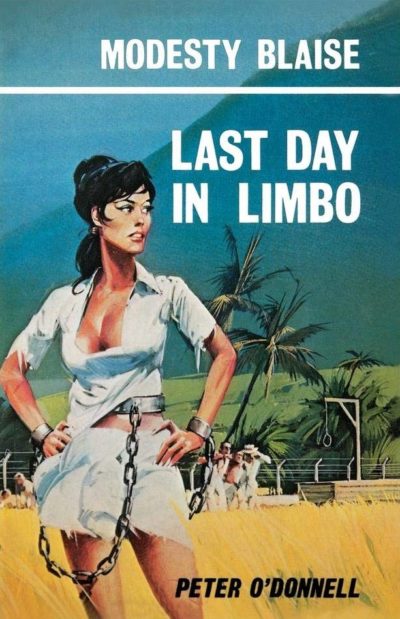 An obvious question readers might ask is, does reading this out of order result in “spoilers” for the earlier books? I would say no, because Modesty’s adventures are each episodic and self-contained; and she and sidekick Willie don’t significantly change, either in their life circumstances or in terms of character growth. Some characters here do appear in earlier books: Sir Gerald Tarrant, for instance, is already introduced in the first book, and Steve and Dinah Collier are in the story A Perfect Night to Break Your Neck, included in the story collection Pieces of Modesty (which I did read previously), though that’s not their first appearance in the canon. The madman who calls himself (and actually believes that he is!) “Lucifer” is, I’m guessing, the title character of the third novel, I, Lucifer, and both Dall and British spy Maude Tiller have also apparently shown up before.
But while having read about them earlier would make them more familiar, all of these were depicted here with enough clarity and depth that I felt I knew them fully well as people. And while occasional references are made to previous adventures, the significance is explained in each case, and for me the effect was simply to whet curiosity, not spoil it. (Of course, it’s clear that Modesty emerged from these triumphant; but that’s a “spoiler” only if you don’t grasp the idea of the word “series….” :-) ) I’d recommend reading the first book before this one, to get a basic idea of who Modesty is, what her early life was like, and the Modesty-Willie dynamic; but otherwise, I don’t think it’s essential to read the earlier books first.
In terms of style and literary vision, this book felt, to me, very much of a piece with the two I’d read earlier. While he doesn’t write with the elaborate diction of his 18th-century Romantic predecessors, O’Donnell’s solidly in their literary camp with his use of exotic locales, extreme situations, and above all, frank appeals to the whole range of readers’ emotions. (In one revealing exchange, Dall tells Modesty she’s a “romantic,” whereupon she replies, “Of course I’m a romantic, dum-dum! And proud of it. There’s not enough of it about these days.”) His plotting is taut and well-constructed, with a good deal of suspense, a steady pace interspersed with frequent jeopardies and vivid action scenes. Modesty has to display her planning acuity and ingenuity as well as her fighting skill; and surviving and taking down the baddies here won’t be a cake-walk, since while she’s highly competent and a born leader, she’s not Superwoman. On the contrary, she’s very much a flesh-and-blood woman, who can bleed and cry (though she doesn’t like to do the latter in front of others); and she’ll do both before we close the book.
In contrast to the cynicism of much modern literature, despite the gritty milieu we find ourselves in here, O’Donnell’s vision is a solidly moral one. Our heroine (and Modesty is a heroine, not an anti-heroine) is pitted against villains who are radically evil, and while she, Willie and their friends have foibles, they basically have a solid and instinctive orientation towards the good. And O’Donnell knows that the basic dividing line between the two separates those who care about others and try to treat them decently, vs. those who care only about self and consider all other humans as things to be used. The author’s social message here isn’t loudly delivered; but we do get a clear look at both the misery the downtrodden in the Third World have suffered (and still do), and the reality that a fixation on vengeance rather than justice can make the oppressed a mirror image of the oppressors.
Content issues here aren’t too problematic, given the literary genre that this is. There’s some swearing and religious profanity (but no obscenity). There are no sex scenes, but there is reference to sexual activity, and it’s made clear that two of the principal villains are into kinky sex that involves inflicting extreme humiliation on women (though O’Donnell spares us any specifics). That such behavior exists in the world should (and does!) offend every decent human; that it’s depicted at all in a book will offend some readers. In the author’s defense on that score, I would say only that a mentality which freaks out on wielding power over other humans is realistically apt to also be reflected in warped sexuality; it warps every aspect of the personality. The language and sexual attitudes/behavior of most of the characters here are what would realistically be expected of secular folk who move in these kinds of circles. Indeed, while some readers would roll their eyes over using the term here, because of the unusual and extreme situation (“unusual,” though, is not the same thing as “impossible!”), I would say that O”Donnell depicts a wide range of life-like characters with very convincing realism, and that his characterizations are a strong point of the series.
Again, I’d recommend reading the series opener before reading this installment; but otherwise, I’d have no hesitation in recommending it to any reader who enjoyed the first book.
Author: Peter O’Donnell
Publisher: Souvenir Press; available through Amazon, currently only as a printed book.
A version of this review previously appeared on Goodreads.
An obvious question readers might ask is, does reading this out of order result in “spoilers” for the earlier books? I would say no, because Modesty’s adventures are each episodic and self-contained; and she and sidekick Willie don’t significantly change, either in their life circumstances or in terms of character growth. Some characters here do appear in earlier books: Sir Gerald Tarrant, for instance, is already introduced in the first book, and Steve and Dinah Collier are in the story A Perfect Night to Break Your Neck, included in the story collection Pieces of Modesty (which I did read previously), though that’s not their first appearance in the canon. The madman who calls himself (and actually believes that he is!) “Lucifer” is, I’m guessing, the title character of the third novel, I, Lucifer, and both Dall and British spy Maude Tiller have also apparently shown up before.
But while having read about them earlier would make them more familiar, all of these were depicted here with enough clarity and depth that I felt I knew them fully well as people. And while occasional references are made to previous adventures, the significance is explained in each case, and for me the effect was simply to whet curiosity, not spoil it. (Of course, it’s clear that Modesty emerged from these triumphant; but that’s a “spoiler” only if you don’t grasp the idea of the word “series….” :-) ) I’d recommend reading the first book before this one, to get a basic idea of who Modesty is, what her early life was like, and the Modesty-Willie dynamic; but otherwise, I don’t think it’s essential to read the earlier books first.
In terms of style and literary vision, this book felt, to me, very much of a piece with the two I’d read earlier. While he doesn’t write with the elaborate diction of his 18th-century Romantic predecessors, O’Donnell’s solidly in their literary camp with his use of exotic locales, extreme situations, and above all, frank appeals to the whole range of readers’ emotions. (In one revealing exchange, Dall tells Modesty she’s a “romantic,” whereupon she replies, “Of course I’m a romantic, dum-dum! And proud of it. There’s not enough of it about these days.”) His plotting is taut and well-constructed, with a good deal of suspense, a steady pace interspersed with frequent jeopardies and vivid action scenes. Modesty has to display her planning acuity and ingenuity as well as her fighting skill; and surviving and taking down the baddies here won’t be a cake-walk, since while she’s highly competent and a born leader, she’s not Superwoman. On the contrary, she’s very much a flesh-and-blood woman, who can bleed and cry (though she doesn’t like to do the latter in front of others); and she’ll do both before we close the book.
In contrast to the cynicism of much modern literature, despite the gritty milieu we find ourselves in here, O’Donnell’s vision is a solidly moral one. Our heroine (and Modesty is a heroine, not an anti-heroine) is pitted against villains who are radically evil, and while she, Willie and their friends have foibles, they basically have a solid and instinctive orientation towards the good. And O’Donnell knows that the basic dividing line between the two separates those who care about others and try to treat them decently, vs. those who care only about self and consider all other humans as things to be used. The author’s social message here isn’t loudly delivered; but we do get a clear look at both the misery the downtrodden in the Third World have suffered (and still do), and the reality that a fixation on vengeance rather than justice can make the oppressed a mirror image of the oppressors.
Content issues here aren’t too problematic, given the literary genre that this is. There’s some swearing and religious profanity (but no obscenity). There are no sex scenes, but there is reference to sexual activity, and it’s made clear that two of the principal villains are into kinky sex that involves inflicting extreme humiliation on women (though O’Donnell spares us any specifics). That such behavior exists in the world should (and does!) offend every decent human; that it’s depicted at all in a book will offend some readers. In the author’s defense on that score, I would say only that a mentality which freaks out on wielding power over other humans is realistically apt to also be reflected in warped sexuality; it warps every aspect of the personality. The language and sexual attitudes/behavior of most of the characters here are what would realistically be expected of secular folk who move in these kinds of circles. Indeed, while some readers would roll their eyes over using the term here, because of the unusual and extreme situation (“unusual,” though, is not the same thing as “impossible!”), I would say that O”Donnell depicts a wide range of life-like characters with very convincing realism, and that his characterizations are a strong point of the series.
Again, I’d recommend reading the series opener before reading this installment; but otherwise, I’d have no hesitation in recommending it to any reader who enjoyed the first book.
Author: Peter O’Donnell
Publisher: Souvenir Press; available through Amazon, currently only as a printed book.
A version of this review previously appeared on Goodreads.
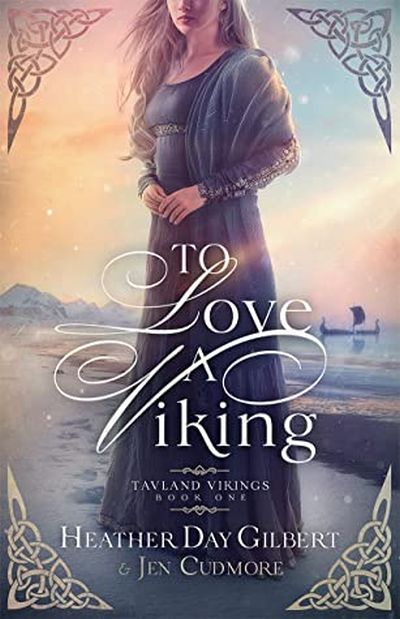 As you’ve no doubt already surmised, yes, this novel does have a romantic component –and, indeed, two romances for the price of one. :-) But it offers more than that, as serious writers know that fiction must if it depicts romantic love as a realistic (and good!) part of the totality of human life; and our two authors here are definitely serious writers. We’re looking here at family life, social relationships, implicit questions of social justice and the relationship of Christian faith to conduct; and we’re also getting a crash course (which sadly is as relevant in 2022 as it was in 998!) in the grim realities of spousal abuse and what is or isn’t a helpful way of dealing with it. (The “Word from the Authors” at the end is constructive in that regard.) Questions of gender roles, and the relationship of career goals vs. family life, are also front-and-center here, and again very relevant.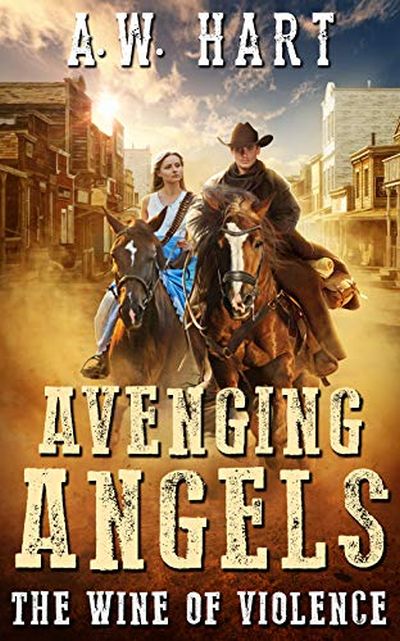
 Like “Franklin W. Dixon” and “Carolyn Keene,” “A. W. Hart” is the house pen name assigned by the publisher to all the various authors of individual books in the series of which this novel is the seventh installment. In this case, though, A. W. is actually my Goodreads friend Charles Gramlich (that’s no secret; he’s credited in the “About the Author” note at the book’s end). Although I’d read and liked a couple of his short e-stories previously, I’d never tried any of his long fiction. So, when I saw this novel mentioned in one of his blog posts last year, I was intrigued enough to buy a copy. (Barb and I read it together, since she’s an avid Western fan, and I knew this would be right up her alley.)
 That’s what happened here, about a month ago,with Quinn wanting to move in the direction of engagement and marriage and Nadia not willing to, leading to a messy breakup that left him very hurt and her “feeling like [vulgarism deleted].” :-( On top of that stress, when this book opens, she’s in rural Michigan on a job (of the kind that she doesn’t advertise). That quickly results, though through no fault of her own, in a traumatic event which has her on the point of meltdown. But before long, she’s in for a moral and emotional ordeal which will make her present distresses look relatively mild.
 Even with her off-the-books side income, Nadia can’t afford to pay more than a tiny staff at her guest lodge; but out of kindness, she’s given a job as assistant housekeeper to a 17-year-old girl from the nearby small town of White Rock, Sammi Ernst. Sammi’s foul-mouthed, barely literate, and has a chip on her shoulder; the latter isn’t surprising, given her life situation. She’s the out-of-wedlock daughter of Janie Ernst. Both women are widely looked down on in the community –Janie because she’s a drunken, mean-tempered, self-centered deadbeat, and Sammi mainly because she has Janie for an (abusive) mother. Also a single mom herself, Sammi’s not promiscuous like Janie (she had a single affair, with a visiting rich college kid who wasn’t interested in marriage or fatherhood, and left her to bear his unacknowledged daughter alone); and also unlike her own mom, she genuinely loves baby Destiny, and wants to work to support her, rather than making a dead-end career out of welfare dependency as Janie has.
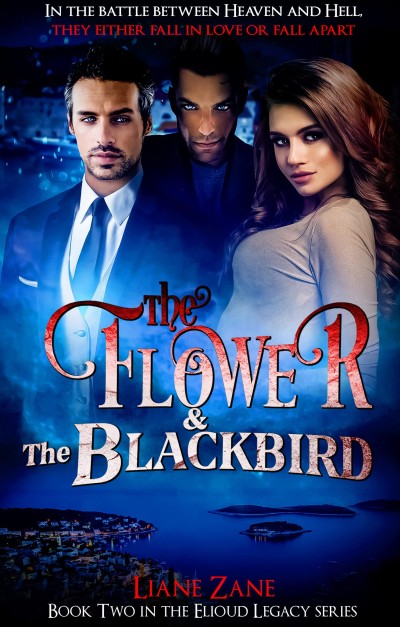 My friend Liane Zane kindly gifted me with a paperback copy of this second of her Elioud Legacy novels, as she did with the first one (The Harlequin & The Drangùe), in exchange for an honest review. Having liked the first book, I was glad to accept; and I wasn’t disappointed with the sequel!
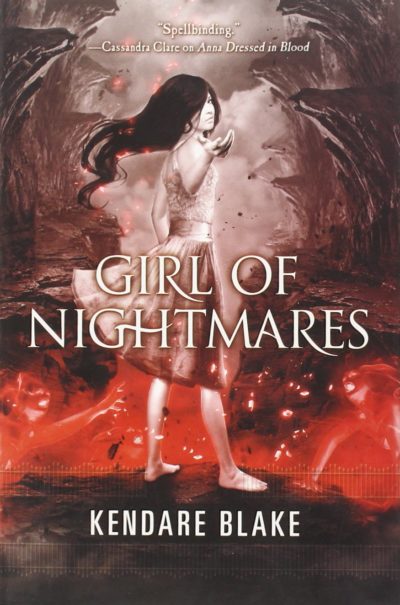 Warning: while this review contains no spoilers for the book I’m reviewing, it inevitably involves some spoilers for the book to which it’s a sequel, Anna Dressed in Blood. (I didn’t review that one here; see below). The situation in this book directly grows out of the events of the first one; and though the author provides some brief references to those in the opening chapters here, if you have not read the series opener, you would get only the very bare basics of what happened there. IMO, she expected that her readers will read the books in order, and I would strongly recommend doing so. Your whole understanding of the premise here, your engagement with the story, and your understanding of who most of the major characters are as people and your emotional connection to them will be seriously impaired if you don’t!