The communiques below were written by the two sides which took part in a somewhat abortive roller derby match in November 2004 at Glendale Arena. For a report on the game, please see here – you’d really be better off reading that first!
Alotta Trouble’s response
![Alotta whizzes past a fallen T-bird [Photo courtesy Wayne Kuban]](https://girlswithguns.org/pics/rd12.jpg) Okay, so here’s what REALLY happened. Sorry I took so long. As you can imagine, I’ve not had much time to sit at my desk lately. Also, this is a very long letter, but I promise, it contains tons of interesting information.
Okay, so here’s what REALLY happened. Sorry I took so long. As you can imagine, I’ve not had much time to sit at my desk lately. Also, this is a very long letter, but I promise, it contains tons of interesting information.
For the last few months, the Landsharks and I have been training hard. We’ve been waking up at obscene hours and staying late nights training for a bout we hoped and expected to be a tough match. Over these past months, our team became a very close, tight knit, cohesive unit. We are all in the best shape of our lives. We cross trained at skate parks, in rinks, on our track, in the gym, and any other way we could think of (Camelback Mountain, swimming, you name it). Dave Martinez came out from California to work with us on tricks,stunts and how to correctly skate the track. We really stuck together and created a wonderful thing.
Meanwhile, back at the office, we were in full production of our event at the Glendale Arena. **Side note: Originally, we were going to have the bout at the Veterans Memorial Coliseum at the State Fairgrounds, but Glendale made us a smokin’ offer we couldn’t refuse. And who wouldn’t rather play in such a fancy house?
In almost daily conversations with TBird manager, Tim Olague, I was assured that the TBirds would be tough competition and threatened that we would most likely loose. From the beginning, I was frank and clear about the new style of Roller Derby we play. (Which is ironically more like the earliest versions of the game, before it was staged.) I made sure that Tim knew how we play.
** For those who don’t know much about new school Rollergirls, our game is played for real. We do not choreograph or plan a winner. We play tough, fast and hard. We keep our fighting to a minimum and do not pull cheap shots like tripping, hair pulling, punching, etc. Our game is a sport. We train like athletes. We use body and hip checking combined with skillful jumps, turns, whips and other moves. Our bouts are full on athletic competitions between tough, sexy women who take their game seriously.
So, for the past few months, Tim has been telling me that the “TBirds New Line-up” played in our vein. He said that they practiced together 3-4 times a week on Lou Sanchez’s banked track and later on their own banked track in their own training facility that was equipped with T.V. cameras and all kinds of multimedia equipment. He told me that they had new uniforms and a street team who were out all the time at events and getting press. Tim told me that he had all kinds of pictures and footage that I could use to add to our marketing…funny, no matter how many times I asked, he never produced. He promised me that with his connections to the Hispanic media, his girls would do interviews and appearances for the Hispanic community (who historically love Roller Derby). Tim told me that he had an Arizona Gaminglicensee and would place ads with the Native American Casinos and send his street team to pump them up. But most importantly, he assured me that the new TBirds were playing the Rollergirl game. In fact, he said that some of his girls were also Derby Dolls. NOTHING TIM OLAGUE SAID WAS TRUE. And because of his negligence, some very nice girls and women were unwittingly placed in a very dangerous situation.
Game day: The TBirds arrive at the Arena hours after we do and take the track for a work-out. Of course, we were up in the stands spying on them. L.A.’s posse consisted of 5 veterans over the age of 40 who had only played the staged version of the game. They also had 3 rookies who were teen-agers from the local skating rink. They also brought some of the rink’s jam/rhythm skating dudes along for color. They did not look like much competition, but the younger skaters were talking so much smack about their “incredible speed” that we went with it.
As the day went on, I got to talk to some of the teen-agers. They were nice kids. They told me that they had practiced together a few times, maybe 6 or 7 on the flat rink. Only Robyn Foster had been on the banked track and only a few times. They told me that they had never practiced all together as a team with the veterans. They said that Tim Olague had promised them a resort hotel and SUV’s to go around town in as well as new skates and new wheels. He told them they would be eating out in nice restaurants and get all kinds of cash. Needless to say, Tim came through with none of these promises. In fact, he had told the teen-agers that this would be a fixed game and not to worry.
Just before the game, I got together with Vicki McEwan, TBird Capt., Veteran Ref Don Lastra, New local Ref Mike Edwards and Tim Olague to discuss rules. We went over the basics… which are pretty universal and agreed that this would be a competitive game with no pre-determined winner. However, Mike, Don and I were all under the impression that Tim had filled Vicki and all the other vets in on our new, evolved style. He had not. Tim told them that we were playing their style minus the pre-determined winner.
Game time: Go Go Liz went out on the first jam. Well, we all know she is “the fastest derby girl in the west”. It was immediately evident that the TBirds were out gunned. After 90 seconds, they were winded and had trouble lining up for the 2nd jam within our allotted 7 seconds. Mayhemily went out on the second jam and was sacked by Stephanie Garcia who proceeded to pull Mayhemily kicking and screaming across the track on the floor by the hair. The refs and several Sharks worked at pulling Garcia off her and when they finally managed to, Garcia clutched a handful of Mayhemily’s hair. I took the 3rd jam. During this jam, I was put in a head-lock by 2 TBirds (I think one of them was Garcia) at the same time. Garcia also grabbed my dress at the neck line and pulled along as I skated. As the first period went on, I was kicked in the back of the knees, my hair and uniform pulled and my arms and legs were grabbed. The TBirds turned almost every jam into a totally stupid looking fake fight. Meanwhile, they were becoming so winded that they could barely line up between jams. By the 2nd period, the out of shape TBirds were taking their seats as much as they could. It was like all they knew how to do was taunt and cause fights.
Half Time: We were informed that the TBirds would not be returning for the 2nd 1/2. My husband Patrick (who built and owns our track) and I along with the refs went to the TBird dressing room to try to keep the game going. They accused us of committing all the fouls that they were so outrageously committing. The young girls said there was no way they would come back and get beat up. Sooooo, I went back out on the floor and challenged the dudes! Supposedly, the male entourage were all skaters, so bring ’em on! Well, that was a no go, they didn’t want to get spanked either.
Finally, the older women agreed to come out and finish what was left of the game. We all know the final score. There were about 1000 people in attendance, no thanks to the rain. We had over 100 people at the meet and greet and were lucky to make tons of new Derby fans. The crowd response was tremendous! We are only sorry that it was at the expense of some very nice people who, in his greed and negligence, Tim Olague really took advantage of.
The next day: Go Go Liz and I flew to California with Ref Don and Dave Martinez to play the Ralphie Valladarez game with the old schoolers. I was put on the Texas Outlaws and Go Go on the L.A. Stars. Ironically, my team Capt. was Stephanie Garcia. Several of the women who had played in AZ the night before were playing this game as well. Go Go and I went into it with the attitude that we were going to learn THEIR game. We were going to do what they told us to and just have fun. My team was AWESOME! They let me jam a whole bunch and get involved in lots of choreography. Sadly, Go Go’s team was not so cool to her. She was treated like an outsider and spoken down to. By the end, I was having a great time and she was fed up and bored. Really, we wanted to play with the men. Their game was much cooler than the womens’.(More than one Californian also told me that Tim was claiming our track belonged to him.)
Anyway, I could go on and on, but I still don’t feel like I even got a work-out. While both games were fun, it is evident that Roller Derby will not be held back. Young, strong athletes have risen to the occasion and evolved a game that has been stuck. Held back by the constraints of choreography. Performed by clowns. It’s time to move on…I can’t wait to play more Landsharks games with REAL competition. Somebody, please, come knock my ass down!
Feel free to send me any questions. I sure have learned a lot in the past few months. Believe me, this story could go on and on. I know one thing though, I love Roller Derby in all its forms and will SUPPORT ALL LEAGUES!
Sincerely,
Alotta Trouble
PHX Landsharks #911
P.S. Martines…thanks for all your help and encouragement. You are the man!
But wait! There’s more! The T-birds who were the visiting team then issued this press release…
An Official Response From The LA T-BIRDS
The LA T-BIRDS lodged a protest with Patrick Sheehan, the AZ contractor who designed and built the track, after he stormed into the T-BIRDS locker room full of half-clad women and stated, verbatim: “I put 80 (explicate) thousand dollars into this game and I will tell Celeste Cooper she cannot (explicate) cheat!”
Celeste Cooper then skated awkwardly (her natural, duck-like style) into the locker room and her “boyfriend” Patrick yelled at her (According to Patrick, Celeste is “only” is “girfriend” and not his wife, a comment he made to the beautiful T-BIRDS women after the game). Patrick told Celeste Cooper, “Celeste, I know now that you can’t (explicate) cheat!”
Thereafter, Tim Olague, spoke through the public address system, which was videotaped. Under the condition of protest and with the understanding that the Landsharks would stop cheating, the T-BIRDS agreed to skate the second-half under protest against Celeste Cooper, the promoter of the event, whose name is on the contract she signed with the T-BIRDS.
Recognizing that there is no official governing body which oversees inter league games, we may likely see the courts hosting some more bouts between these two teams. In addition, criminal assault charges may result out of outright unsportswomen-like criminal attacks by Celeste Cooper’s hired hands, her so-called AZ Landsharks team. After all, the NHL endorses criminal assault charges when one player ‘blindsides’ another, hits them with a stick, or God-forbid, strikes an opponent with a skate.
As for the game, first and foremost, the Landsharks did not skate by their own rules. Several witnesses who were at the so-called game had to endure a repetitive and silly video explaining the rules of the AZ Landsharks, not Roller Derby. According, to the Landsharks’ own rules, as demonstrated in the video, several obvious unnecessary roughness-type tactics, outright assaults, would not be tolerated. In addition, Celeste Cooper provided the T-BIRDS with a list of the AZ rules, which Landsharks completely ignored during the first half.
In fact, the video tape of the game, which Celeste Cooper is contractually obligated to produce, unedited, to the T-BIRDS organization, shows such assaults as pushing from behind, skating across the infield to ‘blind side’ a T-BIRDS skater, and kicking downed opponents in the head with a roller skate. To protect their personal safety, the T-BIRDS women elected to skate under protest in the first half by “allowing” Celeste Cooper’s team to skate past them. After all, there were children in the crowd whose parents told them they were going to see a Roller Derby game, not “ultimate fighting,” which is illegal in AZ. So the video will indeed be telling.
Additionally, the predominately T-BIRDS fans at the game (who couldn’t resist the traditional chant, “T-BIRDS, T-BIRDS”) spoke with their favorite T-BIRDS skaters during half-time, both in person and through cel-phones, proclaiming, “These AZ women do not know how to skate, when they fall down, they kick you with their skates, and when your not looking, they ‘blind-side’ you. This is not Roller Derby. Celeste Cooper skates like an awkward monkey.” [Note: I was at the game, and can state categorically, and without doubt, that the fans were not “predominately T-BIRDS”. Knowing this for a fact, severely damages the T-Birds’ credibility, with regard to their report of other events.]
Second, the track itself was unfinished. Indeed, at this very moment, Celeste Cooper, perhaps knowing that the man who denies her existence as his wife, permitted her skaters to use roller rink “toe-stomps.” Much of the video will show, T-BIRDS women skating on a NEGLIGENTLY designed track upon which Celeste Cooper contractees have to use their toe-stomps, since the track was way-too slippery for Roller Derby.
And that Rope for a rail? Again the videos exist, so do the many photographs, taken by T-BIRDS personnel. Patrick Sheehan is now convinced that he NEGLIGENTLY designed a dangerous track and contributed to the many injuries which will soon be made public. That’s why the man that denies Celeste Cooper’s existence as his wife has decided to “upgrade” his track and provide wooden rails, as opposed to ropes. The AZ Landsharks also had a move called, “rope her,” a haughtingly throwback to the days of lynching.
Robyn Foster, Denise Green and Pam Schwab were told by Patrick Sheehan that Celeste Cooper is not his wife. In other words, he totally denied his existence as a husband to a woman that the fans proclaim, skates like a “Chimp.” No doubt Patrick Sheehan is ashamed of Celeste Cooper and, moreover, was trying to “pickup” on T-BIRDS women.
As ultimate liars, the Landsharks had a chance to be honest just today. Tim Olague personally called Patrick Sheehan to advise him that he is aware of his “girlfriend’s Celeste” slanderous and libelous “spin” on the game. Tim Olague told Patrick Sheehan that the T-BIRDS spin would reflect reality, and that controversy is good for the game resulting in ticket sales.
However, when asked about the tape contractually agreed upon, which will show the UNPROFESSIONAL and NEGLIGENT skating of a bunch of stocky chicks that look unattractive in mini-dresses, Patrick Sheehan claimed Celeste Cooper owed money and she did not have a tape. Both the Glendale Arena and the TV crew at the game agree that Patrick Sheehan and Celeste Cooper received a copy of the tape the night of the game.
Under contract to receive the unedited version of the tape, Patrick Sheehan and Celeste Cooper, “friends” in Patrick’s eyes, “spouses” in Celeste’s, have undeniably elected to stomp like chimps and other ground-foraging creatures about the madness. The T-BIRDS predict, that Patrick Sheehan and Celeste Cooper shall never produce a tape because they know their team violated their own rules and are “True Losers.”
So when the bout resumes in the courtroom, we’ll hear more about Breach of Contract, Negligence, and Criminal Assault, not to mention Libel, Slander, and Tortious Interference with a Contract. The T-BIRDS record in a Federal Courtroom is well-known. Since the Celeste Cooper resides in AZ and she has engaged in interstate tortious activities, she’ll likely be summoned in accordance with Federal Jurisdiction.





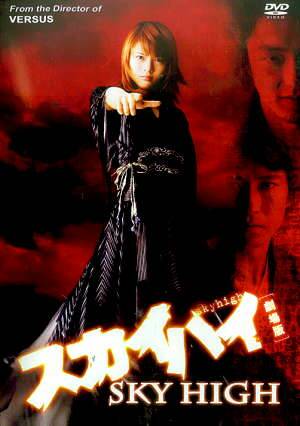 Combining elements from Dead Like Me and Ghost, this still manages to come up with something unique, especially given its origins as a prequel to a popular TV series. It is designed to explain how Mina (Shaku) got the job as Keeper of the Gate, where murder victims must decide whether to forgo revenge and pass on, return to Earth as a ghost, or seek vengeance at the price of eternal torment. She ends up there after having her heart torn out on her wedding day by insane billionaire serial killer Kudo (Osawa) who will stop at nothing to save his one true love, currently lying in a coma. Trust me – it all makes perfect sense, and it’s a particularly nice touch that Mina’s fiance, Detective Kohei (Shosuke) is equally driven in his actions by love.
 Director Ichimura returned for the fourth episode, and despite similar problems as the third installment – most obviously, an apparent doubt that Oichi’s character can hold the viewer’s interest by herself – makes a much better stab at things here. Bounty-hunter Oichi finds out what life is like on the other side of the law, after she helps rescue an unwilling bride from a local magistrate; he slaps a 100 gold-piece reward on her head, which naturally, brings other bounty-hunters on her trail, led by Sankuro (Meguro).
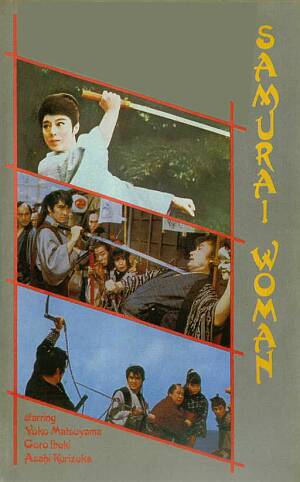 The third entry in the series saw a new director, and unfortunately, a marked turn for the worse, largely because the focus drifts off Oichi. It starts briskly enough, with the heroine coming into possession of a new, effective formula for gunpowder, something barely known at the time in Japan. Understandably, this makes her the focus of attention, in particular for a group with an interest in profiting from the discovery.
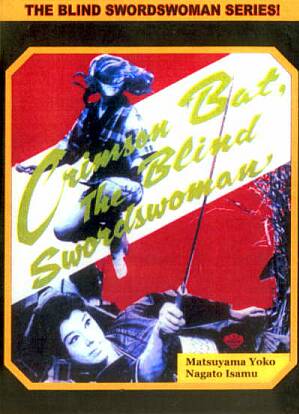 We meet our heroine Oichi as a young child, who has just been being abandoned by her mother – not sure what happened to father, but we later discover Mom’s a prostitute, so can probably fill in the blanks ourselves. To make matters worse, the tree under which Oichi takes shelter from a storm is struck by lightning, rendering her totally blind, in a way that’s – probably wisely – left medically unexplained. However, she is then taken in by a kind gentleman, who brings her up, and on into adulthood.
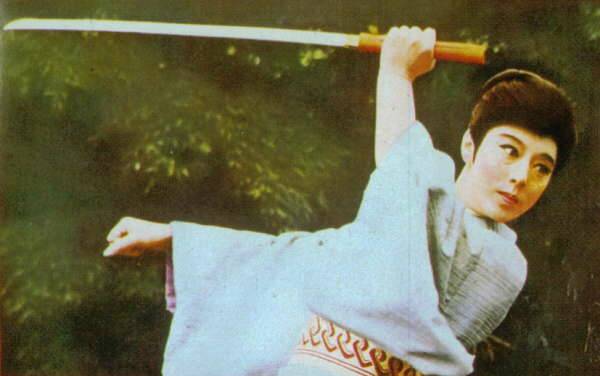 “Up to bat…”
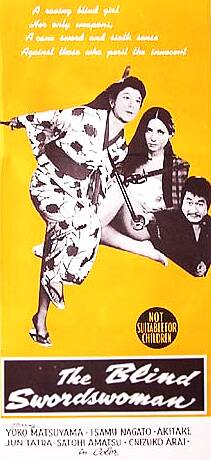 While the samurai is one of the most common archetypes in Japanese cinema, the female version is about as rare as the female gunslinger. Although none of these women reached anything like the popularity of Zatoichi – 26 films starring Shintaro Katsu alone, never mind the recent Takeshi Kitano version – there have been a few that have attempted to break the mould. Azumi and The Princess Blade have both achieved cult status in the West, assisted by Tarantino’s take in Kill Bill, Volume 1. Back in 1973, there was Lady Snowblood, which was successful enough to merit a sequel the following year, but so far, only one samurai-ess series has survived more than two outings.
 Typical. Wait ages for one roller-derby league, then two start up almost after each other. Back in June, we wrote about AZ Roller Derby, but a schism arose almost immediately, disenchanted skaters breaking off into the Renegade Rollergirls. A third group also peeled off in another direction. The reasons are not relevant: here, we don’t take sides, especially if it increases our opportunities for femayhem. Regardless, almost-certainly-
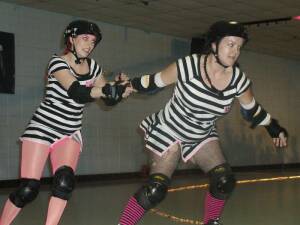 The venue for the first bout was Surfside Skateland, a place with both benefits and limitations: you can get very close to the action, but it’s not designed for spectator sports, and the only seating was three rows of folding chairs at each end of the rink. If you didn’t get there early, audience members either have to stand or sit on the floor down in front. And if you opt for the latter, you might end up with a roller-derby girl flying into your lap – I leave it to the reader to decide whether this is good! On the definite-plus side, concessions are cheap: a bottle of water is only a buck, where they were also offering $2 beers. However, I didn’t bother, since with it being an all-ages show and a small venue, you can’t take your beer back to your seat, but have to drink it in the designated area. Of the two MC’s providing colour commentary and announcements, one seemed to think that the louder he bellowed into the mic, the better it was: he was wrong. We were far from the only people cramming fingers into our ears and wishing for a high-velocity rifle.
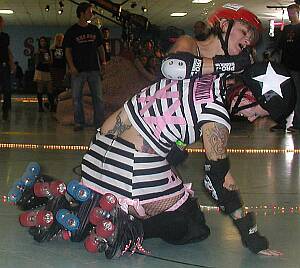 As for the game itself…we got our butts kicked. The visiting girls were simply faster and tougher, as well as more experienced (roller derby in Texas dates back to TXRD’s creation in 2001), and this disparity was painfully clear from about five minutes in. The first brawl saw AZ captain Ivanna Spankin left looking for the number of the truck that just hit her, and by the end of twenty minutes, Arizona was behind 42-18. This huge lead rendered the rest of the contest almost irrelevant: the two other periods were closer, but by the end, Texas had racked up a three-figure point tally too large for the scoreboard to handle, winning 102-60.
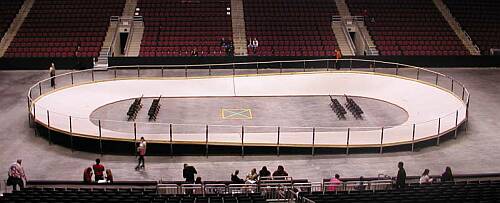 We got tickets through a contact at the Coyotes (thanks, Marissa!) for $15; if we’d gone through
 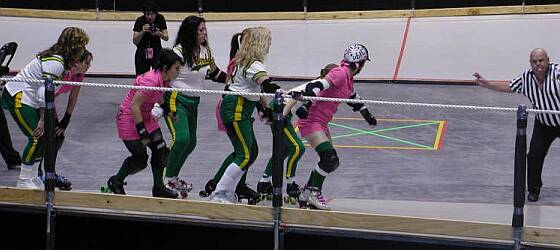 As we waited, promo videos played on the scoreboard, an enormous device hung from the ceiling like a cannon on the Death Star. Bonus points for production values on these films, which explained the rules and introduced the players, as well as promos for their sponsors: Dickies, the Platinum Girlz promotional company, etc. We learned they were calling the venue ‘The Shark Tank’, which is a catchy name, and that the rules were basically the same; the only major difference was there’d be four periods, each of ten 90-second jams, rather than three twenty-minute periods. On the downside, there was no program, and merchandise was limited to one design of T-shirt. One wonders perhaps how quickly this event had been scheduled.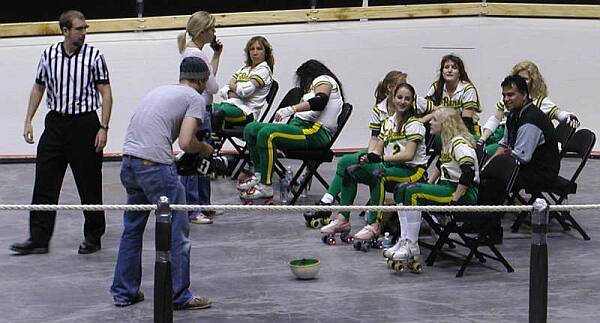
 I liked, and enjoyed the original film, and at first, this seems to have a great chance at surpassing it. The opening fight between our two heroines, one (Choi) a slave-trader, the other (Chung) an enforcer for the Empress, is a masterpiece that combines wire-work, CGI and gimmickry – camerawork from Azumi and what looks like a mutant Klingon batleth – to fabulous (if not fully convincing) effect. All this in a mythical kingdom where women rule, and men are reduced to “dumbbells”, while the cast includes both Jackie Chan and Donnie Yen. Even if the connection to the original is tenuous at best, the potential here doesn’t need to be specified.
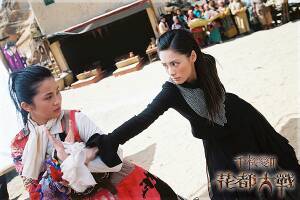 On the plus side, both Twins put in surprisingly solid performances – Choi, in particular, is much less irritating than before, though remains outshone by Chung. However, they still aren’t enough on their own to sustain a movie, despite the parade of celebrity cameos, especially when co-stars Chen and Fong are woefully short of the mark. With a $10.2 million budget, I just wish they’d spent a few more dollars on the script and some decent actors. Then, it might have lived up to the marvellous first fifteen minutes.
 If the inspiration for this one wasn’t clear, Goro Yasukawa’s score will soon enlighten you: Sergio Leone. A character with a mysterious past and equally obscure agenda comes into a lawless town, and kicks ass. For The Man With No Name and his horse, read Saki (Yonekura) and her Harley. Given that Leone basically ripped off Akira Kurosawa’s Yojimbo in A Fistful of Dollars to begin with, the irony is satisfying. She has come to Tsuson – surely a nod to Tucson, less than two hours down the dusty Arizona I-10 from where I write this – to take on Tojo (Tsurumi), the local mob boss, who commits his crimes with impunity from the safety of an American Air Force base. She gets his attention when she interferes with his robbery of a wages truck, and takes the money herself. The two had met previously, though Tojo doesn’t recognise Saki; you’ll probably work out the basic circumstances long before the film reveals them, but it does add a couple of unexpectedly nasty twists of the knife.