“Sidekicks with guns…”
The power of the action heroine is such, that the character often appears in films as support to a male hero – sometimes without any particular justification beyond the fact that it’s cool. Even movies which you’re watching for other reasons can provide a pleasant surprise in these terms. This piece provides pointers towards some of the more interesting examples.
 The Chronicles of Riddick. A survivor from the previous film, Pitch Black, “Jack” turned out to be a young girl, who disguised her sex in order to survive. Five years later, she’s now played by Alexa Davalos (right), and her character, who has taken bad-ass Riddick as a role-model, is now imprisoned in a subterranean jail on the aptly-named planet of Crematoria. Her favourite game is, “Who’s the best killer?”; when she’s accompanying Riddick, opportunities to play are numerous.
Eight Legged Freaks. In this cheerful update of the 50’s giant insect picture, Kari Wuhrer plays the local sheriff; while eventually giving way to David Arquette for the final confrontation in the spiders’ lair, she holds her own for much of the movie, dispatching arachnids with style, flair and a Buffy-esque bit of crossbowing.
Formula 51. Samuel L. Jackson plays a chemist, trying to sell his new concotion to various interested parties in Britain. His former employer, the Lizard, unhappy by the defection, sets Dakota (Emily Mortimer) on him – she is a British hitwoman, working off her debt to the Lizard. But back on her old turf, she discovers an old flame is involved, and is still burning brightly for her…
Hero. This Jet Li vehicle, nominated for the 2003 Best Foreign Film Oscar, features both Maggie Cheung and Zhang Yi-Yi, the former as one of three assassins out to kill the king, the latter as the pupil of another member of the trio. One of the highlights of the movie is a full-on battle between the two, which is not a long way short of Zhang’s classic Crouching Tiger duel with Michelle Yeoh.
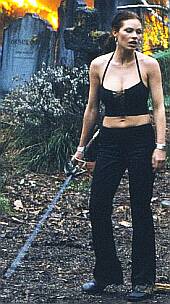 House of the Dead. This critically slated video-game conversion offers three supporting action heroines behind its extremely dull hero. There’s his girlfriend, fencing mistress Alicia (Ona Grauer, left), Coastguard officer Casper (Ellie Cornell), and Liberty, an Asian-American in a patriotic outfit who (like all Asians) knows kung-fu. Sadly, two out of three don’t make it to the end.
The Lion, the Witch and the Wardrobe. As the evil Queen Jadis, who has sunk Narnia into perpetual winter, Tilda Swinton kicks surprising ass, with a sword that turns anything it touches to stone – and she captures the seductive appeal of the dark side wonderfully well. The final battle against the forces of good sees her wielding two swords to good effect as she leads her army against Aslan’s troops. You go, girl…
Mr. Brooks. On the trail of Kevin Costner’s serial-killing family-man is Detective Tracy Atwood, who is simultaneously dealing with a messy divorce and the escape of another serial-killer she helped put away, known as The Hangman. When Brooks kills her ex-husband, she is the suspect, and her partner is told to arrest Atwood. She disarms him handily, and courtesy of information from Brooks, who is somewhat fascinated by her, heads off to an impressive fire-fight in a darkened corridor with the Hangman and his accomplice.
Patriot Games. One of the members of the IRA splinter group is female terrorist Annette (Polly Walker); not actually Irish, she still manages to off a suspected dissident (after having sex with him, of course) with a double tap, before heading off to a North African terrorist training camp, and taking part on the final assault on Jack Ryan’s house. Oh, and her cover is a rare book dealer too.
Rambo: First Blood Part II. Among the most macho movies of all time, we note with interest the presence of Co Bao (Julia Nickson-Soul) as his local guide, who goes through just about everything he does in the jungle. Of course – and this isn’t a spoiler, since it’s painfully obvious – she’s doomed from the start. About the only cliche of the soon-to-be-dead that she doesn’t get to use is taking a picture of her family out, and saying how she looks forward to seeing them again soon…
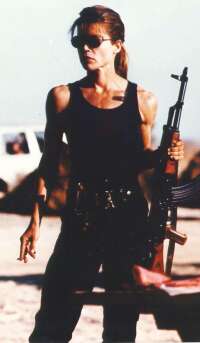 Terminator 2: Judgement Day. The character of Sarah Connor (right) underwent a startling transformation between original and sequel – a wimpy fraidy-cat became a pumped, focused, extremely capable action heroine, intent on defending her son. Though she ends up relying on Arnie in the final steel-mill battle (which includes Linda Hamilton’s twin sister), she definitely gives the T-1000 her best shot. Several of them, in fact. The next logical step followed, in Terminator 3, where Schwarzenegger faced a female cyborg.
Thir13en Ghosts. The most notable thing about this family-trapped-in-a-haunted-house flick is the wonderful set design, on which they clearly spent more time and effort, than trivial things like plot or characterisation. But Embeth Davidtz turns up in the second half, flinging flares at the errant spooks with no lack of confident competence. She delivers a pleasantly no-nonsense performance until she gets, er, squeezed out of the picture.
Total Recall. While Arnold Schwarzenegger movies are rarely places where female characters do more than hang around, in need of rescuing – though see Terminator 2 above – this has not one, but two action heroines, in Melina (Rachel Ticotin) and Lori (Sharon Stone). The former is a Martian rebel, the latter an administration agent who masquerades as the hero’ wife; they’re opposites in almost every way: good/bad, brunette/blonde, demure/sleazy. Melina saves Arnie’s butt on a couple of occasions, and there’s also a fine brawl between Ticotin and Stone which avoids the usual catfight cliches.
 The Transporter 2 – Having thoroughly enjoyed The Transporter, the sequel was already well on the radar. But what we didn’t expect was some serious GWG action, with the psychotic henchwoman (Katie Nauta, pictured left) going berserk in a doctor’s office with two automatic weapons simultaneously. She also rides shotgun after taking our hero hostage on a startling chase through the streets of Miami and, inevitably, faces off against him while her boss makes his escape by helicopter. This finale is a little shorter and softer than expected, but in a film where we were expecting nothing but macho heroics, the mere presence of an action villainess was a pleasant and unexpected bonus.
Van Helsing – From a vampire (Underworld) to vampire-huntress: up until the arrival of Van Helsing (Hugh Jackman) Kate Beckinsale’s gypsy was the last hope of her family and their mission to kill count Dracula. While the guys face off (in a fiesta of somewhat-unconvincing CGI, it has to be said), she has plenty to cope with, in the form of the multiple vampire brides, who can fly, and have superhuman strength, in addition to the usual fangs. Undead catfight! Do have to say, her fate is somewhat disappointing, however.
Zombieland – Emma Stone and Abigail Breslin both give as good as they get from Woody Harrelson and Jason Eisenberg in this post-apocalyptic tale. Initially, it’s a battle of the sexes, with the young women outsmarting the men and taking their vehicle and weapons – then doing it again, for good measure! However, they eventually team up, as they head across country, in an America that is now inhabited almost entirely by the ravenous undead. If you’re familiar with the genre, you’ll know that extreme violence is the only way to deal with zombies, and the ladies are every bit as happy to unleash their weaponry as the gentlemen.



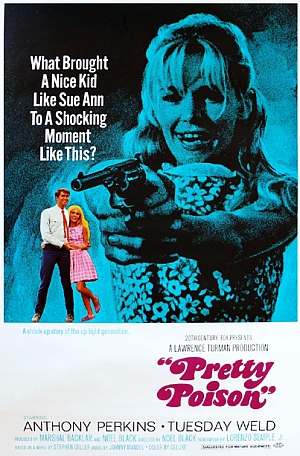 I was expecting more a quirky comedy than a dark thriller from this 1968 film, and only bothered with it because I’m a fan of Perkins (Edge of Sanity is a beautifully-lurid retelling of the Dr. Jekyll story, with the trash quotient cranked up to 11). Imagine my surprise when… Well, let’s start at the beginning, shall we? Juvenile arsonist Dennis Pitt (Perkins) is finally released back into the community as “cured”, though his fondness for fantastic invention appears unchanged. For a while he works at a chemical in the small town of Winslow without apparent issue. But trouble looms in the pretty, 17-year old shape of Sue Ann Stepanek (Weld), even though she appears to be squeaky-clean – an honor-roll student, majorette, etc. To entice her, Pitt spins a tale of being a secret agent, investigating a plan to poison the water supply. Sue Ann seems to swallow it, hook, line and sinker, but after one of their ‘sabotage mission’ goes wrong, it’s apparent that Sue Ann has her boyfriend seriously trumped when it comes to sociopathic behaviour.
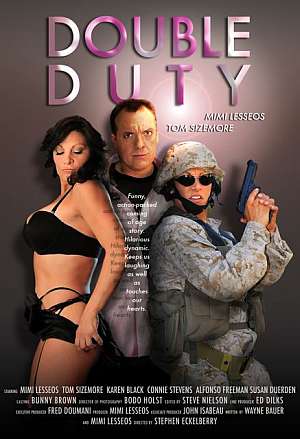 After 20 years in the Marines, MJ (Lesseos) returns to civilian life, but finds it somewhat hard to adapt to life as a civilian. Her old college friend Sophie (Duerden) helps her adjust – somewhat – and introduces her to Craig (Sizemore), a designer who is perhaps rather more feminine than MJ. Sophie is working on a charity auction, not realizing her assistant Carl (Freeman) is planning to steal the top item, a Faberge egg. Meanwhile, hypnosis has given MJ the ability to get in touch with her inner woman – but the problem is, every time someone snaps their fingers, she switches between her two personas. There is that of the rough, tough and gruff Marine, and then there’s the other, a giggling girlie for whom breaking a nail would pose a deep, personal crisis. Which will win out when the chips are down?
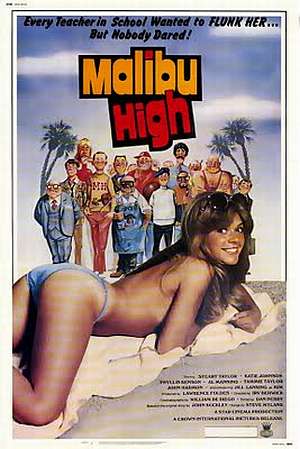 This one popped out of nowhere, on a box-set of discs called Drive-In Cult Classics: most of these were unremarkable double-feature fillers, and this started off looking the same way, Kim (Lansing) is fed up with life: she’s still in high-school at age 18, is about to flunk it, has no money, just lost her boyfriend (Taylor), her father hung himself and her mom’s a total bitch. Finally, she opts to use her natural resources (if you know what I mean, and I think you do) to resolve these issues – though when her mother suggested Kim get a job, I’m not sure she meant as a whore working in the back of a VW van for the ultra-sleazy Tony (Mann). Her ‘popularity’ there lets her move up to work for the slightly-less sleazy Lance (Howard). Which is where the film takes an abrupt right turn, as she discovers a taste for killing – not least on her former pimp – and starts work as, to use one of the movie’s alternate titles, a high-school hit girl.
 It’s nice to see Hong Kong making a decent action heroine film: that’s really where the genre started off, and it’s been responsible for some of the best entries in the field. That said, this doesn’t quite deserve to be placed on the same level, but star Jiang Lui Xia certainly has her potential – my immediate thought is to put her in the same film as Jeeja Yanin, and we might really have something. [Sidenote: Jiang got her big break as the result of a couple of unusual ways. Viral videos she posted on the Internet, which in turn got her a slot on a reality show called The Disciple in Hong Kong, produced by Jackie Chan. The winner – not her – got to star in a feature.] Much like her Thai colleague, Jiang is clearly a martial artist first, and actress…well, probably fifth or sixth, despite her resemblance to Shin Eun Kyung from My Wife is Gangster. She seems to have three expressions, used in strict rotation, and the plot is frankly implausible nonsense too.
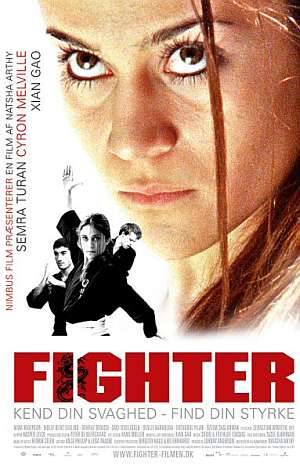 Certainly one of a kind, this coming-of-age film tells the story of Aicha (Turan), a Muslim girl born of Turkish parents, who is obsessed with learning martial arts – the last thing her father wants. This thoroughly unfeminine interest, in the eyes of her community, is carried out in secret, but Omar (Banissi), a friend of her brother’s fiancee’s family finds out, and is thoroughly unimpressed. “I don’t fight girls,” he says dismissively, when ordered to spar with Aicha, and this leads to his ejection from the club by their teacher (Xian). When he confronts Aicha at the engagement party, the resulting argument becomes a brawl, and leads to the breaking off of the engagement – which is doubly unfortunate, as the bride-to-be is discovered to be pregnant. Meanwhile, Aicha has to prepare for an upcoming tournament, alongside her training partner, Emil (Melville) – and for which Omar has also signed up as a contestant.
 If you’ve seen Chocolate – starring the same lead actress, though confusingly billed under a different name here – you’ll know what to expect, and the film delivers much of the same. Which would be stunning, brutal fight scenes combined with moments of mind-numbing tedium. The plan for Yanin’s career seems to be to contrive methods by which she can avoid acting: last time it was autism; here, it’s a drunken style of kung-fu which helps mitigate a voice that might charitably be compared to broken nails on glass. She plays former rock-star(!) Deu, who is on the edge of being kidnapped, when she’s rescued by Sanim (Tang). He and his fellow masters of alcohol-fu have all lost ladies in their life to the kidnappers – who, it turns out, are doing this because… No. You wouldn’t believe me even if I told you – and are trying to locate their lair. Deu joins the team, and agrees to act as bait, to see if the kidnappers will go after her again.
 Film-makers really need to let the sixties go, especially when it comes to mining TV schedules and turning them into movies. The Mod Squad, Thunderbirds, Wild Wild West: the remainder bins in Walmart are littered with the DVD corpses of failed attempts. While it’d be a massive stretch to call this incoherent mess anything like a success, it does have some merits, not least in the casting of Fiennes and Thurman as John Steed and Emma Peel. If undeniably different to Patrick McNee and , it still works, despite the unfortunate efforts to shoehorn in a romantic relationship between the pair; one of the things that made the original series work was the