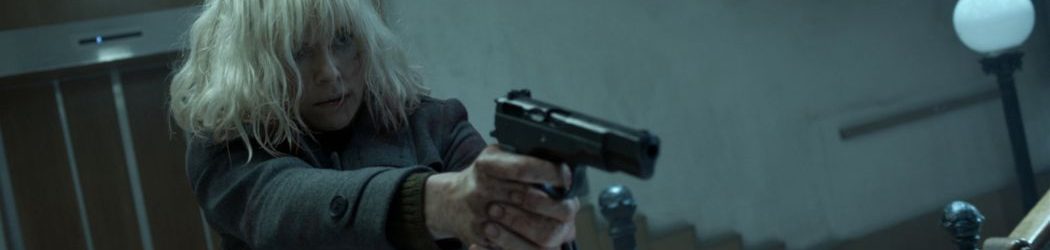
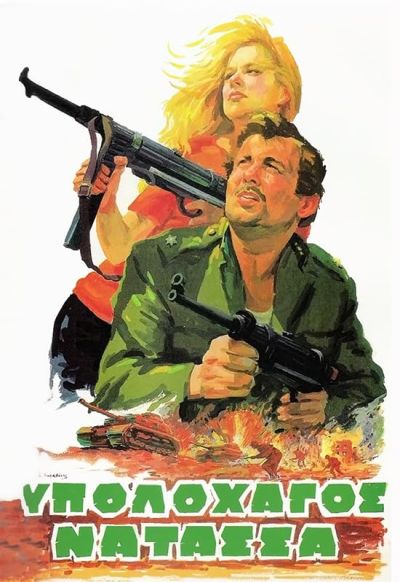
I am reluctant to be overly harsh on this one, because I suspect I didn’t get to see this in its best format. The fact it feels very choppy and disjointed could potentially be a result of the IMDb giving this a running time of 136 minutes, but the only print available ran a good half-hour less. It was also dubbed from Greek into English and pan-and-scanned. Pretty much the holy trinity of cinematic suckage, right there. It’s the story of Natassa Arseni (Vougiouklaki), who lives in Greece when the Nazis invade during World War II. She’s initially largely unconcerned, but gradually becomes involved in the local resistance.
There are two men in her life. A former college friend, Max (Karras), followed his father’s German heritage, and is now a member of the occupying forces, who has feelings for Natassa. Her affections are elsewhere, haven fallen in love at first sight with Orestis (Papamichael), a partisan dedicated to ridding his home country of the occupying forces. She marries him and throws her lot in with the resistance, but is captured by the Nazis, and tortured for information. Except, this was a cold-blooded decision to sacrifice them, in order to provide false information to Germany about the location of a future Allied invasion. Orestis escapes capture, and hatches a daring plan to disguise himself and his men as the Nazi firing squad sent to execute Natassa. Fate, however, has other plans.
There are some good ideas here. The character of Max, with a foot in both camps is an interesting one, and I liked how there are biggest issues at play, requiring sacrifices – unwittingly, admittedly – from those on the front lines. Some scenes are very effective. The wedding of Orestis and Natassa, where they are ambushed on the way to the church, and she pushes through with the ceremony despite being shot, would be one. Then again, I’m a sucker for a bloodstained wedding dress. Vougiouklaki is strikingly blonde, and rather unGreek. However – again, perhaps due to the editing down to the most dramatic scenes, or maybe the dubbing – it feels as if she has her acting permanently set at a level of “11”, occasionally toppling over into overacting.
There are points where this is justified: I mean, you’re being interrogated and tortured (even if Max points out, “I’m not in the Gestapo, I’m in the SS” – not sure that makes much difference…), a little hysteria would seem fair enough. But when it seems most scenes are played out like that, it reduces the impact when it’s needed most. There are also moments which dangle awkwardly, such as the opening, where a post-war Natassa visits Dachau, or when she’s a singer, bursting into(presumably patriotic?) song when the Nazis show up. That feels like a knock-off of the Marseillaise bit from Casablanca. I don’t recall the heroine wielding an automatic weapon at any point, as the poster suggests, either. I’ve read that this was the biggest-grossing local movie in Greece for years after its release. Needs a remake, I’d say.
★★½
“Post-apocalypse, talk will still be in abundant supply.”
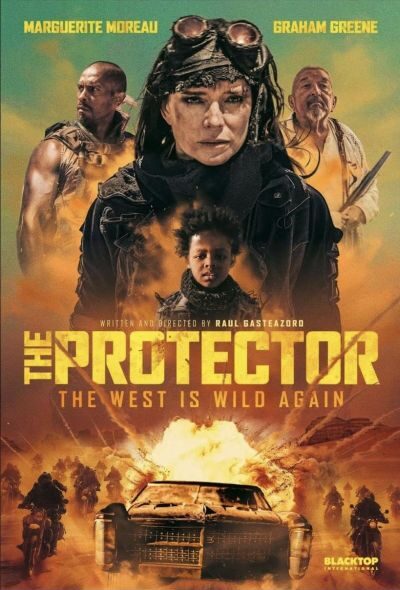
[Note: not to be confused withProtector] The year is 2042. A plague knows as The Rot has decimated the land, and those who survived it are in a precarious state, with the water supply having almost run out. There is one source left: an underground aquifer which has enough water for a century. Needless to say, its highly coveted, but access to it has been cut off by the native American tribe under whose land it sits, with the road heavily mined by Chief Brand (Greene, in what must have been close to his final role before passing away). Warlord Gael (Aryeh-Or) lets Key (Moreau) out of jail, knowing she has a map through the minefield and can give him control of the aquifer.
But, wait! There’s more! Because another issue facing society is mass infertility, with children almost non-existent since The Rot. Key finds herself acting as guardian to one rare kid, Kellan (Lane) on her journey. Oh, and there’s also a mad pastime called “Dirt-Joust”, which is like jousting, only with hot-rods replacing horses – it appears fuel is not hard to come by – on which the combatants ride on the bonnet. It’s not a career choice with a pension plan, shall we say. To be honest, it’s a shame we didn’t get to see more of this sport, since the scene we do get is kinda rad. But then, doing so would have only been possible by cutting out the many, many scenes of chit-chat.
That’s the main problem here, I found. The obvious point of comparison is Mad Max, and in its female protagonist, particularly the new iterations of the franchise, such as Fury Road. However, there, the plot was basically there to act as a delivery mechanism for jaw-dropping action scenes. Here, it’s as a vehicle for moral lectures, pontification and general conversation. It feels as if writer-director Gasteazoro did not understand the assignment, or the rules of the sub-genre. It’s a shame, because there are elements here which work. Not the least of which is Moreau, who looks the part of a world-weary heroine who has had it up to here, and carries herself well, on the rare occasions when she is called into action.
The film also looks pretty nifty. I haven’t been able to find out the budget: it likely wasn’t a huge amount, yet unlike things like Road Wars: Max Fury, it rarely if ever looks cheap. Some wobbly CGI flames are about the worst element on offer. It instead feels like the film is mostly intended to be a vehicle – pun not intended – for Gasteazoro’s liberal views on a variety of topics, from ecology, through the rights of indigenous people, to same-sex marriage. I would venture to suggest that a post-apocalyptic film might not be the best route to change minds and influence people on these subjects. Give me ninety minutes of dirt-jousting instead, and I might be prepared to listen to you.
Dir: Raul Gasteazoro Star: Marguerite Moreau, Aryeh-Or, Mark Lane III, Graham Grene
Mamoru Hosoda is one of the senior figures in Japanese animation, with thirty-five years of experience since he joined Toei Animation in 1991, after graduating from college. He made his feature debut with One Piece: Baron Omatsuri and the Secret Island in 2006, though this came only after he had almost directed Howl’s Moving Castle for Studio Ghibli. He subsequently left Toei, to go freelance, and his works since have met with both critical and commercial success. Mirai was nominated for an Oscar in 2019 as Best Animated Feature – the first non-Ghibli film to be so honoured. 2021’s Belle , loosely inspired by fairy-tale Beauty and the Beast, was the second-biggest movie at the Japanese box-office that year, domestic or foreign.
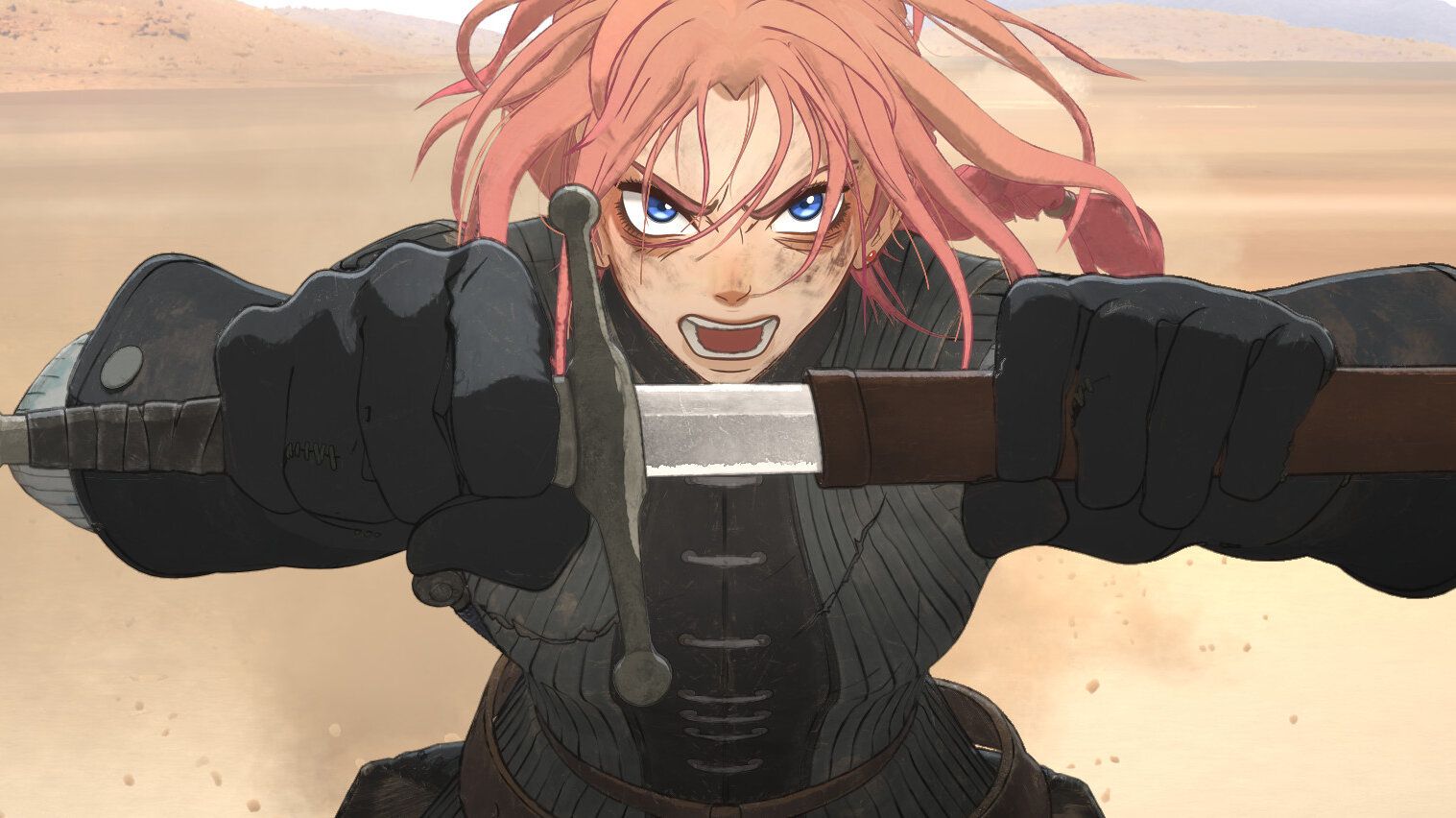
His latest movie and the follow-up to Belle, Scarlet, was a long production, taking four and a half years to complete. It mixes traditional 2D cel animation with computer-generated animation, and is a take on Shakespeare’s story of Hamlet, with its titular heroine seeking vengeance on the people who murdered her father, the monarch of 16th century Denmark. Her first attempt backfires, when she consumes the poison intended for her uncle Claudius, the leader of the plot. Scarlet wakes to find herself in the purgatory of the underworld. She needs to complete her revenge in order to move on to the Infinite Land; otherwise, her spirit will collapse into nothingness. It turns out that Claudius is in the underworld too…
Both Dieter and Jim watched and reviewed this one independently. Below, you’ll find their respective ratings and thoughts, with Dieter going first.
★★★★★
“The undiscovered country from whose bourn no traveler returns”
On the fourth anniversary of Russia invading the Ukraine a movie like this hits harder, I feel. At the same time, the Berlin Film Festival has ended and while a whole lot of boring message movies got awards, this one was not even in competition. I guess it also won’t win any Oscar awards. For the same reason: it’s just too good. It would blow any competing features out of the water. And yes, this is a strongly subjective review. Watch the movie and judge for yourself, I suggest.
But… I’m already starting with the end. I was honestly blown away by this movie. While neither the idea of a female Hamlet is new (see the 1921 Hamlet: The Drama of Vengeance with Asta Nielsen) nor doing a Shakespeare-inspired anime (there is the anime series Romeo x Juliette from 2007) what director Mamoru Hosoda has done here for Studio Chizu, is fascinating. No idea why he chose the story of Hamlet as an entry point: perhaps because it’s the most universally-known revenge story next to Death Wish? It would have worked just as well with new, fictional characters and other names.
I didn’t mind. It only serves as a basis on which the director discusses the general but often overlooked and therefore more essential questions of humankind: What defines our humanity? What do we live for? What does death mean? What is love? What can be forgiven? What cannot? How much are we shaped by the environment we grow up in? And if we spread a loving and peaceful attitude can we change the world for future generations?
These are big, important ideas which do not normally form a part of “entertainment culture” or political discussions today, as everyone is too much occupied in serving their own self-interest. Actually, I would locate these questions more in the areas of philosophy and religion. At the same time, the animation style itself is impressive: not just the usual 2D cell animation nor CGI animation. I don’t know how to describe it: while most of it seems classically drawn, many of the backgrounds seem photo-realistic as if they are “real”, including the desert, water, ruins and a jungle. Also overwhelming is the sky of this “other land” which looks like waves, over which a giant dragon flies and occasionally erupts in deadly lightning.
While the visual style takes some time to get used to, this is not necessarily a bad thing. It’s different and new and that’s it. I liked it but I can understand if other people might reject this approach. It’s really a matter of individual taste. Putting all these aspects aside, I found the movie really entertaining. It’s an epic, bombastic movie with a passionate heroine, lots of fights (somehow these medieval Danes seem to have quite some knowledge of martial arts) and – surprisingly – beautiful songs. With Scarlet being shown training hard since her early youth, her fighting larger opponents doesn’t seem that much of an overstatement. She also doesn’t always win, which helps to make the fights look more realistic.
If Mamoru Hosoda might not be as famous or successful as Hayao Miyazaki or Makoto Shinkai (Your Name), so far, he has always delivered excellent and interesting movies. Scarlet is his 8th movie (I challenge the uninitiated to discover his other movies, and especially recommend The Girl Who Leapt Through Time and Summer Wars) and was co-produced by Columbia Pictures. I regret that movies like this only ever run for one day here, and occasionally some more in some tiny cinemas as I think they deserve so much more exposure. Here is hoping, I may have contributed to making this excellent movie more well-known, and create some interest in its potential audience watching it, or at least giving it a chance.
★★★
“Better red than dead.”
Up-front confession: I haven’t seen any of Hosoda’s other work, so am not familiar with the style. Indeed, for a while, I was confusing him with Mamoru Oshii, of Ghost in the Shell and Avalon fame. Which isn’t as much of a stretch as it may seem. Oshii’s work seems to rely a lot on a loose narrative, using the virtual world in Avalon as a convenient loophole through which any plot thread can pass. You could make much the same argument for Scarlet, with the underworld being a realm where stuff simply can happen, because it’s the underworld. I’m not a huge fan of this kind of plot armour, and would likely have been happier if Scarlet had been pursuing her vengeance in the everyday world.
The early stages will feel rather familiar to any fan of Game of Thrones. Scarlet can only watch as her father, a beloved figure, is executed in the name of political machinations. She then vows revenge, and undergoes a rigorous training program to that end. Very Arya Stark. Fortunately (or perhaps not?), it finds its own way after she consumes poison, and Scarlet finds herself in the afterlife. It’s necessarily a shock, but she has the mental fortitude to adapt. She’s joined there by Hijiri, a paramedic from the present day. In effect, he acts as her conscience, continuing to treat the wounded as he had done in life, and questioning the need for her revenge. This becomes especially pertinent after we hear the message Scarlet’s late father had for her.
I cannot fault the visual side of things here at all. Dieter encouraged me to see this on the largest screen possible. Unfortunately, it did not last long in cinemas here: two weeks after release, it was down to showing in just twenty-four theatres nationwide. But having seen it in my living-room, I would not have minded a much larger viewing experience, and can only imagine the impact. It’s not seamless, in that you can often tell which sequences were old-school, and which were zeroes and ones. But the overall effect is undeniably impressive, and on that basis alone, I’d say it deserved an Oscar nomination more, say, than Zootopia 2.
However, as the above likely suggests, I was not particularly impressed with the plot. The basic elements were there – you can’t go wrong with revenge of the Shakespearean kind – but there are elements which seem not to serve this. For example, there’s a significant chunk where Scarlet and Hijiri are simply hanging out with elderly souls. It feels like John Wick paused his revenge, to spend an afternoon helping out at the local senior centre. I guess the eventual aim is that Important Lessons™ need to be learned by Scarlet about the value of life. But if you compare this to the works of Hayao Miyazaki, the moral lecturing here comes over as less than subtle.
I did like the contrast between Hijiri and Scarlet. Interesting that the “caregiver” character here was male and from the present times, while the vengeance seeking warrior was female and out of the middle ages. This subversion of standard tropes is thought-provoking, without needing to deliver any explicit messaging, and the relationship between the pair works well. If you’re familiar with Hamlet, you’ll also get a kick out of some of the references (the versions here of Rosencrantz and Guildenstern are particularly memorable). But any film which uses a dragon – another Game of Thrones nod? – as a convenient prop for the story-line, needs to be answering questions about its scripting. It’s this which stopped Scarlet from being more, for me, than just a well-crafted, pretty thing at which to look.
Dir: Mamoru Hosoda Star (voice): Mana Ashida, Masaki Okada, Koji Yakusho, Kōtarō Yoshida



 I am reluctant to be overly harsh on this one, because I suspect I didn’t get to see this in its best format. The fact it feels very choppy and disjointed could potentially be a result of the IMDb giving this a running time of 136 minutes, but the only print available ran a good half-hour less. It was also dubbed from Greek into English and pan-and-scanned. Pretty much the holy trinity of cinematic suckage, right there. It’s the story of Natassa Arseni (Vougiouklaki), who lives in Greece when the Nazis invade during World War II. She’s initially largely unconcerned, but gradually becomes involved in the local resistance.
 [Note: not to be confused with
  Mamoru Hosoda is one of the senior figures in Japanese animation, with thirty-five years of experience since he joined Toei Animation in 1991, after graduating from college. He made his feature debut with One Piece: Baron Omatsuri and the Secret Island in 2006, though this came only after he had almost directed Howl’s Moving Castle for Studio Ghibli. He subsequently left Toei, to go freelance, and his works since have met with both critical and commercial success. Mirai was nominated for an Oscar in 2019 as Best Animated Feature – the first non-Ghibli film to be so honoured. 2021’s Belle , loosely inspired by fairy-tale Beauty and the Beast, was the second-biggest movie at the Japanese box-office that year, domestic or foreign.
 On the fourth anniversary of Russia invading the Ukraine a movie like this hits harder, I feel. At the same time, the Berlin Film Festival has ended and while a whole lot of boring message movies got awards, this one was not even in competition. I guess it also won’t win any Oscar awards. For the same reason: it’s just too good. It would blow any competing features out of the water. And yes, this is a strongly subjective review. Watch the movie and judge for yourself, I suggest.
 I didn’t mind. It only serves as a basis on which the director discusses the general but often overlooked and therefore more essential questions of humankind: What defines our humanity? What do we live for? What does death mean? What is love? What can be forgiven? What cannot? How much are we shaped by the environment we grow up in? And if we spread a loving and peaceful attitude can we change the world for future generations?
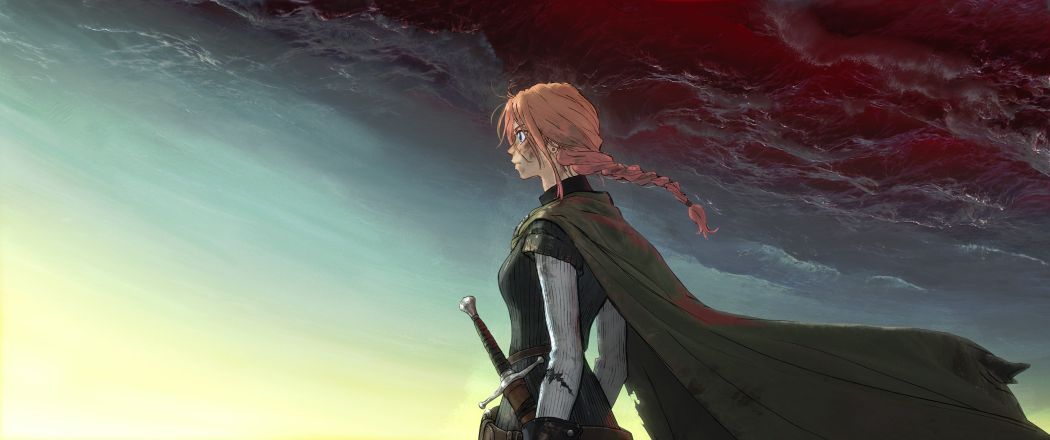 I cannot fault the visual side of things here at all. Dieter encouraged me to see this on the largest screen possible. Unfortunately, it did not last long in cinemas here: two weeks after release, it was down to showing in just twenty-four theatres nationwide. But having seen it in my living-room, I would not have minded a much larger viewing experience, and can only imagine the impact. It’s not seamless, in that you can often tell which sequences were old-school, and which were zeroes and ones. But the overall effect is undeniably impressive, and on that basis alone, I’d say it deserved an Oscar nomination more, say, than Zootopia 2.