




★★★
“A shallow look at a very complex subject.”
Female suicide bombers might perhaps not fit into the generally-perceived definition of “action heroine”, but they have much the same quality of transgressive behaviour – women acting in ways outwith the norm. And, of course, heroism depends on your point of view; one thing this documentary does, is show the cult on the West Bank that surrounds their martyrs. The thin line between “terrorists” and “freedom fighters” is illustrated perfectly by the scene of small children carrying posters of suicide bombers. On the other hand, most of the program skims irritatingly across the surface, not least because host Lisa Ling is a puffcake journalist, uninterested in asking – or perhaps, too scared to ask – the hard questions. Her interview with the mother of Wafa Idris, the first West Bank female martyr, is a masterpiece of shallowness; she doesn’t even bother to follow-up on the answers, let alone challenge the assertions.

Even more annoying is its desire to cram the motivations for all female suicide bombers into the same hypothesis: abused or brainwashed women, who have broken the laws of society, and in particular, religion, so find suicide the only way out. They dig through the histories, looking for evidence to justify their theory: oh, Wafa was infertile and divorced, that must have been it. But this hardly even counts as an explanation: how many women get divorced without committing suicide? It’s actually fairly patronising, the clear implication being that women are incapable of consciously sacrificing their lives for a political or social cause. I think Joan of Arc, Emily Davison (the suffragette who threw herself under the King’s horse at the 1913 Epsom Derby) and Violette Szabo might care to argue with that conclusion.
The film also concentrates the great majority of its efforts on Palestinian bombers; the Tamil Tigers merit only a brief mention, even though they have been using female martyrs for far longer, to a greater extent (almost 40% of their suicide bombers are women) and with greater impact, including the assassination of former Indian Prime Minister Rajiv Ghandi in 1991 – unmentioned by the program, despite it supporting their theory, is the fact that his killer had been raped by Indian soldiers. On the other hand, the Tamil struggle is secular rather than religious, making it hard to apply the same hypothesis of guilt-stricken women opting to go out with a bang. However, I do give the program credit for piqueing my interest in the topic; expect a full article sometime in 2005… [Said article has been delayed indefinitely, as I couldn’t get a good handle on how to approach the topic. I made a lot of notes, then basically gave up. Will maybe dig them out sometime…]
National Geographic Channel documentary, December 2004

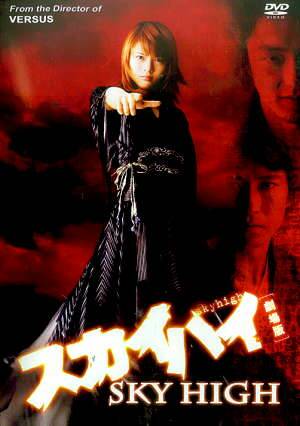 Combining elements from Dead Like Me and Ghost, this still manages to come up with something unique, especially given its origins as a prequel to a popular TV series. It is designed to explain how Mina (Shaku) got the job as Keeper of the Gate, where murder victims must decide whether to forgo revenge and pass on, return to Earth as a ghost, or seek vengeance at the price of eternal torment. She ends up there after having her heart torn out on her wedding day by insane billionaire serial killer Kudo (Osawa) who will stop at nothing to save his one true love, currently lying in a coma. Trust me – it all makes perfect sense, and it’s a particularly nice touch that Mina’s fiance, Detective Kohei (Shosuke) is equally driven in his actions by love.
 Director Ichimura returned for the fourth episode, and despite similar problems as the third installment – most obviously, an apparent doubt that Oichi’s character can hold the viewer’s interest by herself – makes a much better stab at things here. Bounty-hunter Oichi finds out what life is like on the other side of the law, after she helps rescue an unwilling bride from a local magistrate; he slaps a 100 gold-piece reward on her head, which naturally, brings other bounty-hunters on her trail, led by Sankuro (Meguro).
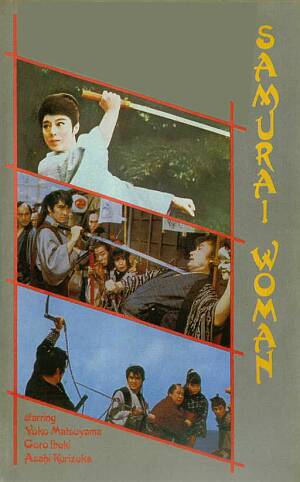 The third entry in the series saw a new director, and unfortunately, a marked turn for the worse, largely because the focus drifts off Oichi. It starts briskly enough, with the heroine coming into possession of a new, effective formula for gunpowder, something barely known at the time in Japan. Understandably, this makes her the focus of attention, in particular for a group with an interest in profiting from the discovery.
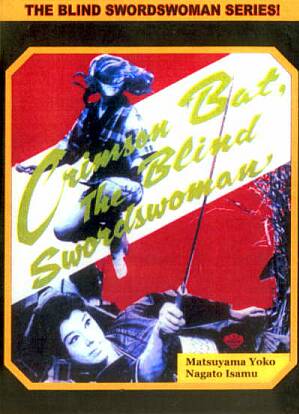 We meet our heroine Oichi as a young child, who has just been being abandoned by her mother – not sure what happened to father, but we later discover Mom’s a prostitute, so can probably fill in the blanks ourselves. To make matters worse, the tree under which Oichi takes shelter from a storm is struck by lightning, rendering her totally blind, in a way that’s – probably wisely – left medically unexplained. However, she is then taken in by a kind gentleman, who brings her up, and on into adulthood.
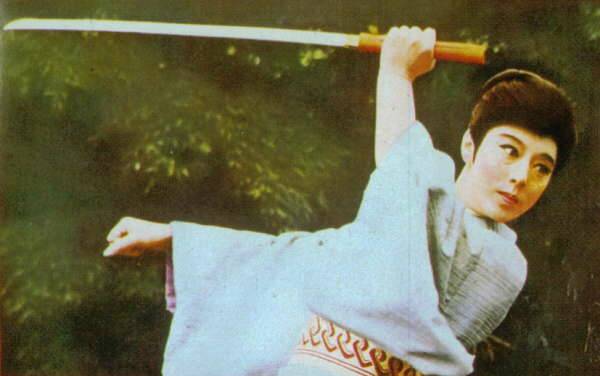 “Up to bat…”
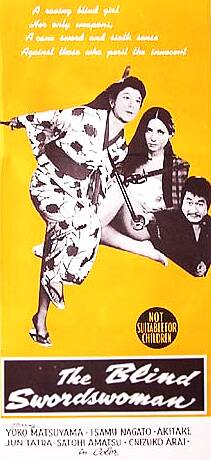 While the samurai is one of the most common archetypes in Japanese cinema, the female version is about as rare as the female gunslinger. Although none of these women reached anything like the popularity of Zatoichi – 26 films starring Shintaro Katsu alone, never mind the recent Takeshi Kitano version – there have been a few that have attempted to break the mould. Azumi and The Princess Blade have both achieved cult status in the West, assisted by Tarantino’s take in Kill Bill, Volume 1. Back in 1973, there was Lady Snowblood, which was successful enough to merit a sequel the following year, but so far, only one samurai-ess series has survived more than two outings.