
Family Blood

★½
“Bloody hell.”

Tubi TV has become a goldmine of obscure, weird and, very occasionally, wonderful content for me. When I say “obscure”, I mean their selection includes films like this, about which the IMDb has only the barest of information. No external reviews; no user reviews; not even a rating. The film exists, and at the time of writing, nobody on the Internet has apparently noticed. To be honest, there is  good reason for this: it’s another one of those modern blaxploitation vehicles, which seem to exist mostly for the director’s pals to show up on the soundtrack. Yet even by the low standards of that genre, this is technically inept, with woefully shoddy audio and almost no storyline to speak of.
What there is, occurs ten years after the event – not that you’d know it, if it wasn’t for a caption saying “TEN YEARS EARLIER”.  Det. Lens Smith (Stagger) tells the story of his ultimately unsuccessful efforts to locate a group of women assassins, operating at the time in Las Vegas. There was Dawn (Jaye), Phoenix (Cantrell)… and it then appears the group ran out of proper names, with the others being called Red Death (Douglas), White Tiger and – I kid you not – Yellow Fever. I have to repeat, there’s really no plot here. One of them is married to another LVPD detective. There’s some light bickering among the women. At the end, Det. Smith gets up and walks away, vowing to re-open the case. That’s it. 

Pluses are hard to find. It’s barely an hour long: that’s one. Initially, I thought it might eschew the usual crap rap, with the first murder accompanied by electro-Celtic bagpiping, which was at least different. This didn’t last long, unfortunately. There are occasional moments of droll humour, referencing the Die Hard and Lethal Weapon franchises, and one victim gets an extra bullet, for having had the temerity to touch his assassin’s ass. Though most of the killings are uninteresting or even unintentionally laughable. What assassin worth their salt, would climb to the roof of a building to try and shoot their victim on the sidewalk with a silenced handgun? I know nothing about guns and still realize that’s flat-out stupid.

As is sadly common, the audio is about the worst aspect. The talking head interview of Det. Smith is the only time where this is acceptable. Anything outside is doomed to be muffled; anything inside is equally inevitably afflicted with a tinny echo. I had to keep my finger permanently hovering over the volume button, turning it up whenever anyone was speaking, knowing that at any second the crap rap would burst out and send my ear-drums to Bleeding Town. In the end, I enabled the closed captions instead. Problem solved. The women are reasonably attractive, and keep their clothes on, with nothing more than a bit of cleavage to show for your troubles. It’s all, very definitely, not one of Tubi’s finest moments.

Dir: Bowfinger Stagger
Star: Kevin Stagger, Marlo Jaye, Porsha Cantrell, Ta’Sha Douglas

Divided We Fall

★½
“Failed to sustain my undivided attention”

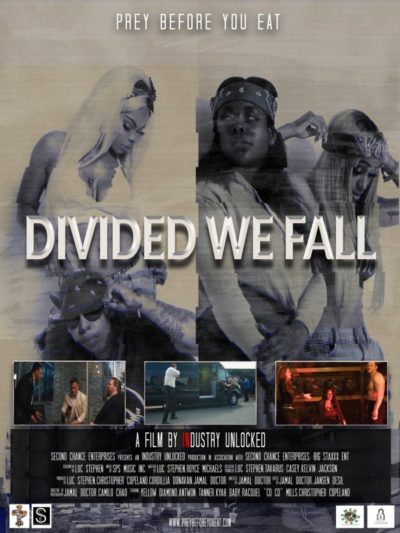
We begin with the usual disclaimer for films of this kind: middle-aged white guys like me are not the target audience. However, I think it’s fair to say that concepts like story-telling and character development are not limited to any particular race, colour or creed, so I still feel equipped to offer an opinion on these aspects. Though, actually, what felt like it worked best here was its strong sense of place. I’ve never been to the projects in Jamaica, New York (though Chris grew up elsewhere in the same borough of Queens). But the film does a good job of showing you that environment; it certainly works better than the (largely token) efforts to convince you some scenes take place in Miami, or even Moscow.
I guess loosely, it’s the story of Keisha (Diamond) and her all-female gang, whose robberies and other action kick of an escalating series of retribution and other incidents. For it turns out the target of the robbery was a front for the Russian mafia, who are none too happy about being on the receiving end of criminal activity themselves. They send a team of enforcers over to find the culprits and wreak retribution. Meanwhile, Sha (Brown), the local boss of drugs and other illicit things, gets summoned to Miami and made an offer he can’t refuse. Finally, the feds are sniffing around, drawn by all the carnage, and to make matters worse, turns out the boyfriend of one of Keisha’s crew is in the FBI.

There is a lot going on here: to be frank, far too much. It runs 107 minutes, yet would probably need at least twice that length to do justice to all of the threads (and the above is by no means an exhaustive list). I tried my hardest to keep track of exactly who was doing what to whom, and why. But the Russians were about the only ones who seemed to have a clear motive and acted towards it. We also come in with the story feeling like it’s already in progress, and Keisha spends half an hour or so introducing us in voice-over to the various players, making her own character and aspirations feel very much like an afterthought, when they eventually turn up.

It is really the brutally obscure plotting which sinks this. The camerawork is occasionally impressive, and compared to other entries in the genre I’ve seen, the production values are mostly decent – the courtroom scene looked like a proper courtroom, though some of the FBI offices did feel rather… residential, shall we say! The ending isn’t even a proper ending, just a vague cliffhanger where the Russians head to Miami. I’ll confess to having drifted off about 70 minutes in, but like a good, conscientious reviewer, I rewound the movie (well, the digital equivalent of “rewound”!) and watched the rest again. The sad thing is, it didn’t make very much more sense when I was fully awake.

Dir: Jamal Doctor
Star: Yellow Diamond, Pritti Militant, Levar Hosten, Shamel Brown

District Queens

★★
“Queen of the East.”

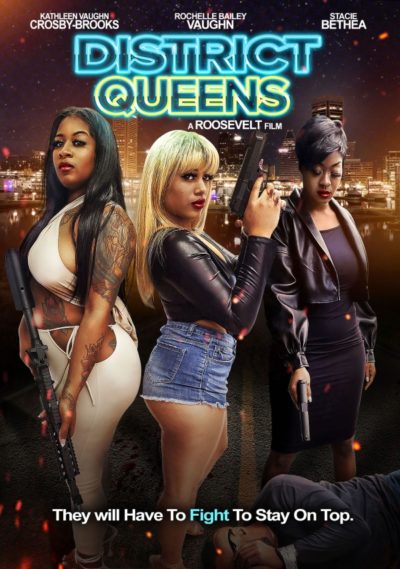
The latest stop in our ongoing tour of female-driven urban crime movies brings us to the nation’s capital in Washington, where the police are celebrating just having taken down a leading light in the city’s organized crime industry. Now, they set their sights on a new target: the gang led by Racine Robinson (Vaughan) and her two daughters, Kat (Crosby) and Candy (Bethea). These might prove a tougher nut to crack, since the Robinson crew have a harsh, zero tolerance policy to anyone who messes with them in the slightest, yet also gathered local support during the coronavirus pandemic. Indeed, Racine is so popular in the neighbourhood, a run for political office is not out of the question. However, she has rivals, who have more than a passing interest in seeing her taken out of the picture – albeit for very different reasons, in order to make room for them to rise up.
This is a real grab-bag of elements, ranging from those which work very well, to those which are almost unmitigated disasters. To start on the positive side, there’s a callous disregard for human life here that’s genuinely disturbing. Even if the CGI splatter is far from convincing, head shots abound. And unlike some entries, the women in this one have no issue getting their hands dirty, for even the most trivial of reasons e.g someone tossed water at them. The guns they tote on the cover aren’t just for show. There are plenty of strong female characters on both sides of the law, from the Robinson family through Police Commissioner Stallworth, to dirty cops who have no issue shooting someone in cold blood and planting a gun on them. Perhaps the most impressive is Jada (Simmons), who looks like she actually would pop a cap in you for looking at her the wrong way. Even if there are points where I wondered if I was watching a black Russ Meyer movie, there are worse things as influence.

These good points are, unfortunately, outweighed heavily by the other side of the scale. Some of them are par for the course, such as the way the movie appears a vehicle for the makers to tout their pals’ music, businesses or whatever, in a painfully obvious way. The shaky technical elements are also unsurprising, with a “police station” that is little more than empty rooms. Audio is, as usual, the main culprit: there are points where two sides of the supposed same conversation will sound radically different. The main problem though, is a script which has no idea of the direction it wants to take, once it has set out its pieces on the chess-board. Scenes happen, with little or no connection to each other, and supporting characters drift in, drift out or (more often) get gunned down, without ever establishing relevance. Throw in embarrassingly amateur lesbian canoodling, without delivering any actual nudity, and you have a film which swings wildly from “That’s actually well-done” to “How could they include this without cringing?” every couple of minutes.

Dir: Roosevelt Jackson
Star: Rochelle Vaughan, Kathleen Vaughn Crosby, Stacie Bethea, Sasheen Simmons

Fear of a Black Planet

★★
“Not everything is black and white…”

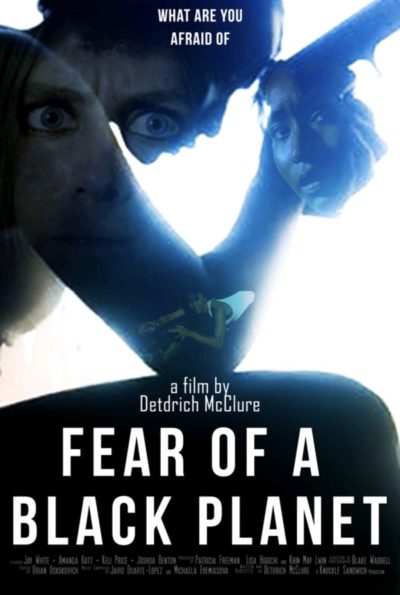
It’s interesting to look at the film’s IMDb page, and contrast the reviews, where there’s nothing less than an 8/10, with the rating, where 73% of votes are a 1/10. One “review” was actually a rant about other reviews which appear to have been removed? Something odd there. There’s no doubt, the film is not so much tackling a contentious topic, as driving head-first into it at 80 mph. Even the title (obviously inspired by the Public Enemy LP of the same name) is an incendiary one, guaranteed to raise the hackles of many – and, to be honest, not without reason, because of the assumptions it makes. It’s a shame, since the film is at least slightly more nuanced than the title makes it seem.
We’re still deep in problematic territory, however. The topic of race relations in post-Trump America is not something a 70-minute film can address in any meaningful way. While I have to admire the intent, it feels like this was doomed to fail from the get-go, and delivers only the most ham-handed of commentary. Fay (White), a newly graduated black cop, is on the way to visit her father’s grave when full-on race war breaks out. She takes shelter in the warehouse belonging to artist Nova (Kott), only to find it’s not much of a safe haven. For Nova turns out to be part of a white militia group, run by Lestor (Benton). They’ve got a van and are plotting something not very nice with it.

The issue here is the script, which has so many flaws it’s hard to pick out the worst. It’s probably Fay’s repeated failure to nope the hell out of there, despite prolific opportunities. Though the competition in this category is tough. Why does Nova let a “monkey” in to their lair, on multiple occasions? Why do the militia not permanently dispose of Fay the first chance they get? Shouldn’t they – oh, I dunno – lock the door to prevent Fay’s white boyfriend, Ric (Price), from coming in? It’s not as if civilization outside has collapsed into anarchy and utter chaos. Oh, my mistake: it supposedly has. Or maybe not immediately recruit Ric onto their team? Guess you just can’t get the white supremacists these days…

None of these have anything to do with the film’s apparent message: it’s basic storytelling. The performances are fine, and the direction occasionally impressive; the ending works better than it should. However, these aspects deserve a much better plot, and aren’t enough to salvage the endeavour as a whole. With regard to the messaging, it’s not as painfully didactic as I expected from its title, tending to let its morality flow from the situations. Though any pretense at balance is limited to a two-minute appearance by a vigilante apparently affiliated to the Black Hebrew Israelite movement, going by his multiple references to “white devils”. The reality, of course, is that 90% of people, black and white, don’t hold these kinds of extremist views. Here, 90% do, making it as much a dubious fantasy as Birth of a Nation.

Dir: Detdrich McClure
Star: Jay White, Amanda Kott, Joshua Benton, Keli Price

The Female Hustler

★★½
“The long climb up.”

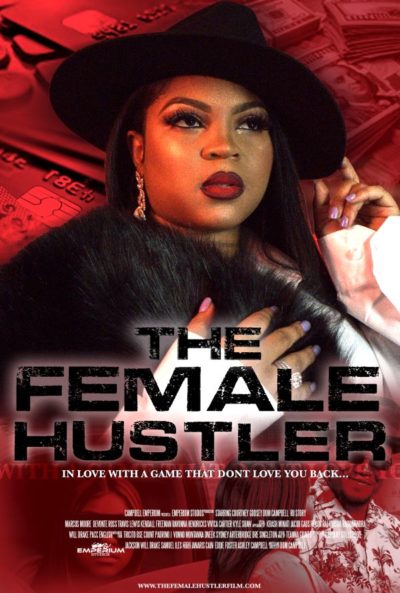
This is another one in the apparently endless series of low-budget urban movies, which focus on crime in the black community. Though this does actually have a couple of wrinkles which make it stand out, if not quite enough to make it a success for a wider audience outside its community. Columbus, Ohio is the setting, where Princess (Godsey) is struggling to make ends meet. She’s relying on handouts from her dodgy brother, Dae Dae, to make rent, and also wants to get her best friend away from her pimp. Opportunity comes knocking, in the shape of an Uber driver, Omar (Campbell), who brings her on board in his business, which he tells her has almost unlimited upside and growth potential.
to the movie’s credit, this isn’t the usual drug-dealing we’ve seen so many times before. While the specifics were a bit vague, it seems Omar is working on white-collar crime, syphoning off company payroll. His associate on the West coast, the appropriately named Cali (Bosley), is planning a hostile takeover, and brings Princess on board. Omar gets wind of this, only for Princess to turn the tables, leaving her boss for dead. That brings us to phase two of the movie, where Princess is now in charge of a nationwide enterprise. However, to no great surprise, it is not as easy as that, not least because Omar is still alive, and unhappy about the situation, to put it mildly.

To start with the positives, Godsey is a good actress, and indeed, most of the cast are solid enough, when their performances are given room to breathe. The first half of this, depicting Princess’s rise to the top, may be small scale, but is effective. I do have some questions though: for example, the reason why multi-millionaire entrepreneur Omar is working as an Uber driver, is never convincingly explained. However, the budget here is entirely incapable of depicting the lifestyle of Princess once she has reached at the top. It needs yachts, big cars, lavish apartments, etc. and the film never delivers. It feels like she’s probably still living in the same crappy apartment she inhabited at the beginning of the movie.

That’s far from uncommon: I’ve seen many similar films whose ambitions did not live up to their resources. A bigger problem, however, is the soundtrack. It feels simply like the director left his Spotify account on random, with one of an endless selection of songs written and performed by his mates, blasting every three minutes. There seems to have been little or no attempt to choose the songs to fit the needs of the scene, and they are far more often a jarring distraction. Occasionally, we get some sequences where Campbell does exercise restraint, opting for stock music instead, and these are inevitably better. But I’m not averse to Campbell overall, who shows enough talent, along with his lead actress, that they will be worth keeping an eye on going forward.

Dir: Dom Campbell
Star: Courtney Godsey, Dom Campbell, Kenneth Bse Count Bosley, Vivica Cartier

Suga Babies

★½
“The drugs do work”

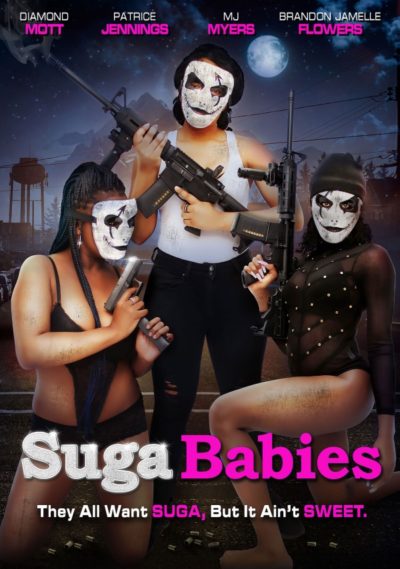
As usual, I begin with the normal disclaimer, that I’m about as far from the target audience as you could imagine. For this is an inner-city story about a drug war between three rival gangs in South Carolina: the Guardians, the Dynasty and the GeeChees. That said, however, there have been other films, with not dissimilar themes, which I have enjoyed. Most obviously, I am not the target audience for Pam Grier’s seventies output either. But those still kick ass. Even among the modern entries, there have been ones like Candy, which have felt authentic in their depiction of urban life. This, on the other hand, feels more like a no-budget hip-hop video.
About the main positive is that nobody makes a particular fuss about the Guardians being an all-girl gang, under the loose leadership of Naomi (Mott). They’re just part of the landscape, and everyone accepts that. The cause of the war is a new drug called sugar. In an odd twist, this actually makes people who take it better. We are told it literally cures cancer. I genuinely LOL’d at that. However, the interest of the authorities is limited to a spokesman for Big Pharma, who expresses concern at the street muscling in on “their” turf. It might have been interesting if it turned out Big Pharma had secretly released the drug to the GeeChees for distribution, as a test of its effectiveness. Sadly, not much is done with the concept, with this largely being an excuse for more black-on-black crime.

Indeed, that social crisis is expressly referenced during one of the multiple sequences of “The Buzz”, some chat-show. These really add very little, and the same goes for the supposed “courtroom” scenes. As well as being woefully unconvincing, I don’t think I ever worked out quite who was on trial, or for what. It’s all horribly disjointed, for example a lengthy scene that’s just multiple people picking up drugs from a motel room. Add in sequences which genuinely are no-budget music videos, and the dramatic pickings became painfully thin. There’s just one scene that has any impact. Mouse (McCoy) gets picked up by the Guardians and is found to be dealing sugar for the GeeChees. Her impassioned explanation that she did so because sugar helped her family, is certainly the movie’s emotional high-point.

According to the IMDb, the director had made eight feature films since her first in 2020. That’s an admirable work ethic, to be sure. But I can’t help thinking that churning out fewer movies might lead to an increase in their quality, because this definitely feels rushed, in almost every aspect. Maybe this is what the target audience wants? But it would be patronizing to believe their standards can be satisfied with this kind of thing. On the other hand, this wasn’t even the worst thing I watched today (hello, Battered), at least reaching a bare minimum of technical competence. However, that’s scant praise for any movie.

Dir: Felicia Rivers
Star: Diamond Mott, Patrice Jennings, Shakeela Koffey Scott, Samantha McCoy

Chained

★★
“Puts the gang in chain gang.”

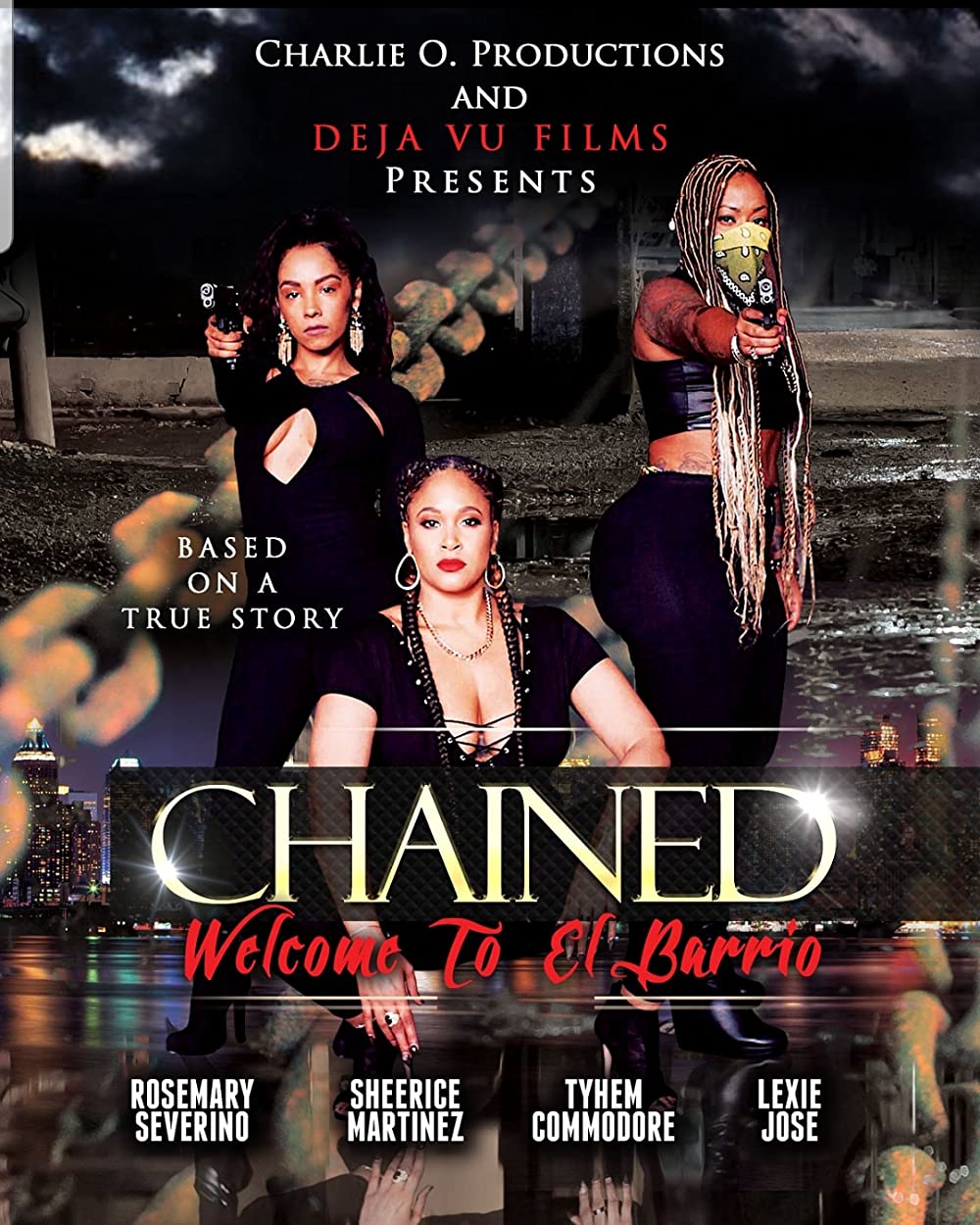
Jaz (Severino) gets arrested by the cops and hauled off to Rikers Island on… well, let’s say slightly bogus charges. Her long time pal, Trouble (Martinez) is on the outside and sets about raising bail for Jaz, by any means necessary. That involves putting together a crew of her own who will seize the opportunity to take over drug-running territory in part of their neighbourhood. Needless to say, this decision doesn’t come without perils of its own, both from the authorities and the others with eyes on the profits to be made. Jaz, meanwhile, is having to come to terms with prison life, and isn’t exactly making friends on the inside. Even when the money for her bond is raised, Jaz’s issues aren’t over. However, Trouble finds a solution, after discovering the cops who arrested her have a little side-hustle of their own.

Considering this was made for $15,000, it has its strengths, Most obviously, it feels authentic. The players here may not have much in the way of formal acting experience or training. But I sense they’re not particularly required to do more than be enhanced versions of themselves. The way they act, talk and behave seems legit. Admittedly, who am I to judge? I didn’t exactly grow up on the mean streets of New York. But I can still tell when there is Obvious Acting going on, and it’s a flaw you often see in this kind of low-budget enterprise. I didn’t have to endure that kind of fakery here, and on the whole, the individual scenes were generally fine.

What didn’t work, unfortunately, was the overall flow, with the various plot threads never coming together into a coherent and engaging narrative. I felt like it was taking place over the span of several decades, but there were points when this wasn’t clear. Any film which wraps up with a brief “Twenty years later” scene – in which nobody seems to have aged a day – is on shaky ground. There were also a lot of moments where the script outran the budget. The “police van” in the opening scene, clearly isn’t. Indeed, I genuinely LOL’d later, as the same interior shows up on a van, rented from U-Haul, used for a raid on another gang. If you can’t afford a police van, or at least a decent facsimile, don’t write a scene needing one. The police station and Rikers Island were also… less than convincing, shall we say.

It is likely a little over-stuffed too. For a movie running only 76 minutes, the story tries to cram a lot in, and some of the threads (such as a pregnancy) end up feeling like afterthoughts. More restraint in writer-director Cardona’s ambition would have been for the best. She’s clearly familiar with street life, its characters, and how they behave. When the story sticks to this, the movie is at its most effective, although there’s nothing particularly new or important being said. When it tries to be more expansive, though, the resources just aren’t there, and the shortcomings are painfully apparent.

Dir: Deborah Cardona
Star: Rosemary Severino, Sheerice Martinez, Tyhem Commodore, Lexie Jose

Jack Squad

★★
“Considerably less would have been more.”

At 85 minutes, this might have been fine. For it’s a fairly simple tale, of three women who decide to escape their financial woes by drugging and robbing married men, banking on their victims not being willing to involve the authorities. While this initially works as planned, inevitably, they end up targeting the wrong guy, a minion of feared drug dealer Grey (Anderson). How evil is he? Grey appears to have an employee whose full-time job is to fan him. That’s some Evil Overlord style, right there. Grey doesn’t just want his stolen money back, he wants the trio to continue their activities – for his benefit. And that isn’t the only problem which the trio face, with Tony, the estranged other half of Dawn (Tares), unhappy at her having escaped their abusive relationship.

Somehow, in the hands of writer-director-producer Rankins, this uncomplicated story runs 128 minutes, which is way too long. If ever there was evidence that films sometimes need someone else to step in and say, literally, “Cut that out,” this would be it. You could go at the “director’s version” blindfolded, with a rusty bread-knife, hacking entire scenes out, attacking others with all the savage brutality of a starving man at a Vegas buffet, and would be incapable of doing any real harm to the end product. If you can’t see where half an hour couldn’t be excised, to the general improvement of the pacing, you’re not trying hard enough.

Which is at least somewhat of a shame, since this wasn’t otherwise as bad as I thought it might be. It is certainly an improvement over the director’s almost unwatchable, Chop Shop. The three leads are adequate, and the script gives them reasonably well-delineated characters. As well as recovering abuse victim Dawn, there’s fashion student Kennedy (Halfkenny), who has qualms about the whole endeavour. Though she’s also the one who triggers the escalating body-count, by robbing Grey’s underling. And then we have Mona (Williams) who develops a liking for the violence, and gradually becomes a fully-fledged psychopath. The three different personalities certainly provide plenty of scope for drama and conflict, as they try to figure out how to handle their increasingly untenable situation.

That said, some of the attitudes here are difficult to empathize with. For example, Kennedy ghosts the kind but poor fellow student, apparently preferring the lure of well-heeled “pharmaceutical” workers. And that’s how you end up in abusive relationships, folks, or having to chase down your baby daddy for child support, as recently documented in Sweet Justice. There’s also no getting over the low-budget approach, most obvious in “gunfire” which couldn’t be much more fake, if the people wielding the weapons were yelling “Bang!” and using their fingers as firearms. But the major problem is the one described above: a self-indulgent approach, almost as if Rankins believed everything filmed had to be included in the final product. When making a low-budget feature, like this, you may need to wear many hats. But that does not negate the need for external and neutral guidance.

Dir: Simuel Rankins
Star: Dawnisha Halfkenny, Onira Tares, Patshreba Williams, Benjamin Anderson

Restless (2020)

★★
“Mom on a mission”

Single mother Naomi Harper (Anderson) is devoted to her son, and he to her. In an effort to help Mom make ends meet, he gets a job working for notorious local “businessman”, Noah Oliver (Wilson). When her child turns up dead, Naomi is sure that Oliver had something to do with it. The police, in particular Detectives Emory Kota (Conell) and August Hayes ( Jeziorski), don’t necessarily disagree, but their hands are tied. This is partly due to a shortage of actionable evidence, partly because Oliver’s connections run deep into the local political and judicial establishment in Conyers, Georgia, making it impossible to take action against him. Well, at least officially. Naomi has no such limitations, and this apparently mild-mannered loan officer has a background that may prove of help.

The script here isn’t bad. There are a number of interesting angles, such as the parallel actions of a vigilante, working in same area as Naomi, and targetting those who consider themselves above the law. Naomi isn’t the only strong female character either, with Det. Kota frustrated by the restrictions of her position. Then there’s Sophia (Rachel Burger), Oliver’s right-hand ma… er, woman, who proves capable of handling herself physically as well. Though I probably would have been more impressed had Naomi not done that crappy, gangsta “holding the gun at an angle” thing, as she headed towards her final confrontation with Oliver. Nobody with experience and an interest in being taken seriously would be caught dead doing that.

However, the problems here are most readily apparent in the resources here. Or, to be more accurate, the lack thereof. Even though the film tries to work within the budgetary limitations, these are so severe, they can’t be hidden. For instance, scenes which are supposed to take place in a police station, very clearly don’t. Indeed, there’s very little effort to make it look like anything, except a bare, empty room. The same goes for a number of other locations, where the bare minimum appears to have been done in terms of set dressing. Hardly less glaring are the plugs for local venue, Triplz Lounge. I’m sure it’s a lovely place.

Another weakness is that most of the actors don’t appear to fit their characters. Wilson is probably the worst offender, never being convincing as a mob boss – he’s just not intimidating or threatening enough. But to a lesser extent, the same goes for Anderson. Despite copious flashbacks to a time when her son was alive, she rarely seemed like a distraught mother, pushed into unthinkable acts by the callous and indifferent hand of fate.  She’s not a bad actress, competent enough from a technical point of view. There just wasn’t any reason for the viewer to pay the emotional buy-in to her portrayal. I’d not mind seeing what Jackson and his team could do with more money, and I’ve certainly seen worse. Here though, the challenges prove just too much for them to overcome.

Dir: Rodney Jackson
Star: Tai Anderson, Tavares M. Wilson, Robyn Conell, Will Jeziorski

Certain Fury

★★★★
“When child stars grow up”

Child actors have a difficult challenge facing them when the reach adulthood. They are not the sweet kids anymore that everyone loves and wants to cuddle with. They can’t rely on the cuteness factor anymore that made them once so successful. That can lead to tragedy. How many former kid stars became drug addicts or committed suicide because they couldn’t return to that time anymore, when in a way the world was theirs? Others were smart enough to leave film business behind them and start a new career e. g. Shirley Temple. But a few of them are indeed lucky. they stay calm amidst all the thunderstorms of early successes and puberty, manage to stay relevant to audiences and even find a new footing and grown-up roles, that cement their careers as everlasting film stars. Actresses like Sophie Marceau or Jodie Foster come to mind.

The latter is a particular success story, making the transition from child actor to grown-up movie star. In the 70s she was the regular tomboy in Disney family comedies and at one point was even under consideration to play a young Princess Leia in what would become the first Star Wars movie. Her constant competitor in tomboy roles was Tatum O’Neal. the youngest ever to win an Oscar, for her performance in Peter Bogdanovich’s beautiful tragic-comedy Paper Moon (1973), next to her father. She also played a tomboy in The Bad News Bears as Walter Matthau’s daughter. Coincidentally, Paper Moon became a TV series in which Jodie Foster played O’Neal’s role! Unfortunately, O’Neal went through the usual teen-phase, then slowly disappeared from the screen. Later she made headlines for her troubled marriage and addiction. Just a couple of years ago again when she was taken in by police because she wanted to buy some drugs.

Why this long introduction? It’s because I think it’s kind of unjust how her career went – though everyone is responsible for their own decisions and you never really can plan to be in “successful movies“. But contrast the career of Foster who had a similar basis, but persevered after making some less interesting movies for much of the 1980’s. Her second career in films began with the Oscar for Accused (1988) and then moved on from there to bigger things. It just shows that you may have talent and get credit for some time in Hollywood. But if the right movie and role doesn’t come along, and you make some bad decisions, anyone’s promising movie career can just evaporate in front of your eyes.

There are movies that are crossroads that can lead to other – maybe better – things or open up a new role type for you, maybe an entire new genre. My feeling is that Certain Fury (title in German cinemas: “In the heat of New York”) could maybe have been that for O’Neal. It just wasn’t to be.

From 1985, it checks all the boxes for a typical 80’s action buddy movie, beginning with the story. At a mass trial of young girls, responsible for different criminal acts, two prostitutes start a shoot-out in the courtroom that has to be seen to be believed. A remarkable act of violence which you hardly would ever find in a modern action movie of today where everything is usually very neat and clean. Scarlet (O’Neal) who has killed a man – in self-defence as we find out later – and Tracey (Cara, who won an Oscar herself for her song in Flashdance shortly before; the title song here is also by her) are among those who take their chances in the ensuing chaos. They run from the court building into the streets, chased by the police.

They are more fortunate than one of the prostitutes, who gets shot into the back. Really, this movie could only exist in the 80’s, and would be unthinkable for today’s Hollywood. The pair make it into the sewers, and survive an underground explosion, caused by a cop’s lit cigarette igniting sewer gas. They eventually meet one of Scarlet’s lovers named Sniffer (Nicholas Campbell) who is an especially disgusting creature. He obviously makes porn and after Scarlet has left, tries to rape Tracey in the shower. While not a particularly graphic scene, it might well work against the possibility of the film being released in the US again. 

Scarlet tries her best to get help from another former lover, the arrogant, rich, criminal Rodney, who turns out to be played by Peter Fonda. Did he ever get an Oscar for one of his movies? I don’t think so. [Jim: no, just nominated for Ulee’s Gold] It’s so strange because he’s the most well-known actor in this movie. But he likes her as lttle as her other ex, and cuts her cheek with a knife. She just returns right on time to escape with Tracey before Rodney’s men arrive to get her after he made a deal with the police. Scarlet has taken some of Sniffer’s drugs and manage to sell them in what looks like a giant derelict house in the slums. It really is a movie from Reagan era! ;-)) Her persecutor arrives on the scene, injects Tracey with drugs, sets fire to the house and has a final fight with Scarlet before meeting a fiery death.

Police inspector Lt. Speier (Murdock) is meanwhile trying to find the girls, together with Tracey’s father, Dr. Freeman (Moses Gunn, e. g. a gangster boss in Shaft). The theme of Black and White working together is repeated in these characters, as in the girls themselves. This is a very positive, uplifting message but – unlike today where many movies have become a lesson about racism and discrimination – it’s not a lecture, it’s inherent in the movie’s story and characters. It makes this much more palatable for me than modern movies who lose the entertainment aspect in the background, while putting their lessons in your face.

As the two girls are believed to be dead (Tracey reads it in the newspapers; Scarlet can’t read) they consider a new life together, free in the mountains. But Scarlet doesn’t believe it’s possible, and in her brusque manner tosses Tracey away from her. When the police arrive, Scarlet still keeps on walking on a bridge, so they shoot her in the back. But the last shot shows Scarlet being hold by Tracey and Dr. Freeman saying it is not so serious, and was only into the shoulder. Guess that’s a happy ending… or something like that!

It’s all tough stuff. Certain Fury isn’t an “important” movie; indeed, you could even argue whether or not it is a “good” movie. As a matter of fact, I had a strong feeling when watching this movie that Charles Bronson might come around the corner any moment to “clean up the slums of New York“. It really looks like one of those cheap Cannon flicks that were such guilty pleasures in the video stores of the 80s (and might be even more now!). And, indeed, just a short time later, Cannon had Charlie handcuffed to a snotty teen, and sent on a similar road trip through gangster-land in Murphy’s Law (1986). Though that movie more or less dropped any social issues of the O’Neal-Cara-film and concentrated on the bloody action of Bronson versus the rest of the criminal underworld.

I note also obvious similarities to the Stanley Kramer-classic The Defiant Ones (1958) with Tony Curtis and Sidney Poitier. Scarlet is not nice and understanding, she is street-wise, prone to anger and absolutely insulting. Heck, she even drops the N-word to Tracey. So the inspiration is arguably there. And who knows, maybe it wasn’t an accident that a year after this movie, The Defiant Ones got an update in a 1986 television movie with Robert Urich and Carl Weathers (also a very watchable movie). [Jim: there’s also Black Mama, White Mama, in which Pam Grier and Margaret Markov are another inter-racial pairing, who escape from prison handcuffed together]

While I mainly saw and enjoyed Certain Fury for what it was – enjoyable over-the-top action trash – the movie nevertheless put some fingers into social issues that may be as relevant today in America, as they were almost 40 years ago. Racism, social class differences, uncontrollable no-go areas, criminality, poverty, drugs and – yes – even police brutality can be witnessed in this movie. Though after the bloody mass shoot-out in the courtroom at the beginning, where hardly anyone is left alive, you can maybe understand the over-reaction of the police! I don’t think this  almost forgotten little movie offers any solutions to these myriad of problems. But it at least suggests that even very different people can understand and support each other, even if it needs an extreme emergency to do so. It’s a theme also mirrored in the very different duo of the white police inspector and the black surgeon.

Now, I wouldn’t recommend the movie if you want a high-quality social drama: too much Charles Bronson in it, if you ask me. But it’s enjoyable action trash, and interesting that at one point Tatum O’Neal could have become an action or thriller star. The latter genre was, after all, the one in which Jodie Foster found her greatest commercial success. O’Neal’s acting is very good, I think; there’s nothing left of that little brat she embodied in the 70s. Her Scarlet is an interesting character of the “hard shell, soft core” variety. She could maybe have continued in this manner; who knows? Instead of that she chose to marry tennis player John McEnroe, which obviously wasn’t the best move for her in any way.

Here’s a little confession: I feel a certain emotional connection to this movie as I discovered the trailer online and then suggested it to a German DVD label who promptly released the movie on DVD here in Germany (even with an audio commentary of two film historians!) – I think my ego is going to explode! ;-) And an interesting final tidbit: In the German-language version Tatum O’Neal is played by the voice artist who regularly dubs… Jodie Foster!

Dir: Stephen Gyllenhaal
Star: Tatum O’Neal, Irene Cara, Nicholas Campbell, George Murdock