




★
“Sucker punched”
 This review is more in the nature of a warning than a critique, since it would be easy for someone to look at the cover (right) and think that this might be a movie about – oh, I dunno, boxing? It seems a reasonable expectation, given the following synopsis:
After her partner is mercilessly gunned down, sexy, streetwise cop Maisie turns in her badge and turns to the relative safety behind the bar of a hip new joint she names Dames. It doesn’t compare to the rush of danger she gets on the streets but it keeps her out of trouble – until trouble finds her in the form of a guy, a dead girlfriend and a probable Mob connection. Now that familiar adrenaline is pumping again as she goes deep undercover with the hot and hardened women who make up the volatile world of female boxing. Will Maisie solve the murder before someone else is “knocked out?”
While none of the above is technically a lie, I should probably have done a little due diligence, and perhaps noticed that the first word on the cover is “Sexy.” For this is actually soft-core porn, with the plot little more than a thin excuse to link together the sex scenes, which take place with such regularity you could set your watch by them. And you’ll certainly be checking your watch with a high degree of frequency. Not that I’m averse to pornography by definition – indeed, not too far down the line, I’ll be writing about a hard-core version of Nikita – but it’s all about expectations. I watched this one on a chilly Tuesday morning, fortunately when Chris was out of the house; however, I still had a somewhat tricky conversation with my son. “Isn’t 9:30am a bit early for porn?” he said sardonically. Why, yes. Yes, it is. Though I’m pleased at least to see he does appear to have picked up my tendency for ironic commentary during his college years.
I supposed I should briefly mention the film, which could have been interesting. White even has some potential, as former cop turned private eye Maisie Calloway [a character she played in two other films the same year, which I will not be rushing to see]. She has a bumpy past, separated from her cop husband, and whose partner was, as the synopsis says, killed – apparently in a previous movie, because it plays no significant part here. Indeed, the storyline is far more of an afterthought, treated as if its of no real concern. I suppose that’s fair enough, but if you’re going to make soft porn, you should at least have the honesty to promote and sell it as soft porn, and not pretend it’s something which the film most definitely isn’t.
Dir: J.W. McHausen
Star: Charlie White, Joey Ray, Nick Manning, Nicole Oring
a.k.a. Twisted Temptations
 Part one was deemed by the qualification panel as falling short of the necessary minimum level for inclusion here, being a mix of poignant drama about an elderly man whose lifelong companion’s battery is running down, and porn. The sequel, however, just about does enough to qualify, albeit while retaining a hefty dose of the latter aspect – and you don’t need to have seen part one either. Here, disgruntled scientist Professor Uegusa (Horiken) hatches a plan to destroy the appearance-based culture of romance, and to finance this sends out his “hostroids”, attractive male androids, in a variety of guises, e.g. office manager, door-to-door salesman, etc. to seduce woman and bilk them of their savings. He also sends them to kill rival researcher Dr. Kouenji, who had been building a countermeasure, in the form of a maid android, Maria (Yoshizawa). Before his death, Kouenji sends Maria to geeky student Shotarou (Haraguchi), but she isn’t ready, needing her “love circuit” activated before she can attain her full potential needed to defeat Uegusa and the hostroids. Can Shotarou manage that final step before the hostroids take him and Maria down?





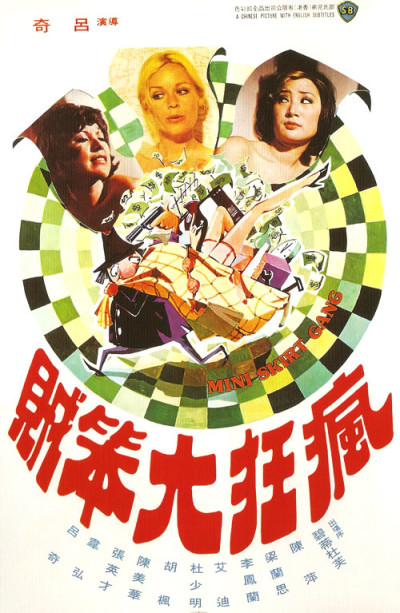 Dear god, this is awful. The only reason this 1974 film manages the dizzy heights of 1 1/2 stars, is the finale, which is actually a pretty decent burst of comedy action, highlighted by the heroine receiving inspiration from a poster advertising a Peking Opera production of the Mulan legend. Up until then, it’s a rancid piece of film-making, wasting the talents of those involved. Well, the actresses anyway, since Lui Kei provides no evidence, in either his direction or script, that there was any talent present to begin with.
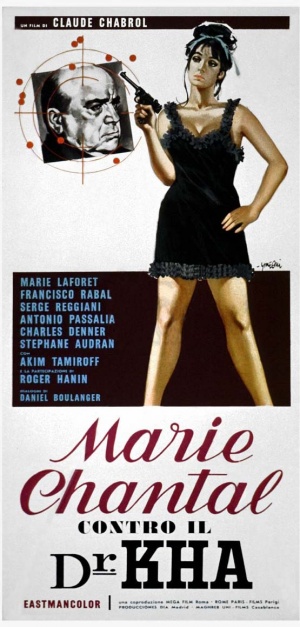 I’d probably better start of by explaining the above tagline, Chabrol was one of the leading lights of the French ‘New Wave’ cinema, alongside the likes of Truffaut and Godard: I’ve enjoyed the films of his I’ve seen, mostly later works such as L’Enfer or La Fille coupée en deux. But in the mid-60’s, he basically sold out, churning out a number of light spy spoofs. Regarding another of his works around this time, he said, “I really wanted to get the full extent of the drivel. They were drivel, so OK, lets get into it up to our necks.” It’s easy to see what he meant, for Marie-Chantal is undeniable drivel, though lacks the necessary enthusiasm to overcome those limitations. Through a chance encounter on a train, the titular heroine (Laforet) is given a piece of jewellery by a stranger. That makes her the target for spies from Russia and America, as she travels from the Alps to Morocco, and also the minions of evil overlord Dr. Kha (Tamiroff), for it holds the secret to a weapon of potential global destruction, that everyone wants to acquire.
 A loose remake of a somewhat infamous 1980 horror movie [rejected by the BBFC and as yet unreleased in the UK], this is a nastily brutal and effective home-invasion story, with a maternal angle that’s both surprising and well done. On the run after a botched bank robbery, the three Koffin brothers end up in the wrong home, and end up with a houseful of hostages, who were visiting Beth Sohapi (King) and her husband. The criminals call on the rest of their family for help, led by their mother (De Mornay), who is 50% June Cleaver – even providing cake and ice-cream for the residents – and 50% Lizzie Borden, showing absolutely no restraint against anyone she perceives as threatening her brood. As the night progresses, a lot of skeletons come out and we discover the Sohapis definitely do not live up to their name…