
Bleeding Hearts

★★
“Not bleeding awful – but close.”
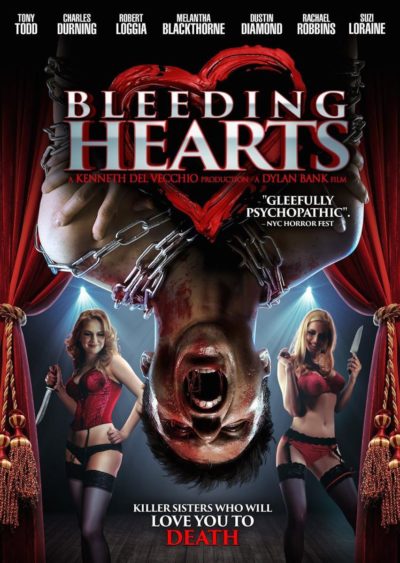
Stumbled across this low-budget horror flick almost by accident when I was Googling the similarly-titled but very different, Bleeding Heart. The premise was kinda intriguing: five successful half-sisters (doctor, lawyer, engineer, etc), living in a small town, take a month off each year together and vanish off the grid. What the townfolk don’t know, is they kidnap various obnoxious menfolk under the guidance of leader Leslie (Robbins), subjecting them to unspeakable tortures and eventually killing them, before returning to everyday life. Into this town comes documentary film-maker Oliver Jaffe (Diamond), who starts to investigate the odd situation, after his car breaks down in town.

The same director previously made Scavenger Killers, which was kinda like a sleazy version of Natural Born Killers, also starring Robbins – this is similarly low-brow, apparently attempting to be as offensive as possible. If you’re not prepared to cope with a naked man in a cage on his haunches, being violated with a wire-brush, this is probably not for you. Though you’d be forgiven for wondering if there’d been some kind of mix-up with the DVD at the beginning, which starts as a social satire in which Santa (the late Charles Durning, in his last feature appearance), Jesus and Satan share a house, occasionally being harangued by God (Tony Todd). Turns out, this is a film-within-a-film, being made by one of the sisters’ targets this year.

Even as someone who IS prepared to cope with the extreme content, I found the results were actually kinda tedious: if ever a film is guilty of trying too hard, it’s probably this one. There’s no shortage of nudity from the actresses, to the extent I began to wonder if this was filmed in its entirety at an adult film convention. But it’s curiously uninteresting and ineffectual, since you’re never really given any reason to care much. The structure is weird too: there’s so little connection between the two halves of the story, right until the end, I wondered if Diamond and Robbins would ever meet (just as I strongly suspect Todd’s scenes were filmed separately from everyone else’s, since you don’t see him and anyone else in the same shot).

Instead, Diamond’s half feels almost like complete filler: there’s no real sense of “investigation” since the audience already knows the truth about what’s going on. Or, most of the truth, at least. While there’s a last reel twist or two, these are no more effective than most of the other aspects. You may be left to wonder why they bother having five sisters, when there’s no more than 2.4 personalities between them – Leslie, and perky foot-model Candy (Lorraine) being responsible for the great bulk of that. This is one of those cases where I can see how the various pieces of the jigsaw could have been fitted together into something potentially transgressive and interesting. It never gets there though, and the likes of Todd, Durning and even Robert Loggia, who plays the local sheriff, are not well-served by this at all.

Dir: Dylan Bank
Star: Rachael Robbins, Dustin Diamond, Suzi Lorraine, Melantha Blackthorne
Girl in Woods

★★★½
“Why we don’t camp, #273.”

It’s always interesting when reviews of a film are deeply polarized, and that’s the case here. The first page of Google results run the gamut from “I simply despised the film as a whole” to “The images are frightening within, and the only thing better than the scares are the performances.” While I lean toward the latter, I can see how this could have failed to make a connection with some viewers, and if that happens, then there isn’t much else to prevent the former opinion. It’s the kind of film where there isn’t likey to be a middle ground in reactions.

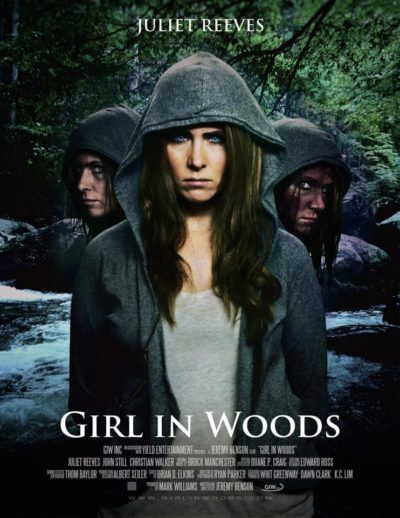
Following an awful childhood trauma, Grace (Reeves) has grown up into a troubled soul, but has finally found some peace, through her boyfriend (not without his own issues) and pharmaceutical help. However, that’s all shattered on a weekend trip to a cabin in the forest; on the way there, an accident (or was it?) occurs, leaving Grace stranded, alone, in the woods and very poorly equipped to survive. For what follows is a gradual and relentless shattering of her sanity, as the stress builds up and the drugs run out, and she tries to get out of her predicament. Grace’s personality splits into three distinct versions of herself – then there’s the darkly aboriginal creature who appears to be stalking her.

Meanwhile, we get flashbacks to Grace’s life with her mother (Carpenter) and father (Perkins), shedding some light on the cause of her mental fragility. It’s not much of a stretch to see Grace’s lost physical state as a metaphor for her psychological one: the title (and yes, that is it – I didn’t miss out a “the”) suggests the same. Since her character is on screen in virtually every scene, it’s a movie which really stands or falls on whether you buy in to Reeves’s performance – or, more accurately, performanceS, since many of these have her interacting only with her other selves. After some shaky moments early on, I found the approach kinda crept up on me, and some of the three-way scenes are near-impeccable, both technically and dramatically.

When your story largely involves watching someone lose their mind, keeping it interesting for the viewer is not an easy task to pull off. Benson succeeds, even if you’ll be reluctant to commit too far, because it’s clear that what Grace remembers, and what actually happened, may be radically different things. There’s a sudden effort at the end to tie everything together into urban legend, which I’m not sure is particularly helpful. It seems to come out of nowhere and feels like pandering toward a sequel. Trim those few minutes off, because you’ll know the “true” ending when you see it, and it would be a tighter overall product. Yet, there’s still enough of merit here to make it worthwhile, if admittedly this could be seen as merely confirming our strong preference against woodland wandering.

Dir: Jeremy Benson
Star: Juliet Reeves, Charisma Carpenter, Lee Perkins, Jeremy London

47 Meters Down

★★★
“Nobody expects the sharkish inquisition!”

Stealing from both Open Water and The Shallows, this takes two sisters on a scuba-diving trip in Mexico. There’s Lisa (Moore) and Kate (Holt): the latter is all gung-ho about the chance to dive with sharks, while the former is considerably less enthusiastic, about life in general, being on the wrong side of a break-up. And, whaddya know, her concerns prove to be entirely valid, as the chain of the observation cage snaps, sending them plunging 150 feet down into the water. Air is limited, the sharks are circling, and they’ve fallen out of radio range with the boat above. How are they going to survive?

I’ve read thoroughly scathing reviews of this from scuba divers, criticizing a number of technical aspects – for instance, their air would be woefully insufficient. As someone who has never even snorkeled, I can only acknowledge these and move on, since they didn’t impact my opinion much. Though I have to say, I did notice how novice diver Lisa becomes remarkably proficient over the course of the film, even swapping out her tank on the fly, something I imagine isn’t a novice task. It is necessary to accept that the entire thing is inevitably going to be highly contrived: the sharks appear only when required, and don’t attack when that’s needed, too. These are creatures, strictly necessary to the plot, and it’s a mechanism which is largely par for the genre course. Who needs motivation? They’re freakin’ sharks!!!

Still, for what it is, this does the job, the director pushing the appropriate buttons with a degree of competence. After a somewhat shaky opening reel, where you wonder how much of the film is going to be emotion-driven, it settles down to what matters. This means a straightforward Problem → Solution → Execution cycle, with the sisters having to come up with strategies for the issues as they arise. Having two leads does help avoid the awkward structure we saw in The Shallows, with the heroine speaking to a conveniently wounded seagull, largely in order to avoid 80 minutes without dialogue. Fortunately for this film, Lisa and Kate are conveniently wearing masks with radios, so they can emote to each other, instead of being limited to enthusiastic hand-signals.

The ending is certainly reminiscent of another movie you’ll find on this site. I’ll avoid explicit spoilers, but it got our seal of approval, and if you’ve seen the film in question, you’ll certainly look askance at the wholesale hijacking carried out here. It’s this general lack of many ideas entirely its own, which prevents this from being as successful as it might be. The performances and direction are good enough for the job, and it laudably avoids any romantic interest worth mentioning at all. This film instead has a single goal, much like sharks are machines with one purpose: killing… Killing and eating. Their two purposes are killing and eating. And making little sharks. Their three purposes are killing, eating, and making little sharks. And an almost fanatical devotion to the Pope. Er, among their purposes are such elements as…

I’ll come in again.

Dir: Johannes Roberts
Star: Mandy Moore, Claire Holt
a.k.a. In the Deep

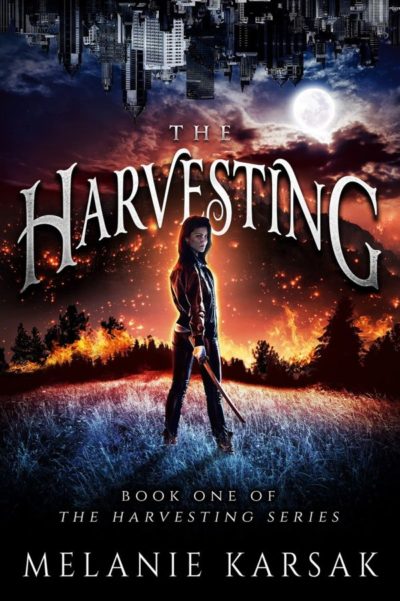
The Harvesting, by Melanie Karsak

Literary rating: ★★½
Kick-butt quotient: ☆☆☆☆
“Twilight of the Living Dead…”

This is likely the kind of book you enjoy rather than appreciate. While no-one will ever mistake this for great literature – you could go with “ludicrous nonsense,” and I’d not argue much – it’s a fun enough bit of pulp fiction that I kept turning the pages. Layla Petrovich gets a strange call from her Russian grandmother in her hometown, the remote rural community of Hamletville, requesting her presence. When Layla arrives, she finds Grandma, a noted local seer, clearly preparing for something. What isn’t clear, until Layla wakes up to find herself in the middle of the zombie apocalypse.
Fortunately, Layla is a bit of a weapons expert – she had moved to Washington D.C. and was working in a museum, specializing in medieval weapons, while giving fencing lessons on the side. What are the odds? So she is soon leading the townsfolk in defense of their realm, while they wait for help to arrive. In the meantime, she has to fend off the unwanted advances of ex-boyfriend Ian and the not-so-unwanted advances of his brother Jamie, deal with her own apparently blossoming psychic talents, and figure out, when the aid eventually shows up, whether it’s quite the kind they want to accept. Hey, who ever said life after the zombie apocalypse would be easy?

There are two aspects that I found memorable here. The first is the psychic angle, which is largely at odds with the straightforward, two-fisted zombie slaying otherwise present. It doesn’t serve much purpose here, to be honest: there is only one supernatural revelation that matters, and you wonder why Granny didn’t simply tell Layla, “You need to get ready for this, that and the other, dear.” However, it adds some off-kilter atmosphere that’s welcome – and perhaps explains why her hit-rate with firearms is close to 100%, despite never having picked one up before going to Grandma’s house. She has the second telescopic-sight, hohoho.

The other thing is the way the story takes an abrupt right-turn at about the two-thirds point, with the zombies being entirely abandoned as a threat, and replaced by… Well, let’s just say, I didn’t see that coming. It’s not the smoothest of transitions, and feels like two separate novels ended up mashed into one file, thanks to an error in the Kindle factory. Yet it perhaps makes some logical sense given the circumstances. On the other hand, the new enemy have a convenient weakness, rendering them astonishingly vulnerable – except their leader, for reasons never made clear, but presumably to avoid the final battle with Layla being over in 0.7 seconds.

Outside the heroine, the rest of the characterization is limited, to put it mildly. While Ian and Jamie gets the most sentences, they’re never much more than cyphers, who exist purely as the other two sides of the love-triangle. Hardly anyone else stands out – save perhaps Buddie, the bow-wielding woodsman who appears to have wandered in on a guest appearance from The Walking Dead. Karsak saves the enthusiasm for the decapitations and brain-splatter, as you’d expect from the very first line: “If you ever need to slice someone’s head off, this is the blade you want.” Providing you’re fine with that, you’ll be fine with this as well.

Author: Melanie Karsak
Publisher: CreateSpace Independent Publishing, available through Amazon, both as an ebook and a paperback.

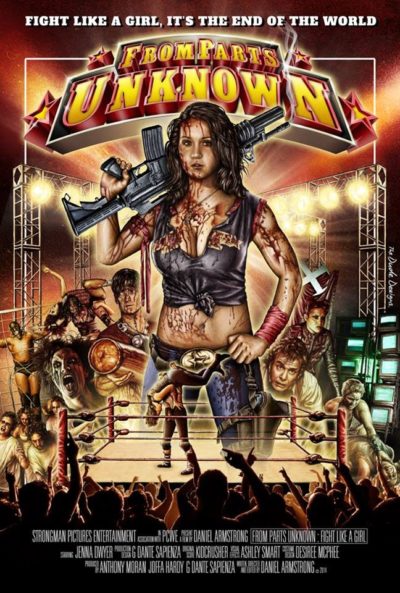
From Parts Unknown: Fight Like a Girl

★★
“Ringpocalypse now.”

Perhaps surprisingly, this is not the first attempt to cross over between the worlds of zombies and pro wrestling. There was also the imaginatively-named Pro Wrestlers vs Zombies, which included Roddy Piper, Kurt Angle and Matt Hardy. This is much lower-budget, Australian and almost certainly contains nobody of whom you’ll have heard. But what both movies share is that… they aren’t actually very good. And that’s a shame, because I’m pretty much the ideal target audience, being a fan of both wrestling and horror. That this one has a heroine, should be another factor in support of it, but it ends up falling apart and devolving into a second half that is little more than a procession of uninteresting set-pieces.
Though in fairness, the makers deserve credit for persevering with production in the face of numerous calamities. The IMDb page lists a few of these, which should stand as a warning to anyone thinking about venturing into the creation of low-budget cinema:

The first edit was completed by the end of 2009 but, due to inexperience and lack of technical know-how, it was completed without location audio… Most of FPU was shot in an abandoned warehouse with no power, requiring a large generator to run lights, the noise of which can be heard in every shot at this location. By 2011 location audio had been re-synced but due to a falling out with those responsible was never delivered to the producers.

During production the director’s car was written off by a drunk off-duty police officer, the insurance money was just enough to allow shooting to continue… In a pivotal scene depicting the death of a main character the actor playing the part of the killer failed to turn up and didn’t return calls. An attempt was made to shoot the scene from a first person point-of-view, but in post production a random beam falling from out of shot was added to create the death scene instead.

All of which is likely more interesting than the finished film, unfortunately. Still, all production problems aside, what of the plot? Charlie (Dwyer) is the daughter of Buffalo Daddy, a wrestler who died in the ring. She’s now training in his footsteps, while working at a video-game company. Their current game, “From Parts Unknown”, involves the use of nanobots to… Well, it’s a bit vague on the details, but to cut to the chase, the nanobots get loose, turning everyone they encounter into flesh-munching monsters. It’s up to Charlie, and some of her pals, to fend off the impending zombie apocalypse.

There are occasional moments that are fun, such as the guy who seizes the chance to channel his inner Bruce Campbell, gleefully quoting Army of Darkness. However, it topples over far too often into self-indulgent stuff, that I’m sure had everyone involved cracking up on set, but triggers less than a faint smile in the viewer. The action scenes are disappointing too: I was expecting to see zombies getting suplexed through tables ‘n’ stuff – instead, it’s just the usual, humdrum removing of the head or destroying the brain, which we’ve seen too often before. I won’t give up though; maybe the third undead ‘rassling film will prove to be the charm. They just need to get Lucha Underground involved somehow.

Dir: Daniel Armstrong
Star: Jenna Dwyer, Elke Berry, Mick Preston, Josh Futcher

Crazyhead

★★★½
“Buffy does Britain.”

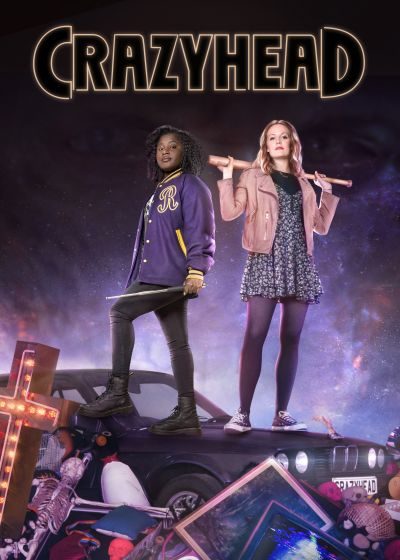
Amy (Theobold) is insane. Or so the rest of society thinks, due to her being able to see things nobody else can. She’s trying to keep her head down, working quietly at a bowling alley. But after being attacked, she is rescued by Raquel (Wokoma), another young woman who can see exactly the same things. Amy learns from her new friend that demons are real, and live among us: Raquel has appointed herself a demon-hunter, and convinces the reluctant Amy to join her. This causes no end of issues, not the least of which is Amy’s room-mate becoming one of the possessed, and the most of which is likely the apocalyptic plan of Callum (Curran). He intends to use Raquel to open the gates of hell on Halloween, allowing thousands more demons to flood into our world and take over humans.
It is, very clearly, inspired by Buffy in many aspects, from its blonde heroine, through the “Scooby Gang” of friends in assistance, such as long-suffering bowling-alley colleague, Jake (Reeves), who carries a torch for Amy and likes canoeing. On the villainous side, Callum also seems to owe a particularly large debt to the Mayor of Sunnydale (though in our house, Curran will always be Van Gogh from Doctor Who!). However, it’s almost fourteen years since Buffy Summers rode off into the sunset, so I guess the statute of limitations has run out there. Another potential inspiration could be a distaff version of Supernatural, but there’s still plenty here that’s fresh and fun, and it has a particularly British approach

For instance, it’s laden with sarcastic banter, as well as (for those who might be offended) plenty of harsh language and general crudity – an exorcism, for instance, requires a very special shower for the target… If somewhat lacking in originality, the dynamic between the two leads helps make up for this; it’s likely the show’s strongest suit, and overcomes most of the scripting flaws. Amy and Raquel are each outsiders in their own ways, who can mesh together into an effective whole. One possesses better social skills, and can hold down a job, so is able to interface with other people if necessary; while the other has superior knowledge about what’s going on, in part thanks to her “special” background. Though both are quite happy to resort to a more physical approach when necessary – and, given who they’re facing, that would be quite often.

It’s all over remarkably quickly, especially if you are more used to American series, typically lasting 20+ editions a season. This only takes six 45-minute episodes to go from introducing the characters to the eve of the apocalypse. It is perhaps a good thing, as the story written by creator Howard Overman is somewhat thin, and could potentially feel stretched if told at any greater length. Instead, you will likely be left wanting more, and that’s never a bad position for the audience to be in, at the end of a show’s first season.

Dir: Al Mackay and Declan O’Dwyer
Star: Cara Theobold, Susan Wokoma, Lewis Reeves, Tony Curran

I Spit on Your Grave 3: Vengeance is Mine

★★★½
“Point made.”

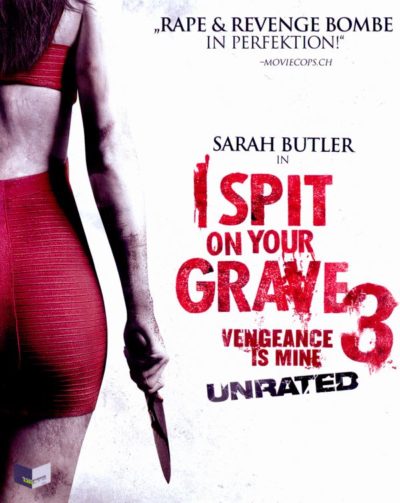
Like much horror, the rape-revenge genre is one which overlaps with, rather than being wholly encompassed by, the action-heroine field. Some entries qualify: the awesome glory which is Ms. 45 being the most obvious example. But others appear to focus more on the rape than the revenge, and are far less interesting as a result. Such was the case for the first two entries in this series – and, indeed, the 1978 grindhouse classic which it rebooted. Here, however, in an interesting twist we bypass the assault entirely. This starts instead with the victim in the earlier movies (Butler) having adopted a new identity, that of Angela, and attending both one-on-one therapy as well as group sessions.
It’s at the latter she meets Marla (Landon), who shares Angela’s dislike for the whole touchy-feely aspect of recovery, and prefers a more… “hands-on” approach to working things out. When they discover that another member of the group is still being molested by her stepfather, it’s time to put their theory into practice. While apparently a success, at least initially, it turns out Marla has her own issues that still need to be dealt with. Additionally, the aftermath of their street justice is bringing the attention of the cops, in particular SVU Detective McDylan (Hogan). It’s kinda hard to explain why you’re in a bad part of town, fighting with a man in a back-alley, and carrying a knife, a Tazer and a can of lighter fluid.

I was sure I knew where this was going. Meeting someone called “Marla” at a support group, is such an obvious nod to Fight Club, I was certain she’d turn out to be a figment of Angela’s imagination, and there are fantasy sequences also pointing down that road. Happy to be proved wrong, and the film twists in some unexpected directions the rest of the way, right until the end. It’s most memorable feature, however, would be two absolutely – bold and capital letters please – BRUTAL sequences of Angela’s revenge. The first, in particular, is going to stick in my mind for a very long time, in part because it comes virtually out of nowhere. But once it begins, it delivers a one-two punch of almost unsurpassed magnitude: barely had the words “Holy sh…” begun to escape my lips, when it got ten times more savage.

It has to be said, having set the bar so staggeringly high in terms of carnage, I was left wondering how the movie could follow up. Truth is, it doesn’t, and that probably counts as a misstep, since it also distracts unnecessarily from what’s actually a solid performance from Butler. She gets to run the gamut from seductive to extremely scary, and is effective enough at both ends of the spectrum. Make no mistake, this is frequently vile and repellent; yet, it’s exactly how sexual assault should be depicted, because that’s what it is. Just be sure to find an unrated version, and if you’re male, you may want to watch from a spot where curling up into the foetal position is easily managed.

Dir: R.D. Braunstein
Star: Sarah Butler, Jennifer Landon, Doug McKeon, Gabriel Hogan

All Girls Weekend

★½
“Why we don’t camp, #173.”

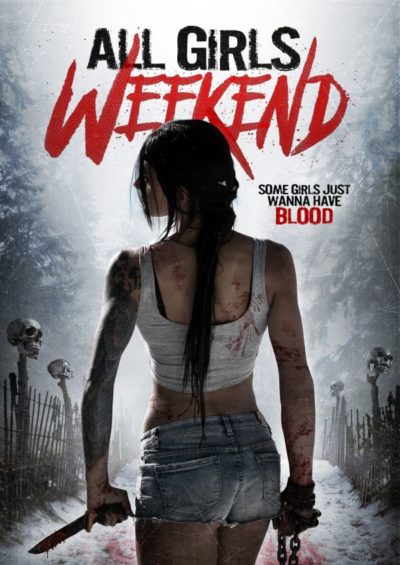
There’s something admirable about a film entirely cast with and directed by women, especially in such a generally male-dominated genre as horror. Unfortunately, all this effort really goes to prove, is that the fairer sex are every bit as capable of turning out uninteresting crap as any man. An ill-conceived cross between The Descent and The Blair Witch Project, this has four old school friends reuniting, along with the workmate of one of them, who tags along because… Well, as with so much in the movie, for no particularly good reason.  There’s friction between the friends, from the moment Nancy (Bernadette) shows up four hours late, forcing their departure to be pushed back.
But it’s when an innocent little pre-dinner hike is suggested that things truly go off the rails. For the workmate falls, and is impaled on… well, let’s be honest, and call it a twig. The party is unable to get out of the woods and find help, finding themselves perpetually going in circles. It’s almost as if the forest itself is trying to keep them from leaving. Turns out that’s exactly the case – not much of a spoiler this – for there was a mill there, which polluted the entire area, and unleashed a curse. Now, in order to regenerate, the earth spirit is now demanding blood sacrifices. So, before you can say, “Hang on – this doesn’t make much sense,” the party are being threatened in different, mostly fairly ludicrous ways. It’s almost like a live-action version of The Gashleycrumb Tinies: “N is for Nancy, pursued by a bear,” albeit where it’s abundantly apparent that Nancy and the bear were never simultaneously in the same zip-code.

Whoever designed the poster likely deserves some kind of award, for making the film look a hundred times more exciting than it is ever capable of delivering. The final 10 minutes can’t make up for the poor pacing and horribly talky nature of what has gone before, Simon appearing to have misheard the cardinal rule of cinema as, “Tell, don’t show.” Hence, we get an awful lot of scenes of exposition and unnecessary back-chat: I mean, do we really care that one of the girls used to be fat at high-school? Does it matter in the slightest? Meanwhile, seems like at least half the deaths take place off-screen, culminating in a staggering moment where it appears someone is found drowned in a pile of leaves. What? No, really: what? About the only positive to come out of this is Bernadette, who gives Nancy more of a character arc than everyone else in the film combined, her character turning a full 360-degrees over its course.

I guess we should at least be grateful that Simon did not make the obvious artistic decision and turn this into yet another “found footage” abomination. It’s one of the few things which would have made this more of a chore to watch.

Dir: Lou Simon
Star: Jamie Bernadette, Katie Carpenter, Gema Calero, Karishma Lakhani

Night of the Living Dead (1990)

★★★½
“Better head(-shot) than dead.”

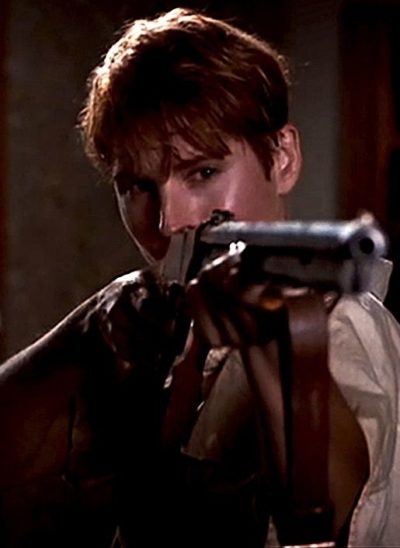
Important to note the year here, because the original Night of the Living Dead, for all its massive influence (without it, there’d be no The Walking Dead or World War Z) was very, very far from an action heroine film. Though it started off focusing on its female lead, Barbara, after she reaches sanctuary in the farmhouse, she spends virtually the rest of the movie in a near-catatonic state, and the film switches focus to Ben, who becomes the film’s hero. The change for this remake is one of a number of alterations, which are likely both necessary and helpful: when you are redoing a film widely regarded as a classic, you’d better bring something new to the party. That’s something largely forgotten by many horror remakes.
Even to non-horror fans, the plot likely doesn’t need much description. On a visit to her mother’s grave with her brother, Barbara (Tallman) finds herself the target for first one, then multiple, crazed attackers. She takes refuge nearby, along with others seeking shelter. They include Ben (Todd), a no-nonsense type, who repeatedly and at increasing volume crosses swords with Harry (Towles) over whether or not everyone would be better off sheltering in the cellar. As the zombie hordes congregate, various escape plans are formulated and tried – but tensions continue to rise, and the biggest threat to collective survival may not be the undead, banging on the doors.

Largely done for financial reasons – creator George A. Romero made very little from the original, despite its success – this works unexpectedly well. Right from the start, it adjusts the story in small ways that will surprise those familiar with the original, on its way to an ending which twists sharply away from the source, not once but twice. However, it’s the change in Barbara which probably represents the largest shift. Initially, it looks like she’s going the same route, and will spend much of the film suffering from shock. However, she snaps out of it, and rapidly becomes the most sensible member of the group: her suggestions are credible, and she doesn’t engage in the bickering which threatens to tear the group apart, instead firing back, “You can talk to me about ‘losing it’ when you stop screaming at each other like a bunch of two-year-olds.”

She’s well ahead of the curve in terms to figuring things out, too. Witness the scene where there’s still some uncertainty about what they’re facing: she fires several shots into a zombie’s body, asking repeatedly, “Is he dead?”, before finishing the creature off with the archetypal bullet to the brain. No further questions. At the end, while still having some moral qualms – “We’re them and they’re us” – she is capable of putting them aside, and become a bandolier-wearing bad-ass. In the event of a zombie apocalypse, this version of Barbara is one of the people you’d most want beside you; she’s smart, ruthless and takes absolutely no shit from anyone, human or zombie.

Dir: Tom Savini
Star: Patricia Tallman, Tony Todd, Tom Towles, McKee Anderson

The Monster

★★
“Less would be more.”

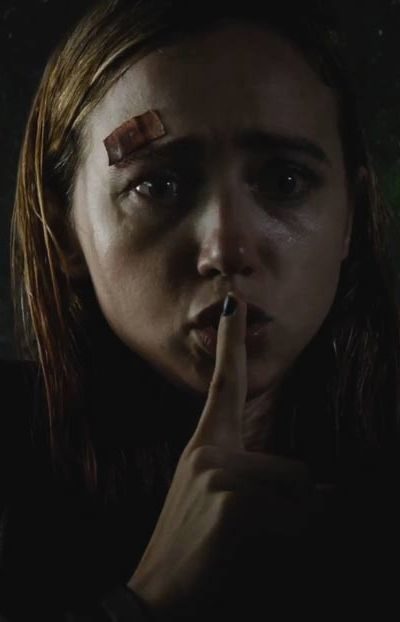
monsterThere is a time when a film-maker needs to fall out of love with their script, and approach the resulting movie with a cold, critical eye, analyzing every scene with a single question in mind: Is it essential to the story being told? And if the answer isn’t “Yes”, then the scene needs to be ruthlessly excised. If you don’t, then what results is this film, where a good idea, which could have been lean, mean survival horror at its most stripped-down, becomes instead a cumbersome exercise in social drama.

Single mother Kathy (Kazan) is driving teenage daughter Lizzy (Ballentine) to her father, when they hit a wolf that has run out into the middle of the road on a remote country stretch of highway. While injuries are relatively minor, the car is unable to continue, and they have to hang out and wait for a repair truck to show up. However, when it does, and the mechanic is at work beneath their vehicle, the wolf’s corpse vanishes. Lizzy tracks it down in the woods, only to discover it shows signs of having been eaten, leaving her and her mother to wonder: what was bad enough that it could make a wolf run? They’re about to meet the answer.

It’s all the film needs, and when it concentrates on this, Bertino (who directed above-average home-invasion film, The Strangers) crafts a taut, effective work, as mother and daughter have to put aside their differences in the name of fending off the creature. The problem is the film’s insistence on inserting entirely unnecessary flashback scenes. They’re unnecessary because the dysfunctional nature of Kathy is established perfectly well before they have even left the house; everything thereafter is superfluous, and had me suppressing an urge to yell, “Enough, already! We get it!” at the screen.

I also get that the creature is intended to be a metaphor – though whether it’s intended to represent Kathy’s addiction-affected personality or Lizzy’s issues with trust and abandonment, is likely open to discussion. Either way, the mother is the monster in this interpretation; but again, it’s the kind of thing which works best when left for the audience to figure out or not, offering bonus depth if you want it. Here, Bertino seems to prefer whacking the viewer over the head with his subtext, to the point I had to undergo concussion tests.

On the plus side, Ballentine makes for an engaging young heroine, and the monster was laudably done with practical effects rather than CGI; given the relatively small budget, it looks decent enough. If you liked The Babadook – and I wasn’t particularly impressed with that either – then you might look more kindly on this attempt to merge the cerebral and the visceral. Only the latter half worked for me, the former providing more of an annoying distraction than offering any enhancement to the story.

Dir: Bryan Bertino
Star: Zoe Kazan, Ella Ballentine