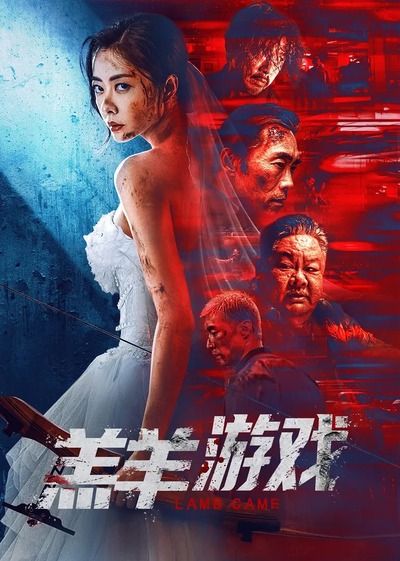
This kinda teetered on the edge of inclusion or not, for about 90% of the movie. The heroine is quite passive, and the action is largely handled by others. It’s still solidly entertaining, and is definitely upper-tier as Die Hard knockoffs go. But it didn’t have a sufficient action heroine quotient… until the very end. There, she finally gets her act together, and takes the fight to her opponents. Was it enough? I was still on the fence, until one bravura shot convinced me. It doesn’t necessarily make logical sense, sure. However, it was just so damn cool, I had no option but to stamp its card and allow the movie entrance through these hallowed portals.
It begins at a wedding, where Shirley (Hung) is about to get married. A gang of jewel thieves led by Di (Chan) shows up, and a firefight with the authorities breaks out. Her husband-to-be decides to have a go. It does not end well for him. A few years later, Shirley gets locked in the building where she works at an archery hall, during a typhoon. By chance, Di and his cronies are also there, working on another robbery. He’s not happy when he realizes Shirley has witnessed him killing his target, and sends his over-sexed brother and another minion to hunt her down. Fortunately for Shirley, another resident in the building is blind martial artist, Nan Ge (Cheng, who used to be married to Yukari Oshima).
This is supposed to be set in Hong Kong during the late nineties, not that any Western viewer could probably tell. But especially in the opening scene, at the wedding, it does feel like a throwback to the golden days of Hong Kong action cinema, before the British colony was handed back to the Chinese. There’s some glorious slo-mo, blood squibbing and gun-fu, that really had me thinking this might be an undiscovered gem. The rest can’t quite live up to the same, heady delights. Yet it’s still a nicely crafted piece of low-budget entertainment, with some particularly impressive photography, which seems to have strayed in from a much bigger production. The setting is cool too, although it appears nobody in Hong Kong has heard of “fire exits”.
Shirley does spend most of the early going running and hiding, with the most memorable bit of violence an encounter with a protruding nail. Eventually, though, Nan Ge is no longer around to protect her, because… of reasons, and she has to fend for herself. Shirley’s employment might be a factor there. It’s a shame, from our perspective, this took so long to show up, since there’s potential for a lot more. To be clear, I was still enjoying proceedings – just on a non-GWG level. When “Action Shirley’ finally does appear, it’s more like dessert than the main course. Go in with that as your expectation, and you should still find yourself enjoying the meal.
Dir: Huang Yi Star: Lynn Hung, Ricky Chan, Mark Cheng, Zhao Jing Shu Yu
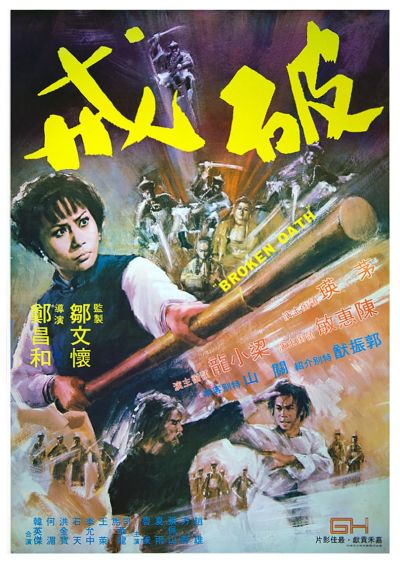
I guess, the old saying “just there for Godzilla” definitely applies to me. This movie is far from perfect, but as long as I see some skilled fighters in fancy costumes battling it out, I’m in. Additional points are given if the respective dub is at least tolerable. Broken Oath is actually an interesting movie. It is kind of a remake of Japanese classic Lady Snowblood with Meiko Kaji from 1973. The difference is that this Golden Harvest production, from producer Raymond Chow, stars Angela Mao.
She was probably the biggest female martial arts star at the time in Asian movies and had the status of a female Bruce Lee. She had starred with Lee in Enter the Dragon and one-time James Bond George Lazenby in two other movies, and also worked with classic directors like Chang Cheh and King Hu. Some of her famous films include Lady Whirlwind, When Taekwondo Strikes, Hapkido, The Fate of Lee Khan and many others. In the seventies. she could hardly walk down a street without being instantly recognized.
Broken Oath was to be her last movie for Golden Harvest which is quite inexplicable because she was a major star – did they let her go or was that her own decision? After that, she began working in Taiwanese movies with obviously lesser budgets. She lasted in movies for quite some time until the early 90s when she retired from film business. In a way it’s a pity that her golden era more or less ended in the 1970s, considering the success stars such as Michelle Yeoh, Jackie Chan, Jet Li or Donnie Yen would later enjoy – and continue to do so – in the West.
Broken Oath follows the story beats of Lady Snowblood quite closely – until it slowly becomes its own thing. It’s comparable to how Temptress of a Thousand Faces freely emulated the French Fantomas movies of the sixties. Like the Japanese original, it starts with a woman sent to prison where she gives birth to a child. On her death-bed she reveals her story of how her husband, General Liu, was killed by a gang of hoodlums; after resisting a rape attempt by one of them, she was sent to prison because the police didn’t believe her.
She gives birth to a girl and asks her “sisters” (inmates) to take care of the child, and to raise it to take revenge for the death of her parents. Instead, one of them, subsequently referred to as the girl’s godmother, gives her to a Buddhist nunnery with the blessings of the abbess who doesn’t think that the cycle of violence should continue. In the English dub, the little girl is called “Lotus”; the subtitles call her Jie Lian, though her original name was Xiao Mei. In any case, she has violent tendencies, though for some unspecified reason these Buddhist scholars are constantly fighting when not listening to the wisdom of Buddha. Lotus ends up killing three drifters in the wood when they try to rape her.
As she has “broken her oath” (to Buddha, I guess), she has to leave the nunnery and goes to live with her godmother, from whom she learns how to become a pickpocket and gets to know her friend and colleague Ah Shu. From there on, the movie loses connection to the original movie which I see as a good thing. Jie Lian finds the murderers, though the plot is essentially hardly more than the bones of a story, rather than a fully fleshed-out narrative. It unnecessarily complicates itself with the introduction of new characters and side-stories, but in the end the overall simplicity is indeed for the better of the movie.
For some time, I wondered if this movie was really worth my attention: I just wanted to see Angela Mao show me how hard and high she could kick. Fortunately, the film didn’t let me down. But it has to be said, it needed more than half of the movie until the whole martial arts machinery kicked – as it were! – into high gear. After being saved by an old, wise man named Qi Feng from the poisonous dust of one opponent. and his subsequent death at the hands of uber-villain Zhao Cai (both took part in the raid on Jie Lian’s parents, with Qi Feng now getting redemption by saving Lotus), things escalated quite quickly.
I have to say, I personally still prefer the melancholic elegiac beauty of Lady Snowblood and Meiko Kaji’s unmistakable charisma (I’m aware that Jim gave that movie a low rating, but for me that Japanese chanbara movie is an absolute high-ranking classic. To each their own, as they say), but the sheer number of ideas that this movie here bombards you with is remarkable. Let’s see… Steel claws as weapons; a liquid, one villain uses to spit fire and burn his victims to death; blades on a string used like a yo-yo. by an opponent played by Sammo Hung; a hat that goes over the whole head of Master Yun (later revealed to be Zhao Cai); sword fights; butterfly needles; group attacks, attack scorpions; and secret passages through stone caves hidden behind book shelves.
Really, the last 30-40 minutes of this go like gangbusters! I only wish the first half of the movie would have been like that, too. Granted, a story needs time to be built up, but let’s be honest: there is not much of a story here. Just the outspoken will for revenge, and that only happens after the godmother tells Lotus about her past. It is revealed at the end that the villains had planned to overthrow the government 20 years ago; General Liu discovered their treachery and was therefore killed. Better a good reason late than never, I guess. These things can’t quite disguise some carelessness in the story-development.
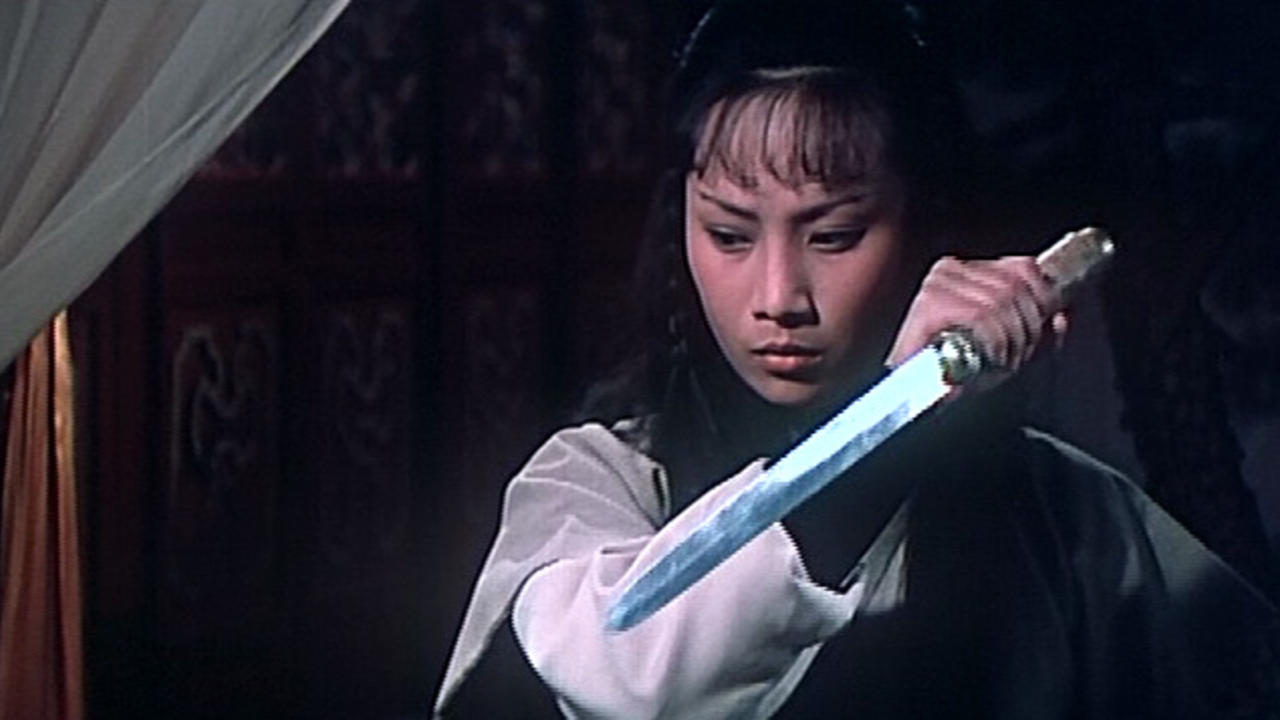
For example, Ah Shu seemed to be built up as a love interest. But he is killed off in a way, as well as the heroine’s reaction to it, which is so casual I wondered why he was even in the story. There is another character supposedly killed – silly me, believing that – who is suddenly back there to support the combatants in their fight again. The whole “she is poisoned and has to be cured” episode feels like a pointless story element, with no good reason except for extending the movie’s run time (admittedly I saw the theatrical version at 98 minutes; there is an extended version around 5 minutes longer), and giving Mao the chance to lay down and take a short break.
The actors here… well, they are Chinese actors in seventies wuxia and act accordingly. One shouldn’t expect Oscar-worthy performances here. The evil villains are evil and the rest of the actors hardly make much of an impression. Angela Mao is adequate as expected, though of course I’m more interested in her fighting skills than her acting talents. She moves elegantly and swiftly and I do believe she can fight off and kill more than half a dozen men, attacking her all at once. She is great “hero material”, and I applaud every action of hers. But I can hardly detect any burning pain underneath, or an insatiably hot appetite for revenge. Comparing that with the painful, tragic, almost longing for death portrayal of Kaji might be unjust. But it is also inevitable.
Of course, the dubbing doesn’t help. Yes, one should see movies like this in the original language version with subtitles, but I prefer a dub when I can get one. I don’t know from when this one comes (possibly the movie’s release in 1977), but the performances aren’t Anthony Hopkins and Jodie Foster acting, to say the least. I’m just happy to get lip-synched dialogue. It mostly plays inside buildings, temples or halls, giving the impression this is first and foremost a studio production. There are only a few scenes on location, though these are nice to look at. While I don’t rank the movie lower for it, I liked the beautiful, natural surroundings of Lady Snowblood much more. It’s just a matter of taste.
That said, as a whole I liked the production design, which makes you feel that the movie’s budget went into it, along with the historical Chinese costumes and some effects. It’s in contrast to Mao’s later Taiwanese films, where I can confirm she was working on a notably lower quality standard. This movie definitely has its qualities. As an old saying (incorrectly attributed to Oscar Wilde) goes: “Imitation is the sincerest form of flattery”. This might be true not only for Lady Snowblood, which Quentin Tarantino paid tribute to in Kill Bill – Vol. 1, but also for Broken Oath, as the fight between Sammo Hung and Angela Mao is definitely mirrored in the one between Chiaki Kuriyama and Uma Thurman.
I would have sworn I had seen every example of Hong Kong girls-with-guns movies from the eighties. But this one had managed to escape my attention completely for 35 years, until accidentally stumbling across it on YouTube. It’s perhaps partly because it never seems to have received any kind of post-VHS release, being unavailable on DVD or streaming sites. Which is a little surprising since it combines two genres that have been quite popular in the West: not just GWG, but also hopping vampires, as in the Mr. Vampire franchise. It’s a rather awkward combo, and there’s definitely significant potential wasted. Yet I’m fairly certain it’s going to be unlike anything you’ve seen before.
It begins with a gang robbing a mausoleum of antiques for their boss, Yiang Wei (Wei). However, included in their haul is a pearl, which was the only thing keeping a traditional Chinese vampire (Kwai) pinned down. It’s now free to roam the land, terrorizing the possessor of the pearl, who is the only person that can see it. Meanwhile, a special police squad has been set up to investigate the ring behind the recent slew of antique thefts. In charge of it is Sergeant Wang Wai Shan (Hu), who follows the evidence to Wei, after one of his minions turns up dead, a victim of the vampire. Wang and her mostly-female team then find themselves having to take on both the hopping undead and the criminals.
The results are kinda decent, but it’s not hard to think of ways it could have been better, particularly from the perspective of this site. I was expecting to get a final battle pitting Wang against Wei. Doesn’t happen. I did like how the cops find a way to control the vampire, and I was thinking it was then going to end up as Wang + vampire against Wei. Doesn’t happen either, with Wang entirely sidelined, and replaced with a climax which is simply villain versus vampire (before an ending which is… certainly an ending, and that’s all I can say). Hu deserves better, and so does Sophia Crawford, who is one of Wei’s minions, and gets almost nothing to do. Admittedly, it was only Crawford’s second film.
Not to say that Wei is a slouch. I simply preferred earlier scenes, such as Wang and her squad battling the largely invisible vampire around her father’s apartment, with a range of improvised weapons, from crosses – would those really work on a Chinese vampire? – to flamethrowers. It’s fairly refreshing how nobody really mentions the fact a woman is in charge, with everyone apparently accepting Wang’s role, and there’s not too much in the way of dumb slapstick, which can derail proceedings. As horror, it’s certainly light in tone. Perhaps it might have benefited from sticking to one genre or the other, instead of trying to be two things at once, and coming in as largely forgettable in both departments.
Dir: Chiu-Jun Lee Star: Sibelle Hu, Dick Wei, Kara Ying, Kwai Po Chun
This was originally titled after its heroine, but since that obviously wouldn’t work in the West, it was changed to become about as generic a title as you could get. Behind this is a decent little flick, which is also worthy of note, because it may be the first Shaw Brothers action film to be directed by a woman. Pao-Shu Kao had been an actress with the studio since 1958, but this ended up being her sole movie as director for Shaw, as she started her own company, Park Films, with her husband. But this, her debut, is the highest-rated on the IMDb of the eleven features she helmed, at a respectable 6.8.
The heroine is Feng Fei Fei (Ho), who gets distressing news when her nephew, Hu Tou (Meng) shows up. He narrowly escaped with his young life after he and his mother, Fei Fei’s sister, were set upon by brigands, with Mom being killed. Fei Fei isn’t having that, so immediately sets out to take revenge on those responsible. She tracks down the first one, but this is where things get awkward. Because it turns out he’s Chin Lien Pai (Nam), the scion of a family friend, and worse, is the person to whom Fei Fei has been betrothed since they were young. While it’s a bit vague on the details, I guess vengeance would bring dishonour to her relations. Or, at least, make subsequent family get-togethers more than a little uncomfortable.
The first half-hour of this is really good, likely peaking with a hellacious fight at a brothel, where Fei Fei takes on what appears to be the entire population of China. It’s also notable, because next door, Hu Tou is also fighting, and it’s quite impressive too. East Asian films, be they Chinese, Taiwanese or from Hong Kong tend to use kids as comic relief, and the results tend to be grating and irritating. Not so here, with Hu Tou taken seriously, and allowed to take part in battles that work because he uses quickness and agility, not strength. But it is mostly Ho’s film and she gets a slew of solid fights, including against her fiancé’s mother, defending her son.
Unfortunately, after the brothel brawl, the film does tend to become a bit chatty and, worse, spends too much time on Chin and the other bad guys. It may be an attempt by Kao to deepen the portrayal of the villains beyond the shallow. However, guess what? I don’t care. The original attack firmly cements them as murderous scum-bags who deserve to die, and nothing is going to change my mind on this, thank you very much. The only interesting section sees Chin’s parents sharply differ in reaction to their son’s crimes: Dad thinks it brings shame on the family, Mum (as noted above), not so much. Fortunately, the ending gets back to the fighting, though it’s disappointing how Fei Fei needs help. Entertaining enough, yet after how if began, it seems a lost opportunity.
I’m just going to begin by quoting the opening credit titles. Spelling, grammar and punctuation as received. “At the early stage of Republic of China, Yuan Hsi Hai wanted to rebel the democratic government & be the king. But there were 300,000 soldiers at Yuan Wan under the command of General Tsai obstructed his desire, so he cheated General Tsai to Peking & confined his movements. So Yuan who lived in Chu Jen Hall could fulfil his ambition but…” I reproduce this because, to a large extent, that’s everything I’ve got in terms of the over-arching plot here. It’s all about Tsai (Kwan) getting out of the city, in order to lead his troops and, presumably, frustrate Yuan’s dictatorial ambitions.
Key to this is Peking Opera star Hsiao Yu (Lee), who is hired by Yuan’s men to keep an eye on the General. However, she’s not as loyal as her employer would hope, and she gradually becomes attached to and involved with Tsai. This eventually results in her helping him to escape the house arrest under which he has been placed. I believe this to be true with… let’s say 90% confidence. There does appear to be other stuff going on: none of it is able to make it through the terrible presentation, and out the other side, to provide details which I prepared to commit to the keyboard. It’s kinda clear why Lee’s Queen Boxer made it out in the West, and this didn’t, even though both were made around the same time.
This did rather well at Taiwan’s 1973 Golden Horse awards, winning Best Film, Leading Actor, Screenplay and a special award for “Outstanding Performance” going to Lee (she lost Best Leading Actress to Hsiao-Lao Lin in A Heroic Fight). All I can say is, it must have been a very slow year in cinema, for this largely plodding and uninteresting history-political drama to have triumphed. Though, again, the presentation does it no justice. For example, there’s one scene where Tsai is repeatedly writing something in large letters on paper. It’s clearly very important to him. Unfortunately, the subtitles – as ever, intended for a Chinese audience, not a Western one – don’t bother to translate it. So its significance is entirely lost.
Lee is about the only reason to watch this, and the film definitely goes up a gear whenever she’s on screen. Her background actually was in the Peking Opera, making this right in her wheel-house. The director – and some sources also credit both Kwan and Florence Yu Fung-Chi – wisely lets her talent shine through, and it’s a no-nonsense approach that works. Witness, for example, the casual way, she shoves a victim out of the way with her feet, after crushing his larynx. But one of the problems is, I honestly couldn’t tell you who’s she’s fighting at the end, or why, since the General has already escaped. It’s just another element lost in translation here, like so many others, and leaves this an underwhelming entity, in the only form available.
Dir: Min-Hsiung Wu Star: Judy Lee, Peter Yang Kwan, Lee Hung, Cheung Kwong-Chiu
★★★★½
“A thinly connected series of action set-pieces…but what set-pieces!”
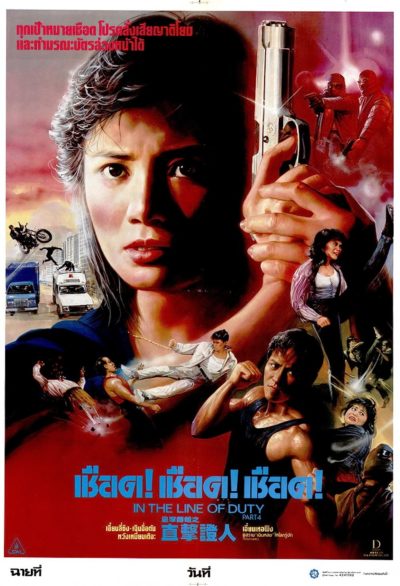
Back in the early nineties, I saw a double-bill of this and Jackie Chan’s Police Story at the late, lamented Scala Cinema in London, and it blew my mind. I had literally never seen anything like them before. The only martial arts movies I’d watched previously were crappy American ones, which made little or no impression. That afternoon changed my life, and awakened a love of the genre that persists to this day. But would In the Line of Duty 4 stand the test of time? There are certainly movies I loved from the same era, which are now a bit cringe, to put it mildly. So it was with some trepidation that I hit play…
Nope, it’s still goddamn awesome. Sure, it’s a bit rough around the edges, and both the plot and performances are little more than means to an end. But the end justifies the means, 100%. I can’t remember the last time a film provoked so many exclamations from me. It felt like every other scene, there’d be another terrific feat of physical prowess, agility or simply endurance. It’s amazing to see Donnie Yen, then a young, skinny and rough-edged twentysomething, but clearly with raw talent in spades. It took almost thirty-five years for him to get the recognition he deserved, with his co-starring role in John Wick 4.
According to another review, 42 of the film’s 93 minutes are action. Reading this, my immediate reaction was, “That little?” Because it feels like it’s almost a non-stop procession of set-pieces, a highlight reel in feature form. It’s not just hand-to-hand combat either. There are some great vehicular stunts, such as a motorcycle chase, or a fabulous battle in, on and around an ambulance. It’s clear that we really have Cynthia Khan dangling off the front of the vehicle, in a way that looks genuinely dangerous, and quite probably was [the eighties in Hong Kong cinema wasn’t exactly a poster-child for health and safety!] I do wish they hadn’t undercranked some sequences; they’re impressive enough they don’t need to be sped-up.
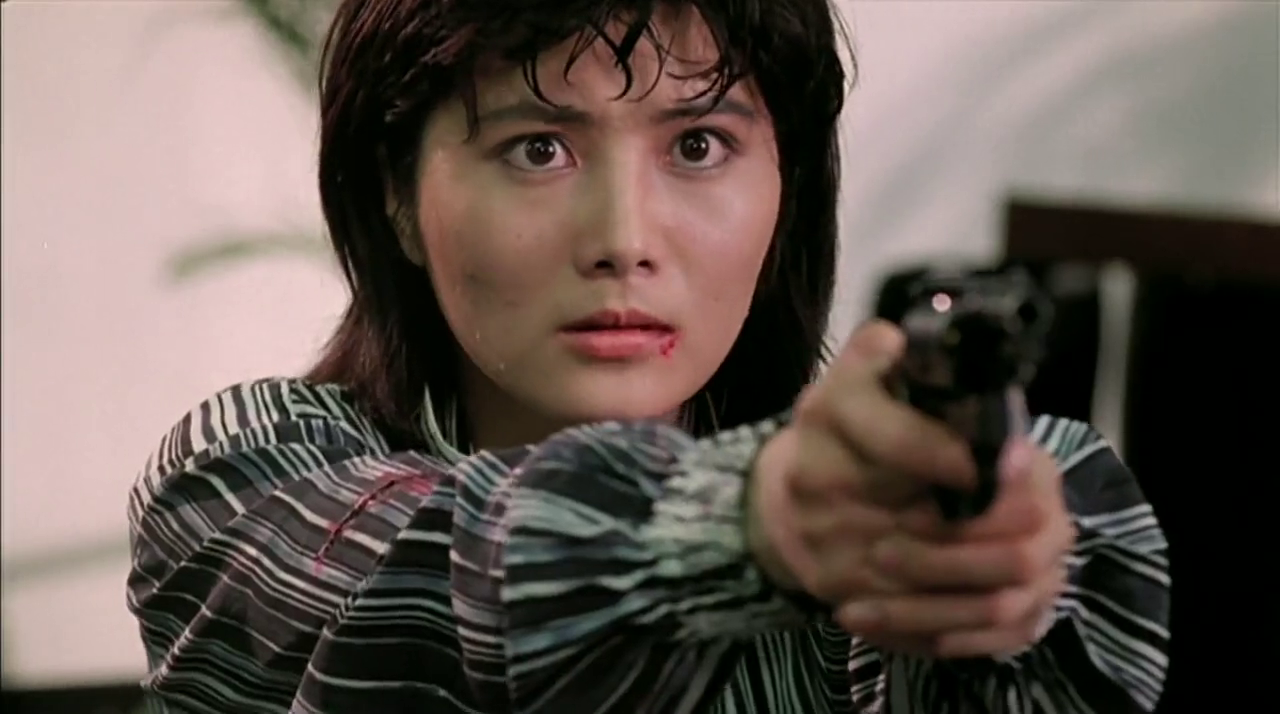
For when all is said and done, the fights are flat-out awesome. It’s not just Khan and Yen, though they obviously get most to do. Everyone here is well up to the task, both showing off their own stuff and letting the stars look good by selling for them. On the female front, I want to give special praise to Farlie Ruth Kordica, who fights Cynthia around a lift-shaft in another sequence which feels disturbingly life-threatening. She only appeared in a couple of other films, which feels like a real shame, based on her performance here. It’s a wonderfully inventive scene (bottom), taking full advantage of the potential in the environment.
There is a case to be made that Yen is the star here, above Khan. The end caption doesn’t even mention her character, Insp. Yeung Lai-Ching, though Khan definitely is not outclassed. But Lai-Ching is the film’s emotional heart, always intent on doing the morally ‘right’ thing, even if it’s not in line with the law. She is the Jiminy Cricket, trying to keep Donnie’s loose cannon in check, while also trying to figure out who’s the mole in her department. The story, incidentally, has aged well: the CIA openly dealing drugs in order to fund Latin American rebels? That’s not something you would expect to see in an American film from that time, the whole Iran-Contra thing being seen as a bit of an embarrassment. Fittingly, it is Khan’s character who delivers the final blow to this Yankee scheme, falling to its doom and taking the American flag with it.
I will admit that the soundtrack is underwhelming: despite two credited composers, it feels like stock tracks pulled at random from the library. There are also times when the plot logic is less than logical, with bad guys and good guys popping up in convenient places for the next showdown, with little or no explanation. Yet this hardly dampens things, because: yep, means to an end. The eighties was an amazing decade for action cinema, from The Empire Strikes Back, through The Terminator, Aliens and Die Hard. I can honestly say that In the Line of Duty 4 deserves to be ranked among those, and remains one of the best examples of Hong Kong cinema, doing what it does best.
[Original review] I don’t think I’ve ever seen a HK film with more action; it seems that every five minutes, along comes another breathtaking fight or stunt sequence. Of course, when you have a master at the helm (Yuen did the fights for The Matrix), you expect a little more, but this is fabulous, even by his standards.
Donnie Yen is perhaps the most under-rated martial artist of our generation, and watching him here, it’s hard to see why he hasn’t become a major star, rather than lurking in (effective) supporting roles in Blade 2 and Highlander: Endgame. For speed, agility and skill, his fights are almost without equal, and most female co-stars would be overshadowed. Fortunately, Cynthia Khan, though occasionally clearly doubled, does more than enough to keep on the same lap – the fight atop, alongside, and dangling from the front of, a speeding ambulance is eyepoppingly extreme, while her aerial battle around a lift shaft is also worthy of mention.
The story is clearly secondary to all this, but for the record, Khan and Yen are cops, one from Hong Kong, one from America, who team up to find a witness to a murder. Double-dealing and twists abound, though most are so obvious, you suspect they were just waiting for cast members to get out of hospital. :-) Interesting to see a foreign view of American cops – even Yen is a barely-controlled psychonaut. Khan is more sympathetic, but characterisation never goes beyond the most basic. However, this is an action movie, and as such, it’s near-perfect, with invention, energy and hardcore guts to spare from all concerned.
Dir: Yuen Wo-Ping Star: Cynthia Khan, Donnie Yen, Michael Wong, Yuen Yat Choh
This opens with a scene that is almost a direct life from the similarly titled Eye for An Eye, directed by John Schlesinger four years previously. Here, businesswoman Carmen Pak (Cheong) is on a video-call – or, at least, the primitive 2000 version thereof – with her daughter, Shan (Tong), when someone breaks in and attacks Shan. Carmen can do little except watch in horror as her daughter is brutalized and raped. Though Shan identifies her rapist as Kiu Chi Yeung (Tong), there’s enough doubt over her statement, specifically regarding a tattoo he does not posses, that the police are unable to do anything. After further tragedy, Carmen decides to seek the justice she has been denied, through her own hands.
To this movie’s mild credit, it does divert from its American predecessor after the opening sequence, though this never manages to find its own identity entirely. It’s based on a rather shaky premise: namely that someone accused of rape would then, almost without hesitation, embark on a relationship with his accuser’s mother. It’s not even as if Yeung doesn’t know who Carmen is, which could have given the concept a sheen of plausibility. She’s right there when Shan physically attacks him after they both leave the police station. The script tries to walk a line of uncertainty as to whether or not Shan is guilty, though not particularly successfully. If you can’t figure out who was the perpetrator before the final confrontation, you haven’t been paying enough attention.
I did like the supporting character of Officer Chan (Ko), who initially comes off as a bit of a callous jerk, caring more about his mahjong losses than the rape case he’s investigating. However, he becomes more sympathetic as things unfold, being more a harried and overworked cop, who still tries to warn Carmen into taking care of things herself. It’s likely a better arc than the heroine gets, her development being largely summarized in a training montage where she hides a knife in the sofa, and uses it to attack innocent watermelons. It’s a curiously specific bit of practice, one made all the more odd by having little or no relevance down the road. She’s no more than semi-competent in terms of self-defense.
The same grade likely applies to the film-making on view as a whole. I can’t point to any elements that are especially deficient. Yet even less can I point to any elements which demonstrate innovation or even artistry. Everything plods along in workmanlike fashion, towards an ending that offers no particular surprises or thrills. Considering the subject matter, it’s surprisingly tame as exploitation, and would barely seem out of place as a Lifetime original movie. I was left yearning for the lurid excess of someone like Wong Jing to inject some pep into proceedings. We are, after all, talking about an anti-rapist vigilante here. This feels more like Carmen is fighting white-collar crime of some kind.
If the title is more than a bit blunt, it’s certainly accurate. May Lin (Cheng) is a brash hooker, who runs a sideline in blackmail videos with her flatmate, Nana. But one night she comes home to find Nana near death, the victim of a brutal client. She tells the police about the video, but before she can give it to them, the perpetrator – rich and influential politician, Kao Tien Chin (Cho) – sends an army of beige trenchcoat wearing killers to take care of both Nana and May. The former succumbs, but the latter escapes and goes on the run. With the police force apparently leaking like a sieve and the case being shut down from on high, prosecutor Yin Li Shan sends his niece, Nancy Cheng (Mishiwaki), to link up with May and bring her in. But they’ll have to get past the trenchcoat mafia, among other threats, for there to be any hope of justice.
This is relatively late in the Hong Kong GWG cycle, and is rougher than most, in more ways than one. There is a nice character arc for May, who initially seems intensely dislikeable, but ends up fiercely loyal to her protector, after realizing the extent to which Nancy will go – literally taking a bullet for the prostitute. This is harshly demonstrated when May lets herself be gang-raped, to save the injured Nancy from that fate. While not in any way explicit, it’s a tough sequence to watch, May mouthing “Go away” to Nancy. Of course, there’s the usual bonding in the middle between the mismatched pair, as they realize neither deserves the scorn with which they view each other.
The plot is more than a little flimsy, with any number of points at which things could easily have been resolved. There are some remarkable moments of coincidence too. For instance, after escaping the trenchcoaters (in a rather risky-looking stunt, involving a plummeting jeep and a giant fireball), seconds later in screen time, May and Nancy bump into them again at a train station. Similarly, the rapists are coincidentally re-encountered, giving our heroines the opportunity for revenge. However, in both cases, the results are a solid bit of one versus many action, in the interesting environments of a train carriage and a food court respectively, so we’ll let it slip.
I do wonder if Nishiwaki was injured during shooting. Because when it comes to the final confrontation, at a party in Chin’s offices, Nancy is replaced by another character for the last battle, without explanation. It’s not a stand-in, it’s a completely different actress in a separate, unnamed role. Very bizarre. This may also have been the final movie of Nishiwaki’s Hong Kong career, which would lend support to the “major injury” theory. All told, this is decent enough. Not all of it works (though the crappy English sub job doesn’t help), yet a sufficient quantity does, and with acceptable pacing to ensure the viewer is never bored, at least for too long.
Dir: Kuo-Chu Huang Star: Yim Lai Cheng, Michiko Nishiwaki, Hoi-San Kwan, Charlie Cho
I kept moving between 2½ and 3 stars for this. It is pretty chatty, and the focus is not as much on the title character as I might have hoped. But there’s no denying that Leng (Shi) is a very solid character, and when she gets her chances to shine, does so in a memorable fashion. This is nowhere better illustrated than her final battle, where she takes on an enemy – who just tried to molest Leng, believing her drugged – while they both balance on a tight-rope. There’s no particular reason for the fight to take place in such an environment. The ground would have been perfectly fine. But it adds an extra dimension, and the way it’s filmed makes it feel surprisingly possible that they were wobbling about up there.
To get there is, however, quite a process. There’s a rapist going about China, but when he eventually escalates to murdering the concubine of a high official, something must be done. That something is Leng, a smart and persistent officer of the law. However, the real rapist, Chen (Shek), and his rich father frame Jiao (Lo) for the crime; he flees, with Leng in pursuit. The Chens seek to make sure Jiao can’t testify. They also seek to sideline and silence an incriminating witness – a blind man who can identify the rapist by his voice. As a result, he could both exonerate Jiao and pin blame on the real culprit.
Once this gets going, it is, however, mostly a pursuit, with Leng tracking Jiao across the countryside. The best sequence likely has him hiding out in a palace whose owner has a massive harem of Warrior concubines. They’re… quite pleased by Jiao’s arrival, but their owner refuses to help Leng in her quest, unless she can defeat the entire harem. It’s a nicely staged sequence, which must have required Shaw Brothers to hire just about every woman at the time in Hong Kong, who knew how to operate the business end of a sword. On the other hand, Lo is top-billed for a reason, and definitely gets a good slab of screen time, despite the title of the movie.
There’s even a prologue where we discover the same men who framed him was responsible for the death of his father, and the child Jiao was only saved by the intervention of the child Leng. This doesn’t add much to proceedings, and can safely be ignored. The same goes for Jiao’s secret mastery of the Flaming Daggers technique: demonstrated, the completely forgotten. I’d rather have seen the time used to develop Leng’s story, such as the intriguing relationship with her white eyebrowed, Taoist mother. Shih apparently took over at Shaw Brothers as their star, after Cheng Pei Pei moved to California in the early seventies. This, which I’ve read sat on the shelf for several years, is the first film of hers I’ve seen (outside of bizarre Shaw/Hammer co-production, The Legend of the 7 Golden Vampires). However, there was enough here to make me interested in finding some of her other work.
Dir: Siu Wing Star: Shih Szu, Lo Lieh, Chang Pei-Shan, Dean Shek
A court official is killed by the emperor’s minion, Jin Gang-feng (Lo), after discovering evidence linking the monarch to a recent slew of terrorist attacks involving the feared “flying guillotine”. His wife, Rong Qiu-yan (Ping), was out of the house at the time, and is forced to flee for her life. Jin knows that he can’t let the emperor know there was a survivor, and his hunt for her has to remain low-profile, so he sends his three children out after Qui-Yan. However, their target is a renowned martial artist in her own right, and is able to fend off their attacks, with the help of a student who learned under the same master, Wang-jun (Yueh), and a former member of the flying guillotines, Ma Seng (Chu). Eventually, Jin decides that if a job’s worth doing, you need to do it yourself. Though there’s one further threat to Qiu-yan, coming from an unexpected quarter.
This all unfolds at a brisk pace over 80 minutes, with plenty of action – there’s a fight-scene about every 5-10 minutes. These are mostly pretty good, even if Chen is probably the least effective fighter on display here. Her background is more in adult fare than martial arts, and though she remains fully-dressed here, Jin’s daughter does do a bit of topless martial arts in pursuit of her target. So there’s that… The makers do a good job at disguising any shortcomings, and we also need to cut her character some slack, since she’s supposed to be several months pregnant! On that basis, any activity more energetic than sedately climbing a set of stairs should probably be admired.
Though despite the title, Qiu-yan is really not all that “vengeful”. Although she certainly kills a lot of people, they’re almost entirely dispatched in self-defense after they attack her, with Jin likely the only true qualifier in that category. The number and styles of weapons on view is impressive, each character having a favourite. Of course, the flying guillotine – which does what it sounds like it does – is a stand-out, but I also have to mention Ma’s ability with crockery, presumably a skill picked up during his time as an assassin for the emperor. I’m a bit surprised his character didn’t get a spin-off film, potentially entitled Master of the Flying Bowl Movement.
While there is at least one twist along the way, it ends up as you’d expect, with Qiu-yan facing off against the man responsible for the death of her husband. Though in another imaginative element, she has to find the right person to kill, first fighting her way through an army of doubles wearing Jin masks. This is the kind of element which sustains the film, even if the heroine’s fights are short of what the likes of Angela Mao were providing around the same time. It’s currently available on Amazon Prime in a nice, widescreen print that is definitely the way to go, and despite its age, offers a very acceptable amount of entertainment value.
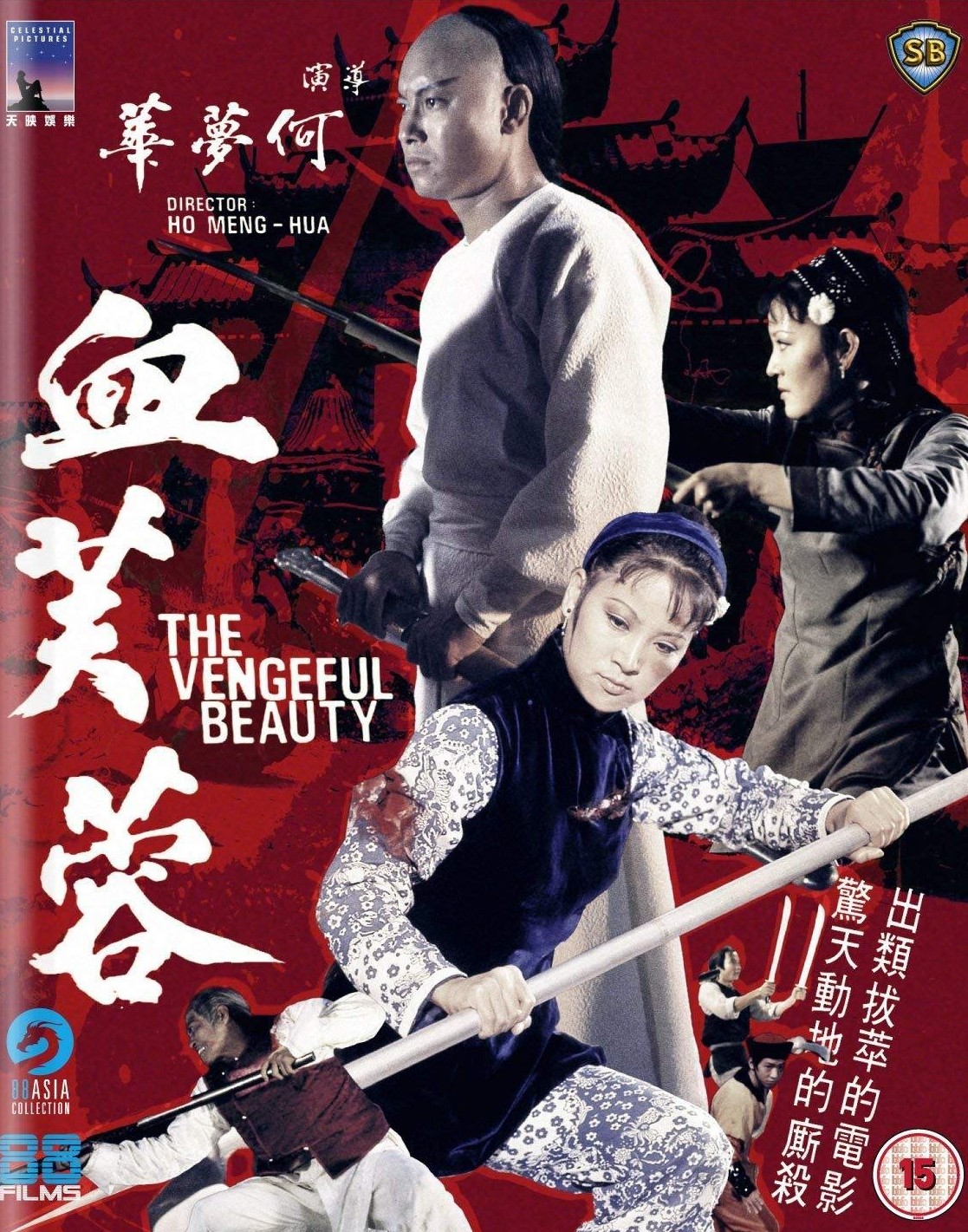
Dir: Meng Hua Ho Star: Chen Ping, Norman Chui, Hua Yueh, Lieh Lo




 This kinda teetered on the edge of inclusion or not, for about 90% of the movie. The heroine is quite passive, and the action is largely handled by others. It’s still solidly entertaining, and is definitely upper-tier as Die Hard knockoffs go. But it didn’t have a sufficient action heroine quotient… until the very end. There, she finally gets her act together, and takes the fight to her opponents. Was it enough? I was still on the fence, until one bravura shot convinced me. It doesn’t necessarily make logical sense, sure. However, it was just so damn cool, I had no option but to stamp its card and allow the movie entrance through these hallowed portals.
 I guess, the old saying “just there for Godzilla” definitely applies to me. This movie is far from perfect, but as long as I see some skilled fighters in fancy costumes battling it out, I’m in. Additional points are given if the respective dub is at least tolerable. Broken Oath is actually an interesting movie. It is kind of a remake of Japanese classic
  Broken Oath follows the story beats of Lady Snowblood quite closely – until it slowly becomes its own thing. It’s comparable to how
  For example, Ah Shu seemed to be built up as a love interest. But he is killed off in a way, as well as the heroine’s reaction to it, which is so casual I wondered why he was even in the story. There is another character supposedly killed – silly me, believing that – who is suddenly back there to support the combatants in their fight again. The whole “she is poisoned and has to be cured” episode feels like a pointless story element, with no good reason except for extending the movie’s run time (admittedly I saw the theatrical version at 98 minutes; there is an extended version around 5 minutes longer), and giving Mao the chance to lay down and take a short break.
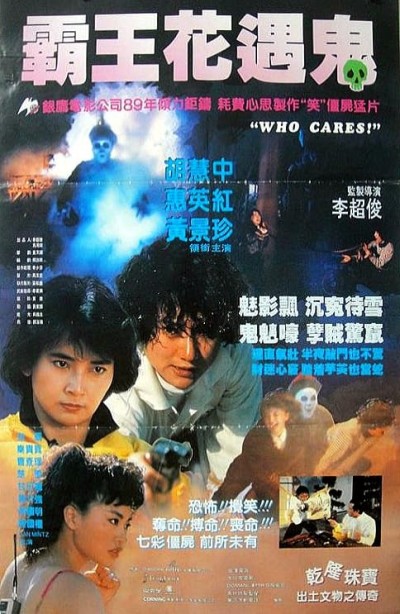 I would have sworn I had seen every example of Hong Kong girls-with-guns movies from the eighties. But this one had managed to escape my attention completely for 35 years, until accidentally stumbling across it on YouTube. It’s perhaps partly because it never seems to have received any kind of post-VHS release, being unavailable on DVD or streaming sites. Which is a little surprising since it combines two genres that have been quite popular in the West: not just GWG, but also hopping vampires, as in the Mr. Vampire franchise. It’s a rather awkward combo, and there’s definitely significant potential wasted. Yet I’m fairly certain it’s going to be unlike anything you’ve seen before.
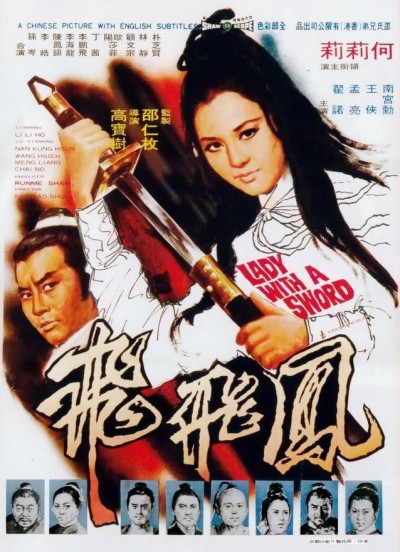 This was originally titled after its heroine, but since that obviously wouldn’t work in the West, it was changed to become about as generic a title as you could get. Behind this is a decent little flick, which is also worthy of note, because it may be the first Shaw Brothers action film to be directed by a woman. Pao-Shu Kao had been an actress with the studio since 1958, but this ended up being her sole movie as director for Shaw, as she started her own company, Park Films, with her husband. But this, her debut, is the highest-rated on the IMDb of the eleven features she helmed, at a respectable 6.8.
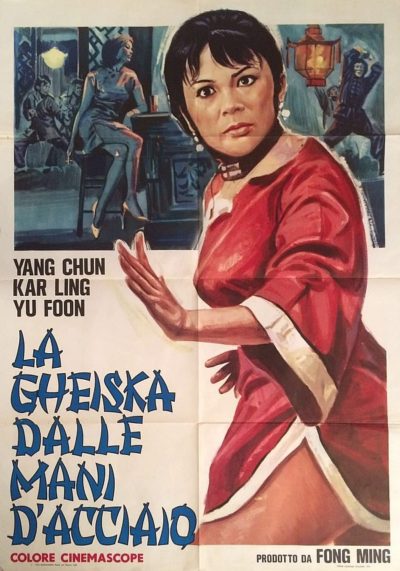 I’m just going to begin by quoting the opening credit titles. Spelling, grammar and punctuation as received. “At the early stage of Republic of China, Yuan Hsi Hai wanted to rebel the democratic government & be the king. But there were 300,000 soldiers at Yuan Wan under the command of General Tsai obstructed his desire, so he cheated General Tsai to Peking & confined his movements. So Yuan who lived in Chu Jen Hall could fulfil his ambition but…” I reproduce this because, to a large extent, that’s everything I’ve got in terms of the over-arching plot here. It’s all about Tsai (Kwan) getting out of the city, in order to lead his troops and, presumably, frustrate Yuan’s dictatorial ambitions.
 ★★★★½
★★★★½ Back in the early nineties, I saw a double-bill of this and Jackie Chan’s Police Story at the late, lamented Scala Cinema in London, and it blew my mind. I had literally never seen anything like them before. The only martial arts movies I’d watched previously were crappy American ones, which made little or no impression. That afternoon changed my life, and awakened a love of the genre that persists to this day. But would In the Line of Duty 4 stand the test of time? There are certainly movies I loved from the same era, which are now a bit cringe, to put it mildly. So it was with some trepidation that I hit play…
 For when all is said and done, the fights are flat-out awesome. It’s not just Khan and Yen, though they obviously get most to do. Everyone here is well up to the task, both showing off their own stuff and letting the stars look good by selling for them. On the female front, I want to give special praise to Farlie Ruth Kordica, who fights Cynthia around a lift-shaft in another sequence which feels disturbingly life-threatening. She only appeared in a couple of other films, which feels like a real shame, based on her performance here. It’s a wonderfully inventive scene (bottom), taking full advantage of the potential in the environment.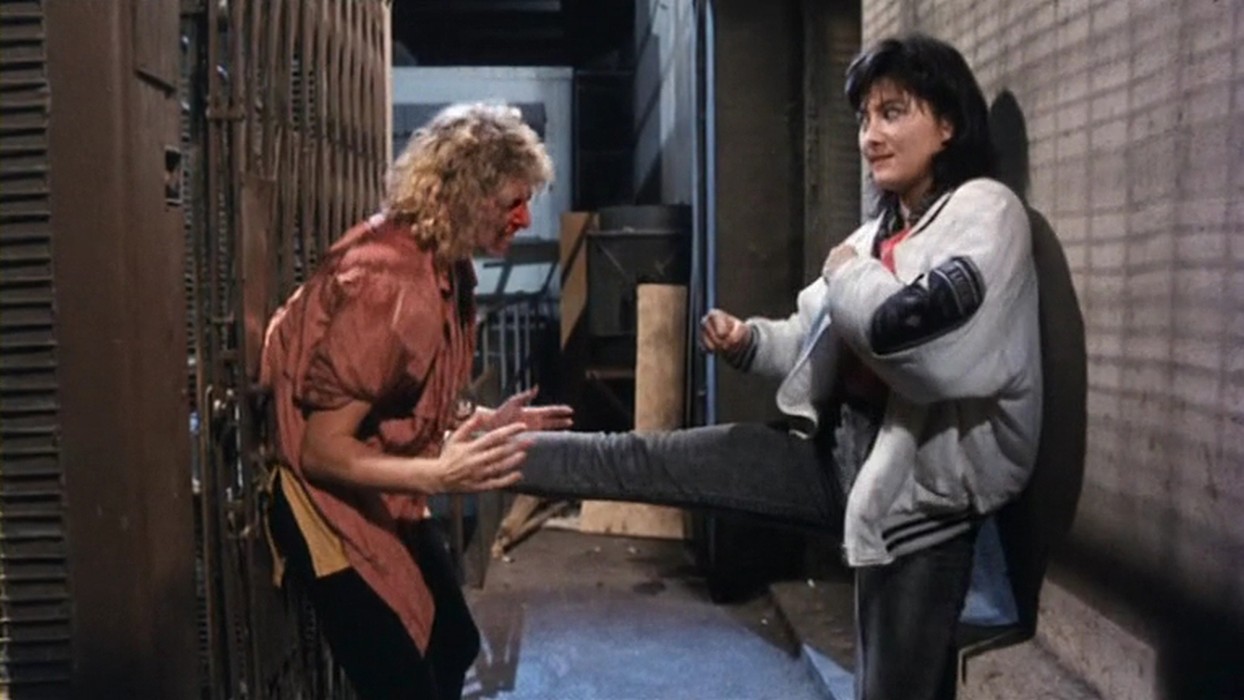
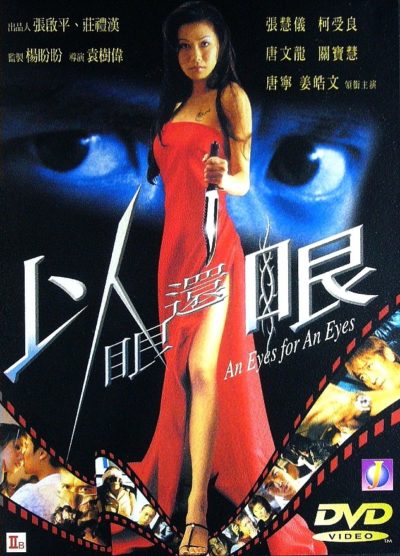 This opens with a scene that is almost a direct life from the similarly titled
 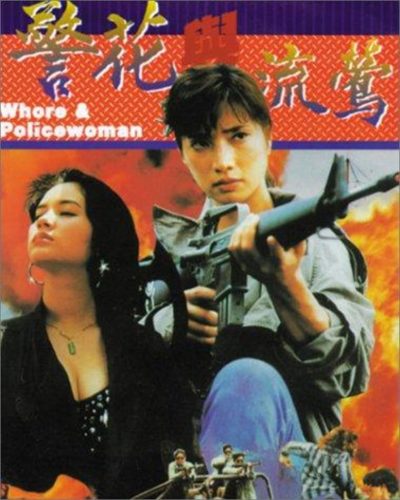 If the title is more than a bit blunt, it’s certainly accurate. May Lin (Cheng) is a brash hooker, who runs a sideline in blackmail videos with her flatmate, Nana. But one night she comes home to find Nana near death, the victim of a brutal client. She tells the police about the video, but before she can give it to them, the perpetrator – rich and influential politician, Kao Tien Chin (Cho) – sends an army of beige trenchcoat wearing killers to take care of both Nana and May. The former succumbs, but the latter escapes and goes on the run. With the police force apparently leaking like a sieve and the case being shut down from on high, prosecutor Yin Li Shan sends his niece, Nancy Cheng (Mishiwaki), to link up with May and bring her in. But they’ll have to get past the trenchcoat mafia, among other threats, for there to be any hope of justice.
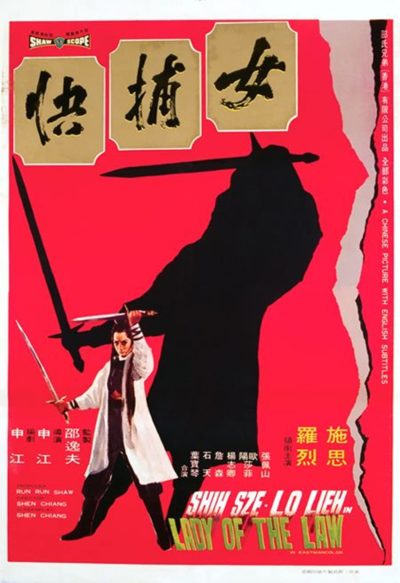 I kept moving between 2½ and 3 stars for this. It is pretty chatty, and the focus is not as much on the title character as I might have hoped. But there’s no denying that Leng (Shi) is a very solid character, and when she gets her chances to shine, does so in a memorable fashion. This is nowhere better illustrated than her final battle, where she takes on an enemy – who just tried to molest Leng, believing her drugged – while they both balance on a tight-rope. There’s no particular reason for the fight to take place in such an environment. The ground would have been perfectly fine. But it adds an extra dimension, and the way it’s filmed makes it feel surprisingly possible that they were wobbling about up there.