



★★★
“An R-rated version of Home Alone“
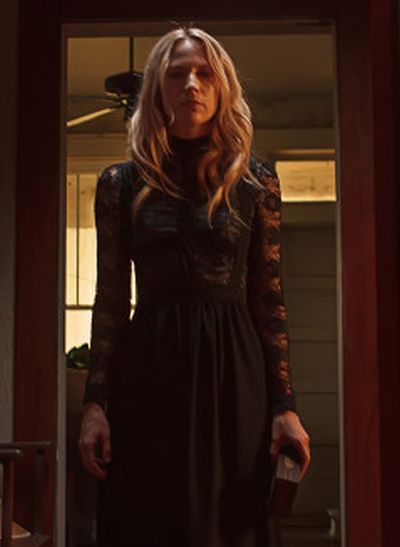 Since the death of their father, brother and sister Conrad and Anna (Riesgraf) have been each other’s companions. Virtually sole, in the latter’s case, as Anna suffers from severe agoraphobia, which means she hasn’t left the house for a decade. After Conrad dies of cancer, her only visitor is Meals on Wheels delivery guy, Dan (Culkin), who dreams of escaping town, but lacks the means. In a moment of empathy, Anna offers him a slab of cash: he declines, but after mentioning it in the wrong place, three criminals, led by J.P. (Kesy), decide to pay the house a visit. They’re expecting Anna to be at Conrad’s funeral, unaware of her condition. They are even more wrong about how helpless it makes her.
Big Sky also used agoraphobia as a plot point, but where this works better, is it uses this as a starting point, rather than becoming the defining characteristic of its heroine. We get an indication, not only of where her condition came from, but how it has affected her in other ways. That helps fill things in after the big reveal, where the tables are suddenly turned on the home invaders, and the hunters become the prey. It’s somewhat disconcerting, since this comes almost out of nowhere and leaves you going “Huh?” for a bit, until things are explained. Better not reveal too much there: let’s just say, this trio of robbers are not the first to enter the house and get what they deserve, instead of what they want.
Originally known as Shut In, before a competing (and larger-profile) film with the same name forced a title change, you do have to wonder if less would have been more. The story eventually unfolding here is rather more convoluted than necessary, except for the desire to provide Anna’s mayhem with moral justification. It isn’t needed, assuming you agree that if you invade someone’s home, your right to life is immediately severely curtailed. You’re Next was better in this area: it didn’t bother with any imperative; for its heroine, all the motivation she needed was her own survival. I’m also not quite sure about the layout here – it’s the same problem we saw in Sweet Home, where it feels as if a floor-plan would help figure out how the various pieces fit together.
However, if you’re looking for a darker version of To Catch a Predator, with additional (mercifully, staged) violence against a budgie, this should be satisfactory. Riesgraf is best known for her work as Parker in Leverage, and you could almost speculate on this being some kind of prequel to the show. It would make for a rather twisted shared universe, to be sure…
Dir: Adam Schindler
Star: Beth Riesgraf, Jack Kesy, Rory Culkin, Martin Starr
a.k.a. Shut In
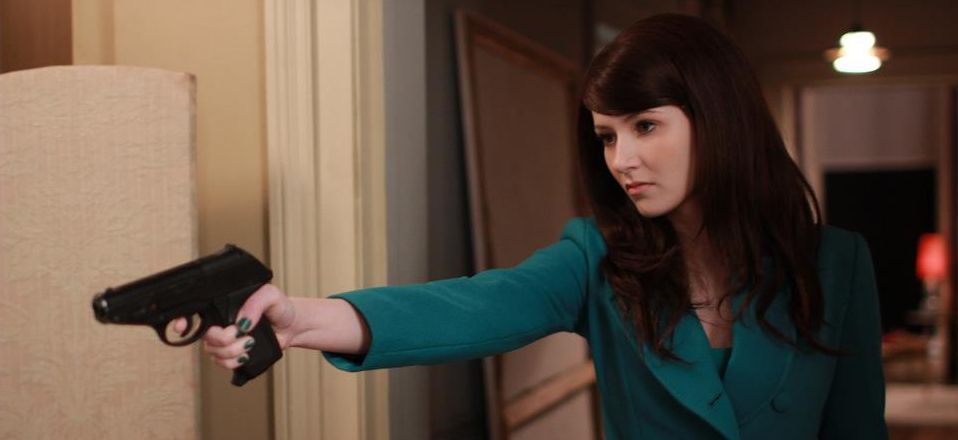

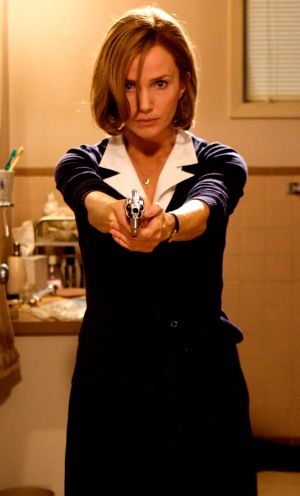 A loose remake of a somewhat infamous 1980 horror movie [rejected by the BBFC and as yet unreleased in the UK], this is a nastily brutal and effective home-invasion story, with a maternal angle that’s both surprising and well done. On the run after a botched bank robbery, the three Koffin brothers end up in the wrong home, and end up with a houseful of hostages, who were visiting Beth Sohapi (King) and her husband. The criminals call on the rest of their family for help, led by their mother (De Mornay), who is 50% June Cleaver – even providing cake and ice-cream for the residents – and 50% Lizzie Borden, showing absolutely no restraint against anyone she perceives as threatening her brood. As the night progresses, a lot of skeletons come out and we discover the Sohapis definitely do not live up to their name…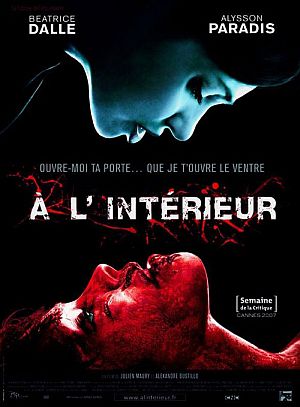
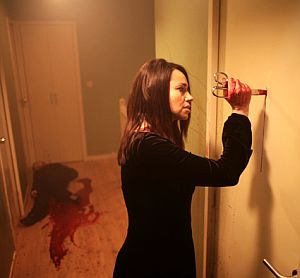 Let me be perfectly clear: this is hardcore horror of the most unrelenting sort, completely unsuitable for those of a nervous disposition, and particularly pregnant women. In the 1980’s, Dalle was a sexpot, for her role in Betty Blue, but you can flush all memory of that down the toilet: here, she has a feral, near-demonic intensity, and god help anyone who is unfortunate enough to get in her way. Particularly the men, who are disposed of with complete dispassion and brutality; as the film goes on, her relationship with Sarah becomes complex, and more a case of, “I’m taking your baby, and we can do this the hard way or… Well, really, that’s all there is. Sorry.” Friends, family, even an entire patrol of cops – no-one can help Sarah. She’s completely on her own, and her fate is entirely in her own hands.