This is a nasty, mean-spirited piece of work. But I mean that as a compliment, for it’s clearly intended as such. The European Queen of Action Heroines Rapace (I must get round to giving her, her own tag!) stars as soap actress Lisa, whose marriage to her director there, Lars (Hennie), is on severely shaky ground. So shaky, in fact, that Lars plans to use their upcoming weekend getaway to his father’s cabin to kill Lisa, cut up the body and dispose of it in a nearby lake, while saying she vanished on a solo hike. Except, just as he’s about to enact the plan, it turns out Lisa also intends to kill him in a “hunting accident”, and she gets the jump on her spouse. But before she can enact her plan, an accomplice of his shows up. Then three escaped convicts (literally) drop in to the cottage, with bad intentions of their own.
In some ways, it’s reminiscent of a hyperviolent version of seventies theatrical farce, something with a title like Run For Your Wife. Plot twist is piled upon twist, the characters furiously reacting to every additional complication and new arrival as best they can, in the hope of finding a way out of the mess. The original Norwegian title translates as “For worse” – as in “For better or…”, and that’s probably a better one than the highly-generic name Netflix tacked on. You will need a strong stomach, to be sure. Wirkola’s previous work has often been in the horror genre, such as Nazi zombie movie Dead Snow and it’s sequal, and that informs a lot of the brutality here. But he also directed What Happened to Monday, also starring Rapace, and this re-union is another good effort. Not all the shots land as they should – there’s what feels like a painfully extended sequence of one of the prisoners going to the toilet on the attic floor, which frankly, I could have done without.
However, the bulk of it works well, if you’re in the mood for brutal black comedy. Having a couple who genuinely want to kill each other, and forcing them to team up against a greater, external threat, is a concept full of potential, and it’s mined with energy and enthusiasm. I particularly loved Lars’s geriatric father, who leaves his nursing home and turns up with a zero-tolerance approach to everyone. But Rapace’s character is the focus, cutting and stabbing her way through proceedings with the best (or worst) of them, while taking no small amount of damage – as the picture (top) suggests. This may not be the sort of film I want to re-visit on a regular basis; not knowing what was coming up certainly felt a significant part of the fun. However, as a bloody good time, with the emphasis on “bloody,” it delivered everything I was hoping, and a little more.
Dir: Tommy Wirkola Star: Noomi Rapace, Aksel Hennie, Atle Antonsen, Christian Rubeck
a.k.a. I onde dager
I kinda agonized, for far longer than I should have, over whether this was a 3-star or 2½-star film. It’s probably 2¾. Or perhaps 2 5/8. No, 2 11/16. In the end though, it doesn’t matter. It’s just another in Megan Fox’s attempts to become the next Angelina Jolie, following in the footsteps of the similarly okay but not exactly memorable Rogue. Indeed, I initially thought this was by the same director, but turns out it’s a different director who uses initials in lieu of a first name. Anyway, with this one now available on Netflix, it will likely raise Fox’s action-actress profile. In terms of current rankings, she probably moves ahead of Ruby Rose in the rankings. Though that’s not exactly difficult.
The problems here are mostly pacing, with the movie being too slow to get to the main course. Emma (Fox) is unhappily married to Mark (Macken), an over-controlling lawyer, and is having an affair with one of Mark’s colleagues. After an excess of scenes belabouring these points, e.g. Mark orders her dessert after she has declined it (what a bastard!), on their 10th anniversary, Mark takes her out to a remote lakehouse. She wakes the next morning to find herself handcuffed to him, and Mark then blows his brains out. Turns out, his life was about to fall apart, but he has a plan to wreck Emma’s life from beyond the grave. This involves sending two thugs (Mulvey and Roth) to the house, one of whom has a beef with her, due to Emma having cost him his eye.
Our heroine, therefore, has to elude the home invaders while chained to a 180-lb (literal) dead weight, in a house from which all sharp objects have been carefully removed. This is kinda distracting, as I found myself figuring out alternative methods of separation, such as slamming the corpse’s wrist repeatedly in a car-door. But that’s perhaps for the best, as a distraction from too many shots of Emma dragging Mark’s body around the house, using her wedding-dress as a tarp (I’ll take “Over-obvious symbolism” for $400, please, Alex). Naturally, this unwanted connection lasts only until the plot decides it needs to be discarded, when it becomes a more standard home-invasion thriller.
It does perk up on the arrival of the villains, and there are some reasonably clever twists thereafter. To be honest, Mark’s warped imagination was almost impressive. Though if I was going to such lengths to extract revenge, I’d probably want to be there to see it. Where’s the fun otherwise? Fox does put in the effort, even if as Chris noted, Emma remains remarkably shevelled (as opposed to dishevelled) over the course of proceedings. Her hair and lipstick remain almost pristine despite crawling across grubby floors and snowy landscapes. I’m reminded of the old line quoted at the top; if you can still look hawt when drenched in blood and brains, your make-up artist deserves some kind of award.
This is the kind of film which makes for very uncomfortable date night viewing, simply because the situation presented is likely to lead to awkward conversations. Happily married architect Evan Webber (Reeves) has the house to himself for the weekend, his wife having gone with their two kids to the seaside, leaving him free to work on a project. A stormy night ensues, until a knock at the door, and he finds two lost young women, Genesis (Izzo) and Bel (de Armas), shivering on the doorstep. He can hardly make them stay there, so lets them in. Almost immediately, something is wrong, though initially this falls into the “Too good to be true” category. For they are nymphomaniac flight attendants, and inevitably – though after a credible struggle – Evan succumbs to their relentless charms.
The next morning, however, the reality proves less pleasant, and it’s all downhill from there. For the pair are avenging angels, honey-trapping married men, then savagely punishing them for their infidelity, and Evan is not their first victim. This development should be no real surprise if you’ve seen Roth’s other films, where bad things almost inevitably tend to result from good. A nice trip to Europe became kidnapping, torture and murder in Hostel. Social activism turned into cannibalistic dismemberment in Green Inferno. So the first half of this was largely an exercise in waiting for things to go wrong, along with strenuously assuring Chris that, in similar circumstances, my assistance would strictly be limited to passing them towels through the letter-box. I highly recommend not deviating from this answer, under any circumstances. For she was firmly convinced, whatever happened to Evan in the second half was well-deserved.
The resulting punishment is certainly not pleasant, with his home-life wrecked, both literally and figuratively. Though there were a couple of ways it could have been improved. Firstly, even with some straggly facial hair, he’s still Keanu Reeves, not exactly your average guy. He likely has to beat off real nymphomaniac flight attendants with a stick, on an everyday basis. It’d have been more effective with a more homely leading man, to whom the audience could relate. And I’d rather have seen Genesis and Bel evaporate like smoke in the night, leaving no evidence of their presence, save their impact on Evan. A little more subtlety, and less scrawling of “DADDY’S LITTLE WHORE” on the family portraits would have gone a long way here, I feel.
Still, Roth is not exactly known for his delicate approach to cinema, and as a blunt instrument illustrating in female form the perils of infidelity, this works well enough. It’s also a rare entry in the “home invasion” field where the invaders are entirely women. À l’interieur (Inside) is one of the few predecessors there, and it’s no shame this doesn’t quite reach the same heights of sheer insanity – very few movies do. It’s still a cautionary tale which had me shifting uncomfortably in my seat often enough to justify its existence, as well as casting wary glances over at Chris.
Dir: Eli Roth Star: Keanu Reeves, Ana de Armas, Lorenza Izzo, Aaron Burns
★★★★★
“The missing link between Psycho and Halloween?”
I’m quite serious about the above. In 1959, Hitchcock’s classic psycho-thriller, which gave an entire genre its name, showed a normal, self-confident woman falling prey to a psychotic serial killer, while John Carpenter’s Halloween, also now a classic, had its heroine fighting off menace Michael Myers. In between these two iconic movies, there is not much that is worth mentioning. Some final girls in Italian gialli maybe managed to survive, I guess – but there’s nothing in big screen thrillers that the average Joe or Jane would be able to name. Except… This movie, in which blind heroine Susy Hendrix (Hepburn) is able to see through the ruses of three gangsters, fight them off, and even win in a final confrontation against evil-as-evil-can-be psycho Mr. Roat (a very young Arkin – gosh, this guy is now 86 at the time of writing).
The story: gangsters Talman (Crenna – best known as Rambo’s boss) and Carlino (Jack Weston) meet the gangster Roat, previously unknown to them, in an empty apartment. Roat is obviously working for – or may even be the boss of – a drug-smuggling ring. A doll that was used to smuggle drugs had been given, for later collection, by their colleague Lisa (Samantha Jones) to an innocent photographer Sam Hendrix (Zimbalist). Sam lives in this apartment, with his blind wife Suzy (Hepburn). As a quick inspection of the flat didn’t lead to the doll, Roat recruits, or more accurately. blackmails the two men into helping him.
As Sam is away for the week-end, the three men are going to put on a kind of play for Suzy. The intention is making her believe Sam is suspected of murder of (the already dead) Lisa, putting psychological pressure on Suzy to reveal the whereabouts of the doll. Fortunately, Suzy may be blind but she is not stupid. Very soon, she notices little things in the behaviour of the men that suggest something else is going on. With help from a young girl who lives in the flat above (Julie Herrod), her suspicions are confirmed and she suddenly realizes she is on her own against three men. The worst of whom is Roat, not just a normal criminal, but who enjoys killing – and from the get-go had planned to kill everyone off, once he gets what he wanted.
Oh, my… ! This movie was (and IMHO still is) a real nail-biter. Based on a play by Frederick Knott who also provided the basis for Hitchcock’s Dial M for Murder (1953), the movie very much breathes Hitchcock’s air and makes good use of the master’s famous “suspense” techniques, in which the audience knows more than the movie’s protagonist. By this method, very special tension arises, as the viewer constantly wonders what will happen when the hero/ine finds out, and how s/he will escape the situation. Of course, this works much better when you have real danger imperilling the central character, so you can worry about them, and get caught up in the web of “suspense”.
For this to work, you need a character the audience likes, feels for and identifies with. In a Hitchcock movie, that might be your average, normal guys like James Stewart or Cary Grant, or later, much less lucky female characters like Janet Leigh or Tippi Hedren. There is no doubt that Audrey Hepburn’s casting here was a stroke of genius; she was at that time probably the most likable and beloved Hollywood star. Having her play a blind woman even contributed to the sympathy and fear felt for her, in a movie that was a very unusual genre for Hepburn.
Until then, she had been seen mainly in sweet love stories like Roman Holiday (1953) and Sabrina (1954), or comedy-thrillers like Charade (1963) with Cary Grant, or How to Steal a million (1966) with Peter O’Toole. She had broken through as a serious actress with The Nun’s Story (1959) and Breakfast at Tiffany’s (1961). She had even been cast by Hitchcock in an adaptation of Henry Cecil’s novel, No Bail for the Judge. But other commitments, qualms about a rape scene in the script, and a pregnancy combined to scupper her involvement and, eventually, the movie itself, which infuriated the master of suspense. So Hepburn had never previously played in a movie like this one.
Wait Until Dark is a dark, almost nihilistic thriller. This time, Hepburn’s heroine is all on her own, and if she isn’t able to put the puzzle pieces together and use her own wits, she will end up dead like poor Suzy in her cupboard. There is no Cary Grant or George Peppard coming to the heroine’s rescue. Even the not unsympathetic Crenna isn’t able to help. The gloves are truly off this time. It was kind of a gamble. There is a tradition of blind people in thrillers now; to name just some, Jennifer 8 (1992), Blink (1993), In Darkness (2018), or home-invasion thrillers e. g. Jodie Foster in Panic Room (2002). But these genres are relatively new, and not that often used then: 23 Paces To Baker Street (1956) and The Spiral Staircase (1945) with its deaf-mute heroine come to mind.
Also, would fans of Hepburn accept her in such a role? A cold, chilling thriller? Her husband, and producer of the movie, Mel Ferrer (himself a former film star whose fame was fading, though he stayed in the business as a successful producer) wasn’t quite sure it would work. But he convinced Audrey, who wasn’t nearly as confident as many believed her to be, to accept the part. But it worked really well. Director Terence Young was a great admirer of Hitchcock’s techniques and had already successful applied them to his James Bond movies Dr. No (1962), From Russia with Love (1963) and Thunderball as well as WWII thriller Triple Cross (1966). Together with Henry Mancini’s highly effective soundtrack, the movie creates an atmosphere of claustrophobic doom around the sympathetic heroine.
In a way, the film somewhat ended the career of Hepburn, as at the same time it started the career of Arkin – though he had some way to go before achieving the status he has nowadays. After this movie, the already rocky marriage between Hepburn and Ferrer came to a quick, unhappy ending. She stayed away from movies for the next eight years until she played opposite Sean Connery in Robin and Marian (1976). But none of her later movies would achieve the iconic status of the string of classics she did in the 1950’s and ’60’s.
She plays Suzy as a sympathetic, sweet woman who tries to be the best she can, even though she complains to her husband about whether she really has to be “the queen of the blind”. It’s nice to see a movie where a man isn’t the big saviour of the damsel in distress, but instead supports her in doing things by herself. Suzy is not without flaws; she insults and hurts the girl neighbour, though more by lashing out, regretted the next moment. It’s a more modern version of the classic Hepburn film persona. But Arkin leaves the strongest impression. His Roat comes off as evil incarnate. Wearing dark glasses throughout – you don’t see his eyes until the finale – and with the typical ‘bowl’ haircut of the time, he looks like an evil version of one of the Beatles! His cold, precise speaking style and efficient, smart handling of things give us the feeling that guy is a terrible wild-card.
The film was a great success. On a budget of $3 million, it made $17 million at the North American box office alone, and earned Audrey Hepburn her fifth and final Academy Award nomination. The plot may seem overly complicated, in how much trouble the gangsters go through for a few grams of drugs, knowing on what scale drug-dealing is executed today (I refer you to the James Bond movie Licence to Kill). But the film is extremely effective, delivering the kind of Hitchcockian experience that, at the end of the decade, Hitchcock himself wasn’t able to provide anymore, experiencing a creative trough at that time.
Arkin was watching the movie at the time with a studio executive and when the audience jumped out of their seats at the final moments of the film, when he came out of the shadows, the exec leaned over to him and said: “Do you realize that’s because of you? You scared them to death!” I think I rest my case there. Wait Until Dark makes a fine link between Psycho and Halloween, making Hepburn probably the most famous “final girl” of all!
Dir: Terence Young Star: Audrey Hepburn, Alan Arkin, Richard Crenna, Efrem Zimbalist Jr.
Despite a very brief running time of only 70 minutes, this still manages to seem talky and overlong. That’s a shame, as it manages to waste a good performance from a genre veteran, playing an action heroine who is not your typical one. The former is Camille Keaton, who is having a bit of a B-movie renaissance in her career, forty years after starring in the notorious rape-revenge film, I Spit on YourGrave. And the latter? Well, Keaton is now in her seventies, but based on this, is still capable of wielding a mean shotgun. And clearly, of taking no shit from anyone. Indeed, you could almost read this as the sundown years of her Grave character, Jennifer Hills.
Though here, she is Marsha Kane, a widow who is faced with fending off predatory offers on her property from local ne’er do wells, the MacMohan boys: Wayne (Peeler), Derrek (Dooley) and Billy, operating on behalf of the family patriarch, Bill. He wants Marsha’s house, and is going to let a little thing like her complete disinterest in selling stand in the way. So he sends his kin to make not-so-subtle hints, knowing the local police are in the family’s pocket. When the threats don’t work either, the boys return at midnight for a more physical approach, only to discover quickly that Kane is more than able to fend for herself. However, her daughter (Konzen) shows up, offering the MacMohan’s potentially useful leverage against her mother.
The title seems to be taken from a Lynyrd Skynyrd song, about the firing of their manager, so I’m not sure of the relevance here. But what could, and probably should be a small-scale version of Assault on Precinct 13, fails to achieve anything like the necessary degree of tension. It instead, collapses in on itself, as the script prefers to concentrate on largely uninteresting chit-chat and extremely slow creeping down poorly-lit corridors. That’s when it isn’t blundering into plot-holes. For example, when the MacMohan brothers arrive for their midnite escapade, they’re greeted with gunfire, injuring one. The smart thing to do would be to back off, call their pals at the police station, and have Mrs. Kane hauled off to prison for attempted murder. Property secured! Meanwhile, on her side, why stop with one? They are literally standing in front of the door, arguing about what to do.
This wastes Keaton, who has a quiet strength about her, as well as hints of a past that were less than squeaky-clean. Though, again – who keeps a copy of their police mug-shot in a box of souvenirs? It also goes to show that action heroines come in more shapes and sizes – and ages – than Hollywood would perhaps recognize. Even when they had Helen Mirren in Red, she was still undeniably glamourous. That isn’t the case here, and it’s all the more refreshing for it. Just a shame it wasn’t put to the use of a considerably better storyline.
Dir: Sam Farmer Star: Camille Keaton, Scott Peeler, Karen Konzen, Eric Dooley
★★★½
“Dear diary: my teen angst bullshit has a body count.”
Becky (Wilson) is the quintessential troubled teenager. Since her mother died, she has become increasingly estranged from her father, Jeff (McHale, replacing the original choice, Simon Pegg, who had to drop out due to scheduling conflicts), not least because of his new girlfriend, Kayla. Dad arranges a weekend away for everyone at the family cabin to try and repair things. However, relationship problems rapidly become the least of everyone’s concerns. For a quartet of escaped Aryan Brotherhood convicts, led by Dominick (James, going completely and effectively against type), have turned up, seeking a key they had hid on the property. Not too happy to find an inter-racial family, they capture everyone except Becky, who had stormed off in one of her huffs.
But hell hath no fury like a pissed-off teenage girl. Especially once Dominick starts torturing her father, the one person about whom Becky truly cares. Naturally, you do need to be able to accept that a 13-year-old – even one as unquestionably highly-motivated and vindictive as Becky – can take out hardened criminals, especially largely without the equalizer of a firearm. Yet the script does a fairly good job of overcoming this, setting up scenarios that allow her to use the tools at hand to her advantage. It helps some of her adversaries aren’t exactly the sharpest tools in the box, stupidity being a significant factor in their deaths by impalement and outboard motor.
The script also does a good job with villains Dominick and the 7-foot tall Apex (former WWE wrestler Maillet), who are respectively smarter and given greater depth than the bad guys usually receive in this kind of film. The latter, in particular, gets more of a character arc than anyone else bar Becky, becoming a surprisingly sympathetic character for a neo-Nazi. This development definitely helps the movie, when Becky is not extracting her furious, bloody vengeance [For instance, we could have done without the flashbacks to Becky playing the ukulele for her terminally ill mother. No, really]. Though it’s Dominick who provides the film’s most insanely hardcore moment, involving a scissors and an eyeball.
However, there is a fatal mis-step by having the movie’s climax take place after dark. This leaves the audience peering into the gloom, trying to figure out what’s going on. I’m still not sure what was being pulled behind the ATV on which Becky rides into her final battle. Going by its effect, I’m guessing at some kind of industrial strength earth-tilling equipment… This shadowy coyness is at odds with the in-your-face energy the film had shown up to that point, and which had it contending for a spot in Top 10, of any genre, for 2020. In the end, it probably falls just short, yet is still an enjoyable slice of brutal, hormonal savagery. As the end credits rolled, my mind drifted off to visions of a Hanna vs. Becky crossover story. Hey, we can all dream, can’t we?
Dir: Jonathan Milott, Cary Murnion Star: Lulu Wilson, Kevin James, Joel McHale, Robert Maillet
There are lessons to be learned here. In particular: should you gun down a home invader in the middle of the night… just call the cops. Even if they have offered you ten thousand dollars to let them walk away, immediately before their untimely demise… just call the cops. Of course, Heather (Rose) and Kurt (Yue) have issues, which make their decision to do otherwise understandable, if not wise. They’re teetering on the edge of financial carnage, and figure that if the intruder was willing to pay them that much, whatever he was after in their house has got to be worth a lot more. Therefore, they postpone alerting the authorities for a bit, choosing to look for the target of the search.
Have these people never seen Shallow Grave? Do they not know that when valuable property falls into your lap in shady circumstances, its real owner inevitably comes looking for it. And that’s exactly what happens here. Polite, hat-wearing villain Moody (Milligan) soon shows up to establish his property rights, and when the couple finally get round to calling the police, the poor officer who turns up simply doubles the quantity of corpses with which Heather and Kurt have to deal. There’s only one way to get through the night, and that path goes through Moody. Fortunately, there is some good news: it turns out Heather used to be in the military, and still has the skills. Bad news: she’s on shaky emotional turf, due to her PTSD, among other things.
This is on most solid turf when it’s in motion. Rose is a stunt-woman, and gets a number of opportunities to put those skills into good use. There’s one particularly good brawl through the house, where she leaves a literal dent in the wall when her body crashes into it, and it’ll make a similarly lasting impression on the viewer. The film is less successful when it’s digging for emotional depth. For example, knowing they recently lost a young child is probably enough. We don’t really need to see the husband wife and staring at one of their drawings, or clutching a toy, respectively: it’s way too obvious. Similarly, the details of precisely why Heather has PTSD are superfluous, and add little or nothing.
Indeed, they may be counter-productive, as they slow the film down, at just the point when it probably needs to be accelerating towards a final confrontation. It does get there, and proves adequately satisfying; it just feels like some opportunities were left on the table to do more. The movie does a decent job of reversing the obvious roles in the marriage, and also of making its single location work for it, rather than seeming a limitation. The film even takes place at Christmas, which could even be considered a small-scale homage to Die Hard, especially when Rose is roaming the house, trying to stay out of the reach of Moody and his men. It’s nowhere near as good, of course. Then again, very few movies are – so no blame should be attached for that!
Dir: Walker Whited Star: Michelle Rose, Kurt Yue, Michael Aaron Milligan, Carlos Aviles
“I realized that there was no such thing as a boundary between good or evil, black and white, right or wrong. All I learned is that this world is divided by the executed and executioners.” The above is spoken by a character toward the end of this, and explains the significance of the title, though your mileage may vary as to how convincing it is as an explanation. Four young women go to a country house by a lake, which holds dark memories for one of them. Belle (Dallender, known here from I Spit on Your Grave 2) watched her father die of a heart attack there, after he rescued her from drowning, and has been plagued by guilt ever since. There’s also Kay (Burn), a writer who is working on a “story of home invasion, mixed with supernatural elements.” And, wouldn’t you know it? Barely has the trip started, before three men burst in and take the group hostage.
There then follows some fairly nasty brutality and sexual violence, which seems especially dubious since the director has made energetic (and, let’s be honest, not unsuccessful) efforts to sexualize the attractive women – both before, and even more questionably, after that scene. The victims continue wandering round in their underwear for no good reason, when any real person would have quickly reached for their clothes. However, the tables are turned, with the three attackers turning out to be a bit crap at the whole home-invasion thing. With them tied up, it’s time for the quartet to mete out their own brand of justice – something which Belle, especially, is very keen to do.
This is where things get at least somewhat interesting, and rather meta. For it turns out the home invaders were not acting on their own initiative. They had been hired to attack the house, by person or persons then unknown, and were live-streaming their actions through bodycams back to their employer. Who is lurking in the woods nearby, and may or may not be ready to intervene on behalf of their employees. The scripting in this section is mediocre: one woman’s break for help and fate is so rapidly glossed-over as to be inconsequential, and one of the attacker becomes an ally with little more than “I’m gonna trust you with a gun. Remember, we’re not the enemy.”
As the poster suggests, Serafini is going for the grindhouse aesthetic. I’m just not sure how well he nails this. The nasty and repellent elements, he seems to have a good handle on, and Dallender impresses in her role. Yet the films in that field which have stood the test of time offer more than that, and it’s there where the film seems to fall short most obviously, with this likely making little or no lasting impression. The eventual explanation raises more questions than it answers, and doesn’t appear to make a great deal of logical sense. If you like your meat raw and bloody, this one may be more to your taste than it was to mine. If only they’d named all the characters after Disney princesses.
Dir: Giorgio Serafini Star: Natalie Burn, Jemma Dallender, Rachel Rosenstein, Anna Shields
I’m generally an easy-going guy with regard to plots in my action heroine films. Give me adequate amounts of ass-kicking and I’ll happily overlook most weaknesses in the storyline. I mention this, to stress I’m not a nitpicky kind of reviewer, who requires an Aristotlean level of logic from their movies. So when I say, there are major problems with the scripting here… There are MAJOR problems with the scripting here.
Alex (Macken) is a nurse, hired as a caregiver to the terminally-ill Claire (Easterbrook), when Claire’s only living relative, grandson Seth (Sizemore), turns up. He’s desperate to get into granny’s good graces and get his inheritance, because he is in deep debt to some dangerous people. Claire is not fooled at all by this sudden show of family feeling, and tells Seth where to go. He teams up with a pair of local hoodlums to rob the safe where grandma keeps her money – only to discover that Alex is far from the innocent caregiver she seems, and has a very particular set of skills. Skills she has acquired over a very long career. Skills that make her a nightmare for people like Seth and his crew.
This comes as absolutely no surprise to the audience, because of an opening sequence showing these skills on view in a gym before she heads off to take up her position. There’s hints of some defining experience in the Philippines – never expanded on, so you wonder why they bother. It would likely have been more fun if her talents had come as much as a surprise to the audience as the home invaders. The main problem, however, is the idiocy of everyone involved, which generates plot holes so gaping, you could sail an oil-tanker through them. Sideways.
Most obviously, we see early on how ruthless and vicious Seth’s accomplices are, killing a prostitute. Given this, there is absolutely no need for them to keep the captured Alex alive: she is in no way needed to help them open the safe. Yet, inexplicably, they do so, even after she learns their names and sees their faces. And repeatedly, both sides fail to press home an advantage when they get the jump on the opposition, preferring to exchange non-witty banter. This is especially unforgivable for Alex, who is supposedly some kind of ex-special forces reconnaissance type, someone whom you’d think would have precisely zero qualms about terminating an obvious, lethal threat, given the chance. And please do not ask me about the scene where Alex takes a bath… in her bra and panties. I hooted loudly about that.
It’s a shame, because Macken is rather good, whom I’d like to see more of (and no, not in the bra and panties sense…). If you’re a WWE fan, there’s something of the A.J. Lee about her, and the actual action sequences are well enough handled. She had a supporting role in Raze, so clearly knows her way around a fist. Indeed, this feels a little bit like an early entry in the career of Zoë Bell, back when she appeared in things that weren’t necessarily worthy of her talents. Hopefully, Macken’s career trajectory will improve similarly, to films capable of meeting even my low threshold for plot logic.
Dir: Jared Bentley Star: Tara Macken, Kevin Sizemore, Jose Rosete, Leslie Easterbrook
After her father is killed, Shaun (Union – yes, I know “Shaun” is an odd name for a woman) heads to the remote home Dad owned in the country, with her two young children, to clear it out. Unfortunately, she crosses paths there with Eddie (Burke) and his gang of three thugs. They are at the house, in the belief there’s a safe which contains a large quantity of money. Shaun and family represent an unwelcome interruption, because they’re on a strict schedule, before the security company makes it out to investigate their disabling of the phone lines. The thugs take the kids hostage, with Shaun stuck outside the very secure home. Fortunately, she has taken a hostage of her own – the safe-cracker Eddie brought along.
This initially makes for a somewhat interesting twist on the usual scenario: rather than being trapped inside and trying to get out, the heroine needs, as the title suggests, to break into the building. And the “mother bear seeking to defend her cubs” motif is always a good foundation. Unfortunately, there hasn’t been nearly enough effort put into the scenario past that point. In particular, both sides need to behave with the enhanced level of contrived idiocy necessary to the plot. If either Shaun or Eddie had acted in accordance with simple principles of common sense, this would likely have lasted no longer than 15-20 minutes. Though in Eddie’s defense, he is a razor-sharp intellect compared to his minions. I’d have a quiet word with his HR department about quality control, which is clearly not among their recruitment tools.
Everything from the basic premise on, is questionable at best. What kind of cheap-ass security company takes several hours to respond to an alert? Quite how Shaun is capable of going toe-to-toe with career criminals like Eddie and his crew is never explained, and nor is her decision not to get help, beyond vaguely hand-waving lines such as, “Moms don’t run, not when their babies are trapped in the nest.” Other dialogue includes, “I wish I could have had a Mom like you,” entirely expositional statements, e.g. “You’re a woman, alone at the mercy of strangers, and your greatest weakness is locked inside this house,” and the climactic, “You broke into the wrong house!” which for anyone, like me, who’s a fan of Tremors, will provoke sniggers more than the intended triumphant cheers.
These quotes are also a fairly accurate representation of the level of effort that we see put into the characterizations here. Thus, among Eddie’s henchmen, we get the inevitable Heavily Tattooed Latino Psychopath, as well as the Nice Guy Who Didn’t Sign Up For This. It’s all very by the numbers, and while Union does her best, the script ensures that’s not much more than coming off as a low-rent version of Halle Berry in Kidnap. Mind you, given the tagline there was “They messed with the wrong mother,” this project largely feels like it was cribbed from the same playbook. And there are certainly better movies available to steal from.
Dir: James McTeigue Star: Gabrielle Union, Billy Burke, Richard Cabral, Levi Meaden




 ★★★½
★★★½ I kinda agonized, for far longer than I should have, over whether this was a 3-star or 2½-star film. It’s probably 2¾. Or perhaps 2 5/8. No, 2 11/16. In the end though, it doesn’t matter. It’s just another in Megan Fox’s attempts to become the next Angelina Jolie, following in the footsteps of the similarly okay but not exactly memorable
  This is the kind of film which makes for very uncomfortable date night viewing, simply because the situation presented is likely to lead to awkward conversations. Happily married architect Evan Webber (Reeves) has the house to himself for the weekend, his wife having gone with their two kids to the seaside, leaving him free to work on a project. A stormy night ensues, until a knock at the door, and he finds two lost young women, Genesis (Izzo) and Bel (de Armas), shivering on the doorstep. He can hardly make them stay there, so lets them in. Almost immediately, something is wrong, though initially this falls into the “Too good to be true” category. For they are nymphomaniac flight attendants, and inevitably – though after a credible struggle – Evan succumbs to their relentless charms.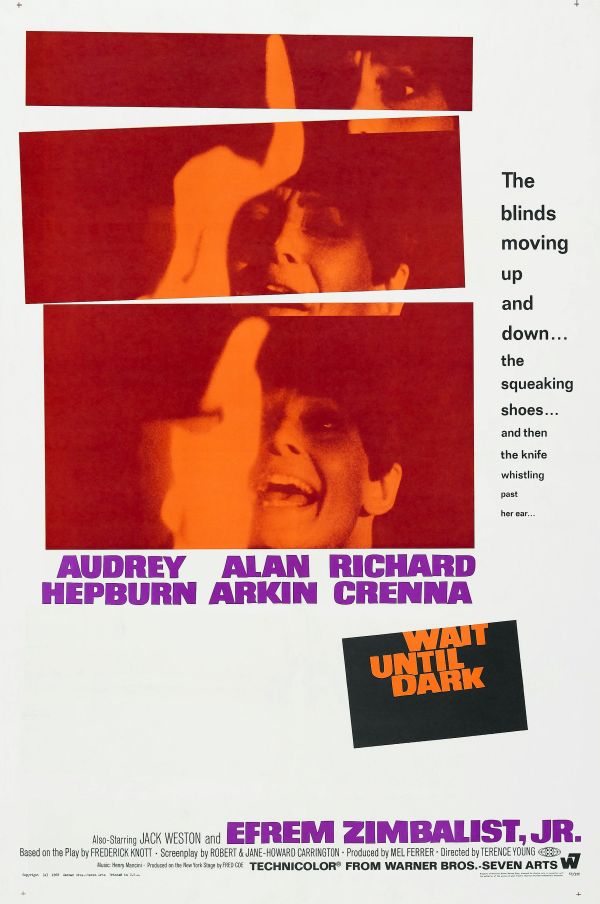
 I’m quite serious about the above. In 1959, Hitchcock’s classic psycho-thriller, which gave an entire genre its name, showed a normal, self-confident woman falling prey to a psychotic serial killer, while John Carpenter’s Halloween, also now a classic, had its heroine fighting off menace Michael Myers. In between these two iconic movies, there is not much that is worth mentioning. Some final girls in Italian gialli maybe managed to survive, I guess – but there’s nothing in big screen thrillers that the average Joe or Jane would be able to name. Except… This movie, in which blind heroine Susy Hendrix (Hepburn) is able to see through the ruses of three gangsters, fight them off, and even win in a final confrontation against evil-as-evil-can-be psycho Mr. Roat (a very young Arkin – gosh, this guy is now 86 at the time of writing).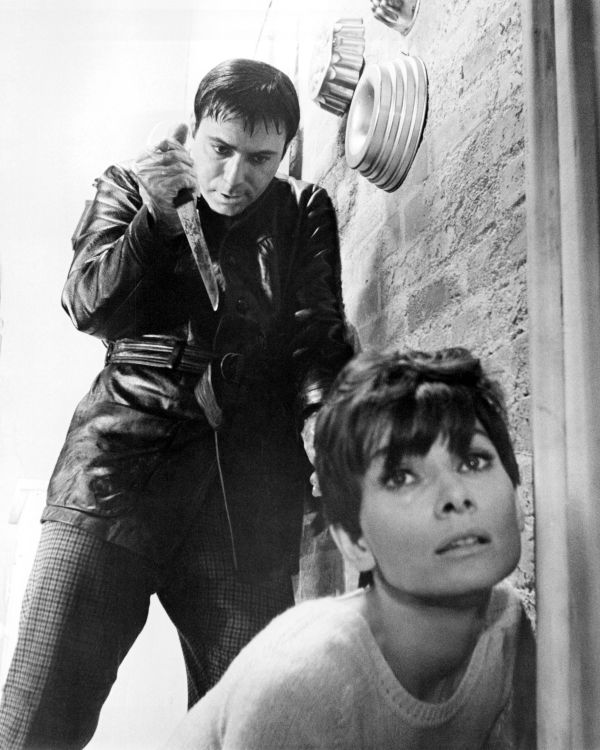
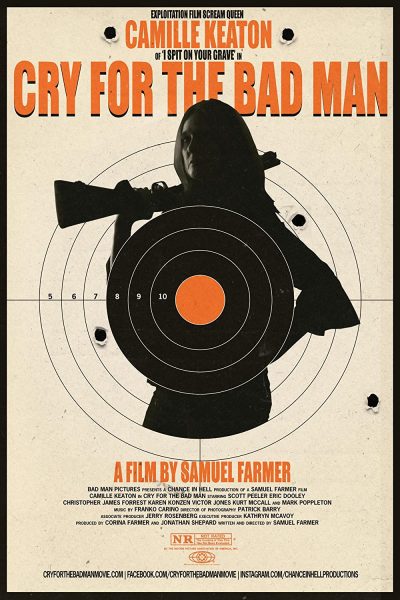 Despite a very brief running time of only 70 minutes, this still manages to seem talky and overlong. That’s a shame, as it manages to waste a good performance from a genre veteran, playing an action heroine who is not your typical one. The former is Camille Keaton, who is having a bit of a B-movie renaissance in her career, forty years after starring in the notorious rape-revenge film, I Spit on Your Grave. And the latter? Well, Keaton is now in her seventies, but based on this, is still capable of wielding a mean shotgun. And clearly, of taking no shit from anyone. Indeed, you could almost read this as the sundown years of her Grave character, Jennifer Hills.
 Becky (Wilson) is the quintessential troubled teenager. Since her mother died, she has become increasingly estranged from her father, Jeff (McHale, replacing the original choice, Simon Pegg, who had to drop out due to scheduling conflicts), not least because of his new girlfriend, Kayla. Dad arranges a weekend away for everyone at the family cabin to try and repair things. However, relationship problems rapidly become the least of everyone’s concerns. For a quartet of escaped Aryan Brotherhood convicts, led by Dominick (James, going completely and effectively against type), have turned up, seeking a key they had hid on the property. Not too happy to find an inter-racial family, they capture everyone except Becky, who had stormed off in one of her huffs.
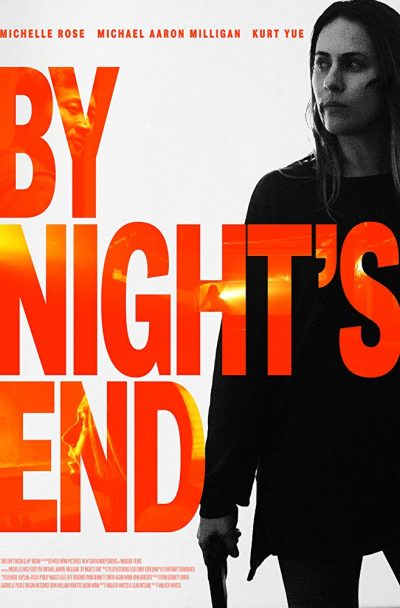 There are lessons to be learned here. In particular: should you gun down a home invader in the middle of the night… just call the cops. Even if they have offered you ten thousand dollars to let them walk away, immediately before their untimely demise… just call the cops. Of course, Heather (Rose) and Kurt (Yue) have issues, which make their decision to do otherwise understandable, if not wise. They’re teetering on the edge of financial carnage, and figure that if the intruder was willing to pay them that much, whatever he was after in their house has got to be worth a lot more. Therefore, they postpone alerting the authorities for a bit, choosing to look for the target of the search.
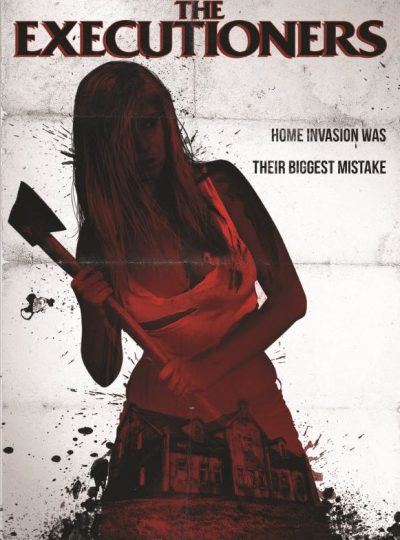 “I realized that there was no such thing as a boundary between good or evil, black and white, right or wrong. All I learned is that this world is divided by the executed and executioners.” The above is spoken by a character toward the end of this, and explains the significance of the title, though your mileage may vary as to how convincing it is as an explanation. Four young women go to a country house by a lake, which holds dark memories for one of them. Belle (Dallender, known here from
 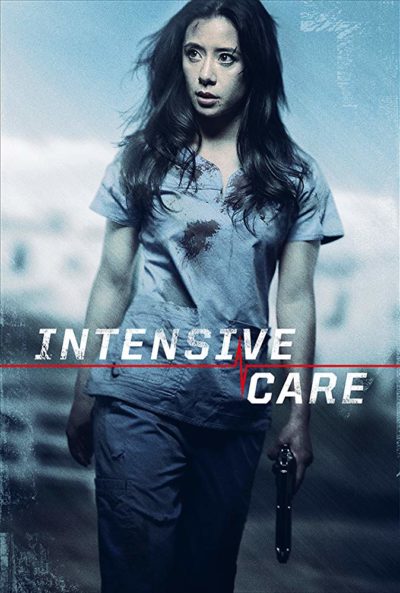 I’m generally an easy-going guy with regard to plots in my action heroine films. Give me adequate amounts of ass-kicking and I’ll happily overlook most weaknesses in the storyline. I mention this, to stress I’m not a nitpicky kind of reviewer, who requires an Aristotlean level of logic from their movies. So when I say, there are major problems with the scripting here… There are MAJOR problems with the scripting here.
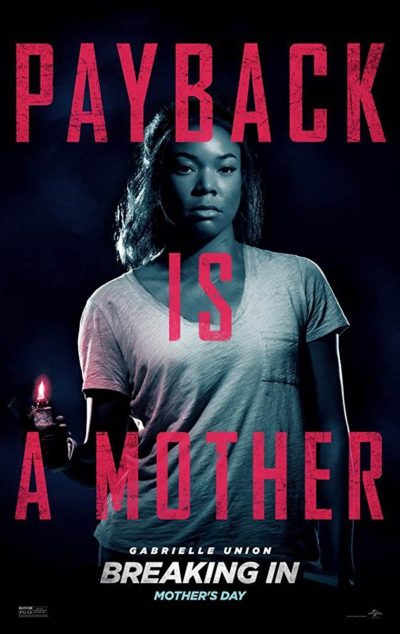 After her father is killed, Shaun (Union – yes, I know “Shaun” is an odd name for a woman) heads to the remote home Dad owned in the country, with her two young children, to clear it out. Unfortunately, she crosses paths there with Eddie (Burke) and his gang of three thugs. They are at the house, in the belief there’s a safe which contains a large quantity of money. Shaun and family represent an unwelcome interruption, because they’re on a strict schedule, before the security company makes it out to investigate their disabling of the phone lines. The thugs take the kids hostage, with Shaun stuck outside the very secure home. Fortunately, she has taken a hostage of her own – the safe-cracker Eddie brought along.