




★★★½
“While feeling incomplete, still a good primer for young action heroine fans.”
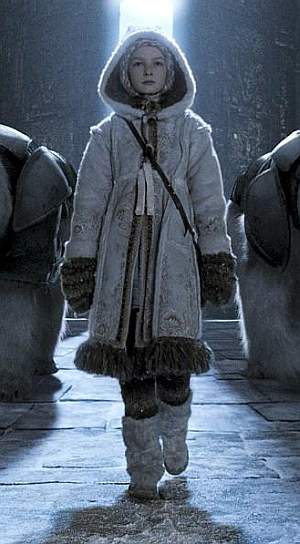 There aren’t that many decent action heroine films for kids: much as I love Bloody Mallory or Kill Bill, they aren’t really child-appropriate. At the other end, films like the Harry Potter or the Narnia series, while containing female characters of some importance, sideline them in favor of the boys. That makes this a refreshing breath of fresh air, in that the heroine is firmly front and center as she goes through her adventures. It’s set in an alternate universe where people’s souls take the form of animals that accompany them everywhere, known as daemons. Childrens’ daemons shapeshift, but adults’ ones are static in form. Things are run by an authoritative group called The Magisterium, but Lord Asriel (Craig) who has found “dust” in a far Northern land, that could challenge the established order – the Magisterium have been kidnapping children for use in human experiments to counter dust. Into this is dropped Asriel’s niece, Lyra Belacqua (Richards), who is given the last golden compass, a device able to answer any question in the right hands. she is about to head North with Mrs. Coulter (Kidman), only to find she has a central role in the kidnapping – as Lyra’s best friend has now vanished, she bravely heads off, initially on her own, to rescue him.
It’s a pretty cool adventure tale, with some stirring sequences and memorable characters – not least the armoured polar-bear (voiced by McKellen), who becomes Lyra’s protector. He doesn’t just sit around drinking Coke, let’s say, though the entirely bloodless nature of the battle sequences lessen the impact significantly, though is likely an inevitable result of the PG-13 certificate. It is satisfyingly full of strong female characters, on both sides: as well as Lyra and Mrs. Coulter, the witch queen Serafina Pekkala kicks almost as much ass as the polar-bear. But the film fails badly to tie up the ends, particularly Lord Asriel, who is kidnapped in the middle and then vanishes, almost without further mention, until a quick reference at the end. Admittedly, while there are decent reasons why – it was intended as the first in a trilogy – we are less concerned here with excuses than actuality. And in actuality, it peters out.
I have to say, I haven’t read the book on which this is based, but opinion generally finds the movie to be ‘dumbed-down’, not least for removing the book’s far greater criticism of religion [the Magisterium is a thinly-disguised version of the Catholic Church]. This is likely inevitable, given the film’s $180m budget, but didn’t stop a campaign to boycott the film – which worked rather better in the US than abroad. It took more than four times its US gross overseas – compare, say, the first Narnia film, where the foreign multiplier was only about 1.5. Its relative failure in America has thrown the sequels into doubt, especially in the current economic climate, and that’s a shame: the world could always use some more heroines, and what you get here is painfully and obviously unfinished. Maybe I’ll go read the books instead.
Dir: Chris Weitz
Star: Dakota Blue Richards, Nicole Kidman, Daniel Craig, Ian McKellen
 Andre (Debbouse) is at the end of his tether, owing large amounts of money to at least three separate gangs. He decides to end it all by leaping off a Parisian bridge into the Seine below, but is beaten to it by the tall, leggy blonde, Angela (Rasmussen, who you may remember in a bathroom stall with Rebecca Romijn-Stamos in the opening of Femme Fatale). His suicide forgotten, he jumps in to save her, and as they sit, dripping on the river-bank she vows that she will repay his selfless act by taking care of him. This may not be quite the way he expects; for example, she hijacks a negotiation with one of the mobsters to whom Andre owes money, marches upstairs and emerges not long afterwards, the debt apparently forgiven and with tens of thousands in bonus cash. Just as important as resolving his pecuniary problems are the emotional ones which plague Andre, and Angela is perhaps even more adept at addressing those: his lack of self-confidence, trust issues, an inability to give or receive love and so on. She sees the good person who is buried
 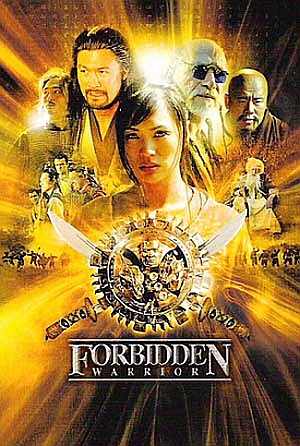 Though I couldn’t put my finger on why, large chunks of this seemed very familiar when I was watching it last night. Maybe it was just the story, cut from a template [mystical book, blah, chosen one, blah-blah, key to all power, etc.] we’ve seen a million times before. But then, when I Googled the film’s title, I realised why: at #6 was
  “Like The Prophecy, made for 75 cents and without Christopher Walken.”
 Things build to a final showdown in a warehouse, where the makers finally locate their supply of fake blood, which has been largely notable by its absence for the first hour, and it is quite effective. I do wonder why the angels, on both sides, don’t make better uses of their powers, though must also say, said powers are also somewhat crap: if I was responsible for holding the balance between good and evil, I’d want something better than the ability to turn into a fat guy. Overall, one would quite like to see this remade as a big-budget work, because the ideas here are good; with a good effects studio – and significantly better fight choreography – this has a lot of potential. However, Hollywood appears too busy remaking mostly-mediocre Asian horror to notice. We are therefore stuck with a cheap version, whose flaws likely distract too much from its merits for this to find a wide audience.
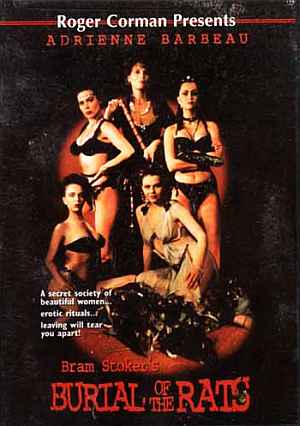 This can only be described as utterly mad. Bram Stoker is kidnapped by a group of bikini-clad female vigilantes, ruled over by “the Pied Piper’s twisted sister” (Barbeau), who can control rats with her flute (when not decapitating them in her rodent-sized guillotine, I kid you not). He is coerced into becoming one of them because the Queen decided his writing skills could aid their PR skills, striking fear into their targets with his eye-witness accounts of the raids where the extract vengeance on evil men. Of course, one of the clan (Ford) falls for him, but when she is captured by the authorities, her colleague must mount a raid to rescue her. Meanwhile, Stoker’s father is trying to find his son. Oh, and I did I mention the topless ballet which is apparently the women’s chief source of entertainment? No wonder Barbeau permanently wears a pained expression. [Though she now looks back and
 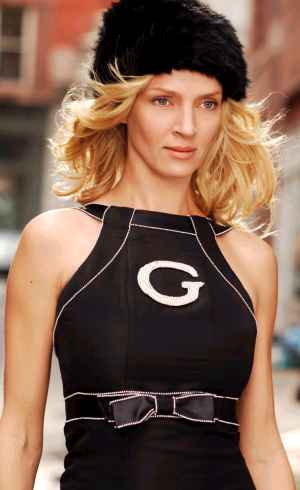 There’s certainly plenty of potential in the idea: how do you break up with your girlfriend, when she’s not just needy and possessive, but also has superhuman strength, the ability to fly and can boil your fishtank with her gaze? And the casting is, in general, excellent, too. Matt (Wilson) is an endearing everyman, and Thurman is perfect for capturing the mix of neuroses and power in G-Girl – her sequence where she pouts and refuses to save New York from a rogue missile is great. Izzard, naturally, steals almost every scene as supervillain Professor Bedlam [or “Barry”, as G-Girl knows him], though Riann Wilson matches him as Matt’s best friend, who talks a far better sexual game than he actually plays.
 It’s kinda sad to say, but the action in this Disney TV movie kicks the ass of, not only most TV shows, but a credible number of Hollywood films. Then again, behind the fights here is Koichi Sakamoto, who is also responsible for Drive, among the best American martial-arts films of all time. And while obviously “Disneyfied”, this is still sprightly and engaging, with a couple of very decent fight sequences. It is, however,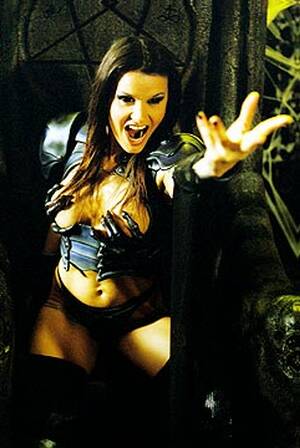


 Combining elements from Dead Like Me and Ghost, this still manages to come up with something unique, especially given its origins as a prequel to a popular TV series. It is designed to explain how Mina (Shaku) got the job as Keeper of the Gate, where murder victims must decide whether to forgo revenge and pass on, return to Earth as a ghost, or seek vengeance at the price of eternal torment. She ends up there after having her heart torn out on her wedding day by insane billionaire serial killer Kudo (Osawa) who will stop at nothing to save his one true love, currently lying in a coma. Trust me – it all makes perfect sense, and it’s a particularly nice touch that Mina’s fiance, Detective Kohei (Shosuke) is equally driven in his actions by love.
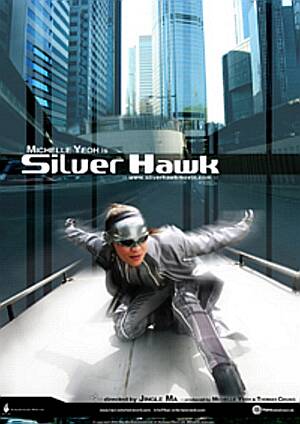 There’s no doubt about the aesthetic they’re aiming for here; heroine with secret identity, sneering evil nemesis, gadgets, etc. Take a Marvel comic from the 60’s, transplant it to the modern Far East, and there you are. Indeed, this period is apparently where SilverHawk originated; unfortunately, the makers failed to learn from similar failures such as The Avengers, The Mod Squad and Wild Wild West, and the results are lacklustre.