




 ★★★★★
“The Smell of Female”
“Ladies and Gentlemen, welcome to Violence. The word and the act. While violence cloaks itself in a plethora of disguises, its favourite mantle still remains – sex. Violence devours all it touches, its voracious appetite rarely fulfilled. Yet violence doesn’t only destroy. It creates and moulds as well. Let’s examine closely then this dangerously evil creation, this new breed encased and contained within the supple skin of woman. The softness is there, the unmistakeable smell of female. the surface shiny and silken. The body yielding yet wanton. But a word of caution: handle with care and don’t drop your guard. This rapacious new breed prowls both alone and in packs. Operating at any level, at any time, anywhere and with anybody. Who are they? One might be your secretary, your doctor’s receptionist, or a dancer in a go-go club!”
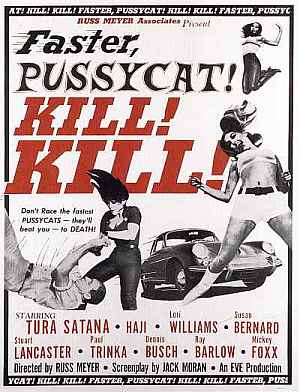
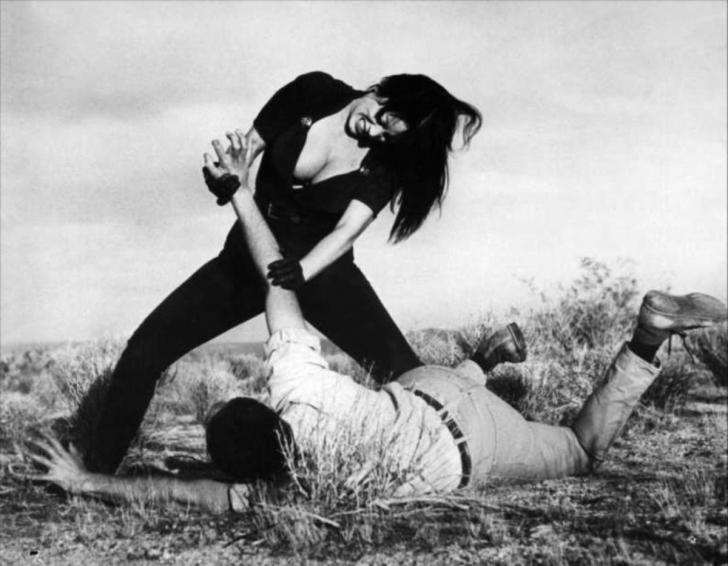
 Made more than forty years ago, Faster was decades ahead of its time – which may explain why it was such a resounding flop on initial release. But in his autobiography, John Waters called it, “The best movie ever made, and possibly better than any movie that will ever be made,” and helped resurrect it: Rob Zombie is another big fan, and introduced its recent screening on – of all places! – Turner Classic Movies. For this is the kind of film, hell, the kind of title, Quentin Tarantino wishes in his wet dreams he could create. And yet, it’s also an interesting example of censorship as artistically productive: probably the tamest of Meyer’s films: subsequently (and, often, before) they would contain a great deal more explicit nudity. But very rarely did he ever come close to the same artistic heights.
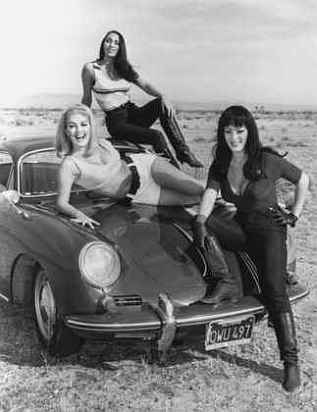
It tells the story of three girls: go-go dancers, hot-rod racers and outlaws, led by Varla (Satana). One afternoon, their chilling in the desert is rudely interrupted by Tommy and Linda (Bernard, who’d become a Playboy centerfold in 1966), a “square” couple who also have a car. After racing against them, Tommy and Varla get into a fight, which ends with Varla snapping his back. The trio kidnap Linda, and drive off. Stopping to get gas, they hear from the attendant about a crippled old man, who lives with his two sons, and is rumoured to have a fortune as the result of an accident. The girls decide to pay him a visit, and relieve him of his money – only to find out that he may be even more twisted and sadistic than they are…
Where to start? What about with the dialogue, which is prime, ripe and firm as last year’s Gouda, even if Satana has a slightly-irritating tendency to belt out every line at the top of her lungs. But as Rosie (Haji) says, “Honey, we don’t like nothin’ soft! Everything we touch is hard!” – these broads are “like a velvet glove, cast in iron,” as another memorable line reports. Or, as Varla puts it, “I never try anything. I just do it.” Almost every line has a sneer attached to it, and while none of the actresses went on to do anything else of real significance, they are all perfect here. They’re obviously playing characters, but their characters are also playing characters, so it all ties together with either remarkable happenstance, or artistic genius.
 Often neglected are the male contributors, in particular Stuart Lancaster as the target of their scheme. Though confined to a wheelchair, he rules his twisted clan with a rod of iron; in many ways, this is an ancestor of the family from Texas Chainsaw Massacre, with ‘the vegetable’ – as even his own father refers to him – a kinder, gentler version of Leatherface. Seeing the old man slobbering over Linda certainly shifts the audience, and helps to turn the murderous Varla and the other girls from villains into heroines, even as they progress their plan of robbery, because you sense their fate could end up being worse than death.
Rarely have all the aspects of a film come together with such perfection: it’s like throwing a dozen die and watching them all come up sixes. The editing; the script; the casting; the performances; the theme-tune alone is one of the best of the decade, and all the music helps drive the film along at a relentless pace. You could argue that it’s all idiotically unrealistic, and I would be hard-pushed to disagree. But I would, however, counter that this is much of the film’s appeal: it takes place in an alternate universe ruled by large-breasted, leather-clad, superwomen. Speaking personally, that may not be somewhere I’d want to live, but boy, it sounds like a fun place to visit. :-)
A militant feminist a decade before feminism was popular, Varla is also among the first openly bisexual women in cinema history, and the film is remarkably unjudgemental about the sexuality of any of the women. This helps explain why the movie’s cult appeal crosses so many boundaries, from the gay community to hardcore punk. And though they’re nothing to raise eyebrows today, Satana also used martial arts when they were almost unheard of in Hollywood. It’s sardonic, trailer-trash chic from an era that had yet to grasp fully the entertainment value of such irony. Others would aim at the same targets subsequently, mixing sex with violence in various ratios (Barbarella, Danger: Diabolik, The Perils of Gwendoline), but even now, few have come closer to capturing the heady, hyper-kinetic approach of Meyer’s finest work.
Dir: Russ Meyer
Stars: Tura Satana, Lori Williams, Haji, Sue Bernard
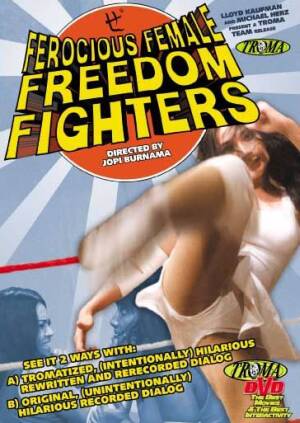 After the excesses of Lady Terminator, I hoped for something equally as berserk here: instead, however, I got a reminder of why I sometimes hate Troma so much. Here, they took a fairly lame Indonesian movie (called, I believe, The Stabilizer) and handed it to the brother of head honcho Lloyd Kaufmann, who wrote a “funny” script and dubbed it: imagine What’s Up Tiger Lily with fart gags replacing all wit and humour. Here’s a sample: they make the hero an Elvis impersonator. Oh, hold my sides, for I fear they may split with laughter…
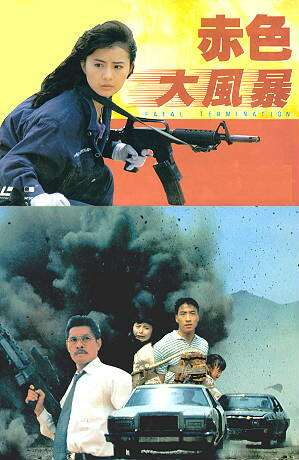 At first, this isn’t much of anything, least of all an action heroine movie. Cop Simon Yam investigates a customs officer (Shou) who is smuggling guns; it’s pretty ho-hum until an innocent underling is killed after finding evidence of the crimes. When his sister Moon (Lee) and her husband (Lui) get involved, this swiftly leads to the one scene in this film that
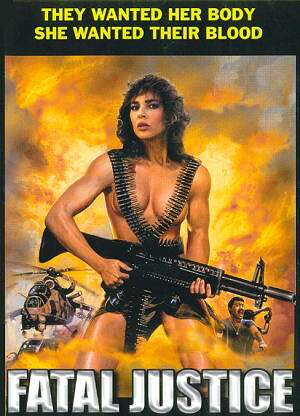 Half a point added for the lurid sleeve, an absolute classic of exploitation, that certainly lurid-ed us (“us?” says Chris – okay, me…) into purchasing, even as I knew it would disappoint. And I was not, er, disappointed in my disappointment. There’s a slight hint of Alias about the plot, in which an agent (Ager) with a penchant for wigs, discovers her father (Estevez) is in the same organization, and that she might not have been working on the side of the angels. It diverges sharply when she is ordered to kill him, along with a training camp for assassins that badly overstays its welcome. [Though it has a decent start, where the would-be hitmen have to cut the patriotic bull and admit they just like killing people.]
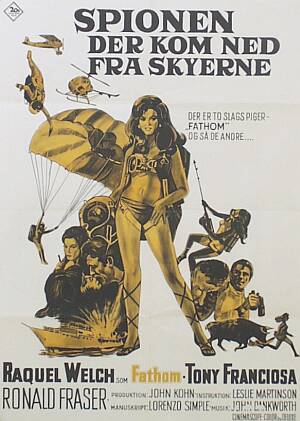 Released five years before Jennifer Garner was even born, there are some odd similarities between this 1960’s time-capsule and Alias:
 Odds are you won’t see the key twist here coming, but on the other hand, it renders the preceding hour almost redundant. This sums up the entire film: as an exercise in technical style, few directors are as good at camerawork as De Palma, yet little here withstands scrutiny, despite an abundance of smoke, mirrors and Romijn-Stamos. She plays Laure, a jewel thief who cons her partners out of $10m in diamonds, then is lucky enough to fall into another identity. Seven years later, they get out of jail, still miffed, and she’s now married to the American ambassador. When paparazzi Bardo (Banderas) exposes her identity, she instigates a complex plan to play her various problems off against each other.
 Paul plays Philadelphia detective Laura Underwood; while investigating a string of deaths in which men have fallen from buildings, she discovers they are all her high-school classmates. Someone is clearly delivering payback for old misdemeanours. That someone would be Vicky (Johnson); the film is upfront about this, and indeed, there’s very little that isn’t out in the open. We know the who and the why, which leaves the film short on suspense. Paul is hardly credible playing a cop either, and Hall as her ex-fiance Brian is simply irritating.
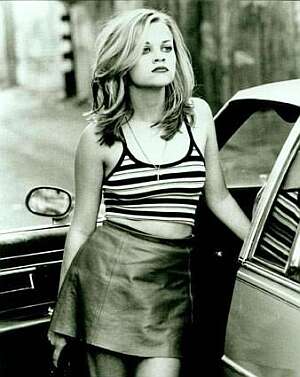 Right from the opening credits, a debt to the Brothers Grimm is clear. In this modern-day version, Red’s stepfather is a sleazebag crackhead, and her mother a street hooker; when both get carted off to jail, Vanessa Lutz (Witherspoon) heads, with basket, up Interstate 5 towards Grandma’s house. Except that on the way, she meets Bob Wolverton (Sutherland), the notorious I-5 killer. And what big teeth he has!
 Wuhrer plays Sasha, a space pilot coerced into attempting to stop a rocket, hijacked by evil emerald dealer Conrad Nash (Rossi) and his creepily incestuous sister Carla (Rubin), from ploughing into LA. The proper pilot (O’Keefe) provides assistance, with much running around corridors and plunging into a glycerine tank. Yes, glycerine: a feeble excuse to give our heroine the wettest T-shirt of all time. Between this and the “ass panning” (as Chris described Simandl’s fondness for shooting at waist level), it seems disturbingly fetishistic, though a large chunk is due to footage spliced in from another movie – see
 Five years after a vicious gang-rape, Chihiro has somewhat recovered, with a new apartment, job and boyfriend. But one of the attackers turns up on her doorstep, with a video of the assault, and threatens to destroy her new life. He moves in. Worse yet, his colleagues are on their way. What’s a girl to do? If you answered “kill the bastard, stuff him in her freezer, then wait for the other two rapists”… you’ve clearly seen this before.