



★★½
“Because the more accurate, Taking the Luke-warm, wouldn’t exactly fly off the shelves.”
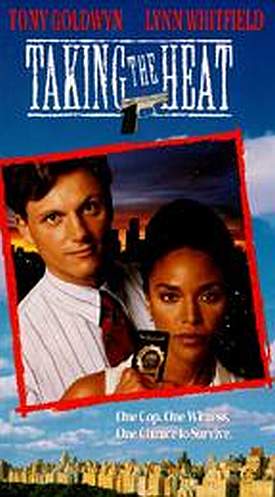 Michael Norell (Goldwyn) sees mob boss Tommy Canard (Arkin) whacking a debtor, but won’t admit it to the cops. However, when they look at the credit-card transactions, the truth comes out and Detective Hunter (Whitfield) is sent to retrieve the witness; Canard, thanks to a mole, also finds out and send his top hitman to ensure Norell never reaches the courthouse. A heatwave has simultaneously hit New York, leading to blackouts, gridlock and a breakdown in communications, so it’s down to Detective Hunter, back on her old stomping ground, to negotiate her way through the traffic jams and dodge the killers out to get Norell.
The IMDB states this 1993 film is a TV movie. Some language and one brief nude scene seem to argue against that, but with some minor trims, it could certainly play on television, and there are some aspects, such as the Patrick Williams original score, which appear straight out of TV-land. The story is hardly novel – Midnight Run is perhaps the best-known example of the ‘Protect the irritating witness’ thriller, and if you’re looking for a distaff version, In the Line of Duty IV has more martial-arts, courtesy of Cynthia Khan and Donnie Yen, than you could possible want. This isn’t up to the level of either of these, and barely scrapes by as an acceptable way to waste ninety minutes on a wet weekend.
The film does occasionally get away from the pedestrian, but the potential inherent in the scenario, as the city swelters and boils in the heat, turning into an urban jungle, is largely wasted. There are some moments which work quite nicely, such as Hunter and Norell picking their way through a booby-trapped drug den, but it’s largely predictable stuff, with the heroine and her charge initially bickering like cats and dogs, then – over the course of a mere few hours – falling for each other. For most of this, I couldn’t help thinking, Whitfield is no Pam Grier – though in her defense, few people are, and she does well enough, I suppose. If there’s nothing else on TV, it’ll do.
Dir: Tom Mankiewicz
Star: Tony Goldwyn, Lynn Whitfield, Alex Carter, Alan Arkin
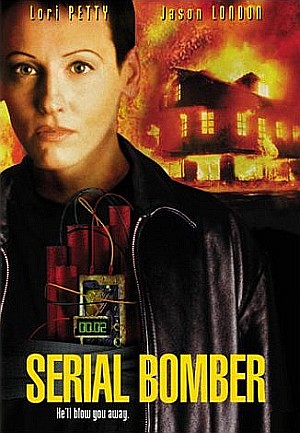 Mad bomber Chris Murdoch (London), is running around Seattle, blowing up Japanese people. FBI agent, Sara Davis (Petty) is part of the team looking into the case, but though they take Murdoch’s Japanese girlfriend (Kawagoe) into custody, Lt Sugimura (Amami) of the Tokyo police sweeps in and demands they release her, so she can be returned home – her father has influence on both sides of the Pacific. Davis won’t let that happen, since the girl is their main hope of catching the bomber; he, needless to say, is none too pleased to find the love of his life in the hands of the police.
 This is a competently-made but ultimately forgettable film – it feels very much like a TVM, albeit for one of the slightly-more liberal channels. Hemingway plays Secret Service agent Lynn Delaney, who has to look after the Vice-President, when their place crashes in the Pacific. Of course, in the way things only happen in Hollywood movies, the island to which the struggle is a rebel outpost, and the VP is a former soldier, with more-than adequate combat skills of his own. Which extend to more than shooting people in the face, Dick Cheney please note. Meanwhile, there’s a lot of tension with female journalist Sharon Serrano (Bennett), who is also among the survivors; this includes tension of a sexual kind, if you know what I mean, and I think you do. Like I said: one of the slightly-more liberal channels. However, it’s nice that no big thing is made of this; you’re not whacked over the head with anyone’s sexual orientiation, as in D.E.B.S. [Curiously, even the nods in this direction are edited out from some releases]
 Take an FBI agent with some psychic ability, January Blackburn, and partner her with part-vampire Catholic priest, Dorian Scarletti. Intrigued? Me too. That’s the premise of the three stories in this book, where our odd couple investigate paranormal crimes around the US. The results are somewhat uneven, yet with much promise: Blackburn is probably a more interesting character, possessing both great inner strength, and quirks that make her vulnerable and more human. In contrast, Scarletti, thus far, seems a bit like a “vampire by numbers”, with all the standard moping around, relationship angst and so on, too familiar to be of more than passing interest. Though, must say, his weapon of choice – hundreds of cross-shaped throwing knives inside his coat – is worth cool points in my book (even if I presume he doesn’t go through airports).
 Despite influences all over the place – Assault on Precinct 13, Aliens, Night of the Living Dead, The Magnificent Seven – Siri takes and runs with them very effectively. Laborie (Farès) is a career soldier, tasked with transporting an Albanian gangster to his trial; but the convoy is ambushed, so she and her men hole up in a nearby warehouse on a deserted industrial estate. However, it is being robbed by brothers Santino (Magimel) and Nasser (Naceri), plus their crew – and the attackers have also followed them, intent on rescuing their boss. Can they survive until help arrives?
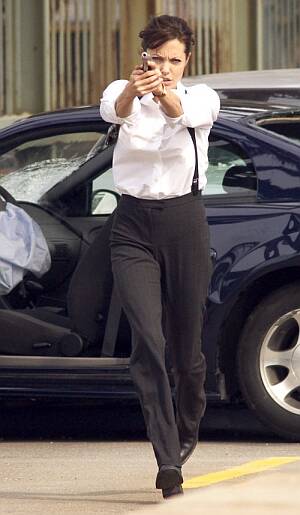 Rarely has a film started so promisingly, and gone so consistently downhill. The start is fabulous, with one of the most shocking moments I’ve seen…though if you’ve seen the trailer, you’ll have had it spoiled. But regardless, the first time we meet FBI profiler Illeana Scott (Jolie), on special assignment to Montreal, she’s lying in a grave. She is hard as nails, and takes absolutely no crap from anyone: her local friend, Captain Leclair (Karyo) hardly needs to bother protecting her, despite the nicely-handled cross-border tension. The case is that of a serial killer who, as the title suggests, inhabits the lives of his victims: the crack comes when his mother (Rowlands), believing him dead for two decades, spots him in Montreal by chance. However, the only other person to have seen the suspect is art-gallery owner James Costa (Hawke), but Scott starts finding her emotions getting in the way of her work…
 This frothy concoction is light-hearted entertainment, which doesn’t exactly pack much of a wallop, but has some nice characters and situations. Heroine Chun (Kim), is a young cop, galled when her undercover mission is swept away by a rival; she gets another chance, but to her dismay, this involves going back to school to watch the daughter (Nam) of a gang member who has agreed to testify against his boss, but has since vanished. Of course, a hot-tempered cop with martial arts skills fits
  This is an interesting contrast to Sunland Heat which took a woeful script and executed it briskly enough to work. Here, the story isn’t bad – Anna Rios, a Hispanic lawyer (with a special forces background!) goes back to her roots, after her brother is gunned-down, and uncovers a maze of murky deals. It’s the execution which is largely inept, “Kantz” providing further evidence that one-name directors suck at GWG films – see also Charlie’s Angels: Full Throttle (McQ), Catwoman (Pitof), Ecks vs. Sever (Kaos) and Tomb Raider 2 (Jandebont).
 The daughter of Clint does her best in this police thriller but, despite one decent twist, and a couple of half-decent scenes, this collapses under the weight of too familiar a storyline and some rampant overacting. Inspector Billie Palmer (Eastwood) is assigned to catch a killer who has promised a victim a day for 20 days, and is living up to their promise. Events centre around a local deaf priest (Rhys-Davies), but she also must deal with a disgruntled suspect whom she shot, a traumatic incident in her past, and a suspiciously knowledgeable informant. Oh, and a laughably gratuitous sex scene that appears out of nowhere, 80 minutes in.
 Another title in the ongoing Metropolitan Police Branch series, has much the same ingredients as the other entries: cheesecake and mildly competent action. I think this is the second entry, but as the three films have three different pairs of actresses playing policewomen heroines Mika and Rin (Hara + Iijima in this case), it’s clear continuity is less the purpose of the exercise than the aforementioned C + MCA.