




★★
“A more appropriate title – Valium: Feel the Pillow”
 I’m still trying to work out what the title actually means; it certainly bears no relevance to the film. More generaly, the biggest point of interest is its similarity to Blade 2, which took the basic concept (hunt for the carrier of a virus that turns its victim into bald, psychotic bloodsuckers) and did a lot more with its Eastern European setting. Henstridge is Delon, a policewoman who has her partner dismembered while they search a house, and Lambert leads the backup team – they follow their target into some vents which connect to an old prison, and where they rapidly become the prey. All this is set just outside a post-apocalyptic (plague, specifically) Boston – though the cop cars have ‘POLICIA’ on them. There’s also a subplot about Delon’s son, and a black-market passport she bought for him, which is of no significance whatsoever, and is probably there only to get the running time up to feature length (and at 76 minutes, only barely!).
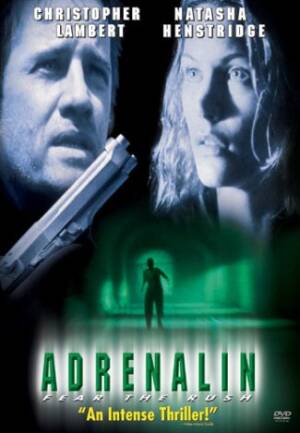 Shot in what looks like four rooms, it’s up to director Pyun to make the most of a higher-profile cast than he usually manages – unfortunately, he fails, though I liked the snap-zoom technique applied to bullet hits. This is straightforward ‘spam in a tunnel’ cinema, with little tension, character, or anything else that might elevate this above the mundane. Henstridge, bless her, does what she can, and comes over like a grubby version of Lara Croft; her undeniable action heroine potential has so far been wasted in stuff like this or the lame She Spies. Partly shot in the capital of Herzegovina, Mostar, the “just-bombed” look is likely genuine, from a conflict that only ended the previous year; it may be exploitative, but at least Pyun brought employment to the locals. I imagine he’s now scouting locations in Kabul and Baghdad.
Dir: Albert Pyun
Star: Natasha Henstridge, Christopher Lambert, Norbert Weisser, Elizabeth Barondes
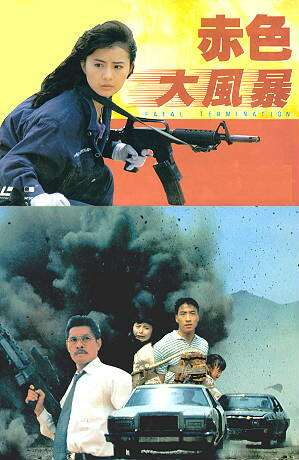 At first, this isn’t much of anything, least of all an action heroine movie. Cop Simon Yam investigates a customs officer (Shou) who is smuggling guns; it’s pretty ho-hum until an innocent underling is killed after finding evidence of the crimes. When his sister Moon (Lee) and her husband (Lui) get involved, this swiftly leads to the one scene in this film that
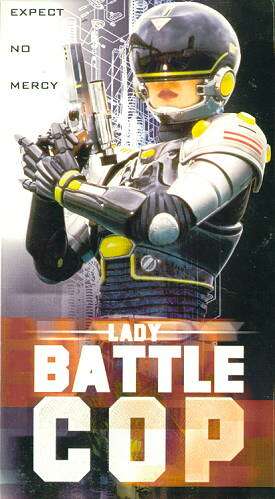 At least, so claims one of the songs in this largely ineffective movie, about professional tennis starlet Kaoru – Anna Kournikova will be in the Hollywood remake, no doubt – who is transformed into a crime-fighting machine. This takes place after she is killed by the Cartel, a crime syndicate bent on taking over Japan, despite apparently having about seven members. They do, however, have a “psychic robot” called Amadeus, which is probably the sole original thought in the entire film, and the whole thing gets kicked up a notch during his battles. The interesting question of where he came from (apparently a NASA creation), is never explored. This is a shame, since it’d be rather more interesting than almost anything the film actually offers.
 This film is a 90-minute explanation of why Jade Leung’s star never took off. While some decisions Michelle Yeoh made might have been questionable, at least her films were rarely boring, and never down to the level of this piece of tedious dreck. It depicts the struggles of a class of policewomen (including Jade), to become part of the elite. The idea certainly has potential – the Inspector Wears Skirts series has a similar premise – but here, there is almost no character given to any of the girls; they all blur into each other, like a dozen GI Jane-wannabes.
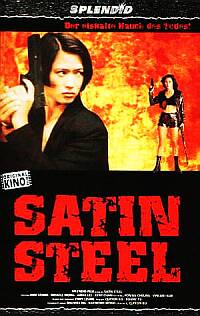


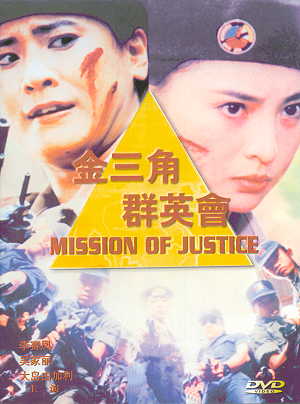 I hoped for more from a pairing of Lee and Oshima, each having done fine work individually, but as is often the case, the return declines, the more action heroines are crammed in. There’s no less than five here: two special agents (Lee and Oshima), their commander (Ng), plus the smuggler they’re after (Sharon Yeung, at a guess?) and her sidekick. Oh, Sophia Crawford turns up briefly too. Never mind the quality, feel the width…
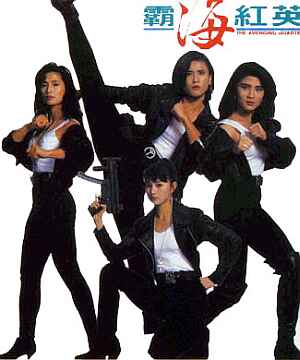 Add supporting roles for Michiko Nishiwaki and Yukari Oshima to Khan and Lee, and you should have a winner, all four being in perhaps the top half-dozen or so action heroines from Hong Kong. Yet while the fights here are grand, the film wastes far too much effort elsewhere. Khan is a Chinese cop who comes to Hong Kong and bumps into gangstress Lee while looking for former lover Waise Lee, who is a) also Lee’s love, and b) now involved with a painting that hides documentation on Japanese wartime human experiments, which Nishiwaki is trying to sell to Oshima. Like I said, far too much effort (if you want to know about those experiments, track down the grim but jaw-dropping Men Behind the Sun).
 Things do perk up later on; after all the oestrogen, Chin Kar Lok is welcome light relief as an amusing dumb cop, and the finale is excellent, with echoes of Thelma and Louise. However, it’s too little, too late. It’s worth pointing out that while the title and artwork imply some kind of team-up, as in The Heroic Trio, the reality is unfortunately totally different, and nowhere near as interesting.
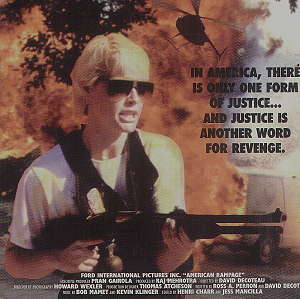 While not averse to the idea of gratuitous nudity in movies, this movie presents some of the most startlingly unattractive examples I’ve seen in some time – but then, director Decoteau is now making (more or less openly) gay-interest movies, so his judgement in such things is highly suspect. Even the heroine, Detective Samantha York, is…well, let’s be kind and say “homely”, though this could count as refreshing realism, given LAPD officers don’t win many beauty contests. I would like to think, however, that they are better shots; York couldn’t hit a barn if she was standing inside it.
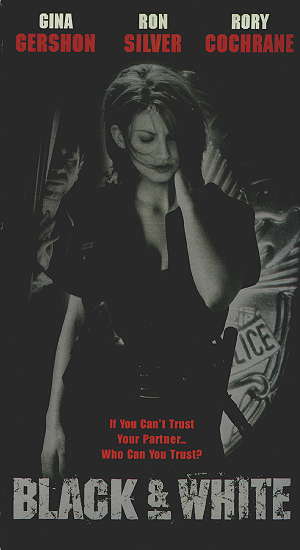 Gina Gershon showed previous action heroine potential in Face Off; here, she moves a little further up that line with an effective whodunnit in which she plays a thoroughly unconventional homicide cop with a shady past. Cochrane is her rookie partner, who begins to suspect she may be the serial killer who is taking out the local garbage. There’s almost inevitably a sense of disappointment in twisty thriller like this one; when the film-makers reveal the real culprit, the viewer tends to feel let down. Black suffers less from this than most, though still requires some suspension of disbelief. The script, by the director and (one assumes, his brother) Leon Zeltser, crackles along nicely, with convincing dialogue and good pacing, revealing information at just the right rate to keep the audience guessing.
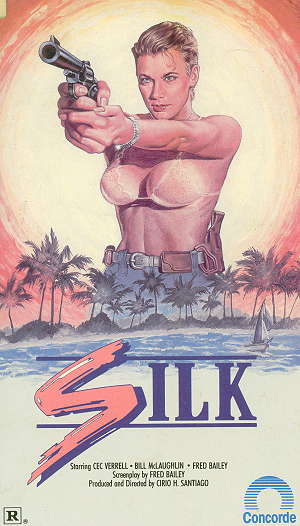 One of the primary rules of exploitation cinema, is never to trust a movie with painted box-art. And, verily, no scene like the picture at right occurs in the film. Indeed, the whole film is sold on sizzle rather than steak, and will probably leave you feeling more than a little hungry. Verrell looks the part, though her slicked-back hair is rather too cliched and obvious, and she does appear to be doing her own action. Her lack of acting ability is painfully obvious, however, and Santiago is wise to keep her dialogue to a minimum.