
Ring Girls

★★★
“Punches above its weight.”

This dates back from 2005, before Carano was a household name in the world of mixed martial arts, or a somewhat successful actress. At this point, she was only involved in the sport of muay thai, which as it’s name suggests, is a martial art originating in Thailand. She was one of five girls training in Las Vegas under Toddy – a nickname given because the teacher’s real name of Thohsaphol Sitiwatjana was too unpronounceable to Westerners! The goal of both Toddy and his students was a trip to Thailand to take on the best local practitioners of the sport. This “documentary” covers both their training and the visit itself, climaxing with Carano’s battle against the Thai champion.

Quotes are used advisedly around documentary, because of two elements – neither of which help the film. The first is some kind of beef, I’m guessing entirely fabricated, between Toddy and his brother “Master A”, who is a muay thai trainer back in Thailand. Apparently Toddy brought disrespect to the country by teaching their skills to foreign devils or something. [I think this may have been lifted from the life of Bruce Lee?] It’s a bit silly and pointless, but at least it can easily be ignored. Worse are the fake sounds added to the fights, when punches and kicks land. They’re not even well done, and rather than enhancing things, make the contests seem fake.

This is unfortunate, as there’s otherwise a lot to like here. Even though an unknown at the time, you can see why the film focuses on Carano, who is clearly not just the best fighter, even to my amateur eyes, she is also the most charismatic. Sometimes, this works against it: we barely get to learn the results of the other four fights in Thailand. But it mainly helps, like a low-budget movie which lucks into starring a future Oscar winner [hello, Cyborg 2!]. And despite the post-audio’s relentless attempts to derail things, the fights are quite impressive, with the impact of the blows apparent purely from the visual side, such as the reaction of the punchee.

It all makes for a rather inconsistent blend of fact and fiction, and everyone involved would have been better served by deciding in which camp they stood. If fictional, develop a better narrative, with setbacks (at the risk of spoilering, I’m not sure we see any of the girls ever lose a match). Or go strictly factual, and use the time spent on things like Toddy’s family issues, perhaps to give us deeper background on the fighters. Heck, more info on the Thai women would have been welcome, too, comparing and contrasing life in Bangkok to Las Vegas. However, you should not let these criticisms put you off watching this (I stumbled across it on Amazon Prime), as it’s still an interesting insight into the tough world of women (or the world of tough women?) in martial arts.

Dir: Jennifer Ferrara + Thomas Weber
Star: Gina Carano, Master Toddy, Ardra Hernandez, Lisa King

Avia Vampire Hunter


How to finish 2018: one of the all-time worst action heroine flicks.

I usually try to be tolerant when it comes to low-budget cinema and the resulting flaws. There are some things which you just cannot expect when a film is financed on the maker’s credit-card, and I’m willing to overlook rough edges if a movie can hold my interest in other ways. However, there are times when the end product is almost irredeemably bad, with few, if any, merits. This would be one such case. Your script is the main area which should be an area of equal opportunity, regardless of budget. Here, if anything, the flaws at the technical level are magnified by the failings on the page.
Vast chunks simply don’t reach basic coherence, with scenes that come out of nowhere, go nowhere or are entirely unconnected to anything. And what little does makes sense is completely uninteresting. Let me give you an example of the former:

  • Insert shot of the kind of clock you’d find at your grandmother’s
  • 30 seconds of hand-held camera moving towards the heroine as she kneels in a forest
  • 90 seconds of her twirling a sword to no purpose, where my main reaction was “Why are there table napkins stuck to the trees?”
  • 25 second of hand-held camera backing slowly away from the heroine.

The basic story sounds as if it might have some potential. Avia (Valentino) saw her family attacked by vampires, and made it her life’s mission to seek out and destroy them, with the help of police officer Detective Raymond Guy (Jackson). Except it’s executed in such a low-energy and incompetent fashion, from the performances through the woeful audio mix, to the action – the only person who has a slight clue how to fight is Tomahawk, who plays the master vampire. Otherwise, the sole entertainment value to be found is in mocking its inadequacies. I will say, there’s plenty of scope there, from the moment Guy and his partner don’t notice Avia bringing a large samurai sword when she tags along with them on a routine interrogation.

The whole thing about her family? Forgotten entirely after it has been mentioned. The relationship between Avia and Raymond? Thoroughly unconvincing, sinking to “howlingly bad” during their fully-clothed sex scene. The use of music is particularly execrable, being completely inappropriate to what’s happening on screen to the point it appears to have been added at random. This is despite the presence of eighteen names in the opening credits as “music by”, not counting the London Philharmonic Orchestra, whose presence here is… well, let’s say it came as a surprise to me, and probably to them as well.

The only moment where I had interest briefly roused, was the suggestion made by Raymond’s partner (who vanishes for the middle two-thirds) that Avia might actually be completely insane, and killing innocent people in the belief they are vampires. Her slaughter of a family supports that theory, and it could have been an interesting direction. Except that the film has already established she has official sanction for her acts, Raymond clearly doesn’t give a damn about the possibility, and the final coda has Avia saying it doesn’t matter either. So why bother? Indeed, “why bother” is an entirely appropriate summary of the whole enterprise. Take my advice, and don’t.

Dir: Leon Hunter
Star: Allison Valentino, Rodney Jackson, Cliff Lee, Antonio Tomahawk

Shira: the Vampire Samurai

★★
“Blade-ette”

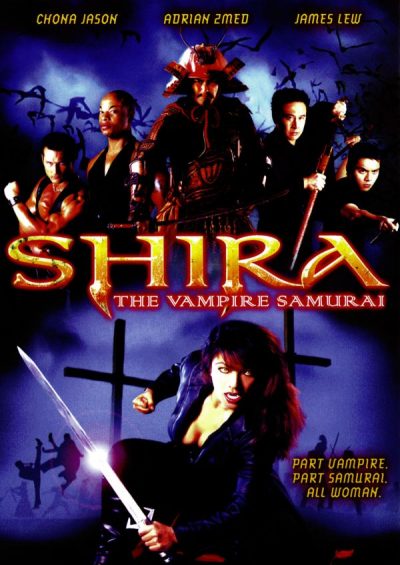
I could have sworn I’d seen this before, to the point where I almost skipped over it on Amazon Prime. But on checking, appears not. Did I watch it, and just not review it? Or does it only seem very familiar? It’s clearly trying to be a low-budget, female version of Blade, with its half-vampire heroine taking on her cousins, with their plans against humanity. In this case, Shira (Jason) is bitten by a vampire in medieval Japan, but somehow ends up not going full-bloodsucker herself – apparently because she tried to commit suicide first. The film bounces back and forth between then and the present day, where she has become a vampire hunter, along with her Scooby gang. Yet she has also come to the attentions of Kristof (Zmed), who owns a strip-club for reasons that, I’m sure, are entirely necessary to the plot. He and his former Nazi death-camp vampire scientist assistant want to use her in a breeding program to create a new race of super-vampires, who can go out during the day. Shira, naturally, is having none of this.
This probably would have worked better if it had decided whether it wanted to be Shira’s origin story or not. Either stick to the feudal Japan setting or the modern one: instead, the constant bipping between the two is thoroughly confusing rather than enlightening. A better-written script would have handled her creation in a brisk five minutes, then have allowed more opportunity to develop the contemporary portion, which comes off as rather under-cooked. Not helping matters here are the slew of supporting characters, most of whose purpose and motivations are never adequately explained. The whole thing feels almost as if this was a trilogy, edited down to feature length, with little regard for a coherent narrative. As a result, subplots are left sticking out at a variety of awkward angles.

For example, Shira is being pursued through the centuries by Kenji (Klein), a samurai with a grudge. What is the serum Shira apparently has to take on a regular basis? And a descendant of Professor Van Helsing also shows up, to no particular purpose. On the plus side, the fight scenes are copious and surprisingly well-choreographed. Admittedly, with regard to the latter, it probably helps that I watched this immediately after the dire Hollywood Warrioress, which would make anything look good in comparison. So, amend that to be “seem surprisingly well-choreographed,” perhaps. And if you don’t like this one, there’ll be another along in a couple of minutes. It builds to a “homage” to Enter the Dragon, with Shira chasing Kristof through a hall of mirrors. Because…  Hell if I know. Why not?

It makes about as much sense as the rest of the film, e.g. why does Shira’s boyfriend (Dwonzh) spend so much time with his shirt off? Pondering these enigmas may well provide as much amusement as the movie itself.

Dir: “Simon” (Jeff Centauri)
Star: Chona Jason, Adrian Zmed, Louis Klein, Lawrence Dwonzh
a.k.a. Vampire Shadows

Duelist

★★★
“A triumph of style over content”

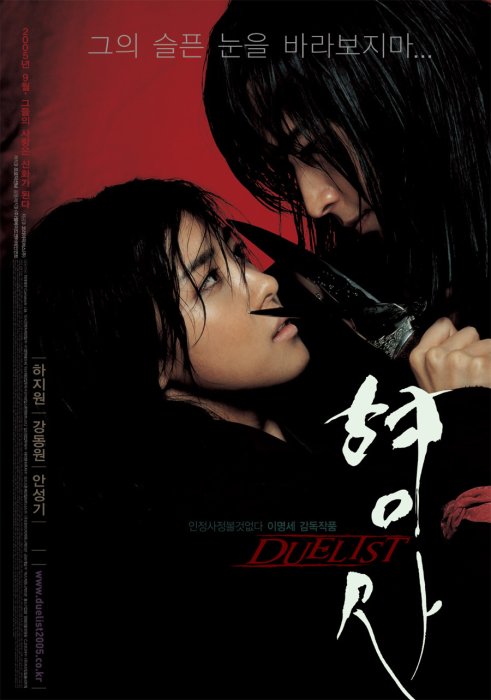
DuelistposterNamsoon (Ha) is a hard as nails detective in medieval Korea. While working undercover at a market on a counterfeiting case, she encounters a masked man (Kang), and battles him before he vanishes, though not before she manages to cut away a fragment of his mask revealing his ‘Sad Eyes’ – the name by which he is known for the rest of the film. What is his tie to the forged money? And why has be been seen going into the house of a powerful government Minister Song (Song)? Namsoon and her mentor, Ahn (Ahn) investigate, though the closer they get to the truth, the more perilous things become, not least because she begins to fall for Sad Eyes, especially after infiltrating Song’s mansion as a courtesan – a task for which she is singularly unsuited. After a public incident, while Ahn has to fire Namsoon from the police force, this is merely a ruse, allowing her to go after the final piece of evidence they need to raid Song’s mansion and bring down his operation.

Rarely have I seen a more beautifully-shot film. Truly, this picture is as pretty as a… er, picture. The cinematography is top-notch, offering a sumptuous feast of visuals that mixes styles and techniques to great effect, and freeing the movie from bothering with banal chores like dialogue for extended periods. Unfortunately, neither the story nor the characters are a match for the look and feel, leaving the viewer largely to admire the film, rather than being engaged by or liking it. As I recall, the director’s previous film, Nowhere to Hide, had much the same issue, pitting two (male, there) adversaries against each other, in a rain-drenched landscape that was emotionally distant – but, boy, did it look good. Here, the action is extremely stylized, resembling a modern dance routine more than a fight in some cases, or even, as one character puts it, “It was like they were making love under the moonlight.” I also sense there are creative anachronisms at work: did they even have cops, never mind lady ones, at this time? However, the biggest weakness is likely the sudden way Namsoon falls for Sad Eyes; she doesn’t seem at all like the kind of person who would do that, and since this supposed relationship is at the film’s emotional heart, it’s a flaw that may explain why this feels so uninvolving.

Under other circumstances, this could well be a fatal flaw, yet there’s still enough for your enjoyment in the eye candy department to make this worth watching, even at a fairly long 111 minutes. One senses that Lee is much more interested in the technical aspects of cinema, rather than the emotional one of connecting with the audience. I can appreciate that side, certainly, yet for a film to be truly successful, there needs to be some yin to go along with the yang, or what results will seems frustratingly incomplete.

Dir: Lee Myung-se
Star: Ha Ji-won, Kang Dong-won, Ahn Sung-ki, Song Young-chang

Blood +: Episodes 1-25

★★
“Bloody mediocre”

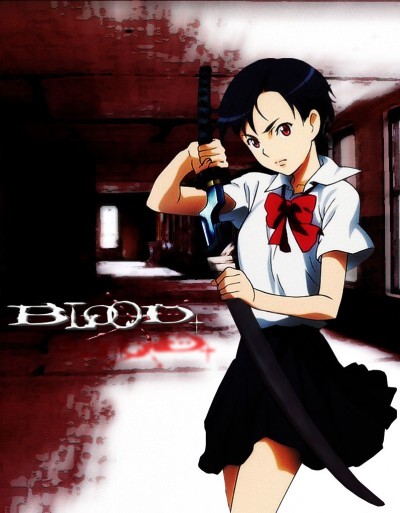
bloodThis is the third version of the same concept I’ve seen, following some years after the first animated version (released in 2000), but a couple of years before the live-action movie from 2009. What they both had over this was commendable brevity. If I’d realized the degree to which this was true, when I started the series on Netflix, I probably wouldn’t have bothered. The main problem, for anyone who has seen the other two takes, is that you know what’s going on. You’re well aware that the heroine Saya is a human-vampire crossbreed, who has now sided with humanity and dedicated her life to taking out the monsters. This was taken care of, quickly and efficiently, in the alternate versions, and we could move on to the kicking of vampiric ass. Here, however…. Not so much.
After 25 episodes – eight hours of story, even discounting credits – I still haven’t seen Saya in full-on attack mode. Indeed, I really don’t know a great deal more than I did after the first two parts, because the story unfolds at a glacial pace. A military group is trying to weaponize the “Chiropterans,” alongside a shady industrial conglomerate, Cinq Flèches. Opposing them is the Red Shield, dedicated to wiping out the Chiropterans, who can only be killed with a sword dipped in Saya’s blood. And then there is Saya’s own history: she may be a teenage girl in modern Okinawa, but she gradually remembers that she goes back through the Vietnam War, all the way to pre-Revolution Russia. Of course, telling this in chronological order would be too simple: not when she can have dramatically convenient amnesia, and recall things at whatever leisurely pace is needed by the plot.

Instead, we get a lot of chat about her not being fully “awakened” and, even more irritatingly, all the characters seem to know what’s going on, they just refuse to enlighten the audience. For instance, there’s a diary, started by the founder of Red Shield, Joel, which contains all his research; successive generations have kept it, to share with those who commit their lives to Red Shield. Do we get to know what’s in it? No, not even after Saya’s brother Kai is given the diary to read. It’s something which can be sustained for a short time, but as the episodes roll on, and information continues to be dribbled out, the approach becomes increasingly irritating. It’s a shame, since the core idea is imaginative, with scope for plenty of development, and the animation is solid, and better than I expected. There’s one wonderful episode in the middle, where an attack on a research facility unleashes children which turn into… things. I was all ready for this to be Saya’s blossoming, and the next dozen episodes to hurtle towards a thrilling conclusion. Didn’t happen.

Instead, we got more in the show’s ongoing series of inconclusive battles, with the villains muttering something dark and meaningful, before flying off into the night, and Saya recalls another incident from her past. By the time episode #25 rolled around, with the heroine finally getting to face off against the uber-mysterious Diva, I was wondering how it would all be wrapped up, but hardly unhappy to have finally reached the en… What? There’s another 25 episode chunk hidden elsewhere on Netflix? You have got to be kidding me. And, from the reviews I’ve read, these make the first batch look like masterpieces of storytelling. Don’t expect a review any time soon. Life’s just too damn short.

Dir: Junichi Fujisaku
Star (voice): Eri Kitamura, Akiko Yajima, Hiroyuki Yoshino, Junichi Suwabe

The Bullet Wives

★★½
“A heavily-armed version of The First Wives’ Club.”

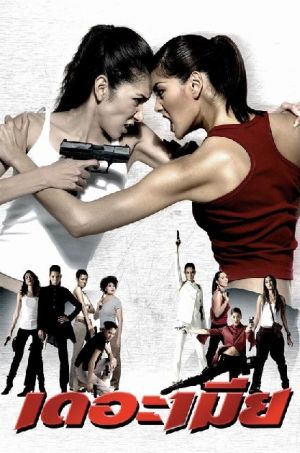
According to the film’s introductory narration, Thailand now has about three women for every man. This has led to many men both having an “official” wife, while also keeping a mistress, and not exactly being secretive about it – when the wife dies, the mistress gets “promoted” to replace her, which has obvious implications for both parties. In order to protect their rights, the eives form an association, the FCWI, which stands for First Class Wives International. Not to be outdone, the mistresses do the same thing, with the ECWI (Economy Class Wives International). After two members of the former are gunned down on a stretch of highway, the two groups seem set for a fiery and murderous collision between the wives and mistresses.
Except, it doesn’t really happen until the very end. Even at a brisk 77 minutes, there are way too many scenes of the two groups sitting around chatting, getting information from a guy who is selling to both sides, and deciding not to attack each other quite yet. Some of the technical aspects are also remarkably awful, given what appears to be a professional production in other ways – the audio, in particular, appears to have been recorded on a cellphone [which reminded me of another weird aspect; the informant’s cellphone appears to be right out of the 1980’s, the size of a brick, while everyone else has modern ones]. And since it appears the cast are almost entirely models, rather than even model/actresses, the performances are largely uninspiring, though Punnakan as first wives’ leader Jittra, does hold the viewer’s attention nicely when on-screen.

What also worked for me, surprisingly well, were the action choreography and cinematography. However, for that to happen, you must accept that the former is clearly intended to by hyper-stylized rather than in any way realistic. Once I understood and accepted that, I was able to enjoy those for what they are, and the camerawork is nicely fluid and, occasionally, truly beautiful, as when there’s a slow zoom out with the camera going up, over a bathtub containing a dead body. It’s moments like that which will keep you watching, through the severely tedious sitting around and feminine bickering.

Dir: Kittikorn Liasirikun
Star: Metinee Kingpayom, Nussaba Punnakan, Manassavee Krittanukoon, Naowarat Yuktanan

Operation Pussycat

★★★
“Superfluous if harmless remake, smaller in every way than Russ Meyer’s original.”

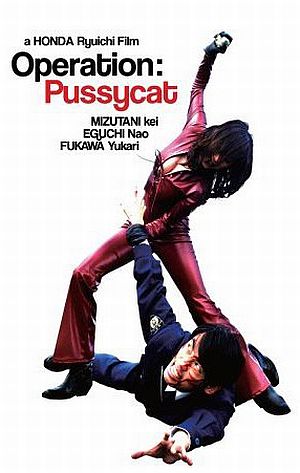
Faster, Pussycat is one of the icons of the action heroine genre, literally entire decades ahead of its time. This Japanese version uses a lot of the same elements, starting with a trio of go-go girls on the lam, under their macho leader. They stumble across a wheelchair-bound man and his muscular if taciturn companion, who appears to be stashing a large sum of money somewhere on the premises. If only they could find it… There’s also an innocent who gets entangled in the web of deceit and counter-deceit – in the original, it was because she witnessed them kill her boyfriend, while in this case, it’s after she apparently witnesses the three beat up a policeman, who stopped them for speeding, and discovered the dead body stashed in the back of their pick-up truck.

The main problem is likely anyone trying to step into the shoes – make that, boots – of Tura Satana. It’s probably a lost cause for anyone, trying to capture the complete commitment of Satana, who took the role by the scruff of the neck and shook it, like a Rottweiler mauling a rag-doll. It’s this which was largely responsible for lifting the original to its heady, dizzying heights. Much as Mizutani gives her all, in the parallel role of “Harry”, she’s inevitably going to come up short, and the film never reaches the same heights as a result. The dialog in the original was another highlight, cheesily fragrant like the ripest cheddar, and while it may be the translation at fault, none of the lines here stick in the mind the same way.

That said, while a pale imitation, this is still fun enough on its own terms, and was clearly made with a lot of love for the original, which I can only respect. At a mere 43 minutes, it gallops along at a brisk pace, and the areas where it diverts most sharply from Faster – particularly the end – were interesting and offered scope for future development. All told, while there’s really no point to this, that isn’t enough to condemn it, and if treated as a homage to Meyer, it’s a pleasant, if brief, diversion.

Dir: Ryuichi Honda
Star: Kei Mizutani, Nao Eguchi, Yukari Fukawa, Eguchi Nao

Angel-A

★★★½
“Emotional Battle Angel.”

Andre (Debbouse) is at the end of his tether, owing large amounts of money to at least three separate gangs. He decides to end it all by leaping off a Parisian bridge into the Seine below, but is beaten to it by the tall, leggy blonde, Angela (Rasmussen, who you may remember in a bathroom stall with Rebecca Romijn-Stamos in the opening of Femme Fatale). His suicide forgotten, he jumps in to save her, and as they sit, dripping on the river-bank she vows that she will repay his selfless act by taking care of him. This may not be quite the way he expects; for example, she hijacks a negotiation with one of the mobsters to whom Andre owes money, marches upstairs and emerges not long afterwards, the debt apparently forgiven and with tens of thousands in bonus cash. Just as important as resolving his pecuniary problems are the emotional ones which plague Andre, and Angela is perhaps even more adept at addressing those: his lack of self-confidence, trust issues, an inability to give or receive love and so on. She sees the good person who is buried very deeply, and slowly teases it out. For her name is almost literal: she’s an angel, sent down to save Andre from himself.

After six years where he was involved in writing a dozen film and producing even more, this was Besson’s first film as director since The Messenger. Nice to see him back, and the decision to shoot the entire film in black-and-white adds to the fairytale feel, though sometimes it feels more like a Calvin Klein commercial than anything else. The contrast between the 5’10” Rasmussen, towering over the 5’5″ Debbouse like an Amazon, is also unique, and it’s the former’s attitude that makes it qualify here, in a way reminiscent of Run Lola Run. Angela is as relentless as a force of nature, and will let nothing and no-one get in the way of her mission; in this way, she also reminds me of Leeloo in The Fifth Element, or even Mathilda from Leon.

In terms of action, it’s more understated than I’d like: Angela could certainly kick the ass of everyone else in the film, but never needs to get out of second gear. However, the emotional content of the film is considerable, never more than in a single shot that seems endless, where Angela makes Andre stare into a bathroom mirror and look at himself for, probably, the first time in his life. It’s a beautiful moment of impressive heartfelt exposure, laying bare Andre’s soul and exposing the human heart beating inside the scam artist. If not quite the badass-oriented remake of Wings of Desire I was hoping for, it proves very satisfactory and a unique romantic fantasy. I hope Besson doesn’t forget to showcase his own talents as a director more often in the future.

Dir: Luc Besson
Star: Jamel Debbouze, Rie Rasmussen, Gilbert Melki, Serge Riaboukine

Princess Aurora

★★★★
“Hell hath no fury like a woman… Well, let’s just leave it at that, shall we?”

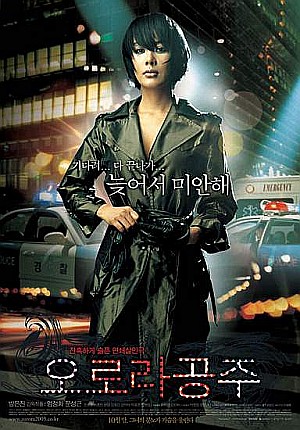
After inflicting Forbidden Warrior on Chris, my stock with her had slumped like Morgan Stanley. Fortunately, this Korean serial-killer flick provided a good measure of redemption. It stars in a department store, where Sun-Jung (Uhm) sees a mother abusing her young daughter, before leaving her and going into a stall. Sun-Jung shepherds the girl outside, breaks into the stall and stabs the mother repeatedly. The case is investigated by Detective Oh (Mun), who spots his ex-wife in the store security video. When bodies keep turning up, though killed in different ways, the police link the cases due to the cartoon stickers found on each scene. Oh gradually comes to suspect his wife is taking revenge on those holds she responsible – directly, or otherwise – for the death of their child, killed in a brutal kidnapping previously. Is that really the case, and if so, does he have the moral fortitude to turn in a woman he still loves as a murderer?
At first it seems that Sun-Jung is simply a psychopath, albeit one who only takes out those who (more or less) deserve it, such as the mistress she sees being unsufferably rude to a food-delivery woman. However, the truth that emerges makes her different from just being Hannibal Lecteress (which makes sense, since female psychopaths are different from their male counterparts), and director Bang brings her own female sensibility to the portrayal. There’s no doubt where the focus of the film or its sympathies lie. However, not until the final reel, after you think everything is over, is everything unfolded: it makes perfect sense, and is as chilling a denouement as you can possibly hope to imagine, with Sun-Jung not the deranged killer she appears to be.

It’s Uhm’s movie as much as Bang’s, with her performance entirely convincing: she doesn’t look like a dedicated, cruel and ruthless killer, which is exactly the best way to be [and reminds me, I’m heading off to watch Dexter in a few minutes]. Her character is absolutely sure that she is doing the right thing, leaving the audience in an interesting predicament: do they go along with this moral certainty, and effectively become an accomplice to her crimes? Usually, in the female vigilante genre, there is some scope for distancing oneself, since the victim is usually the vigilante herself. Here, the perceived moral is more altruistic, and that makes things muddier. I’d love to say more, but can’t, without serious spoilerage, but there hasn’t been a more poignant story of love for a lost child in some time. It seems no-one does revenge quite like the Koreans.

Dir: Bang Eun-jin
Star: Uhm Jung-hwa, Mun Sung-kyun

Forbidden Warrior

★½
“Eminently forgettable. And I’ve now watched it twice, just to prove that.”

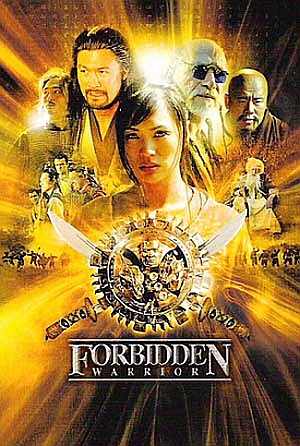
Though I couldn’t put my finger on why, large chunks of this seemed very familiar when I was watching it last night. Maybe it was just the story, cut from a template [mystical book, blah, chosen one, blah-blah, key to all power, etc.] we’ve seen a million times before. But then, when I Googled the film’s title, I realised why: at #6 was my review on our other, non-GWG site, from back in October 2005 when this came out on DVD [which I’ve just seen contains basically the same ‘blah’ line as above. Hey, if I had to watch this twice, you can read it twice. It’s the least you can do]. It made little impact on me then, and it hasn’t improved with time. The main problem is its absolute failure to stand on its own: the movie ends just as the heroine heads off towards the evil emperor who holds said mystical book, which only she can read. The aim was, apparently, to make a trilogy, but three years later, we’re still waiting for any word of the sequel. The moral is, if you’re going to make a series, either get your cash lined up in advance (as in Lord of the Rings), or make your first film capable of working by itself (see The Matrix) – otherwise, you’ll be left with something that looks utterly unfinished.

That aside, this is also not exactly enthralling. While the fight sequences are not bad, they are nowhere near frequent enough, and the first hour in particular is turgidly-paced. Seki (Matiko) is sent into exile for her own protection, as the only person standing between the emperor and world domination. There, her blind sifu (Amendola) teaches her magic and self-defense, while the emperor eventually sends out his sons to look for her – albeit after first waiting a couple of decades for her to grow up. It’s nice to see a good number of Asian-American actors getting decent roles, even if there there is a random mix of ethnicity that detracts from any real sense of time or place. It seems to be trying for some kind of Princess Bride-like vibe, yet the clunky set-up approach taken here would likely tax the patience of even a moderately-impatient eight-year old. Maybe they should have started in the middle, like Star Wars: the second episode has to be better than the first, largely because it can’t be much worse.

Dir: Jimmy Nickerson
Star: Marie Matiko, Sung Yang, Karl Yune, Tony Amendola