




★★½
“Once upon a time, there were three little girls…”
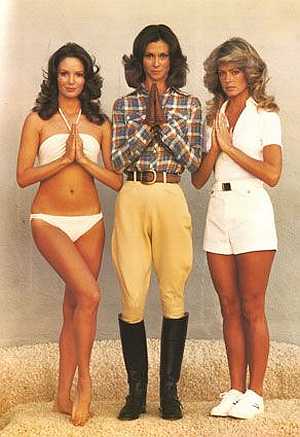 I suppose my main surprise is how pedestrian this was. Action? Hardly anything to speak of at all, despite the credit sequence which shows them training as police officers. The story has them going undercover at a vineyard, whose owner vanished seven years ago, and is about to be declared legally-dead: his ex-wife (Muldaur) and the sleazy foreman will clean up…unless the daughter, also missing, shows up. Of course, the Angels play both a fake daughter (Smith) and the ‘real’ thing (Jackson) – the former is designed to be exposed, in order to get herself involved with the wife and foreman, and reveal what’s going on. Quite cunning, really.
Cunning, yes – exciting…not so much, unfortunately. It plays mostly like the TV movie it is, and is never more than fluffy, warm-hearted entertainment at best. It’s somewhat interesting to note the presence of David Ogden Stiers as another of Charlie’s henchmen, a role later dropped for the actual series, where Bosley was deemed sufficient for all normal purposes. However, the biggest shock is perhaps an unknown Tommy Lee Jones, playing a childhood friend of the heiress, who threatens to expose the Angels’ plot. He probably gets more screen time than Fawcett-Majors, who is barely used at all in this episode: she gets one real scene of note, an entertaining performance as a backwoods bimbo luring the bad guys into buying her land, on the basis they think it’s loaded with oil.
Otherwise, it’s hard to say why this became one of the most successful series of its time, running for five seasons and 110 episodes, as well as spawning [albeit twenty years later] a pair of Hollywood motion pictures. Even those expecting a full-on jiggle-fest will be very disappointed, as the costumes here are more functional than anything: the most skin is shown by whichever of Charlie’s babes is handing him a drink – and I have to say, the whole concept of women unquestionably accepting orders from an unseen Father-figure seems more creepy and patronising than anything else. The 1970’s were a different time, however, and it’s not really fair to judge work from another era by our own standards of morality. On the other hand, this is only sporadically entertaining and slowly-paced, and that seems an entirely reasonable criticism.
Dir: John Llewellyn Moxey
Stars: Kate Jackson, Farrah Fawcett-Majors, Jaclyn Smith, Diana Muldaur
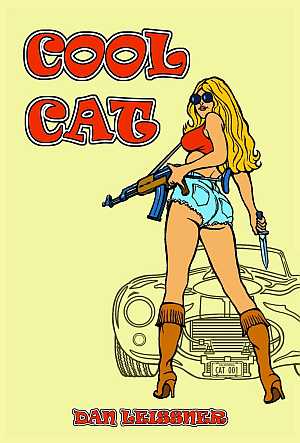
 My review of this is somewhat delayed, because the book spent two months inside what remained of our car, after a nasty accident on the freeway. It was finally rescued, and the next chance I got was actually on a plane going to Las Vegas – fortunately, it appears as though the book was not cursed, and I survived that trip intact. Chris actually got to read this one first: she made note of Leissner’s frequent usage of the word “Undulating”, to describe everything from the landscape to the heroine’s figure. Me? It’s a good word, one you don’t get to use too often, so more power to him there. The heroine in question is Cat Warburton, the semi-estranged daughter of an industrial tycoon, who works as a secret agent for an agency of uncertain origins. Her intended vacation goes awry, and she finds herself knee deep in a plot involving black militants, white supremacists and – this’d be a spoiler if it weren’t mentioned on the back cover – aliens from outer-space. She’ll need all her talents, if you know what I mean, and I think you do, to survive.
 Sometimes, you just have to sit back and let the DVD sleeve do the talking. “The notorious serial killer, Harry Eugene Loveless AKA Mr. HELL roamed from town-to-town and job-to-job, brutally murdering his victims, with the demonic intention of removing the ‘windows to the soul’ – their eyes! Mr. HELL mutilated Dr. Karl Matthews at a government laboratory where biological weapons were secretly being developed. The daughter’s precocious daughter, Tyler, who discovered her father’s body with his eyes missing, was then pursued by Harry through the lab’s subterranean tunnels. During the chase, Harry was accidentally destroyed by toxic industrial acid, and his remains flowed into a storage container. Was this the end for Mr. HELL?
 While it’s nice to see our favourite topic here getting some printed love, I can’t say I was impressed with this end result, which struggles to be all things to all women, and ends up not being very good at any of them. There’s no denying the breadth of coverage here, with everything from Sailor Moon to Ilsa getting covered – though they appear rather too willing to stretch the bounds of the term, “Amazons”. I mean: Pippi Longstocking? The coverage is grouped into various areas: monster killers, super-sleuths, fur bikinis, etc. along with additional essays on more specific themes, such as the representation of women as felines. It’s a somewhat lumpy distinction, which occasionally makes for strange bed-fellows, but occasionally comes up with some thought-provoking nuggets.
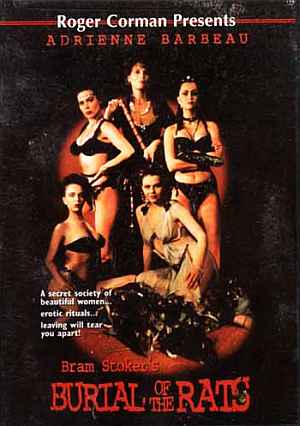 This can only be described as utterly mad. Bram Stoker is kidnapped by a group of bikini-clad female vigilantes, ruled over by “the Pied Piper’s twisted sister” (Barbeau), who can control rats with her flute (when not decapitating them in her rodent-sized guillotine, I kid you not). He is coerced into becoming one of them because the Queen decided his writing skills could aid their PR skills, striking fear into their targets with his eye-witness accounts of the raids where the extract vengeance on evil men. Of course, one of the clan (Ford) falls for him, but when she is captured by the authorities, her colleague must mount a raid to rescue her. Meanwhile, Stoker’s father is trying to find his son. Oh, and I did I mention the topless ballet which is apparently the women’s chief source of entertainment? No wonder Barbeau permanently wears a pained expression. [Though she now looks back and
 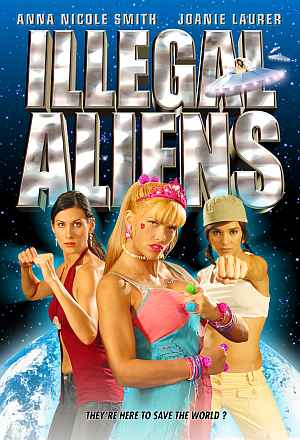 Okay, her swansong won’t be up there with James Dean’s or Bruce Lee’s, but this does at least sense its own idiocy, rendering the movie somewhat bullet-proof, critically speaking. It’s supposed to be dumb, wildly implausible and hideously over-acted. So condemning it for these flaws is complaining because your hotdog tastes of meat. A trio of shape-shifting aliens land on Earth to protect it from the scum of the universe. Thanks to their first encounter with our culture coming in the shape of a porno mag, they opt for the form of attractive women. Two end up getting jobs as FX/stunt people in Hollywood – a sadly underexplored angle – while the third is…Anna Nicole Smith. Then their nemesis (Laurer, the actress formerly known as Chyna) turns up, taking over the body of a mobster’s wife, and prepares to bring about the end of the world. Can she be stopped?
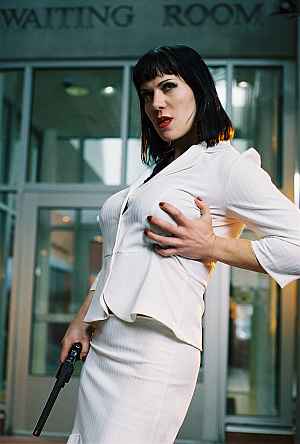 There’s no doubt this film is, if not cashing in on her death, certainly shrugging its shoulders and taking advantage of an unfortunate situation. I don’t really blame them for that, even if anyone looking for skin will be wasting their time here. In sharp contrast to her previous, ah, body of work, AN’s clothes remain on; as exploitation goes, this is tame and restrained. And that may be the main problem: a failure by the makers to decide which way to go. SF/action or all-out comedy? There’s enough of each to suggest, with greater commitment, either might have worked better. Instead, it comes off as somewhat lukewarm – can’t say we were ever bored, yet I can’t say I was ever more than mildly amused.
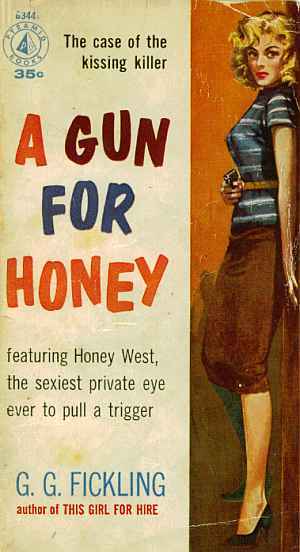 Honey West is best known as the heroine of a mid-60’s TV show created by Aaron Spelling, starring Anne Francis. But her origins actually date back almost a decade further, to a series of pulp detective novels written by Forest Fickling, under the vaguely-pseudonymic name of G.G.Fickling – his wife was Gloria, which may explain the choice. The heroine is a private eye, who follows her father into the profession, after he was killed on the job. These adventures, judging by A Gun for Honey, are rather more hard-boiled, and occasionally risque, than the TV show, though even in the book, the characters never actually seem to do “it”.
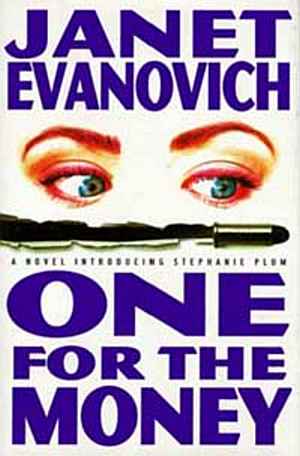 Former romance writer Evanovich switched genres and hit paydirt immediately with the first in the series, describing the adventures of former Newark lingerie buyer Stephanie Plum. She’s forced, through financial misadventure, to find a new job, and goes for a job filing paperwork for her bail bondsman cousin, but ends up hunting FTA’s (those who Failed To Appear for their court date) instead. She starts at the top, with suspended cop Joe Morelli, who has vanished after being accused of shooting an unarmed man. But as the witnesses to the incident start to die, Plum realises things may not be what they seem. The novice bounty huntress is well out of her depth, not least when she crosses psycho boxer Ramirez – until help comes from an unexpected source…
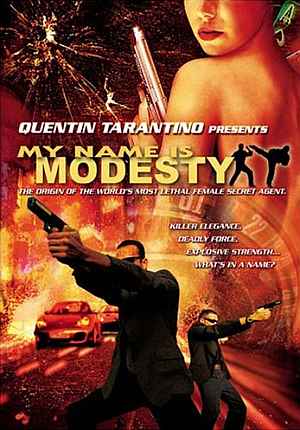 The word is, Miramax made this in order to keep their rights to the Modesty Blaise series active: I imagine a clause reverted them back to creator Peter O’Donnell, if unused within X years. Tarantino wanted to direct it, but couldn’t find the time, hence this stop-gap directed by journeyman Spiegel, who’s familiar with Quentin cast-offs, having also directed From Dusk Till Dawn 2. Shot in 18 Romanian days, the limitations of time and budget are clear [save admittedly copious flashbacks, the movie is almost all set in one location], but given them, it’s by no means a disaster. The main failing is the lack of action; we don’t see alleged jet-setting, goddess of kick-butt Blaise do much at all until the last few minutes. This may be because Staden looks as if she’d struggle to move forward in a stiff breeze; seeing her trading blows is unconvincing, and the fight choreographer should have focused on speed and/or agility instead. Though in terms of presence and steely gaze, she does fit the part well.
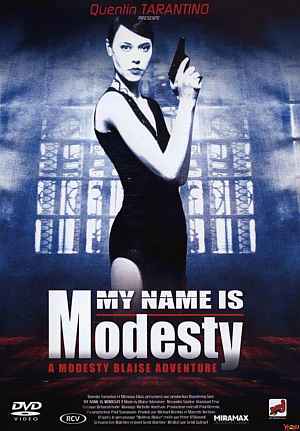 I remember the books from my youth, and the huge disappointment I felt when I saw the 1966 camp abortion starring Monica Vitti [there was also an 1982 TV pilot, with Ann Turkel, which I haven’t found]. This “origin” story is an improvement, at least taking the characters seriously. Blaise is trapped in a casino by a robber with a grudge against the owner (Waldau), and as they wait for the guy with the safe combination to arrive, she trades stories of her past for the freedom of the other hostages, Arabian Nights style, almost. I’d be somewhat curious to see the original cut, which apparently ran nearly two hours. Now, it’s barely 70 minutes between Bond-esque opening and closing credits, yet is still pretty talky, Blaise and her mentor (Pearson) meandering between the Balkans and Morocco.
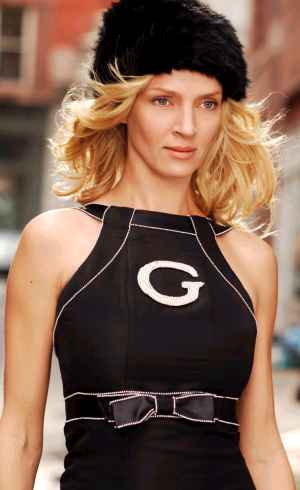 There’s certainly plenty of potential in the idea: how do you break up with your girlfriend, when she’s not just needy and possessive, but also has superhuman strength, the ability to fly and can boil your fishtank with her gaze? And the casting is, in general, excellent, too. Matt (Wilson) is an endearing everyman, and Thurman is perfect for capturing the mix of neuroses and power in G-Girl – her sequence where she pouts and refuses to save New York from a rogue missile is great. Izzard, naturally, steals almost every scene as supervillain Professor Bedlam [or “Barry”, as G-Girl knows him], though Riann Wilson matches him as Matt’s best friend, who talks a far better sexual game than he actually plays.