
Sweet Revenge

★★
“More sour than sweet.”

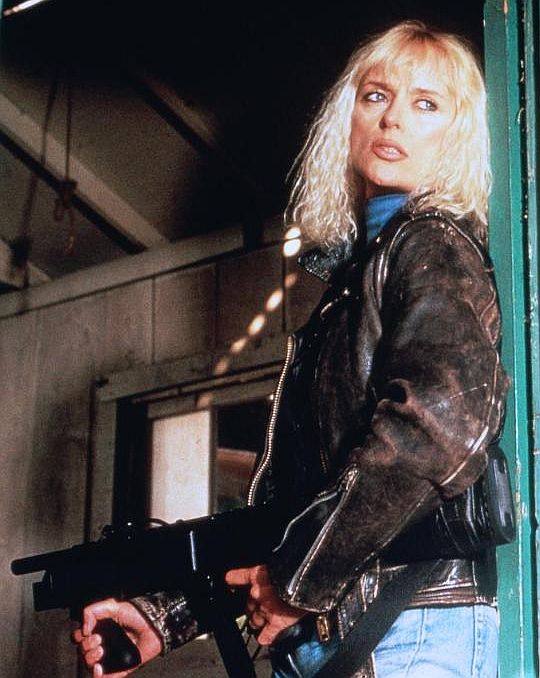
sweet-revengeAh, the eighties. A time of big guns and even bigger hair, going by this underwhelming entry, which sees Allen as feisty and well-lacquered reporter Jillian Grey, who gets too close to the white slaving operation run by Mr. Cicero (Landau). [Even though he operates out of the Philippines, he’s still kidnapping girls out of bars in Los Angeles, which seems logistically inefficient, shall we say] She is abducted and offered for sale, only to break out of the auction with a couple of other American girls – the non-Caucasians are, it appears, left to their own survival – pausing only to rescue international perfume smuggler, Boone (Shackelford). Believing Cicero has also kidnapped her daughter, Jillian convinces Boone to join her and the girls in an attack on the white slaver’s compound – but to get the necessary weapons for that, they’ll first have to help out his outlaw friend, Buddha.

Shudderingly uneven in tone, this would have worked much better if the makers had figured out whether they were going for Romancing the Stone style hi-jinks or New World Pictures exploitation, because what we get here doesn’t work as either. The problem with the former is Boone, who demonstrates the thin line between endearing and irritating, falling firmly on the latter side, as the result of Shackleford’s painful lack of charisma and acting talent. The latter, meanwhile, is defused by the almost complete lack of nudity; save one bit of skinny-dipping, the rest of the film would likely merit a PG these days. There’s lots of running around with automatic weapons, of course, and an energetic amount of things being blown up, plus you get Gershon in what may well be her first feature role, apparently knowing martial arts and making far more of an impression than Shackleford. You can certainly see why, almost 20 years later, she’s still working and he isn’t.

Indeed, the film as a whole would be significantly improved if Boone was removed entirely, and the film concentrated solely on Grey and her sidekicks, even if the whole subplot about the heroine’s daughter is half-baked at best. Just have that happy-go-lucky trio going up against Cicero and his gang of (fortunately, incapable of aiming) goons, and you could have something looking like a better-financed version of an Andy Sidaris film. Though admittedly, you would need some more gratuitous hot-tub action as well, before it would reach that level. Instead, you have something trying to be too many things and appealing to too many audiences, instead ending up as a film which is no better than “somewhat satisfactory” for just about anyone.

Dir: Mark Sobel
Star: Nancy Allen, Ted Shackelford, Gina Gershon, Martin Landau

Hard Bounty

★★★
“Nobody dressed like that in those days.”

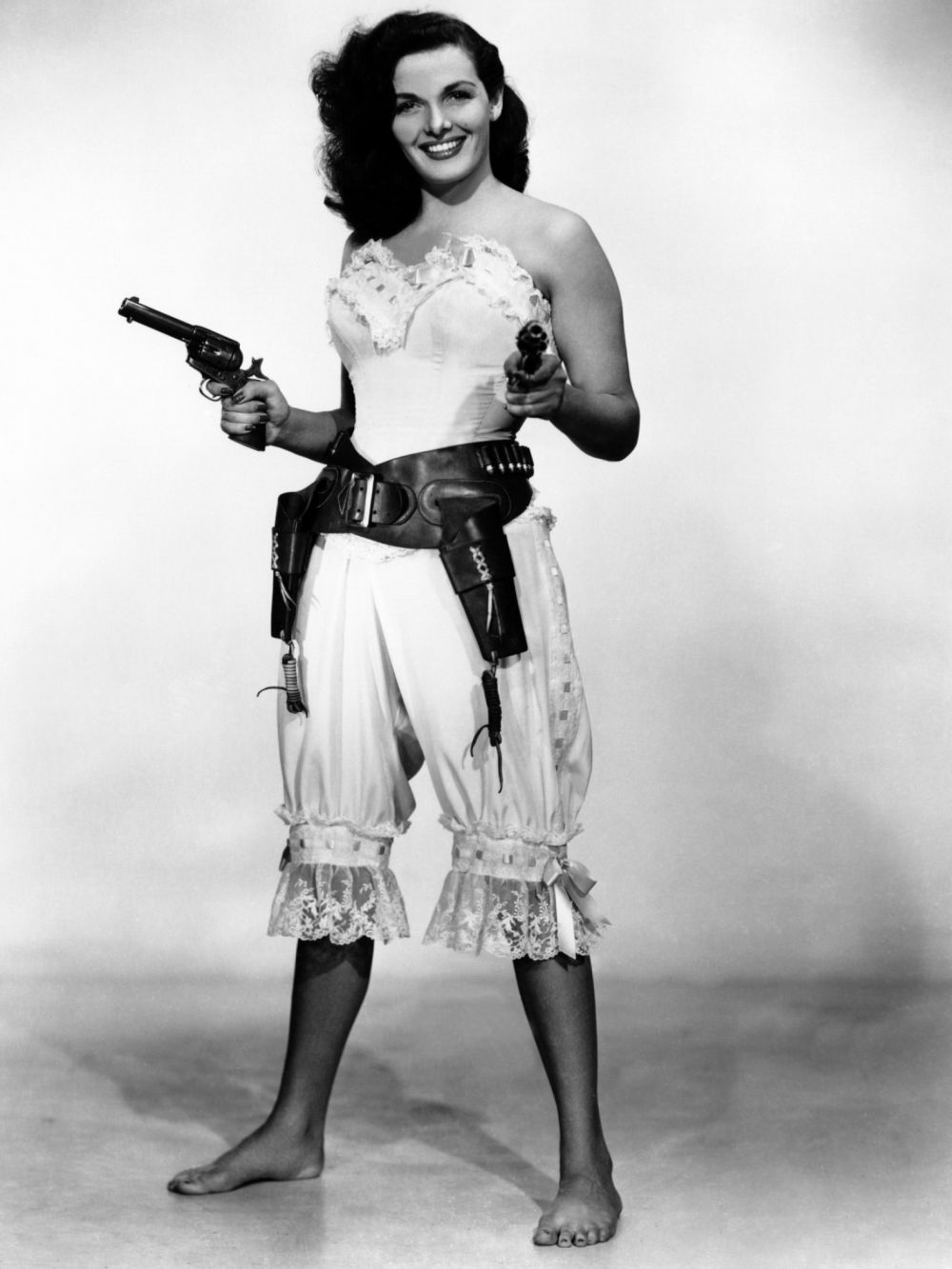
hardbountyI can’t believe an IMDb reviewer wrote the above, with an apparently straight face, because it’s severely missing the point of this nudie-cutie Western. The women are certainly packing, but the large-caliber weapons on display are not restricted to six-shooters, if you know what I mean, and I think you do…  That said, I reviewed this as a girls with guns flick a long time ago, back when this site was not even a gleam in my eye. But watching it again, I was beginning to wonder if I’d seen a different movie, as the first half is entirely action-heroine free.

It focuses more on bounty hunter Kanning (McCoy), whose life is disturbed when his former partner shows up, the murderous Carver (Terlesky, whom we’ll always remember fondly for his role in another Wynorski film, the brilliantly tongue-in-cheek Deathstalker II). The tension of unresolved issues runs high between them, in and out of the saloon/brother where Kanning’s girlfriend, Donna (LeBrock sporting a British accent for some ill-explained reason) is the head girl. There’s no shortage of nudity, certainly, but that’s the only action in which the ladies take part. Then, Carver – again, for ill-explained reasons – strangles one of the saloon ladies, and high-tails it off back to the land baron who employs him. Donna and her colleagues decide to head after him and take revenge for their fallen comrade, and Kanning, fearing the worst, tails along to help them out as they go in with guns a-blazing. Ah, so that’s why I reviewed this.

It certainly isn’t saying much, but this is far better than Gang of Roses II, and arguably more entertaining than the similarly-themed Bad Girls [which I probably should review here at some point, though that would mean having to watch it again]. The players are easy on the eye, though who knew breast implants were so prevalent in the Old West, and the dialogue could certainly have used an additional polish. For example, just before heading off on her mission, Donna is told by Kanning, “You can’t do this!”, to which she replies with the immortal (for all the wrong reasons) line: “There’s only two things I can’t do. One is make love to a woman, the other one is piss up a wall. And right now, there’s only one of those I regret not being able to do.” Er… what?

The action is about what you’d expect from a modest genre entry, with a moderate amount of blood-free gun-fighting. The ease with which the whores become stone-cold killers is quite surprising, given the complete lack of any fondness for guns shown previously. However, I was just happy to see it at all, having started to question my memories from two decades previously. You need to be able to handle that this almost feels like two different films joined in the middle, with the first being a lightly-amusing excuse for lingerie and less, and the second a revenge-driven thriller. Still, I can’t say I minded either too much, and as long as you manage your expectations, you probably won’t either.

Dir: Jim Wynorski
Star: Matt McCoy, Kelly LeBrock, John Terlesky, Rochelle Swanson

Awaken

★★
“Liver and let die.”

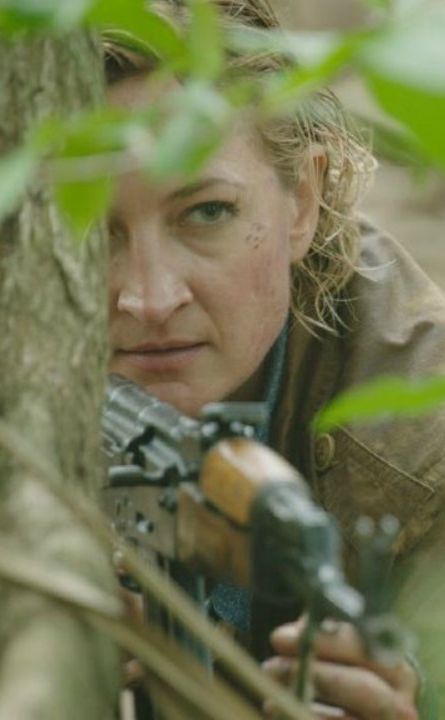
awakenThere’s a stellar B-movie cast here, of faces you’ll recognize, even if you don’t remember their names; let me start by listing a few. Vinnie Jones! Daryl Hannah! Edward Furlong! Robert Davi! Michael Paré! David Keith! Even Benny Urquidez, whom I don’t recall seeing since he memorably battled Jackie Chan in a couple of 80’s flicks. Shame the plot is such nonsensical garbage. The heroine is Billie Kope (Burn), whose sister disappeared five years ago and Billie has been trying to solve the mystery ever since. She mysteriously wakes up to find herself on a tropical island with a group of other, similarly abducted people, who are occasionally hunted by camo-clad soldiers, under the command of Sarge (Jones). Turns out they are, effectively, a holding pen for an organ trafficking ring run by Rich (London). With the help of some of the the other prisoners, such as Nick (Copon), Billie has to fight her way off their island prison and find the truth about her sister’s fate, before becoming a live organ-donor herself.

There’s so much here that doesn’t make sense, with characters wandering in and out of the movie without logic; for example, leader of the prisoners Quentin (Davi) just walks out of the plot, and you never find out either what happens to Mao (Hannah), whose daughter is intended as the recipient of Billie’s liver. I’m not certain of the medical accuracy of much of what’s depicted either, but I am not a doctor, nor do I play one on TV, so we’ll leave that alone. Instead, I wallowed in some of the more surreal aspects, such as the football commentary Sarge is listening to on the radio; seriously, just listen to it and see if it sounds like any game you’ve ever heard. Though at least Jones, and to a lesser degree Hannah, appear to have realized the dumbness of what they signed onto, and decided to go full, bone-in ham and have some fun with it. If only the rest of the cast had adopted the same approach.

However, Burr isn’t too bad: she also co-produced and co-wrote the film, so credit is certainly due for her passion. While she could do with some more muscle, she packs the right attitude and the scenes of her training with her father (Urquidez) set the tone early. She uses a brisk, no-nonsense style of fighting, closest to MMA than kung-fu, and the fights in general are edited and put together well – fast-paced, yet still coherent, which is less common than it should be. Unfortunately, it’s the storyline which strangles this puppy, and any viewer who is moderately high up the evolutionary ladder will be alternating raised eyebrows and derisive snorts for much of its duration. Occasionally-decent action makes this just about an adequate time-passer, and there’s worse on Netflix. Yet, that last clause falls more into the “damning with faint praise” category, and is hardly much of a recommendation.

Dir: Mark Atkins
Star: Natalie Burn, Michael Copon, Jason London, Vinnie Jones

Chastity Bites

★★★
“Not-so real housewives.”

chastitybitesA somewhat successful modernization of the vampire legend, it sees feminist wannabe journo Leah (Scagliotti) clashing with the popular clique at her high-school, under their queen bee Ashley (Okuda). Just as Leah is preparing a devastating expose on how the cool girls are planning a mass virginity loss, the ground gets pulled out from under her by the arrival of Liz Batho (Louise Griffiths), a counselor who begins a devastatingly successful abstinence program, the Virginity Action Group, into which Ashley and her cronies buy in, for their own ends. Liz also lures in the local moms, with her devastatingly impressive line of skin-care products. Leah digs into the past of Ms. Batho and thanks to a helpful tip from her Internet search engine (which is, at least, a first in cinematic plotting!), realizes Liz is – gasp! – Countess Elizabeth Bathory, who escaped being walled up in her chamber, and has roamed the world ever since, using the blood of virgins to sustain her youth. But since Leah’s relationship with local police soured following an article calling them racist, she’s going to have to stop the Countess using her own resources.

The results are sporadically funny. It’s a nice reversal on the usual horror trope of “have sex and die,” [albeit not the first: Cherry Falls already got there], and some of the characters are a hoot. Griffiths hits the spot just right as Bathory, combining elegance and threat with just a hint of Katie Holmes, and Okuda makes the Alpha Bitch far more rounded than most depictions [it took Chris to realize where we’d seen her before; she plays Tinkerballa in popular web-series The Guild] But she and Scagliotti are both clearly past high-school, well into their twenties, and so aren’t convincing teenagers. The heroine also appears to have eaten a dictionary, leading to dialogue that is both forced and not as witty as it thinks it is. Worst of all, I could have done entirely without Leah’s lesbian sidekick (Raisa), since her main purpose in the film appears to be to allow for embarrassingly-bad banter with her gal-pal.

It does make some nice stabs (hohoho) at social satire, in particularly the hypocrisy of high-school and American vs. European values, but it’s a bit too monotone in its approach. I did appreciate its almost entirely gynocentric nature. The only male character of note, is in the film mostly to ensure Leah is no use to the Countess, and when the chips are down, rather than rescuing anyone, is disposed of with ease, leaving Leah to face her immortal enemy alone. However, there remains too much of a problem with the heroine, who comes over for much of the movie as smugly PC, rather than someone with whom I’m interested in spending time. It’s this which restricts the film’s eventual success, leaving it as more of a respectable time-passer than an outstanding triumph.

Dir: John V. Knowles
Star: Allison Scagliotti, Louise Griffiths, Amy Okuda, Francia Raisa

Pride + Prejudice + Zombies

★★★½
“Not the zombie apocalypse I expected.”

ppz09I’d imagine the market who would most appreciate this – those who like early 19th-century literature, but feel it would be improved by the addition of the walking dead – is rather small, which may explain its lackluster performance at the box-office. Personally, I’m more a fan of Victorian and later work, and have never actually read Pride and Prejudice, so suspect all those aspects here, flew entirely over my head. I have, however, seen more than my fair share of zombie flicks, so that’s the angle from which I will be reviewing this. Several angles surprised me. Firstly, it’s not a comedy. While we laughed, the film takes its theme seriously. Secondly, there’s surprising invention here. It’s not just dropping zombies into a costume drama; there’s thought gone into details of the setting, and also ideas such as the undead initially retaining their humanity.

On the other hand, it’s not the action extravaganza I expected from the trailer, and never achieves the all-out heights of excess I was hoping to see. There are some decent sequences, but a number of missed opportunities, for example, in eye-patch wearing aristocrat, Lady Catherine de Bourgh (Lena Headey), who is described as the ultimate bad-ass, yet barely lifts a finger. I expected a massive battle at the end, and didn’t get one; instead, the film almost rubs our face in this, inserting a mid-credits epilogue that’s the biggest tease since the end of My Wife is Gangster 2. Not that you’ll mistake this for anything other than a zombie film, of course, even if it is closer to Pride and Prejudice (and Zombies) – which would make sense since I believe the book was about 85% Austen’s original text. There are still plenty of positives, led by James, as Elizabeth, the feistiest of the five Bennet sisters, whose father (Charles Dance) has brought them up as zombie-killers, much to the concern of their mother (Sally Phillips), who’d rather they married rich.

The story revolves around a love-triangle between Elizabeth, Mr. Darcy (Riley) and Lieutenant Wickham (Huston), unfolding against an the backdrop of an escalating zombie threat, which lurks in almost every hedgerow, whist party and back bedroom. Previously, the walking dead have largely been confined to London, but appear to be developing organization, and given their increasing numbers, this could be disastrous for humanity. Meanwhile, Elizabeth also has to fend off the perhaps even more threatening predations of Parson Collins (Matt Smith), who has been brought in to marry one of the sisters, providing a male heir that will secure the family’s future, since the daughters are unable to inherit property. Her skills are unquestioned, and nicely understated; when Darcy suspects one of Elizabeth’s sisters of being bitten, and releases carrion flies to see if he’s right, she plucks them out of the air, one at a time, and hands them back to him.

Their relationship is another well-handled aspect. This Darcy is not exactly swoonworthy, and hardly the life of the party (no-one who totes carrion flies everywhere they go, ever will be), yet he’s prepared to let Elizabeth be the person she wants to be – a sharp contrast to Collins. It’s her free-spirited nature and stubborn refusal to be ground down by the conventions of society – even the severely-skewed ones of this scenario – which make her an engaging heroine. Other pleasures are the work of Smith and Phillips, adding a great deal of background charm, largely due to their total indifference to the zombie apocalypse – achieving marital bliss is clearly far more important. It probably works better as satire on class, rigid social norms and the British stiff upper-lip, than as real horror; its PG-13 rating obviously limits the latter aspect. As long as you are not going in expecting a Georgian-era version of World War Z, this should be well-made and enjoyable enough.

Dir: Burr Steers
Star: Lily James, Sam Riley, Jack Huston, Bella Heathcote

ppz01

Eye for An Eye (1996)

★★★
“No-nonsense crypto-fascist cinema.”

eyeforaneyeSubtle, this ain’t. But if you’re looking for a knee-jerk tale of vigilante vengeance, when the lily-livered justice system has failed, kowtowing instead to the “rights” of the guilty… This has certainly got you covered. Karen McCann (Field) is on the phone with her teenage daughter, planning a birthday party, when their call is interrupted by the arrival of serial rapist and murderer, Robert Doob (Sutherland). Karen can only listen as her daughter is brutalized by Doob, then bludgeoned to death with an ice sculpture. While his DNA is found at the scene, Doob walks because of a prosecutorial blunder, leaving Karen and husband Mack (Harris) aggrieved, and investigating detective Joe Denillo (Mantegna) powerless to help, even when Karen follows Doob and finds him apparently preparing to strike again. She joins a support group for those who also lost their kids, only to discover some of the members have an additional agenda; to help each other take revenge, where the law has been unable to do so. However, it turns out the FBI have also been monitoring the group, so what is Karen to do?

It’s entirely straightforward, pitting the perfect American family against an utter sleazeball; Sutherland is extremely creepy in his portrayal of Doob, and it’s quite eye-opening if you’re more used to him as (the similarly crypto-fascist) Jack Bauer. This reaches its apex when Doob confronts Karen and her surviving six-year-old daughter, Megan, whom he has been stalking, and whispers to the mother, “I don’t even really like kiddie pussy – but I’m willing to make an exception…” Yeah, I think that was probably the point at which the last vestiges of my liberal sensitivities checked out, and I could throw myself fully behind Karen’s mission. Just don’t expect anything approaching moral balance, or philosophical insight: this is rabble-rousing cinema at its most elemental. Which isn’t necessarily a bad thing; it’s following in a long line of such movies, going back at least as far as Dirty Harry in 1971.

On the other hand, I can’t really argue with Roger Ebert, when he wrote, “Movies like Eye for an Eye cheapen our character by encouraging us to indulge simplistic emotions – to react instead of analyzing.”  For this certainly is simplistic, and if Sutherland is impressively one-dimensions as the villain, Field is less convincing as Karen, in what needed to be a rather more nuanced performance, if it was going to rise above the material [There’s also an unexpected cameo from Cynthia Rothrock, of all people, as her self-defence teacher]. However, not all cinema needs to be “deep” or “thought-provoking,” and Schlesinger clearly has no such aspirations. Even if the targets here are hung low, it still hits more than it misses.

Dir: John Schlesinger
Star: Sally Field, Kiefer Sutherland, Ed Harris, Joe Mantegna

Last Shift

★★½
“Bit of a cop-out.”

last shiftA strong start fails to be sustained, as it becomes increasingly apparent that the director here has a very limited selection of weapons in his cinematic arsenal. Jessica Loren (Harkavy) is a rookie cop, following in the footsteps of her late father. Her first assignment is the last (wo)man standing, on the final night before all duties at a police station are transferred to a new building. She’s supposed to be little more than a caretaker, waiting for the final clean-up crew to arrive, but virtually as soon as she is left alone, weirdness starts happening. She gets increasingly frantic calls from a woman who says she has been abducted, then a vagrant appears, first outside and then inside the facility. Furniture moves. Ghostly singing is heard. And that’s just the tip of the iceberg, before a conveniently-passing bystander informs Jessica that tonight marks the year to the day that a notorious cult of serial killers were caught and brought to the station, where they all committed suicide.

Despite moments that are unquestionably effective, DiBiasi uses the jump scare far too often, beyond where it becomes not just ineffective, and instead a joke. I lost count of the number of times that the heroine saw something, heard a noise that made her look in another direction, and when she turned back, whatever had been there was gone. I did like the way you were never quite sure whether what you were seeing had any objective reality – perhaps a prank by her fellow officers on a new recruit – or if it was entirely in Jessica’s head. And while she stays around well past the point at which any rational person would have legged it out of there, the backstory gives a plausible explanation, in terms of her desire to make a good first impression, and live up to her father’s legacy. However, given that, her apparent complete ignorance of (or amnesia about) previous events doesn’t make sense, especially since her father died apprehending the cult in question.

Things ramp up in the final reel, with the station under siege by other members of the cult, but I have to confess, my attention had not been adequately sustained through the middle portion. Harkavy gives her best shot, and is decent, but this performance isn’t so much acting as reacting, and given she is alone for much more of the film than you’d expect, it needs a good deal more. I couldn’t help comparing this with another take with a not dissimilar theme and location, Let Us Prey. That succeeds a great deal better, not least because it provided a solid antagonist against whom the heroine must battle, rather than an apparently endless line of ghosts and cheap (if, it must be admitted, sometimes successful) shocks, as provided here.

Dir: Anthony DiBlasi
Star: Juliana Harkavy, Joshua Mikel, Hank Stone, Mary Lankford

Saint Joan

★★
“Joan of Inaction”

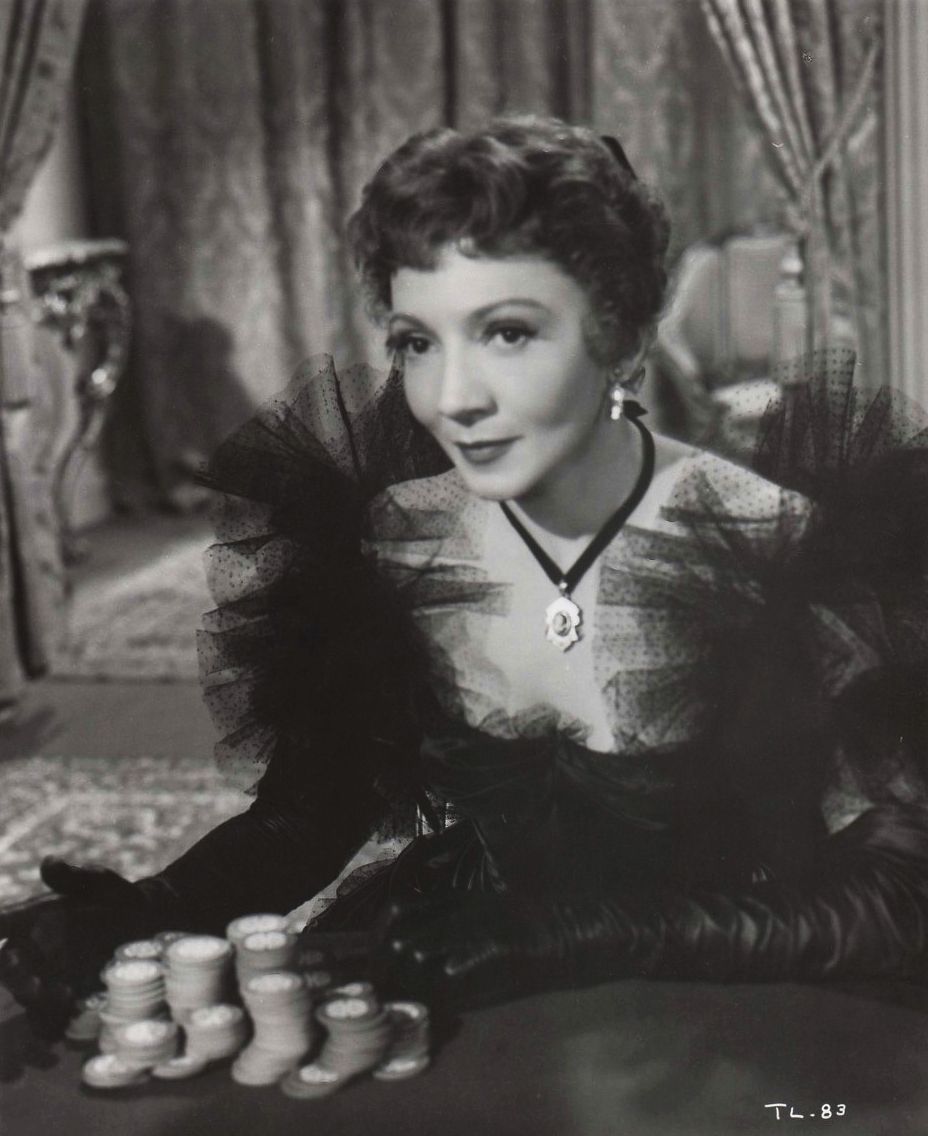
saintjoanAn adaptation by noted playwright Graham Green of George Bernard Shaw’s 1924 play, this is most famous for the extensive search undertaken by director Preminger to find the “right” Joan for the job, which involved testing over 18,000 candidates before settling on Seberg. whose only previous acting to that point had been in school plays. That’s in sharp contrast to the experience in the rest of the cast, which included Widmark as Charles, the Dauphin enthroned by Joan’s actions, and Gielgud as the Earl of Warwick, whose schemes lead to the heroine’s death at the stake. But what’s most notable here, in contrast to some of the other versions of the story we’ve written about, Preminger and Greene seem entirely disinterested in the process which brought the Dauphin to the crown. We see Joan’s rise to command, but the film then skips over everything from her approaching the fortress of Orleans, to the coronation of King Charles. In other words: the fun bits.

The framing story has Joan as a specter, visiting the aged king, along with the ghost of the Earl and other participants in her life, such as the English soldier who took pity on Joan at the stake and gave her a makeshift cross to hold. The adaptation whacked out, it appears, close to half the running-time of the play, and one had to wonder whether it is any more faithful to the work’s spirit. For in the preface to his work, Shaw explicitly wrote, “Any book about Joan which begins by describing her as a beauty may be at once classed as a romance. Not one of Joan’s comrades, in village, court, or camp, even when they were straining themselves to please the king by praising her, ever claimed that she was pretty.” This is in sharp contrast to Seberg, who even after giving up her long feminine locks for the almost compulsory crew-cut, looks more like Audrey Hepburn’s tomboyish little sister than someone, in Shaw’s words, “unattractive sexually to a degree that seemed to [contemporary writers] miraculous.”

It’s not entirely without merit; some of Shaw’s text still retains its impact, such as Joan’s explanation of why the French are losing: “Our soldiers are always beaten because they are fighting only to save their skins; and the shortest way to save your skin is to run away. Our knights are thinking only of the money they will make in ransoms: it is not kill or be killed with them, but pay or be paid. But I will teach them all to fight that the will of God may be done in France; and then they will drive the poor goddams before them like sheep.” The sheer certainty in Joan’s mind that’s she’s right, and will accept no arguments to the contrary, is impressive. Unfortunately, it’s not enough to sustain the film overall, and you’re left without much insight into either the history, or the personalities who created it.

Dir: Otto Preminger
Star: Jean Seberg, Richard Widmark, Anton Walbrook, John Gielgud

Guns For Hire

★½
“Fires nothing but blanks.”

gunsforhireThe first spectacular misfire of 2016, I was hoping for much more, than a story that could only be claimed to make any sense if it was entirely the ravings of a mentally-deranged idiot. Beatle (Hicks) is a tow-truck driver/assassin – yes, that’s what it says on her business cards – who rescues Athena (Carradine) from her abusive ex-boyfriend, Kyle (Mendelsohn). In revenge, he sets deranged psychopath Bruce (Morgan) on their trail, and he is prepared to stop at nothing to bring them back to his boss. Meanwhile, Athena hires Beatle to kill her, but they have to hang out until the change in Athena’s life-insurance policy, making Beatle the beneficiary, is officially completed. Except, is Beatle actually a killer at all? For her therapist seems convinced otherwise. The entire saga unfolds in flashback, as Beatle is being interrogated by a detective, who has found the videotape of Beatle’s infomercial for her hitwoman business. Certainly sounds like an unusual set-up, and potentially interesting, right?

Wrong. It’s an overly talky and thoroughly unconvincing slab of pretentious nonsense, which is nowhere near as smart as it thinks, and completely fails to provide the “Nonstop action!” proclaimed on the cover. Both Beatle (seriously, what kind of name is that?) and Athena are the kind of characters you would actively seek to avoid if you met either of them in real life, and the film does nothing to make spending 75 minutes in their company any more attractive. Perhaps it might have worked, if the story had done more with the question of whether or not Beatle is an assassin only in her own mind, following the American Psycho approach. That would, at least, have tied in with the final twist, which basically screws up everything you’ve endured to that point, and throws it out the window. Thanks a bunch, for wasting the audience’s time, Ms. Robinson.

There’s a subplot involving Beatle and a stripper, which seems present only to provide some gratuitous lesbian titillation for undemanding male viewers, and – speaking as the apparent target audience – doesn’t even work on that level. Instead, you’re left to cope with performances which range from the passable (Morgan does his best, in limited screen time) through the gratuitously excessive (Tony Shalhoub turns up as a DMV employee, for no reason) to the spectacularly incompetent (I’ll spare the name of the “actor” “playing” the “detective” – all three sets of quotes used advisedly). Add dialogue which, I can only presume, must have sounded an awful lot better in writer-director Robinson’s head than it plays on screen, and you’ve got something that fizzles an enormous amount more than it sizzles. As the first of our “coming in 2016” films to be reviewed, it feels more like a New Year’s Day hangover than any kind of shiny, positive resolution.

Dir: Donna Robinson
Star: Ever Carradine, Michele Hicks, Jeffrey Dean Morgan, Ben Mendelsohn

The Big Bad

★½
“What big eyes you have…”

bigbad1Few things are more irritating than a film where the characters clearly know what’s going on, they just refuse to let the audience in on it, jabbering away to each other in cryptic dialogue that obscures more than it reveals. Not that a movie’s script has to lay everything out from the start, or can’t be subtle. But if you are going to go for an understated approach, this has to be tempered with sufficient well-handled exposition, that the viewer can understand who the players are, and care about them and their role in proceedings as they unfold. It’s here where this falls down, repeatedly. There’s one conversation which ends with the heroine, Frankie Ducane (Gotta), being banged on the head and shoved into the trunk of a car. Who did this? Why? Where is he taking her? None of these questions are ever adequately answered, and I reached the end of the film, with only a vague idea of who Frankie was, or her situation.

As the title hints, and her fondness for swigging shots of liquid silver emphasizes, this is a werewolf movie, with Frankie on the bloody trail of Fenton Bailey (Reynolds), the man responsible for her current situation. There’s an apparent clock running – at one point, we see a notebook with “3 DAYS LEFT” written in important-sized letters, but like so many elements here, its significance is never explained, and there no sense of any particular impetus to the plot resulting from it. Mind you, this is a film which is happy to spend quite a bit of time with Frankie chatting to a girl in a bar – apparently populated entirely through a casting call at the local roller derby bout – in an effort to discover what she knows about Fenton. This probably goes on far longer than necessary, but you have to respect a film which is prepared to let things unfold at their own pace, even if the audience might be tapping pointedly on their wrists and making hurry-up sounds.

What does work, better than the plot, is the atmosphere, feeling like a modern-day version of a Grimm Fairy Tale, with Gotta making a decent enough Red Riding Hood – one more interested in vengeance, than visiting Grandma with a basket of goodies. Frankie’s dagger proves quite an effective equalizer, and proves much needed when she wakes up from her trip in the trunk, to find someone has an eye on her eyes, as it were. This sequence was probably the most effective, in terms of being a modernized legend, even though its relevance is dubious. It’s an infuriating failure as a whole, feeling too much like a short film needlessly stretched to feature length (though at 78 minutes, barely so), without enough thought given to whether it possesses sufficient meat to sustain its running-time.

Dir: Bryan Enk
Star: Jessi Gotta, Jessica Savage, Timothy McCown Reynolds, Alan Rowe Kelly