



 ★★★★
★★★★
“Harriet Potter and the F-sized Weapon”
 There are occasionally times where our book reviewer Werner’s “split scale” of grades for both artistic merit and action, would come in handy. This is one of those times. For the action scenes here are as glorious as you would expect from the man behind Dead Fantasy, virtuoso symphonies of exquisite hyper-violence, meted out and absorbed by characters and monsters without fear or bias, in ways limited only – and not very much, at that – by the creator’s imagination. Probably inevitably, this overshadows a fairly perfunctory plot, and characters whose characterization is largely defined by the shade they wear. On a split scale, this would merit five stars for both the quantity and quality of action, but likely three or three and a half for artistic merit.
It takes place in the world of Remnant, in a three-cornered struggle between humanity, the monstrous Creatures of Grimm, and the Faunus, who are part-animal, part-human, and largely perceived as second-class citizens, despite their own talents. There’s a substance called “Dust” which has magical powers, and an academy where young men and women train as Hunters and Huntresses, to do battle with the Grimm. The focus is on four teenage girls who are part of this year’s new intake, and who end up forming team RWBY [pronounced “Ruby”]: Ruby Rose, Weiss Schnee, Blake Belladonna and Yang Xiao Long: the last is yellow-themed, you should be able to figure out the others. The main nemesis is Roman Torchwick, a terrorist who is working with a group fighting for Faunus’ rights, yet who had entirely his own agenda – as well as some high-powered minions and skills of his own.
Originally a web series, the first and second seasons have now been collected into feature-length collections, and while their episodic nature is occasionally apparent, they probably work better that way. The opening takes a little while to hit its stride, as it has to create the world, introduce the characters and establish the situations. The animation style takes some getting used to: it’s done in CGI, but trying to look like traditional cel animation; some of the resulting movement is almost too smooth, and I find the lack of noses on some of the characters, a bit unsettling. However, the script is well-written, sometimes sharp and witty, occupying a good place between self-awareness and parody. Even the characters that are largely superfluous – and some of the hunters in training could be so described – are less irritating than they might be.
It is, however, all about the action, and it’s clear that all of the other aspects – the plot, the participants and the world they inhabit – exist merely to facilitate the fight scenes, which is where all the work, imagination and energy become truly apparent. The highlight, for me, in volume one, was a battle at a temple against a series of Grimm, while the second part climaxes with a running fight in, on and around, a train as it hurtles toward the capital city. You forget they are animated, while simultaneously wishing someone would throw $200 million at the studio behind it, Rooster Teeth, and let them make a live-action version. Sadly, creator Oum died of a severe allergic reaction in February this year, although it has been announced that Volume Three of the series will continue. Hopefully, the quality will not suffer, and will be a fitting monument to Oum’s sadly-missed talents.
Dir: Monty Oum
Star (voice): Lindsay Jones, Kara Eberle, Arryn Zech, Barbara Dunkelman



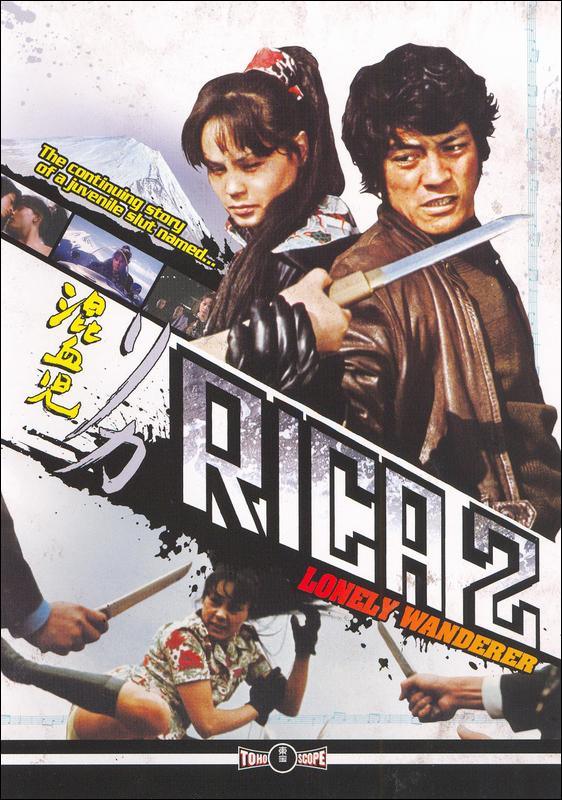
 Aoki appears to have streaked like a star across the pinky violence firmament, appearing only in the trilogy of which this is the first, and one other film, Gakusei yakuza, before returning to the streets whence she came. Or I like to think that was her origin, anyway, and this is less a dramatic work, than a documentary depicting her life. Sharing the same name, Rika is the child of rape, a GI impregnating her mother before being deployed to Korea, and it’s not long before one of her mother’s boyfriends/customers [the film is sketchy on this detail] has taken a similar approach to Rika. She ends up heading an all-girl gang, but is sent to a reformatory after an opposing, male gang leader accidentally dies during a fight with her. But it’s not long before our heroine escapes, only to find some rivals have taken advantage of her absence, and the rest of the gang has been abducted and are about to be sold off to Vietnam. The boss offers to sell them to her instead, and Rika blackmails her father into paying up, only for the women to be sold anyway.
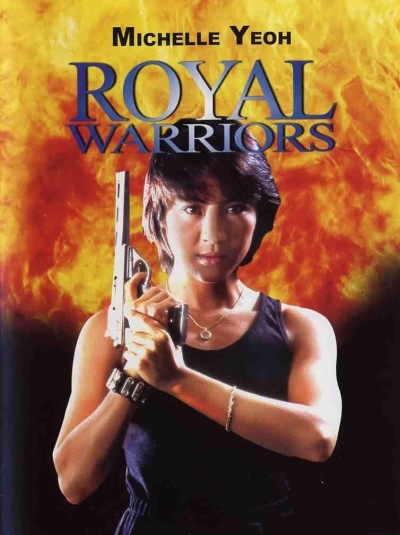 It’s really the finale which makes this stand out – not necessarily for its qualities (though it’s far from bad), more for the batshit insanity. It sees ex-cop Michelle Yip (Yeoh) storm a construction site in an armoured car, to rescue the coffin containing the body of a colleague, which has been suspended from a crane by the bad guy. How the hell did we get here? Good question. It all starts on a plane back from Japan, where among the passengers are Yip, Interpol agent Peter Yamamoto (Sanada, recently seen creating doomsday diseases in Helix) and security guard Michael Wong (Wong – a lot of thought clearly went into that character). On the flight, there’s a hijack, in an attempt to free a killer being extradited to Hong Kong; our heroic trio foil it, killing the hijackers. But that just brings down the wrath of the rest of the gang, who vow to take their revenge on the people who killed their colleagues. And they really don’t care who gets in their way, as a mass gun-battle at a night-club shows – it also gets Yip taken off the case.