




★★★
“A tale without enough to rattle you”
 This occupies a rather odd middle-ground between a meditation on what it means to take a life, and a violent thriller. I’m not sure it manages to pull either off entirely successfully, yet some striking imagery helped sustain our interest. Katrina (Ejogo) is driving from Phoenix to Oklahoma City, with her young daughter, Clara (Pratt), to start a new life: it’s hinted that there may be an abusive partner in the rear-view mirror. The route takes her across the Texas Panhandle, and in an effort to avoid a traffic jam, she hits the back roads. This turns out to be mistake, as she first gets a flat, then Clara is bitten by a rattlesnake.
Fortunately, there’s a trailer nearby, where Katrina is able to get help; by the time mother and daughter reach the nearby hospital in Tulia, there’s no indication of any snakebite. But a stranger turns up in their room, demanding payment for the emergency assistance, and not the kind covered by their health insurance: a “soul for a soul”. If Katrina doesn’t kill someone by sundown, Clara’s life will be forfeit. After the validity of the threat is confirmed, Katrina seeks a victim, and seems to find one in another abusive man, Billy (Rossi), whom she encounters in a local bar, taking out his anger on his wife, Abbie (Greenwell). But even when her own daughter’s life is at risk, can Katrina find it in herself to go against all her morality, and take another person’s life?
It does pose an interesting question: how far would a mother (or anyone, I guess) be prepared to go in defense of their child? As we learn, Katrina is prepared to sacrifice whatever might be necessary, but it’s a bit of a process to get there. For example, she spends rather too much time hanging around the hospital, hoping for a chance to smother an already-dying patient, conveniently nearby. And Billy is similarly convenient, a character so unpleasant, the resulting moral dilemma becomes massively diluted. It would have made for greater drama if there hadn’t been an easy candidate, and Katrina was forced to choose between her child and someone decent.
Hilditch has a good eye, however, and there are some striking scenes where the heroine experiences visions, reminding her of her task, and that time is running out. A priest spontaneously combusts; a little kid engages in equally self-destructive acts. These help create an unsettling atmosphere, which keep the film’s head above water, when the plot struggles to do so. Ejogo is also decent in the central role, making it relatively easy to put yourself in her shoes. But I’d have like to have seen more of the background filled in here. Katrina does some light Googling, which suggests she is far from the first person to have found themselves in debt. Yet this angle is severely under-explored, and the net result is something which almost feels more like a series pilot.
Dir: Zak Hilditch
Star: Carmen Ejogo, Theo Rossi, Emma Greenwell, Apollonia Pratt
 We’ve seen Ngo, the star here, previously on this site in
  This wasn’t quite what we expected. In fact, replace “quite” with “at all”. It starts off as looking like some kind of revenge porn, with pathologist Margaret Powers (Tyson) kidnapping Finnbar (Ward), the man she’s certain murdered her son. Finnbar was apparently able to get away with it, because he was the son of a notorious local criminal, Tommy O’Neil (Hayman). She wants Finnbar to confess to his crime, and recruits her son’s ex-girlfriend, Zoe (Jarvis) to help in getting her vengeance. Initially, the capture goes well, with the two women then holing up in an abandoned warehouse by the docks, to begin the interrogation. However, this is where the film starts to diverge from the expected, as it turns out Zoe’s intentions are not in line with Margaret’s, as they initially appeared.
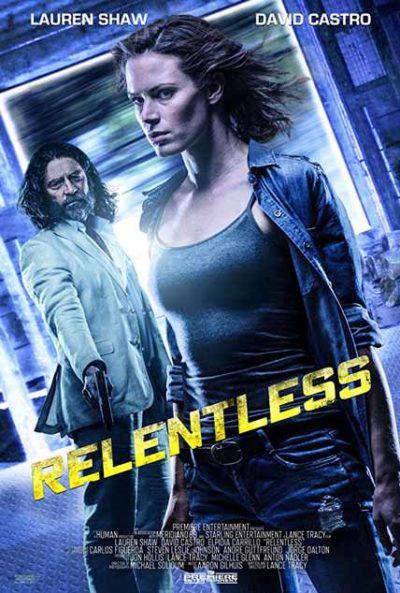 From just about all I’ve read, the director seems entirely earnest in his desire to make a serious film about a serious problem, human trafficking in Central America. That the end result falls almost entirely wide of the mark is a bit of a double-edged sword. In terms of making its intended point, that it feels more like a B-movie from the fifties is a bad thing. But on the other hand, the serious film about the serious problem would likely be considerably less amusing.
 Malorie Hayes (Bullock) is nervously heading towards the birth of a child, supported by her sister (Hayes), when a mysterious epidemic of suicidal psychosis breaks out worldwide. In the ensuing carnage, Malorie finds shelter in the home belonging to the acidic Douglas (Malkovich), whose wife dies trying to help Malorie, and a small number of other survivors. They figure out the epidemic is triggered by entities of some kind who are now prowling the planet – if you see them, you are overwhelmed by your worst fears and kill yourself. The obvious defense is not to make eye contact. Yet how do you survive in a world you cannot see? Especially when it turns out that those who were previously psychopathically inclined are immune to the effects, and are free to roam that world, with their sight intact.
 Oh, how the mighty have fallen. And considering Halle Berry’s last appearance on this site was for Catwoman, that’s saying something. This is so dumb, I genuinely felt I could feel my IQ slowly sliding away as I watched the movie. Even now, simply remembering it has me feeling more stupider by the sentence. If this review ends up sounding like Beavis & Butthead by the end, that will be why. Its plot is beyond simplistic. Karla Dixon (Berry) has her child abducted from a New Orleans park while she’s on the phone, by husband and wife kidnappers Margo (McGinn) and Terry (Temple). Losing her cell in the process, she takes off after them in hot pursuit, and nothing will get in her way for the next 80-odd minutes.
 Based on the title and synopsis, I was expecting something like a Lifetime TV Movie. A mother frantically searching for her abducted child in a foreign location, before they can be sold off to some rich Arab, would seem right up their alley. [Though of course, this kind of thing has long been a popular subject for exploitation, to the point where the Hays Code of the thirties had explicitly to ban movies about “white slavery”] It’s a good deal grittier and harder hitting than that, though could have done with much better explanation of why this momma bear is so ferocious – among a number of other aspects.