



★★★
“Growing old gracefully”
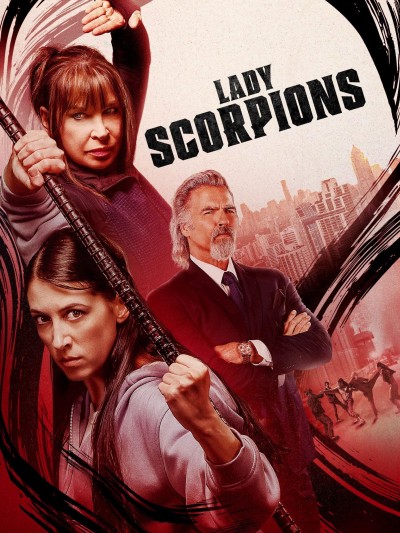 Cynthia Rothrock is 67 years old. That is considerably older than I am, and I consider it a victory if I manage to get out of bed in under ten minutes. I am certainly not kicking and punching my way through a slew of bad guys, in moderately convincing fashion. While this certainly has its flaws, it’s hard not to be impressed, especially for anyone familiar with Rothrock’s long career in action movies. Personally, I’m just glad she has moved on from the “erotic thriller” period of her career. Sixty-seven is too old for some things. But there’s also a passing of the torch here, introducing us to a potentially promising action actress in Caitlin Dechelle.
She was Gal Gadot’s main stunt double in Wonder Woman, and also doubled for Betty Gilpin in The Hunt. While still a little rough around the acting edges, you could certainly say the same about Rothrock’s early work, such as Yes, Madam. Here, she plays martial arts teacher Lacy Moore, who is estranged from her workaholic mother Alena (Rothrock). For several decades, Alena has been chasing after drug kingpin Lucien (Fahey), to no avail. He’s now ready to pass on the crown to his loose cannon offspring, Sonny (Manuel), After Alena interferes with Sonny’s activities, he decides to sideline her by kidnapping Lacy’s daughter, Ariel. Very poor judgment on his part I’d say. I suspect I need hardly bother outlining the rest of the film.
Though just in case there is someone who has never seen a film in this genre: Lacy reunites with Alena, and they team up to go after Sonny and rescue their mutual descendant. This involves them working their way through minor henchmen, until they extract Ariel’s location. There’s a rescue attempt, the duo get captured, we learn why Alena is so obsessed, they escape thanks to the help of a bad guy with a conscience, and the expected large fight ensues. There’s not much new here, and what there is, tends to be irritating. Del Castillo worked as a grip on a number of Tarantino films and it seems to have rubbed off, in the shape of inappropriate needle drops and villains who love the sound of their own voice.
In between the rolling of eyes these provoked, however, this has its moments. While it’s clear Rothrock won’t be scorpion kicking anyone, she has a grace and fluidity that’s inspiring. Or, would be, if only I could get up off this damn couch. Wisely, it’s left to Dechelle to do the heavy lifting in the action scenes, and she delivers, especially in a fight against fellow stuntwoman Mamyi Ithou, which I wanted to see go longer. I’ll admit to being a bit disappointed in the ending, since this goes from sixty to zero – more specifically, sixty to a “Six months later” caption – far too quickly. But it remains the best Rothrock vehicle I’ve seen in a while. If this is the way she chooses to go out, I’m fine with it.
Dir: Bruce Del Castillo
Star: Cynthia Rothrock, Caitlin Dechelle, Jeff Fahey, Jose Manuel
 This ended up turning into an Internet investigation. The title above is the one by which it appeared on Tubi. But it’s clearly pasted onto the opening credits, and I ended up having to go through the IMDb credits for the one identifiable actress to find it there – where it appears under another title, with some promo materials giving it a third name. The end credits are entirely in Chinese, and provide absolutely no information as to who is playing who. So that also had to be pieced together. But least helpful of all, were subtitles that may be generated by a drunk AI, operated by a seven-year-old
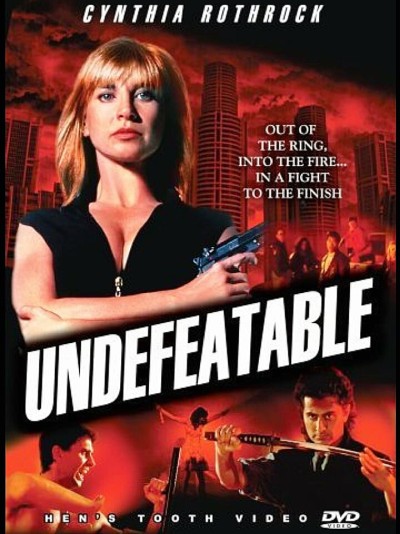 The traditional rule of thumb is, Cynthia Rothrock’s Hong Kong movies are good, but her American ones are bad. The question is, what category should this one be placed? On the one hand, it’s a Hong Kong production. On the other, it’s filmed in America, with an American cast. On the third hand, it’s directed by notorious schlockmeister Ho, as “Godfrey Hall”. I’m painfully aware how much his work can vary in quality, though I’ll confess, I am generally adequately amused. The results here are a real grab-bad of the good, the bad and the laughable. Put it this way: Cynthia is probably close to the best actor. That’s not something you’ll hear often.
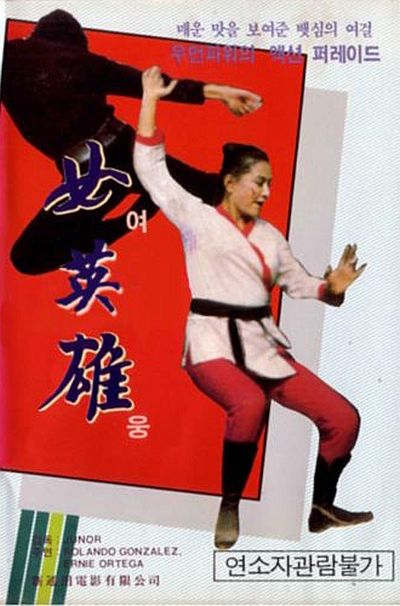 In various places, the title for this is “a Lady”or “the Lady” fighter: I’m going with what’s firmly stated on the opening credits of the print, ungrammatical as that may be. It’s a Filipino product, but unlike the New World Pictures of the early seventies, is an entirely domestic production. Though in many ways, it feels almost like a Taiwanese chop-socky flick, taking place in a rural village, beset by bandits. Into town strolls wandering martial arts master Ming (Ortega), who agrees to teach the locals his self-defense skills, albeit only following a stern warning about what will happen if they use them for revenge or gain.
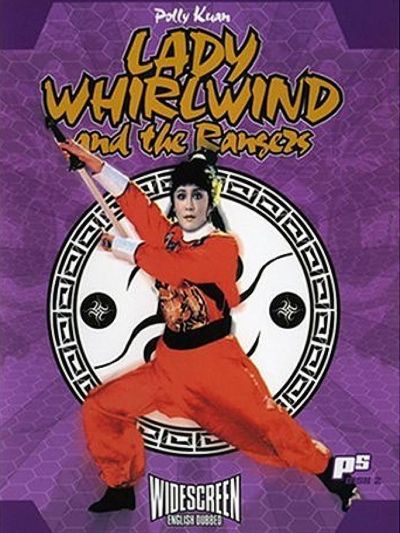 Not to be confused, in the slightest bit, with
 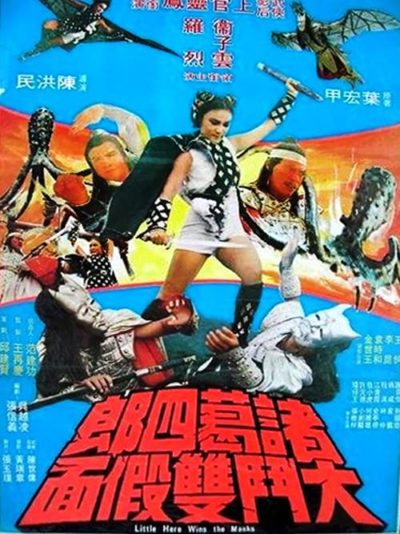 Although almost a decade earlier than Lin Hsiao Lan’s slew of fantasy kung-fu flicks, this shares a lot of the same elements – not least an approach to narrative coherence best described as “informal.” This starts at the beginning, where we don’t even get introduced to the participants, before the martial arts breaks out. As we learn a little later, it turns out this pits Chu-Kwok Su-Lan (Shang-Kuan) against three members of the Devil’s Gang, in defense of her two, largely useless sidekicks. This is just the first of numerous encounters between our hero – yes, it’s
 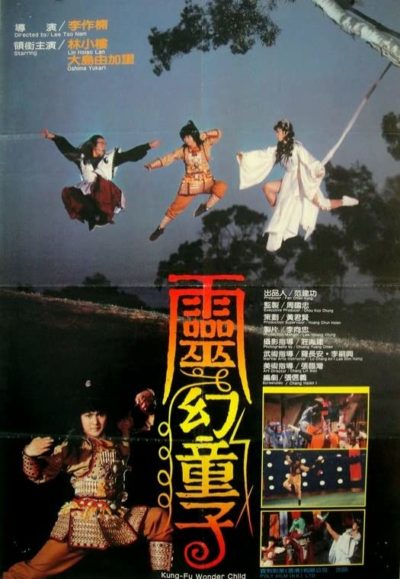 You may have noticed that I’ve been on a bit of a spree with these Taiwanese fantasy-fu flicks of late. However, I think I’m feeling a bit sated with them at this point, and the law of diminishing returns seems to be setting in. There are only so many unconvincing male impersonators, bad effects (both optical and practical) and almost illegible and/or illiterate subtitles a man can take, and I think I’ve reached my capacity in almost of these categories. Fortunately, my queue of such things seems to be nearing an end, with just a couple more to go. Still, after this delirious experience, I feel in need of a week or two’s break from the madness.
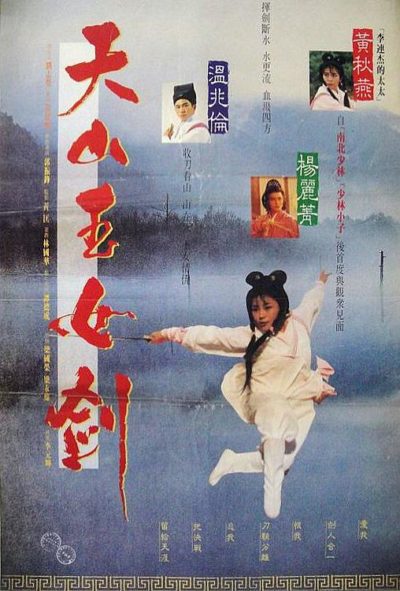 Yeah, if the above line of subtitled dialogue makes sense, this film then ups the ante, with white subs on a frequently white background, and which frequently appear to be making a bid to escape from the bottom of the picture. It’s safe to say that a decent presentation of this, perhaps with a print which doesn’t look like it was left in someone’s pocket when their suit went to the cleaners, might merit a half-star more. A few more fight sequences would help too: the ones there are, don’t lack in quality. There’s just a bit too much farcical comedy for my taste.
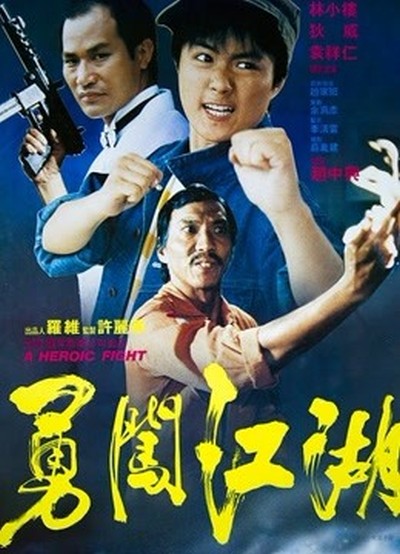 Well, this is certainly… a film. Indeed, of all the movies I’ve seen, it is unquestionably… one of them. Is it good? Bad? I’m still not sure. There are so many shifts in tone here, you’ll get whiplash. It’s clearly intended to be a parody of eighties Hong Kong cinema (even though it was made in Taiwan), yet is equally guilty of committing many of the same sins. I can’t deny the imagination here. A gangster, the unfortunately named Mr. Duh (Chao) is embroiled in a struggle for control of his empire with a lieutenant (Wei) who wants to start dealing drugs. To this end, the boss’s grand-daughter is kidnapped, only to be rescued by conveniently passing martial arts actor Hsiao-Long (Lin). He – and I’ll get back to that – is part of a film studio under his father (Yuen), who specializes in action and special effects. They end up hired by Duh, putting their skills to use to protect the grand-daughter and, at one point, fake the boss’s death.
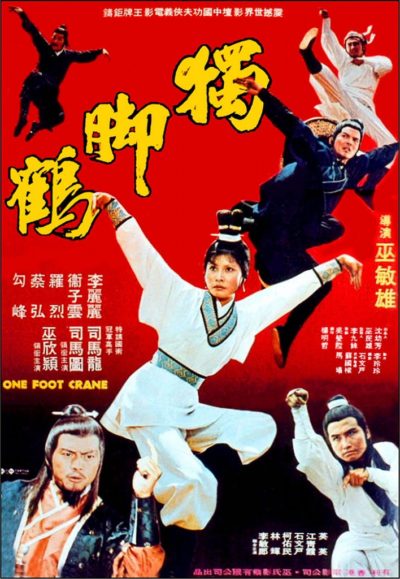 We begin with the murder of a family, with the sole (apparent) survivor being a small child, Fung Lin-yi (Li), who is able to escape. Rescued by – and stop me if you’ve heard this one before – a kung-fu master, she is rigourously trained in the titular style of martial arts. It’s fairly nifty, not least for the dagger hidden in the tip of her shoe which she uses to administer the coup de grace, Rosa Klebb style. Fifteen years later, she’s ready to seek revenge on the quartet of outlaws responsible for killing her family, who unlike our heroine, appear not to have aged a day over the decade and a half since they participated in the slaughter. Matters are complicated by a few factors. Her first victim is the father of one of the outlaws, who then starts tracking down the mysterious “One Foot Crane” responsible. There’s also a police official investigating the situation (Sze), and it turns out Lin-yi may not be the only survivor after all (Wei).