★★★½
“The final countdown.”
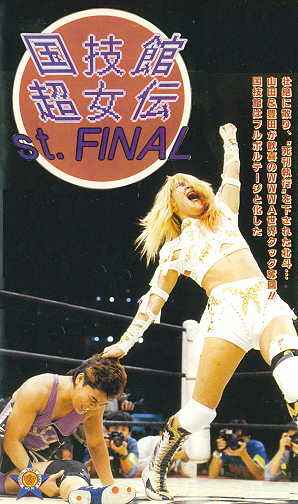 The tapes for this show – it’s a 2-cassette set – came from a friend in Hong Kong; I have to say, when I saw the official retail price, was rather gobsmacked. Y180,000, which is about $150! And that’s in 1994 money… I can only presume it was intended for the rental market rather than the fan. Needless to say, I didn’t pay so much for it…
Still, financial considerations aside, 1993 may have been the year when Japanese women’s wrestling was at its peak. Perhaps the greatest single event ever, Dreamslam, took place in April, pitting the best wrestlers against each other, regardless of what wrestling company they worked for. The St. Final show in December, was a similar cross-promotional attempt to create a mega-event, and took place in Tokyo’s Sumo Hall, before a crowd of 11,500.
Leo Kitamura/Otaku Hozumi vs. Tomoko Watanabe/Chikako Shiratori. Not really much to say about this opening match, which was clearly a warm-up; the crowd were still coming to their seats. Tomoko Watanabe would go onto much greater things (particularly as part of the ZAP tag-team), and Shiratori would also move on, but Kitamura and Hozumi vanished off the radar as far as I can tell. Next up after this was a midget wrestling bout – it says something that it was considered worthy of a higher place on the card!
Chaparrita ASARI vs Candy Okutsu (JWP). Here is another case where the contenders would go on to better things, and their feud for the WWWA Super-lightweight title in the late 90’s is well-regarded. But even now, and despite both wrestlers having only made their first appearances the previous year, this bout had its moments, though it was pretty variable. The boston crabs Okutsu put on ASARI were spine-poppingly good, while ASARI was athletic and agile, in a fast-paced bout. She failed to hit her finisher, landing head-first after a Skytwister Press, and the rapid pin thereafter by Okutsu was probably very welcome.
Sakie Hasegawa/Kaoru Ito vs. Miki Handa/Yasha Kurenai (LLPW). This one wasted no time, the combatants going at it before the introductions were even completed. The bout was a good illustration of the difference between single bouts and tag teams; both sides worked well together, both to attack their opponents, and making saves when their partner was in trouble. I note with interest that the referee was also from the LLPW – the shirt kinda gave it away – so it was no surprise when Handa and Kurenai took the win. However, when the “visitors” win the undercard bouts, it’s often a clue that the main events will go to the home federation…
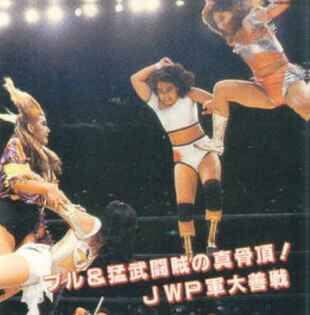 Bull Nakano/Mima Shimoda/Etsuko Mita vs. Cuty Suzuki/Plum Mariko/Hikari Fukuoka (JWP). This had the makings of a squash match, with the JWP girls out of their depth. However, when Nakano wasn’t in the ring, it was well-balanced. Fukuoka in particular performed like ring-icon Manami Toyota, even using Toyota’s signature rolling cradle move. Suzuki took a lot of punishment, and her gold armour costume was cool, while Mariko (later in her career, she would die after a bout) helped out with good assists. Shimoda and Mita kept pace nicely, but Nakano ruined things by brushing off all attacks, destroying their impact by her refusal to sell. No surprise her team got the win, but this bout was one player short of being memorable.
Kyoko Inoue/Takako Inoue/Yumiko Hotta vs. Eagle Sawai/Rumi Kazama/Harley Saito (LLPW). Onto the second tape, having got the appetisers out of the way. Things still not quite at full boil, as this match was dominated by the strength brigade of Kyoko Inoue, Hotta and Sawai – the other three were next to invisible. Hotta is infamous for her kicks, and they’re not something I’d like to receive, while Sawai gave a good account of herself, flinging Inoue across the ring. But it lacked much in the way of variety, though Kyoko Inoue’s agility was impressive for someone of her size.
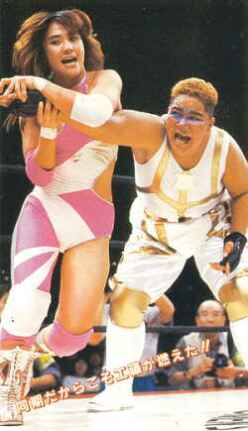 Aja Kong vs. Megumi Kudo (FMW). It says something that a match for the WWWA World Title wasn’t the main event, or even the second one. We know how this one’s gonna go: Kudo getting punked repeatedly. Wrong. Had quite forgotten Kudo knows how to wrestle, easy to do when she’s fighting talentless thugs like Shark Tsuchiya. Kong was playing the straight champion, at least until Kudo took advantage – then the gloves came off, Kong giving her opponent no slack, with brutal kicks and slaps.
Initially, this was mat-based, which seemed like a bad move for the much smaller Kudo, but when Kudo started locking in the cross arm-bars, the balance shifted. Her problem was keeping Kong from heading for the ropes, but frequent repetition (and Kong’s excellent selling of the moves) made the possibility of an upset quite plausible. Kong hit back with power moves, and Kudo switched to trying for falls…a fatal mistake. :-) She would have got one but the ref had been “knocked out” – a rare stunt in Japan – and we all know that means you’re gonna lose. Kudo seemed genuinely tearful in the post-bout interviews.
Dynamite Kansai/Mayumi Ozaki (JWP) vs. Manami Toyota/Toshiyo Yamada. This was for the WWWA tag bout, but was just one fall, rather than the usual three. Probably wise, as the pace was totally frenetic. My notes for this one peter out after about 10 minutes, since I gave up trying to write because something was always happening. I like well-balanced bouts, and this was one which could have ended at almost any time, in either direction – both sides had one high-flyer (Ozaki & Toyota), and one powerhouse (Kansai & Yamada), giving plenty of variety and scope for action of all sorts.
Toyota was likely the star, not just for the pounding she took, or even her usual suicidal athleticism – though the moonsault from the top rope to the arena floor was memorable – but because she seemed really into the contest, screaming like a banshee. This in no way should be taken to indicate slackness on anyone else, as they all played their parts. Kansai and Yamada punted each other ferociously, the latter also hitting Ozaki with a seemingly-endless Giant Swing. The only weakness was an ending which seemed sloppy and not up to the amazing standard of the rest of the bout, but this contest still merited an immediate rewind and repeat.
Akira Hokuto vs. Shinobu Kandori. Can you imagine the WWE headlining a pay-per-view with a non-title bout? But these two had a ferocious rivalry – their Dreamslam I match was voted the best contest of the 90’s in an Internet poll – and any contest between these two was an obvious attraction. Within ten seconds Hokuto was bleeding badly from the mouth, after trading lethal punches with Kandori, and you just knew this was going to be a brawl from hell, rather than an exercise in scientific wrestling.
As such, while you couldn’t knock the intensity on view here, couldn’t help shake the feeling that we’d left the wrestling world behind, and were now operating somewhere between pro boxing and Brawlin’ Broads. Kandori had a nice arrogance though, deliberately holding back on her kicks and, at one point, applying a submission hold on Hokuto then letting go with a waggle of her finger, as if to say, “Too easy!”. But it was just too close to an episode of Jerry Springer to make this a classic in my eyes.
Overall, this is a solid tape. Perhaps only the WWWA tag team bout would make it onto any best-of compilation – but even the worst is still better than 90% of the contests in the WWE these days. Even though it’s only a single event, it demonstrates the breadth and depth of Japanese women’s wrestling, with a variety of styles, looks and attitudes which we in the West can, for the moment, only dream of enjoying.
Star: Akira Hokuto, Shinoba Kandori, Dynamite Kansai, Manami Toyota




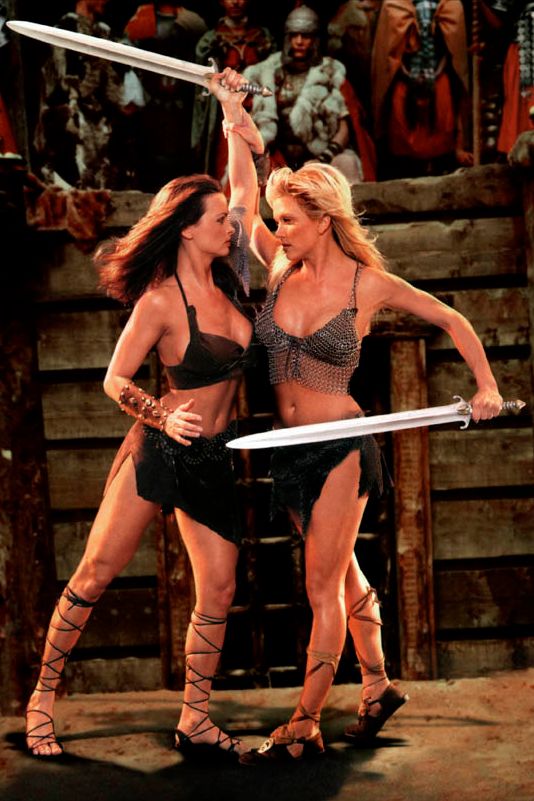
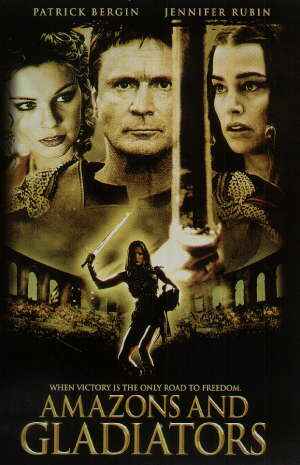 Benefiting from a slew of decent performances, A&G manages to surpass most of the competition and become a worthy entry in the “gladiatrix” sub-genre. This is perhaps because the cast have been hired either because they can act or because they can fight, while simultaneously not embarrassing themselves in the other department. Pity poor Hiltz, who is in virtually every scene, yet doesn’t even get her name on the cover.
 After thirty minutes, I was toying with the idea of giving this the first ever 0 star rating. On that basis, eventually creeping up to two counts as something of a miraculous recovery. The heroine is an alien, transporting her child across the English countryside, while being pursued by white-masked hunters. There is almost no dialogue, which is so obviously a penny-pinching device it hurts – the video stock and woeful “martial arts” don’t help.
 To tide you over the summer until the new series starts, as well as an ‘official companion’, Random House has published two novels, which fill in the back story before the show. Recruited tells of how Sydney Bristow was brought into SD-6, while A Secret Life details her first overseas mission, infiltrating a Paris fashion house being used as a cover for gun-running.
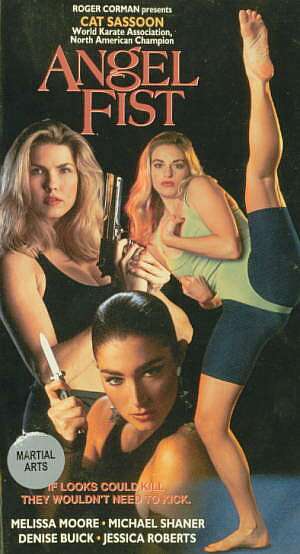 Cat opted not to follow in the footsteps of her father, shampoo magnate Vidal, preferring instead to win various karate titles (allegedly) before moving into movies. Between two parts of the Blood Fist series, she popped over to the Philippines, and made this one for Roger Corman, under the gaze of familiar GWG director Santiago (TNT Jackson, etc.). She plays an LA cop, who comes to Manilla to investigate her sister’s death – she was killed after photographing a political assassination. And, hey, whaddya know? She was also taking part in a karate tournament… I trust I need not extend the plot synopsis any further.
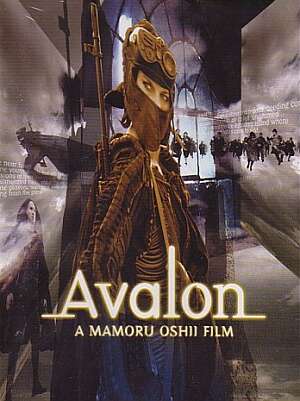 While this is live-action, Oshii is best known for his anime work, such as Ghost in the Shell. That also had an action heroine, great visual style and lost its way in philosophical navel-gazing. There, it was the nature of self – here, it’s the nature of reality. Set in Poland, which may be a first for a Japanese film, the heroine, Ash (Foremniak), is addicted to an illegal computer game called Avalon. When she hears about the existence of a special level in it, she’ll stop at nothing to find the entrance. But, for her, the line between life and pastime is becoming more and more blurred…
 Don’t look for Aruba Red in your local video store. You won’t find it, because it is a beer. Yes, an alcoholic beverage. So, what in heaven’s name is it doing on this site? Well, as far as I know, it’s the only beer inspired by a female action heroine, albeit a fictitious one.
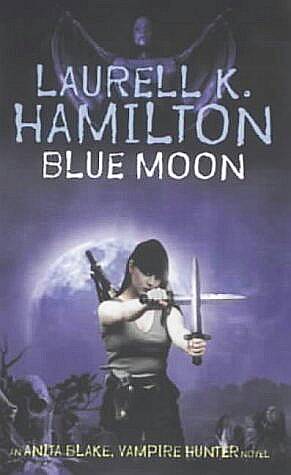 This long-running series, with the 11th entry due in 2003, takes place in an alternative reality where vampires have equal rights as citizens. Heroine Anita Blake is a state-appointed executioner (“when good bloodsuckers…go bad…“) in St. Louis, who takes out the undead trash and also has a day job – actually, more of a night job – raising zombies. Oh, did I forget to mention them? There’s also were-creatures, ghouls, and pretty much the whole range of supernatural monsters.