 ★★★½
★★★½
“Mums with guns.”
 Twenty years ago, Cops debuted on Fox, and has become a part of the cultural landscape, leading to an avalanche of spin-offs, ranging from the serious to the complete spoofs (Reno 911 being the most notable). The very first episode took place in Broward County, Florida and, two decades later, the latest in the field returns there. PoBC, as I’m going to refer to it for obvious reasons, follows four women members of the Sheriff’s Department there, both at home and on duty, as they take down the bad guys and deal with the public.
The four present a cross-section, covering three races and a broad range of ages, from 25-year old Deputy Shelunda Cooper, to Detective Julie Bower – almost double Cooper’s age, whose hair appears firmly rooted in the 1980’s. Each episode is a semi-random selection of incidents. If there’s a theme, it’s in the type of crimes with which each deals. Bower is a member of the sex-crimes unit, which covers everything from rape cases to staging prostitution stings [one of which involved her dressing up as a street hooker]. All the cases of Detective Ana Murillo seems to involve drugs, while Cooper is the queen of the “domestic” – if there’s a family squabble, she’ll be there. Detective Andrea Penoyer’s caseload has a little more variety, though she achieved a certain notoriety for her gung-ho quote, “There’s always a good time to use a Taser,” featured prominently in the trailer (below).
Murillo seems to have a little bit of an attitude, shall we say, especially if any of the members of the public with whom she comes into contact do not adopt the appropriate reverential approach – such as the woman who has the temerity to talk on her cellphone. Murillo basically confiscates the phone, and there are numerous other incidents in the show which have a questionable nature as far as constitutional rights go. Her approach to law-enforcement appears to have more in common with Judge Dredd than “To protect and serve,” though one wonders whether TLC’s description of it as a docudrama – emphasis added – has more significance than might immediately be obvious.
“I’m no different fron the guys, I still kick ass and take names – I just do it with nail-polish and lip-gloss.”
— Ana Murillo
 Despite Murillo’s unquestioned position as Empress of Lip-gloss, it’s blonde, blue-eyed Penoyer who is the glamour queen of the show – though the illusion is somewhat damaged when she starts yelling commands at suspects in a voice that’s probably the audio equivalent of getting Tazered. Though as she points out, such an attitude is necessary: “When someone walks in a room and you got a cop who is 6’5″ and 300 pounds, he looks intimidating. So we have to act intimidating: we have to be very, very serious and let people know we’re not playing around.” Well, not all the time, anyway. We also get to see Penoyer and her policewomen friends shopping for guns, and relaxing on the beach. In their bikinis.
This illustrates the strange double-standard at the heart of the show: on the one hand, it wants to show that the subjects are “just like the guys”. On the other, it keeps reminding us that three of the women are mothers – two of them single moms – and takes great care to point out how much they care about their kids. That’s the dichotomy that’s at the core of girls with guns: the contrast between the maternal and life-giving aspects and the death-dealer. I suspect, however, that it would be giving the creators of the show more credit than they deserve if I were to say they were conscious of such philosophical concepts.
Oddly, it’s Cooper of whom we grew fondest, even though she seemed condemned to the pettiest of crimes – someone refusing to pay a taxi fare for instance. Yet she seemed the one most genuinely concerned with her role as a member of the community, not just as a law enforcer. In one scene, she was called to an elderly gentleman’s apartment and ended up calling his girlfriend on his behalf; in another, she gave a homeless person the sandwich her husband had bought for her dinner. When she got a ‘proper’ crime – a burglary – and was able to take fingerprints, she was so genuinely delighted, we couldn’t help but cheer – hopefully, she’ll eventually achieve her ambition of getting into the CSI side of things.
I do have some serious qualms about the philosophy of policing shown here. While there’s no denying the awful effects of drug addiction [some of those arrested are a stark, poignant reminder of that], the efforts here seem almost entirely directed at street-level pushers – who, curiously, all seem to be black. What are the odds of that? Busting them is a pointless endeavour, since it simply creates a temporary gap in the marketplace, into which someone else will stop. Even more dubious are the prostitution stings: disturbing amounts of police resources are devoted to something which is basically a massive waste of time. Want to control prostitution? Legalize it, license it and tax it.
Once again, however, the creators have little no interest in addressing such things. This is about the telegenic end of policing, where no bad guy gets away and questions about rights and the ethics of entrapment operations are not considered. It’s entertainment, pure and simple – and even as people who have a very low tolerance for “reality entertainment” [since we usually find it neither realistic nor entertaining], this is curiously habit-forming.
Shown: TLC, Thursdays, 9pm
Star: Ana Murillo, Shelunda Cooper, Julie Bower, Andrea Penoyer



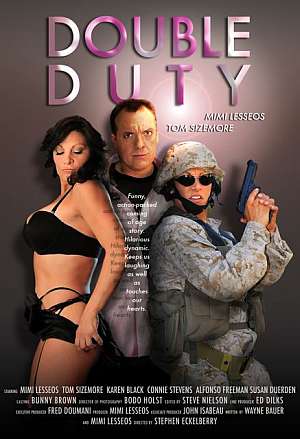 After 20 years in the Marines, MJ (Lesseos) returns to civilian life, but finds it somewhat hard to adapt to life as a civilian. Her old college friend Sophie (Duerden) helps her adjust – somewhat – and introduces her to Craig (Sizemore), a designer who is perhaps rather more feminine than MJ. Sophie is working on a charity auction, not realizing her assistant Carl (Freeman) is planning to steal the top item, a Faberge egg. Meanwhile, hypnosis has given MJ the ability to get in touch with her inner woman – but the problem is, every time someone snaps their fingers, she switches between her two personas. There is that of the rough, tough and gruff Marine, and then there’s the other, a giggling girlie for whom breaking a nail would pose a deep, personal crisis. Which will win out when the chips are down?
 If you’ve seen Chocolate – starring the same lead actress, though confusingly billed under a different name here – you’ll know what to expect, and the film delivers much of the same. Which would be stunning, brutal fight scenes combined with moments of mind-numbing tedium. The plan for Yanin’s career seems to be to contrive methods by which she can avoid acting: last time it was autism; here, it’s a drunken style of kung-fu which helps mitigate a voice that might charitably be compared to broken nails on glass. She plays former rock-star(!) Deu, who is on the edge of being kidnapped, when she’s rescued by Sanim (Tang). He and his fellow masters of alcohol-fu have all lost ladies in their life to the kidnappers – who, it turns out, are doing this because… No. You wouldn’t believe me even if I told you – and are trying to locate their lair. Deu joins the team, and agrees to act as bait, to see if the kidnappers will go after her again.