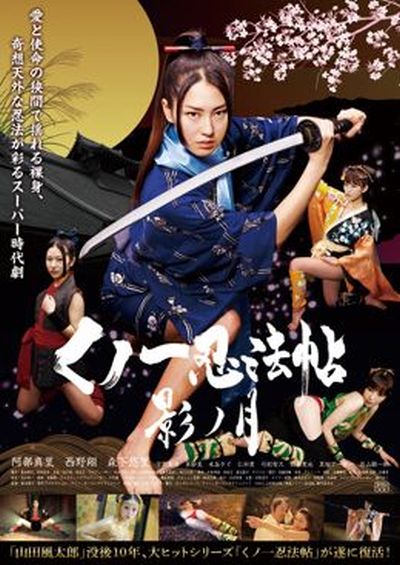
This has more than slight echoes of the Female Ninjas, Magic Chronicles series, sharing the feudal setting, along with similar… unconventional attack forms by the protagonists. That’s unsurprising, since both are apparently based on Ninja Tsukikagesho, by Yamada Futaro. And, just to confuse matters further, the IMDb states that part 6 of FMMC shares the title here. Whether this might be the IMDb getting confused, I can’t say. I wouldn’t blame them if so, because the entire plot here is more muddled than enlightening. It takes place in the 1730’s, when Shogun Yoshimune and his deputy, Muneharu, were struggling for control. As a way of fomenting dissent by embarrassing him, Muneharu drags out the Shogun’s former concubines; to stop this, Yoshimune sends a group of his top female ninjas, under Tsurugi (Abe), to kill the women before Munharu’s men can get to them, triggering a ninja war. Complicating matters, turns out one of the concubines may have had a bastard son by Yoshimune, and whoever gets proof of that lineage will really hold the whip hand.
However, the script gets bogged down in murky shenanigans, with poor differentiation between too similar characters – not helped by people pretending to be other people on more than one occasion. It might sound bad to say this, but when it seems 90% the men have the same hairstyle, and 90% of the women have the same hairstyle… Well, I could have done with a scorecard, shall we say. Instead, save perhaps for Tsurugi, who does get painted with a bit more depth, the only way you can tell them apart is by the special magical attacks, the names of which are conveniently yelled out as part of their execution, and which are certainly the most memorable aspect of the film. This starts with – and I wrote these down to be sure I got them right – the “Ninja Snake Penetrator,” then proceeds through “Ninja Milk of Death,” “Icicle Sword” and the “Echo-blade Weasel Attack,” before climaxing [and I use the word advisedly] with the “Memento of the Full-bloom Lotus” – not quite as innocent as it sounds. However, the action sequences are generally forgettable, even including the flurry of second-tier digital effects unleashed as a result of the special attacks.
The plot certainly has its share of twists and turns, but I can’t say I was enthralled by many of them, and the end result just doesn’t gel into anything more than very sporadically interesting. Just as with FNMC, fifteen years earlier, this proves that you need more than marginally inventive magic to make for an entertaining movie. Maybe it helps to have read the source novel, but I can’t say there’s enough here to make me put in any effort to that end.
★★
“The aroma of Troma is not necessarily a good thing.”
First off, bit of an retitling faux pas here. The heroine’s name is actually Drew: nobody ever calls her “Femme”, and this part of the title appears to be purely a Troma invention. Which is unfortunate, because “Femme Fontaine” is French for “squirting woman”. As I found out when Googling for an image to illustrate this. It took quite a long time staring at cat videos to detox from that, let me tell you. Anyhow, this is what could kindly be described as a labour of love for Hope, who stars, directs, wrote and produced this. Less charitable opinion may prefer the term “vanity project,” especially considers she never directed, wrote or produced anything else.
Heroine Drew Fontaine (Hope) is an assassin, who gets drawn into a murky web of shenanigans after her mentor, Master Sun (James Hong), an agent turned Buddhist priest, is gunned down during a raid by a neo-Nazi group on his temple [which may have been inspired by a real-life mass killing at a Buddhist temple in Arizona, three years earlier]. Turns out the place was being use to hold cash from an Oriental crime gang run by Mercedes Lee (Dao), being laundered through an adult movie producer. But the Aryan neo-Nation, under their Ilsa-like leader Gertrude Schank (Paxton), are instead going to use the money to fund research into biochem weapons of mass destruction, with the help of a former Nazi scientist. Fontaine is recruited by federal authorities for an off-book operation to infiltrate and destroy the group, which requires an unholy alliance with Lee – who, it turns out, had a relationship with Fontaine’s now-disappeared father.
I hope you were paying attention there, because this will be on the test at year-end. It’s definitely a slog during the early stages, with little or no narrative flow, instead consisting of scenes that start, proceed and end, without connection to the ones that precede or follow them. There’s also no consistency of tone: for instance, Dao appears to be approaching her role largely straight, but Paxton chews scenery at such a rate, she seems to have strayed in from another Troma project, the renowned/infamous Surf Nazis Must Die. Hope wobbles uncertainly between these extremes, not sure whether or not to take her own project seriously, and that inevitably infects the viewer with a degree of emotional apathy: you can’t commit to a film, if its makers can’t. Things do improve in the second half, and there’s one scene, where Fontaine and Lee are trying to extract information from a prisoner, that possesses a genuine edge which is refreshing. However, this never gets out of second gear; to be honest, I’ll remember the Google Image search much longer than the actual movie!
There have been rumblings about a live-action version of iconic anime/manga series Ghost in the Shell for years, with Dreamworks picking up the rights to Masamune Shirow’s creation as far back as 2008. However, things appear to have moved forward significantly in the past year, with director Rupert Sanders, who helmed Snow White and the Huntsman, named as on board last January. Rumblings in Septemner had Margot Robbie (Wolf Of Wall Street) interested in the lead, but she stepped aside the following month, and Johansson’s name moved into the frame instead. This has now become a firm commitment, with Varietyreporting yesterday that the actress has now agreed to take on a role, presumably one based on Major Motoko Kusanagi, the heroine in many of Shirow’s stories.
Set towards the middle of this century, both manga and anime focus on Public Security Section 9, a Japanese special-operations task-force made up of former military officers and police detectives. In this future, mixing flesh and technology is commonplace, with many humans enhancing or replacing their abilities with so-called “cyberbrains” and prosthetic mechanical enhancements. While conferring obvious benefits, it also opens the door to a wide range of new criminal activities, and countering these is where PSS 9 comes in. Kusanagi is one of its officers, and a childhood accident left her almost entirely cybernetic. One review described her as having “the body of a Baywatch babe, the face of a beauty queen and the soul of a machine.” Johansson’s performance in unexpected global success Lucy, playing a similarly enhanced human, may have helped open the door for her here, and there was also Under the Skin, where she portrays an alien who seduces men.
However, not everyone is impressed. Forbes wrote a scathing critique of the announcement, calling her “not a good fit” for the role of the Major. There is admittedly, the obvious question of race here: do they change the lead from being Japanese, or make Johansson wear yellow-face? Neither would seem particularly credible, though the cybernetic nature of the heroine does open the door to the possibility of whatever look you want. Since she’s almost entirely an artificial construct, she could wear any face – or even no face at all. But there’s still the potential for disaster here, on an almost unmitigated scale: you only have to look at the last big budget, live-action movie inspired by Japanese animation. That would be The Last Airbender, almost universally regarded as one of the worst films in the last five years, which Rotten Tomatoes gives a 6% approval rating, with an average score of 2.8/10.
It’s reported that Johansson will get $10 million for her work, which would put her into a very exclusive club of actresses. Certainly, between Lucy and her roles as Black Widow in the Marvel universe, her credentials are as robust as anyone currently working in Hollywood, so I’m cautiously optimistic for this film. It’s certainly good to see studios prepared to make an investment in a high-profile action film with a female lead character. But the critical and commercial success which resulted will depend heavily on the script. Given the extremely large amount of money that this will need to spend to create a futuristic universe, there’s genuine reason to fear that the more subtle and metaphysical aspects of both the anime and manga versions, may be set aside in favour of less interesting but more bankable aspects e.g. giant fireballs. This certainly is not a certain success.
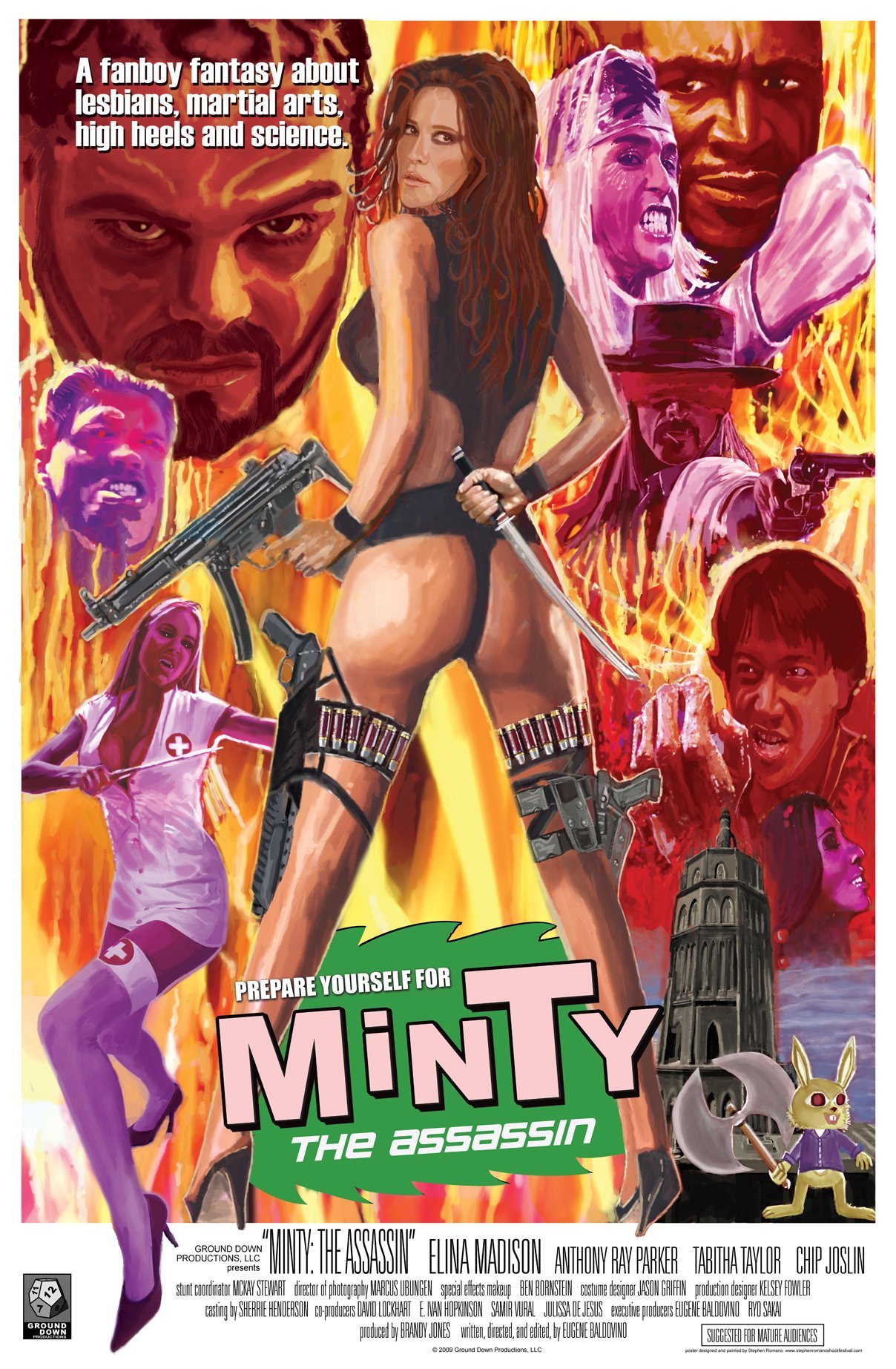
When a film clearly doesn’t take itself seriously, and in particular, when it almost takes delight in acknowledging its own flaws, this does convey a certain immunity to criticism. “Yes, we know this is crap,” it seems to be saying. “So what?” But on the other hand, it’s hard to be a parody of comic-book fan-service, when you actually are comic-book fan-service. The heroine here is Minty (Madison), an assassin who works for a man known only as Big Boss (Parker, channeling the spirit of Michael Clarke Duncan). When he is kidnapped by Dr. Brain Bender (Joslin), an evil scientist – really, how could he be anything else with that name? – and his vampire sidekick, Double Delicious (Taylor), Minty, powered by chocolate, has to fight her way up through the levels of the Cock Tower [sic], defeating Bender’s other minions, up to where Boss is being held. While Bender can’t beat Minty himself, he transfers his mind into DD’s body, and there’s only one way for our heroine to prevail…
If you guessed the answer is “lesbian canoodling,” give yourself two points.
It’s very much a mixed bag here. Some moments fall entirely flat, and the film often isn’t as funny as it thinks it is. This is in part because most of the supporting characters don’t have the acting chops to pull off the satirical aspects, which is a lot harder than it looks. “Broad comic mugging” seems to be the main direction provided by Baldovino, and that rapidly becomes more tiresome than entertaining. However, there are some scenes which do work well. I particularly enjoyed Minty going up against a Bruce Lee look-alike (the fight here was nicely put together and edited), while there’s also an animated interlude featuring Minty being chased through a Prince of Persia-style level by a psychotic rabbit. This ends in an arterial way that feels like it comes out of a particularly twisted Tex Avery cartoon.
Unfortunately, the finale then gets itself bogged down in soft-core shenanigans with poor continuity e.g. in one shot, Delicious is topless, the next, she’s wearing butterfly-shaped pasties. [Look, you’re either willing to get undressed or you’re not. Have the courage of your convictions, and don’t change your mind mis-scene] Admittedly, it’s preceded by Dr. Bender explaining that the goal of all fanboys is to see the heroine naked, so this is simply delivering on that promise. But blatant foreshadowing doesn’t make it any more interesting or entertaining, and the movie doesn’t at all make it clear that Bender is actually a fanboy who has somehow come across into Minty’s comic-book world for nefarious purposes. Maybe there’s a director’s cut somewhere that explains all this. Instead, as seen here, it’s a probably over-ambitious and occasionally entertaining mess, not without its charms, yet some way short of being charming enough.
Dir: Eugene Baldovino Star: Elina Madison, Chip Joslin, Tabitha Taylor, Anthony Ray Parker
Cassie: What a day, huh? Parachuting into a cemetery because the perimeter was guarded and it was our only way in, and exposing a deadly double agent who was trying to elude capture by faking his own death and being buried with an oxygen tank, only to be dug up later. D.D.: We knew all that, you know. Cassie: I know. I’m just saying it for anyone who might’ve been wondering why we’re going through all that trouble. Shane: Who’d be wondering? Cassie: I don’t know, anyone. Look, I’ve never told you guys this, it’s kind of embarrassing. Sometimes I get the weirdest feeling like people are watching us, like they’re listening in on every single thing we do or say. Shane: Yeah, I get that feeling, too.
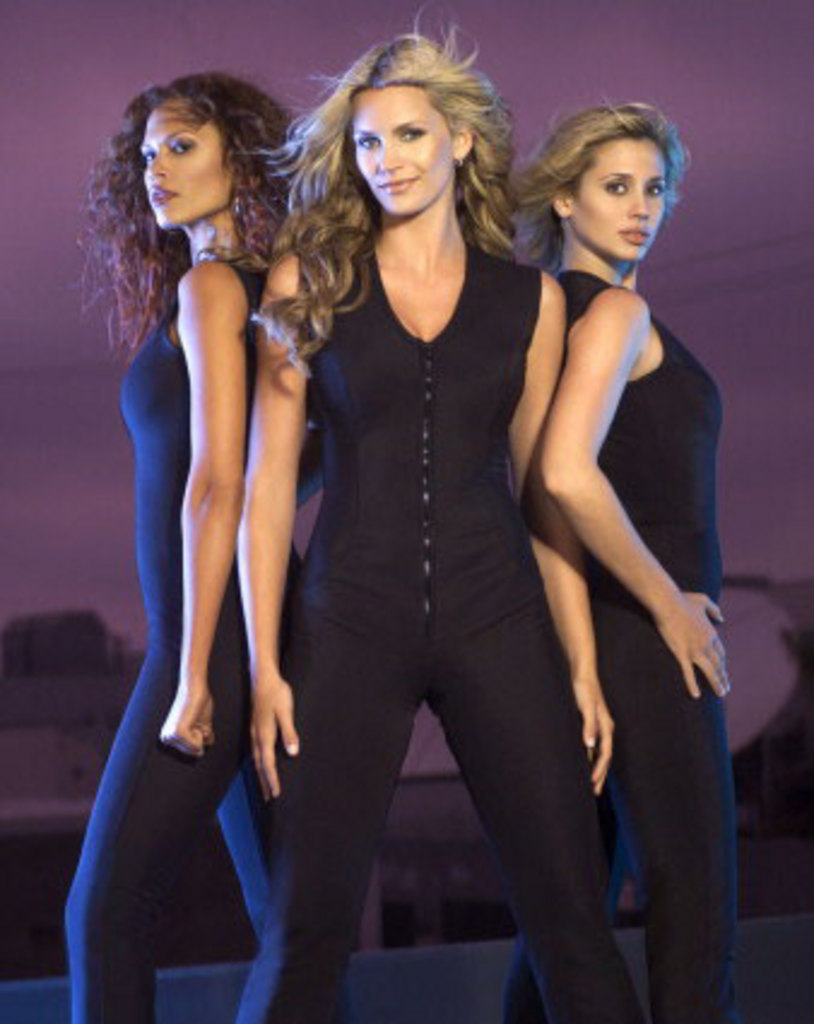
This series came out in the wake of the Charlie’s Angels movie which rebooted the franchise in 2000, and shares much the same combination of action escapades and tongue-in-cheek, self-referential (and often self-deprecating) humour. However, sustaining this for 90 minutes is a much easier proposition than doing so over 20 episodes, each three-quarters of an hour or so without commercials. What seemed like a deliciously frothy concoction in the opening episode, juggling the elements with some skill, eventually ground down to tedious repetition. Chris, in particular, hated the show with a passion, which is a little odd, since she’s a big fan of the similar Chuck. Mind you, since I can’t stand Chuck, I’m not really able to argue, especially since my arguments in defense of She Spies became more like token gestures by episode 20.
Just like Charlie’s Angels, this focuses on a trio of butt-kicking babes: in this case, liberated from prison by Jack Wilde (Jacott), who puts them to work in a quasi-governmental organization that hunts down bad guys while exchanging witticisms. They also share a house, which makes things very convenient for any of said bad guys, who want to take them out. The trio all bring their disparate, somewhat dubious skills to bear on the situations that result: there’s con-artist Cassie McBaine (Henstridge), computer hacker Deedra “D.D.” Cummings (Miller) and master thief Shane Phillips (Williams). The first episode is a fairly accurate summary of the basic idea: they’re assigned to protect a former politician turned talk-show host from an assassination plot, and have to go undercover at the studio to reveal the culprit [and given the target’s former and current occupations, there’s no shortage of suspects].
What the first episode does brilliantly – and what the rest of the series never consistently recaptures – is not so much breaking the fourth wall, as riding a wrecking-ball into it, repeatedly. For instance, the three ladies are introduced by Jack on a literal game-show, with him as a host. Does this make any sense? Of course not. But it doesn’t matter, since we are already on a show about, to quote the introductory voice-over, “three career criminals with one shot at freedom. Now they are working for the feds who put them away. These are the women of She Spies, bad girls gone good!” Take the suspension of disbelief that requires, added to the cast and crew clearly being in on the joke, and you can potentially manipulate proceedings in any direction you want, the more ingeniously whimsical the better. The universe is your plaything.
Too often, however, the opportunities this offers are squandered rather than exploited, and the plots became tedious rather than springboards for the imagination. Though there were still occasional moments of surreal genius, such as the trio pretending to be Swedish – which worked rather better for blondes Henstridge and Miller (“I like toast!”) than African-American Williams. Most of the time, the episodes largely have to skate by on the personalities of the leading ladies: that’s not a bad thing as such, since they all do credibly, with Miller likely faring best. There are also some very entertaining guest stars, beginning with Barry Bostwick as the talk-show host mentioned above; also in the first season are Claudia Christian, as the original She Spy, and Jeffrey Combs. However, there’s only so much emptily witty banter I can take, and the script-writers’ well ran painfully dry, the deeper into the series I went, for instance with the increasingly obvious use of money-saving flashback sequences.
The last edition of season one was particularly bizarre. Shane bumps into a former boyfriend who is planning to have himself cryogenically frozen so that he can be with his dead fiancee, and uncovering a plot by the facility to harvest body parts from their subscribers, in order to keep a billionaire away. I’d like to have been at the planning meeting where that idea got green-lit, simply due to the copious quantities of drugs which much have been ingested there. It possesses a darker tone, which is jarringly at odds with the ironic approach of the series as a whole, and supports the impression, generally escalating as the series went on, that those involved in creating the show had more or less given up and were phoning it in. I do exempt the four leads from this criticism, since they bravely struggle against the snowballing tedium of the scripts until the very end.
Even the action becomes relatively muted, and to be honest, it was never very good to begin with. And that is comparing the show to its contemporaries on television – say, Buffy the Vampire Slayer – rather than the Charlie’s Angels movie, which had the SLIGHT advantage of action choreographed by Yuen Wo-Ping. This is the area where Miller is probably the weakest of the three, since she looks less like a brick-house, and closer to one built of straw, vulnerable to anyone on-set sneezing in her direction. While Henstridge and Williams fare better here, it’s still generally clear they are more effective in the scenes requiring flexibility and grace, than at portraying strength and power. All three sometimes suffer also from painfully obvious stunt doubling, though since this is the bane of TV action generally, it’s par for the course.
In the end, it’s a difficult path to tread, because the show [at least the first season watched for the purposes of this article] could never appear to decide whether or not it quite wanted to be taken seriously. Zap2It.com describes She Spies as “Alias meets Austin Powers” and, while that certainly isn’t inaccurate, those are almost contradictory and mutually exclusive genre entries. It’s very hard to be taken seriously, when you are constantly undercutting yourself with cool, ironic asides or acknowledging the silliness of the scenarios being depicted, and you probably shouldn’t even try. In reviewing the Angels movie, the conclusion I reached was “It works beautifully, despite its flaws, but it wouldn’t bear frequent repetition.” Twenty episodes of She Spies largely proves the truth of this.
The first four episodes in September 2002 were planned to screen on NBC, before the series was then bumped from network to syndication [while this was always the plan, it is snarkily referenced in a later discussion about She Spies action figures: “You wind them up and they dare you to find their time slot”]. but it only lasted three before being yanked. At the end of the first series, Jacott left proceedings, and the second run of episodes also abandoned much of the self-referential approach, playing things straighter. However, the new approach failed to catch on any better, and the show was not renewed beyond its sophomore season. Below, you’ll find the first episode in its entirety – all forty have been up on YouTube for more than three years, so seem to have at least tacit approval. But it’s largely downhill from this first show, folks.
Star: Natasha Henstridge, Kristen Miller, Natashia Williams, Carlos Jacott
[Note. This is a XXX-rated film, so while I’m being very restrained, the discussion of it is, of necessity, still for mature readers.]
I don’t have any problem with pornography, but the concept of porn with a storyline leaves me somewhat baffled: it’s a combination that doesn’t seem to make sense. Personally, I either want to watch people having sex or a movie with actual characters and a storyline; I don’t think I’ve ever been in the mood where I’ve thought, “I want 2 1/2 hours that combine hardcore pornography with more traditional elements of cinema,” but that’s what you have here. Actually, 2 1/2 hours of hardcore pornography alone, seems like serious overkill, by a factor of somewhere between five and ten. I certainly didn’t get through this in one sitting.
But I was intrigued by the concept. The porn parody has a long, disreputable history, from Skinemax fluff like Lord of the G-Strings through to hardcore entries like – and, I swear, I’m not making this up – Naporneon Dynamite. But this, dating from somewhere between 1996 and 1999, depending on which source you believe, is the first I’m aware of which was based on an action heroine. [Subsequent investigation turned up what appear to be multiple entries involving Lara Croft-alikes. I wouldn’t hold your breath waiting for reviews here] The star here, Sarah Young, got her start doing Page 3 shoots at the age of 14 (!), and transitioned to hardcore later, under the care of her future ex-husband, Hans Moser. Last I could find out, she had quit the adult industry, and was studying to be a lawyer.
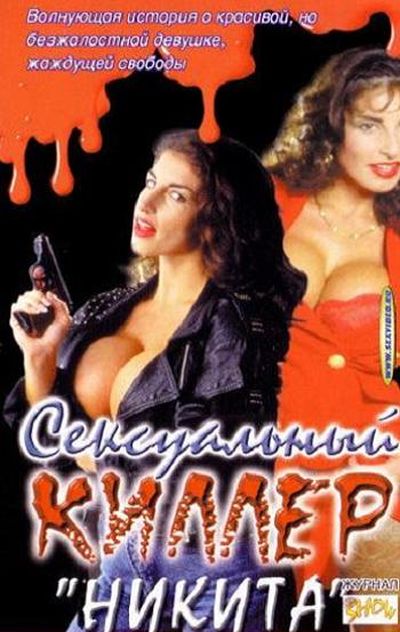
Anyway. This film may simply be titled “Sexy Killer”, going by the print – this would make more sense from a “not having Luc Besson sue your ass off” front, but the IMDb begs to differ, so I’m going with that. It certainly does follow the basic storyline of Nikita, particularly early on, though the crime which gets the heroine, Sarah Lester (Young) on her journey into Nikita, is a home invasion – albeit one which turns into a group sex scene between the actual invading of the home and the cops showing up. Then, as in the original, she shoots a cop while high, but is bailed out of the resulting life sentence, by Serge (Clark), who offers her an alternative: wet work and other operations for the organization in which he works. There’s a restaurant scene where she has to assassinate another diner, and another mission involves sniping from a window, both of which will be familiar to fans. But the film does divert at the end, where – and I trust I’m not spoiling this for anyone – Nikita lifts some incriminating documents she’s supposed to be recovering, and uses this as leverage to break free from her employers. Which is actually a kinda cool idea, I have to admit. I also appreciated the cat-fight between Nikita and her mentor/colleague, Jeanette (Sartori). Besson missed a trick there, I feel. And the subsequent lesbian canoodling.
Mostly, though, it’s about the sex. Lots and lots of sex, with the ratio of that to plot being approximately 3:1. And, since the running time is 152 minutes, that is an awful lot of multiple aardvarking, as Joe Bob Briggs used to call it. As for what happens in the remaining 38 minutes (approx), you have to cut the performances some slack, given dubbing where the voice actors are far more enthusiastic with regard to moaning and groaning, than the actual dialogue. But, actually, the actors aren’t bad: in particular, Clark is spot-on, as the world-weary agent tasked with keeping his rebellious underlings in line, and a good equivalent to Tchéky Karyo (or Gabriel Byrne, if you prefer the remake). But the action scenes are perfunctory, and little more than a token gesture – admittedly, it’s an entirely different kind of action in which the makers are interested, so criticizing them for this seems irrelevant. It is possible to make films that mesh hardcore sex with narrative in an interesting way: Caligula is perhaps the best-known example, and Lars Von Trier’s Nymphomaniac, by reports, also does so. Here? Not so much, and it’s probably of interest only to Nikita completists.
Dir: Mario Bianchi (as “Nicholas Moore”) Star: Sarah Young, Christoph Clark, Stefania Sartori
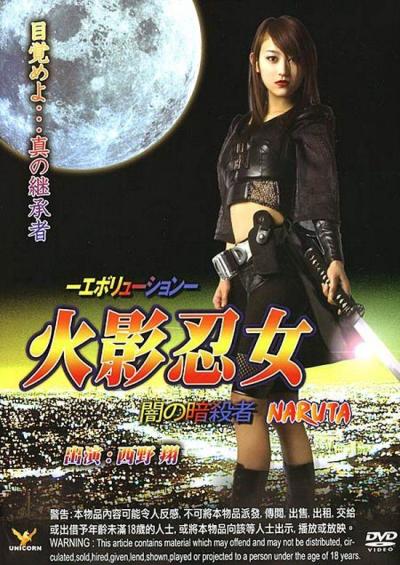
Call me picky or pedantic, but to me, a movie titled Ninja Girl: Assassin of Darkness, should contain a reasonable amount of girl ninjaing, along with, one would hope, some assassinations. Running through a dark room once with a sword doesn’t cut it. Unfortunately, the makers of this appear to take a different view, feeling that their story, about a ninja girl sitting around feeling sorry for herself and bumping uglies with her Manchurian Candidate boyfriend, is more interesting. They’re wrong.
The setting here is modern Tokyo, apparently now a hotbed of espionage. The Japanese government defends against these by using ninjas, whose skills are passed on, not through years of training, but by heredity. After their father – one such ninja – is killed, sisters Naomi (Shou) and Sayaka are left to fend for themselves, unsure which, if either, of them has received the ninja gene, because it will only be discovered when the recipient is “awoken.” Naomi is by far the less stable of the two. After being dumped, she spends all the time sitting around her apartment, blacking out and occasionally attempting self-harm: seriously, that’s it, she says, “I know my sister and my room.” But her life is changed when she bumps into Mitsuyoshi, who opens a window into her sorry, sad life. Except, every so often, he gets phone-calls which cause him to drop everything – including, amusingly, a naked Naomi – and go out on missions.
Eventually – and I’m talking about 70 minutes into an 80-minute film – things do eventually lead to some activities which at least border on the ninja-esque. However, Shou’s talents in this area are about as feeble as you’d expect from a porn-star whose works, Google informs me, include titles such as Openly-Displayed Squirting Orgasm. Though I suppose you could argue that’s a bit of a ninja skill, in and of itself. There is little or no information about this one, which doesn’t seem to have an IMDb entry: it was made in 2006, according to the copyright, and apparently on a budget consisting of the spare change left over after purchasing a bowl of ramen noodles. The actress who plays Sayaka is not bad, with one scene where she and her sister are talking, that does actually manage to put over some emotion. I also get the sense the next part, now Naomi is “awakened”, might not be so bad. But as is, the bulk of this opener is uninteresting talk, with occasional interruptions for bad action.
★★★
“There are bad people in the world and they shouldn’t be around the good people, especially the little ones,”
A young woman is walking down the street. A truck pulls up alongside her, and the driver starts talking to her, at first nicely, but gradually more crudely. When she spurns his advances, he pulls a gun. However, the woman pulls her own weapon from her handbag and shoots him dead. Welcome to the world of Miss Meadows (Holmes), where bad behaviour is countered with lethal force. It’s an offshoot of the “urban vigilante” film, where someone goes off the rails in response to rudeness and the perceived failures of modern culture, rather than a direct threat. Falling Down was perhaps the first example, also seen in Bobcat Goldthwait’s God Bless America. Both those were rather more acerbic than this, gynocentric entry, which perhaps has more in common with John Waters’ Serial Mom. At one point, a cop calls Miss Meadows a “Pulp Fiction Mary Poppins,” and that’s a fairly accurate high-concept here.
She’s a somewhat nomadic first-grade substitute teacher, with a past which clearly contained a defining trauma, who has long phone calls with her mother (Smart), and seeks to protect her local community from an influx of criminal elements. But when she meets and falls for a cop (Dale), who gradually realizes the woman he’s seeing may also be the killer his colleagues are hunting. And he’s not the only person who discovers the secret behind her facade. Meadows is an wonderful and engaging concoction, a throwback to an earlier era of politeness and courtesy, and its that contrast to her ruthless approach, tap-dancing her way to mass murder, that drives the film. It’s not entirely successful; the storyline, overall, relies too much on good fortune and convenience [every fast-food restaurant I’ve been in has surveillance cameras; the one here, not so much], and also tends to the obvious – a priest who molests children, there’s a shocker. It would make for a far ‘edgier’ film, if there was more grey involved in her targets, even at the risk of losing some of the audience. Killing paedophiles and murderers is an easy option, weakening the moral dilemma posed here.
But I thoroughly enjoyed Holmes’s performance; I hadn’t seen her in anything since Thank You for Smoking, back in 2005, before she became most famous for being Mrs. Tom Cruise. She takes a character that possesses two distinct, largely-opposing aspects, and nails it: Miss Meadows is, at once, charming and, clearly, barking mad, with a grip on reality that, we discover, may be a great deal looser than it initially appears. Concentrating more on these psychological aspects – perhaps instead of the rather implausible romantic angle – might have boosted this film out of the “quirkily forgettable” niche into which it is instead dropped.
Dir: Karen Leigh Hopkins Star: Katie Holmes, James Badge Dale, Callan Mulvey, Jean Smart
While the film itself is not that good, it did introduce me to a new action heroine of history: Olga of Kiev, who seems to have been a serious bad-ass, even by the high standards of European bad-asses of the time. There’s some suggestion she was of Viking extraction, with her name originally Helga, and that would certainly make sense. She married Igor of Kiev around 903, and after his death, ruled the state of Kievan Rus’ for 18 years, in the name of her young son, Svyatoslav. The Russian Primary Chronicle recounts how Igor was killed by a neighbouring tribe, the Drevlians, and that’s where things kick off, because they then dispatched a delegation of 20 to pressure Olga into marrying their Prince Mal, so he would become the rule of Kievan Rus’. She had them buried alive, though sent word back that she accepted, only if the Drevlians sent their most distinguished men to accompany her on the journey to their land. Upon their arrival, she offered them a warm welcome and an invitation to clean up after their long journey. After they entered the bathhouse, she locked the doors and set fire to the building.
Having disposed in one stroke of the Drevlian elite, she then invited the unwitting remainder to a funeral feast at the site of her husband’s grave so she could mourn him. That didn’t go quite as the guest planned either: “When the Derevlians were drunk, she bade her followers to fall upon them, and went about herself egging on her retinue to the massacre of the Derevlians. So they cut down five thousand of them; but Olga returned to Kiev and prepared an army to attack the survivors.” First, however, with the aid of some inflammatory pigeons, she set their city on fire. “The people fled from the city, and Olga ordered her soldiers to catch them. Thus she took the city and burned it, and captured the elders of the city. Some of the other captives she killed, while some she gave to others as slaves to her followers. The remnant she left to pay tribute.” She was also the first Rus’ ruler to be converted to Christianity, being baptized by Emperor Constantine VII, and in 1547 was canonized by the Orthodox Church, who proclaimed her “equal to the apostles,” one of only five women so honoured in the history of Christianity.
Hard for any film to portray a woman like that, and to be honest, this one doesn’t succeed. It’s an odd structure which is mostly told in double flashback, from the perspective of Olga’s grandson, Vladimir. On his death-bed, he’s trying to figure out the true nature of his late grandmother (Efimenko), and we then see him as a youth (Ivanov), asking a number of people about her. That includes a Greek scholar who recounts the bloody story above, but also his housekeeper mother, whose memories reveal a different side to Olga. That’s perhaps the film’s most interesting aspect, the problem of separating myth and legend from reality, when everyone has a viewpoint that shows a different aspect of a historical figure. However, the format keeps the film too distant, and I really wish it had focused more on Olga, rather than (the much less-interesting) Vladimir. While made in 1983, it also suffers from an extremely-stilted approach that feels a couple of decades earlier, and despite its potential, certainly falls short of doing its titular subject justice.
Dir: Yuri Ilyenko Star: Lyudmila Efimenko, Les Serdyuk, Vanya Ivanov, Konstantin Stepankov




 This has more than slight echoes of the Female Ninjas, Magic Chronicles series, sharing the feudal setting, along with similar… unconventional attack forms by the protagonists. That’s unsurprising, since both are apparently based on Ninja Tsukikagesho, by Yamada Futaro. And, just to confuse matters further, the IMDb states that part 6 of FMMC shares the title here. Whether this might be the IMDb getting confused, I can’t say. I wouldn’t blame them if so, because the entire plot here is more muddled than enlightening. It takes place in the 1730’s, when Shogun Yoshimune and his deputy, Muneharu, were struggling for control. As a way of fomenting dissent by embarrassing him, Muneharu drags out the Shogun’s former concubines; to stop this, Yoshimune sends a group of his top female ninjas, under Tsurugi (Abe), to kill the women before Munharu’s men can get to them, triggering a ninja war. Complicating matters, turns out one of the concubines may have had a bastard son by Yoshimune, and whoever gets proof of that lineage will really hold the whip hand.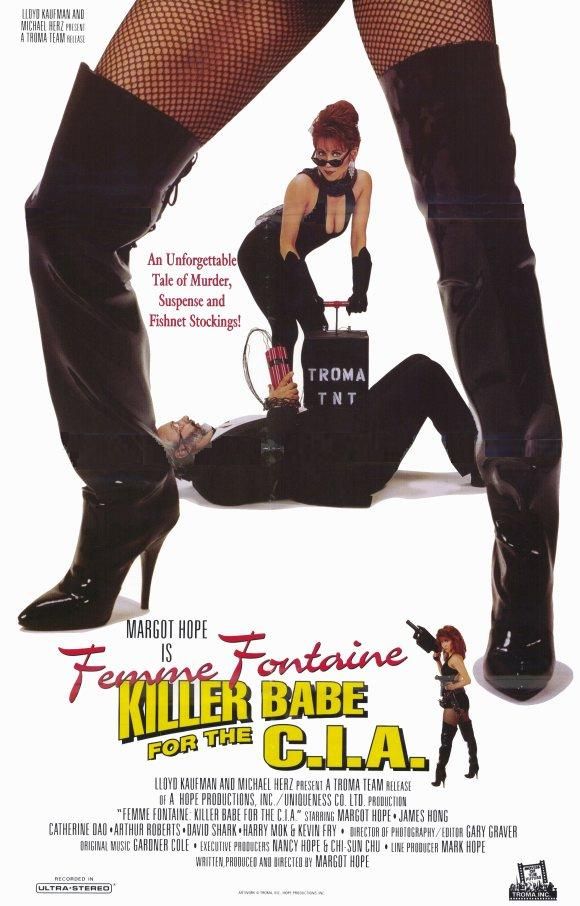



 Call me picky or pedantic, but to me, a movie titled Ninja Girl: Assassin of Darkness,
 While the film itself is not that good, it did introduce me to a new action heroine of history: Olga of Kiev, who seems to have been a serious bad-ass, even by the high standards of European bad-asses of the time. There’s some suggestion she was of Viking extraction, with her name originally Helga, and that would certainly make sense. She married Igor of Kiev around 903, and after his death, ruled the state of Kievan Rus’ for 18 years, in the name of her young son, Svyatoslav. The Russian Primary Chronicle