



★★★★
“Raiders of the East Ark.”
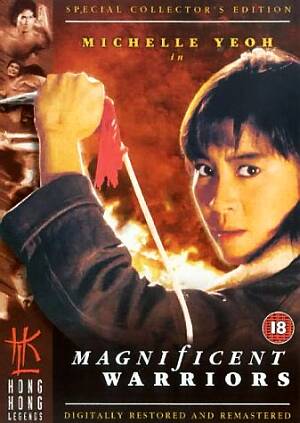
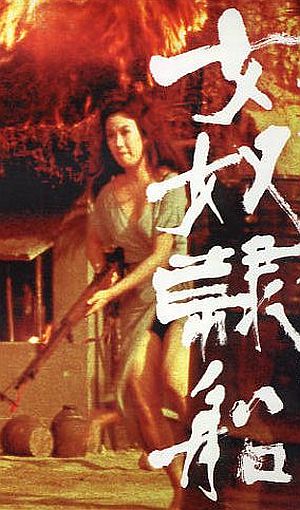
 Ok, the above is a rabid simplification; there are no artifacts here at all, but there’s no doubt Michelle Yeoh’s adventurer owes more than a touch to the archaeologist we all know and love – not least in the bullwhip she wields in the opening sequence. While for nasty Nazis, read nasty Nips, with the Japanese who are occupying mainland China at the time of this film, so villainous they might as well be twirling wax moustaches and wearing top hats. They’re building a poison gas factory, and it’s up to Yeoh, agent 001 Yee and scoundrel Ng to stop them.
It does live up to the claim of “nonstop action” on the sleeve, certainly, and when Yeoh is in full flow, it’s a joy and absolute delight to see. For example, almost the first fight has her wielding a rope with a blade on the end, and it’s better action than many films have as a climax. There’s plenty of similar scenes, and more than enough moments make you go, “Whoa!”, in your best Keanu voice. Though for my tastes, and especially towards the end, there’s too much running/driving about, firing of weapons, explosions and stuff that doesn’t particularly showcase the skills of those involved. Supporting actress Cindy Lau comes over well as the feisty sidekick of the man they have to rescue.
This was the last action film in the first stage of Yeoh’s career; in 1988, she retired, and married D&B Films owner Dickson Poon, until her return to the screen in Supercop. This is perhaps the least well-known of her early trilogy of starring action roles, behind Yes, Madam! and Royal Warriors; in all honesty, it is probably the slightest, yet is still an impressively insane piece of work.
Dir: David Chung
Star: Michelle Yeoh, Derek Yee, Richard Ng, Lowell Lo
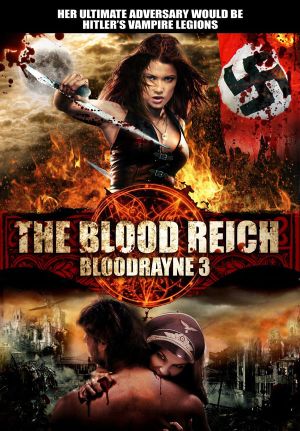
 This will only make sense, or be in any way entertaining, if you’ve seen Bloodrayne 3: The Third Reich: because it’s basically the same film, with a really fat chick (Hollister) replacing Natassia Malthe. And when I say, “the same film,” I mean the same storyline, same actors playing the same roles, and same scenes in the same locations. Really, I suspect this must have been made at the same time, with Boll simply swapping out Hollister for Malthe every other take. As there, the heroine is a half-human, half-vampire, who finds herself involved in a Nazi plan to take the powers of vampirism and turn them to their own ends. Except here, it is, of course, a spoof – and one so extremely broad, the makers of those Epic Movie flicks would have been cringing on occasion. Fat jokes, gay jokes, Nazi jokes… No easy target is left unstoned, paved with deliberate anachronisms like Segways and Internet dating.
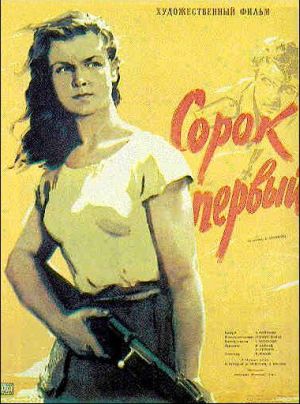 It’s the war between the Bolsheviks and the White Guard. A platoon of the former is left with no route of escape except across the desert to the Aral Sea. They begin the perilous trek, under Commander Yevsyukov (Kryuchkov), aided by the unit’s best sniper, Maria Filatovna (Izvitskaya). During the journey, they capture a White officer, Lieutenant Vadim Govorkha (Strizhenov, who looks kinda like Cary Elwes in The Princess Bride!) who is carrying information vital to his side. The Bolsheviks take him with them, as they head back to HQ, with Maria given the task of guarding him. But when she is separated from her comrades, and left with Vadim to fend for themselves after a storm, duty and loyalty to the cause of Communism becomes conflicted with other less revolutionary emotiona.
 After the abomination that was Part 2, I’d filed the third entry under ‘watch whenever I have time’, until a spirited debate on its merits (or otherwise) broke out on over oun our
  It isn’t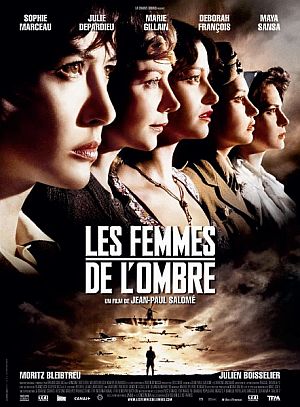
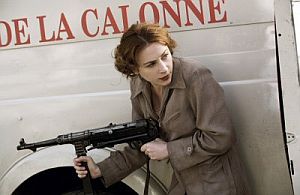 It’s a solid piece of action/drama, which managed to keep both of us awake, despite a session earlier in the evening at the “all you can eat” fish fry; normally, that requires 30,000 Volts to keep us from sliding into post-gluttony unconsciousness. I think Chris enjoyed the movie a little more: I was somewhat on the fence about giving it the seal, finding some of the plotting a little convoluted and occasionally implausible, but her endorsement of this as “great” provided sufficient impetus. Marceau is particularly good, exuding steely resolve to hold the team together, and Bleibtreu makes an excellent foil, coming across as equally smart and committed as Louise. Their conflict is the glue that binds the story together, and makes it one of the best efforts in the wartime heroine genre to date.
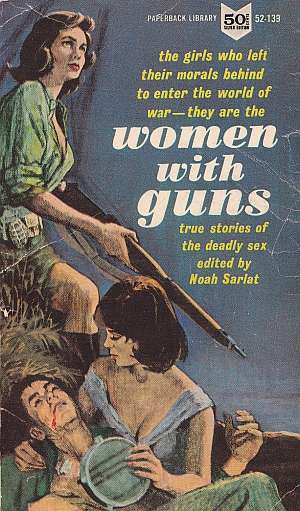 The tender sex – and the terrible things they can do. Violence, savagery, sudden death on the battle field, torture and butchery behind enemy lines – these are the facts of war. It is a man’s world… but what of the women trapped in it? What of women such as:
 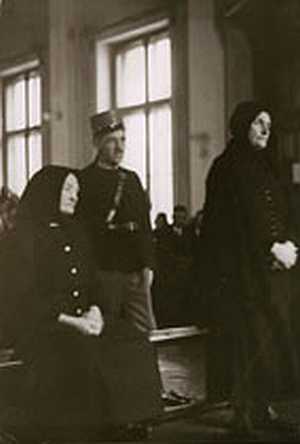 You wouldn’t know it to look at the sleepy Hungarian village of Nagyrév [population: 872], but there was a time between the world wars when this was the murder capital of the world. Between 1914 and 1929, an estimated
 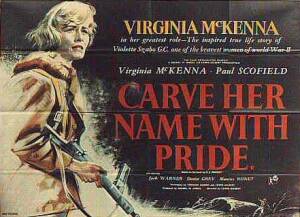 This is based on a true story, so we know from the start this is going to end in front of a firing-squad – at least until the Hollywood remake, with a happy ending. Given this, the film still tries to crank up the tension, but as written, Violette Szabo comes off as beyond saintly, without flaws or imperfections. Almost as irritating, she is shown as being mostly inspired by the death of her husband, rather than any innate patriotism (Charlotte Gray similarly portrayed a female SOE agent as passive-reactive). Having said that, the movie generally stays true to the facts, though the poem supposedly written by her husband was actually, in far less romantic reality, by her SOE codemaster – interestingly, the SOE’s name is not mentioned at all. Much of the end is fictionalised; details of her interrogation, for example, are obviously unavailable.
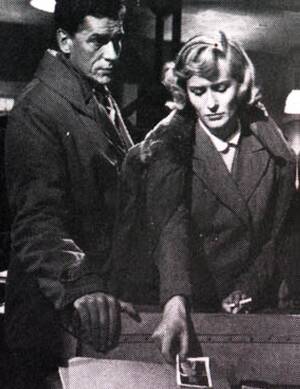 The film does take
  Love story or wartime thriller? The script here tries to have it both ways, and as a result of this uncertainty, the undeniable potential in the idea is unfulfilled. Gray (Blanchett) is dropped into Vichy France during World War II as an agent, but her bosses don’t realise she is more interested in finding her pilot lover (Penry-Jones), who’s been shot down nearby. While conflict between love, and love of country, would have been interesting, the former is almost ignored, then disposed of in a thoroughly unconvincing manner. Not that this diversion is uninteresting; you get a real sense of the terrors of war, with people being “vanished” in seconds, and the tension of living your life on a knife-edge behind enemy lines.
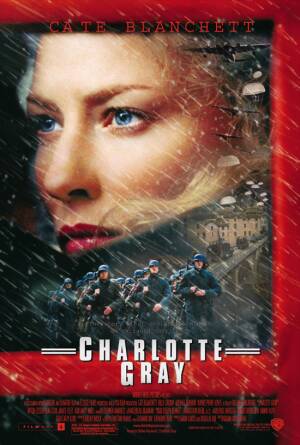 Mostly, the film is concerned with Charlotte’s protection of two Jewish children, and involvement in a resistance cell led by Julien (Crudup). They’re communists, so the British don’t really like them, but they’re convenient – and can be abandoned when necessary, the revelation of which provides the film with its most chilling moment. Blanchett has the right steely resolve for the role, and the cast is generally excellent; particular credit to Gambon (magnificently surly as Julien’s father), Ron Cook as Gray’s contact, and Anton Lesser, an oily collaborator who had us screaming “Die! Die!” at the TV set.