
★★★
“Innocence behind bars.”
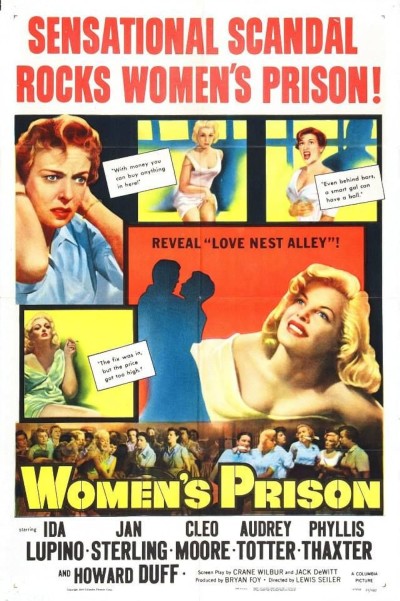 It’s always interesting to watch these early entries in the women-in-prison genre, and see the elements which are still staples of the genre, close to seventy years later. Well, some of the elements anyway: this dates from 1955, so is obviously tamer than a kitten on Valium in terms of sexual content. No strip searches. No prison showers. And when it’s revealed that one of the inmates is pregnant, it’s almost as much of a surprise to the audience as it is to the authorities. But it’s still recognizable as an ancestor, thanks to things like the sympathetic prison doctor, new inmate who shouldn’t be there, and the sadistic warden who rules things with an iron fist.
It is an ensemble piece, whose focus shifts throughout. Initially, it seems likely to be the story of “fresh meat” Helene Jensen (Thaxter), who is doing time for vehicular manslaughter, and has a tough time adjusting to life inside. Then it shifts to Joan Burton (Totter), an accomplice to her robber husband, Glen, who is doing time in the men’s prison next door. He has something vital to tell her, and makes repeated attempts to sneak across the border to visit Joan. On the other side of the bars is the power struggle between the warden, Amelia van Zandt (Lupino) and jail physician Dr. Crane (Duff). Her methods are anathema to Crane, who flat-out calls van Zandt a psychopath. He may have a point.
Despite the lack of salacious elements, this is still entertaining fodder. There are a lot of amusing characters among the inmates, from cheerful fraudster Brenda Martin through to black inmate Polyclinic Jones – named after the hospital where she was born! She’s played by Juanita Jones, who’d be Oscar nominated a few years later. Interestingly, despite this being years before the Civil Rights era, the prison is not segregated: the black inmates have their own cell, but otherwise mix freely with the white prisoners. Race is never even mentioned here. There’s an impressively meta moment too, when two guards are discussing a cinema trip. “They never get things right in prison pictures,” muses one, and is told, “I know, but I like to pick out the flaws.”
This happens just before another familiar element: the prisoners riot and take over, after being pushed too far. In this case, it’s van Zandt’s brutal interrogation of Burton which proves the tipping point. Or at least, “brutal” by fifties standards; it’s not much more than a bit of light slapping around. The rebellion leads to tear-gassing and hostage taking, as the women seek to make van Zandt pay, plus Glen roaming around with a pistol. Really, the men’s side need to look into their security protocols, I reckon. For all its innocence in many ways, bordering on naivety, there are still moments which have an emotional impact; I found the death of one inmate surprisingly affecting. Released in Germany as Revolte im Frauenzuchthaus, which I only mention, as “frauenzuchthaus” may be my new favourite German word.
Dir: Lewis Seiler
Star: Ida Lupino, Howard Duff. Audrey Totter, Phyllis Thaxter
 This was the second-to-last of Republic’s sixty-six serials and, to be honest, it shows. Having watched
 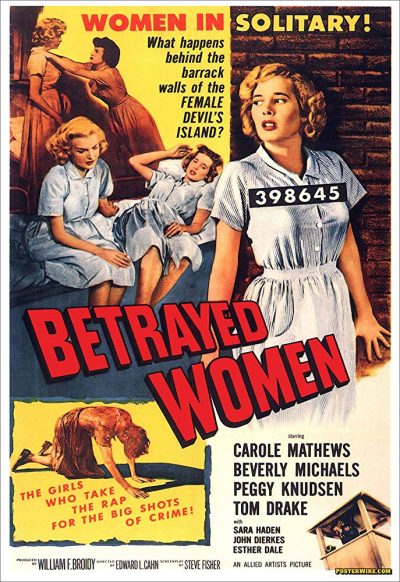 First, let me just say: that poster is a true work of art. Seriously, how can anyone look at that and