



 ★★★★
★★★★
“Everyone has a breaking point.”
 Haruka Nozaki (Yamada) is just a couple of month away from graduating junior high. But will she make it? Because her life is being made a living hell by bullies at the school. Rumour has it that she “stole” a boy, Mitsuru Aiba (Shimizu), from another girl, Taeko Oguro (Ôtani). As a result, Haruka has become the relentless target of other female students. The staff are no help: the school is going to be closed after this class graduates, and the teachers consequently couldn’t care less. Indeed, Haruka’s father, a substitute teacher – that’s why she ended up transferring in – is being victimized by the male bullies, in a similar way to his daughter.
Things come to a head after fire destroys Haruka’s home, killing her parents and putting her perky little sister in the hospital with severe burns. And when I say, “come to a head”, the rest of the film is filled with some of the more disturbing violence I have seen in recent years. The attitude here feels almost like Battle Royale, in that the people inflicting this level of savagery are basically kids. They are not supposed to be this way, folks. There’s not even the distancing element of a dystopian future, which Battle Royale enjoyed. Nor it is simply Haruka. You can’t claim “one bad apple”, because there are a lot of people here, who seem to live by the motto, “Hurt people, hurt people.”
The famous quote, “The only thing necessary for the triumph of evil is for good men to do nothing,” often misattributed to Edmund Burke, came to mind here too. Because, while Mitsuru initially pushes back against the bullies targeting Haruka, it’s a half-hearted effort. Though I guess it’s better than the completely useless adults, from parents through pedagogues, to the all but entirely absent authorities. By the end though, you will perhaps be left questioning whether anyone here genuinely falls into the category of “good.” Everyone has their traumas, which have left them negatively impacted, and many are paying it forward to others. This is most apparent in the character of Rumi Sayama (Ôtsuka), one of the bullies’ victims, who ends up joining their clique.
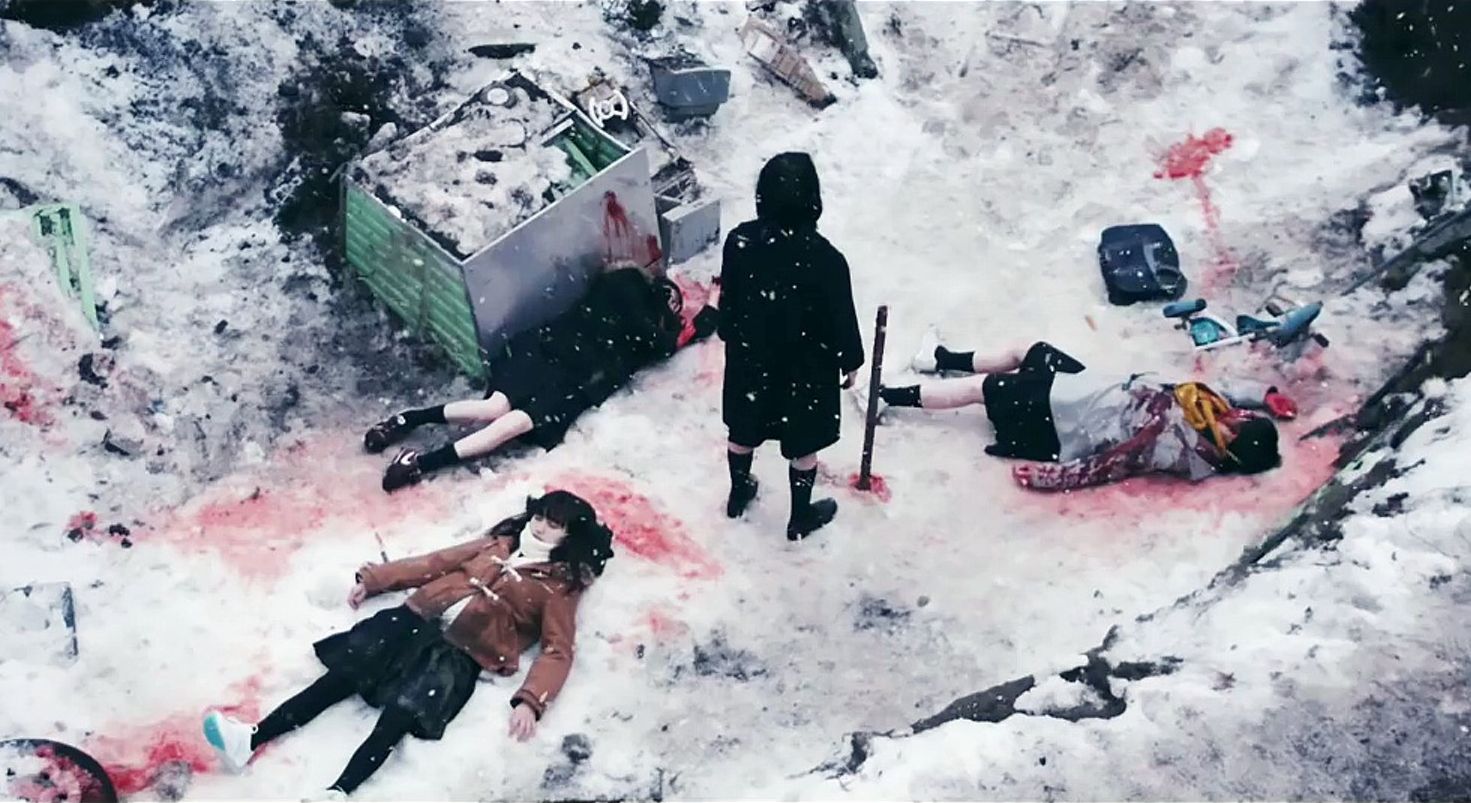
Naitô directs things with a bleakness appropriate to the story. Much of it unfolds against a backdrop of snowy weather (the title, incidentally, refers to a winter flower). If there’s one shot of red, red blood splattering across a snowdrift, there’s a dozen. But it’s such an iconic image, I can’t blame him for using it more than once. I note that Naitô himself used to be a teacher. This isn’t the only case where that previous career seems to inform his work, if the title of a previous movie is any guide: Let’s Make the Teacher Have a Miscarriage Club. I’ve seen enough movies that my level of concern for the Japanese educational system, and those who go through it, is certainly non-zero. This ensures it won’t be going down any time soon.
Dir: Eisuke Naitô
Star: Anna Yamada, Hiroya Shimizu, Rinka Ôtani, Rena Ôtsuka