




Literary rating: ★★★
Kick-butt quotient: ☆☆☆
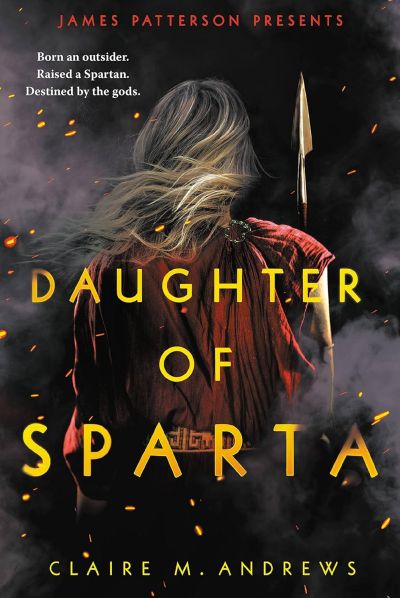 The author says, “My goal was to bring to light the often-underappreciated women of Greek myth and history—I wanted to give these women the stories they deserved.” It’s a somewhat odd goal, given there’s not exactly a shortage of them already. Hard to call the likes of Zeus’s wife Hera, goddess of war Athena, or Artemis the huntress particularly “underappreciated.” But what Andrews has done here specifically, is flip the script on the myth of Apollo and Daphne. Originally, it was the story of Apollo’s relentless pursuit of wood nymph Daphne, who ended up becoming a laurel tree to escape him.
That is, understandably, far too stalkery for modern consumption. In this version, Daphne lives in Sparta, and is a strong warrior. However, because she was not born there, she is destined to remain a Mothakes, an outsider. Regardless, she is still the gods’ choice, when they need someone mortal. Their divine abilities are waning, after someone has kidnapped the Muses, “the source of all the power of Olympus”, home to the gods. Daphne is compelled by Artemis to go on a mission to find and free them, with Apollo alongside her. This sends our heroine across the entire Hellenic region, encountering deities both benign and malevolent, as well as facing mythical creatures like the Minotaur, ending with a journey into Tartarus, where the souls of the wicked are punished.
As a reversal, it’s fairly well-done. It reminded me of the other quest stories which pepper Greek mythology, such as the twelve labours of Hercules. I particularly liked how the gods covered the whole spectrum of characters. Artemis, for example, while clearly acting in the best interests of Olympus, has no hesitation in forcing Daphne’s co-operation, by transforming those near and dear to her, into animals. Determining where the loyalties of the others lie can sometimes be tricky, though if you’ve seen Wonder Woman, you’ll not be surprised by Ares’s allegiance. Daphne’s character arc over the course of her adventures was also an effective one, and she becomes battle-hardened, taking damage to the point she can barely walk by the final encounter.
I was considerably less convinced by the, sadly, inevitable romance which was developed between our heroine and Apollo. There were points where I would have welcomed turning into a tree myself, to escape it. The presence of so many deities, all with infinite powers, does become a bit of a “Get out of jail free” card on a couple of occasions, though the limitations resulting from the missing Muses do prevent this from becoming an excessive crutch. It’s an interesting twist on mythology, albeit one which has to bang a few square pegs in, to mould the narrative to its desired ends. I wouldn’t call it any better than the classical stories. Just a little different, and that’s no bad thing.
Author: Claire Andrews
Publisher: Little Brown Books, available through Amazon, both as a paperback and an e-book
Book 1 of 3 in the Daughter of Sparta series.