




★★½
“Slow, slow, Quick…”
 Polo plays Quick, an assassin whose job is to take out mob accountant Brewer (Donovan) after he turns stoolpigeon. When her employer tries to double-cross her, she goes on the run with her target, who has hidden $3m in ill-gotten gains. Her corrupt cop boyfriend (Fahey) also has designs on the money, raising the suspicions of his partner (Carrere, an effective but wasted performance).
Despite the potential here, this 1993 film ends up being remarkably sluggish, with Brewer and Quick mostly driving around and, inevitably, going through the Stockholm Syndrome thing, wherein they eventually bond. While the sleeve wants you to believe she’s the ultimate bad-ass (“Young, hot and deadly…She’s Quick. You’re dead. She’s the perfect assassin”), the heroine is actually a bundle of badly-controlled neuroses. Which may be the point: everyone in the film seems to be controlled by someone or something else, save perhaps the top mobster, played by Robert Davi, who could do this kind of role in his sleep.
Polo, who’d go on to find stardom as the girlfriend in Meet the Parents, does make Quick an interesting character, but we’re given no reason why she turned killer, for example. And while the aim here seems more psychological than action, she’s not cold-blooded enough, or sympathetic enough, to be memorable. If the film occasionally manages to be surprisingly earthy, the overall effect is otherwise almost completely forgettable.
Dir: Rick King
Stars: Teri Polo, Martin Donovan, Jeff Fahey, Tia Carrere
a.k.a. Crossfire
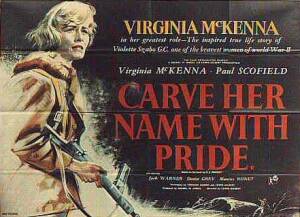 This is based on a true story, so we know from the start this is going to end in front of a firing-squad – at least until the Hollywood remake, with a happy ending. Given this, the film still tries to crank up the tension, but as written, Violette Szabo comes off as beyond saintly, without flaws or imperfections. Almost as irritating, she is shown as being mostly inspired by the death of her husband, rather than any innate patriotism (Charlotte Gray similarly portrayed a female SOE agent as passive-reactive). Having said that, the movie generally stays true to the facts, though the poem supposedly written by her husband was actually, in far less romantic reality, by her SOE codemaster – interestingly, the SOE’s name is not mentioned at all. Much of the end is fictionalised; details of her interrogation, for example, are obviously unavailable.
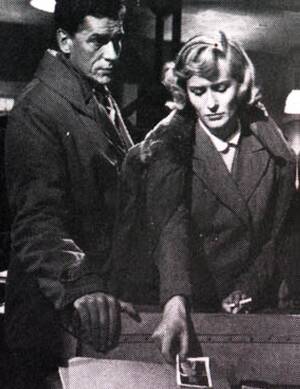 The film does take
 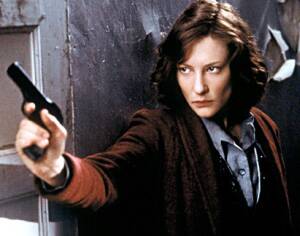 Love story or wartime thriller? The script here tries to have it both ways, and as a result of this uncertainty, the undeniable potential in the idea is unfulfilled. Gray (Blanchett) is dropped into Vichy France during World War II as an agent, but her bosses don’t realise she is more interested in finding her pilot lover (Penry-Jones), who’s been shot down nearby. While conflict between love, and love of country, would have been interesting, the former is almost ignored, then disposed of in a thoroughly unconvincing manner. Not that this diversion is uninteresting; you get a real sense of the terrors of war, with people being “vanished” in seconds, and the tension of living your life on a knife-edge behind enemy lines.
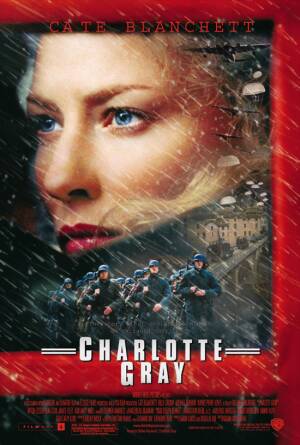 Mostly, the film is concerned with Charlotte’s protection of two Jewish children, and involvement in a resistance cell led by Julien (Crudup). They’re communists, so the British don’t really like them, but they’re convenient – and can be abandoned when necessary, the revelation of which provides the film with its most chilling moment. Blanchett has the right steely resolve for the role, and the cast is generally excellent; particular credit to Gambon (magnificently surly as Julien’s father), Ron Cook as Gray’s contact, and Anton Lesser, an oily collaborator who had us screaming “Die! Die!” at the TV set.