




★★★★½
“Angel of vengeance”
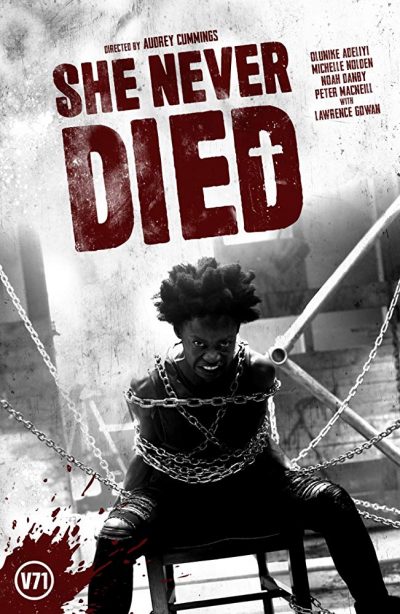
 This is neither a prequel nor a sequel to He Never Died, but is clearly related, and takes place in the same universe. Like its predecessor, it was written by Jason Krawczyk, who hands the directorial reins over to Cummings for this. And it probably works better as a result. I tend to think having a separate writer and director allows each to build on the other’s talents, while countering the weaknesses. In particular, He, which starred Henry Rollins, didn’t have quite enough plot to sustain it. That isn’t an issue here, resulting in improved pacing. Combine this with the ultimate “give no damns” performance at its core, and you’ve got one of the best action heroine films of 2019.
That performance is Adeliyi’s portrayal of “Lacey”, whose real name we learn at the end, and which will make some sense to students of Biblical lore. Like Rollins’s character, she plays an immortal being, doomed to wander the planet for eternity, sustained only on human flesh. However, she operates on a code, eating only scumbags. This still brings her to the attention of local authorities, in particular the thoroughly world-weary Detective Godfrey (MacNeill). But when he discovers Lacey’s nature, he makes the ill-fated decision to weaponize her, and points her in the direction of a sex-trafficking ring run by Terrance (Danby), which he has been unable to take down by more formal methods. Complicating matters is the gang’s victim, Suzzie (Madeira), whom Lacey encounters during her first mission, and who becomes something of her acolyte.
Lacey is potentially among the most taciturn bad-asses of the genre, a woman of few words, whose remarkable healing powers allow her to take a baseball bat to the head, and then discuss the mild irritation of having to wait for a detached retina to repair itself. No wonder Suzzie is confused, wondering “Are you just a jacked-up lady blitzed out of her mind? Or a government experiment on the lam? Robot? Zombie? Vampire? You sound like a vampire.” The contrast between the pair, one hyper almost to the point of manic, the other deader than deadpan, is a joy. Seeing Adeliyi in action is another. This film doesn’t shortchange her diet, and Cummings background in horror is apparent. About the only person who can half-stand up to Lacey is the person in charge of the traffickers – which makes me wonder if they, too, may be more than human.
It’s one of the intriguing questions which this poses. Particularly at the end, after things appear to have been tied up nicely, the story opens an entire case of cans of worms, with both Godfrey and Lacey having encounters that’ll leave you going “Hmmm…” And that’s not even including the Bikers of the Apocalypse. While it’s definitely not necessary to have seen He Never Died, the cross-over of information may slightly enhance your information of both. I’m wondering if it’s all pointing towards a third entry – They Never Died?- in which the characters from these two films team up. If so, where do I start the queue?
Dir: Audreey Cummings
Star: Olunike Adeliyi, Peter MacNeill, Kiana Madeira, Noah Danby
Screened at Phoenix FearCon 2019
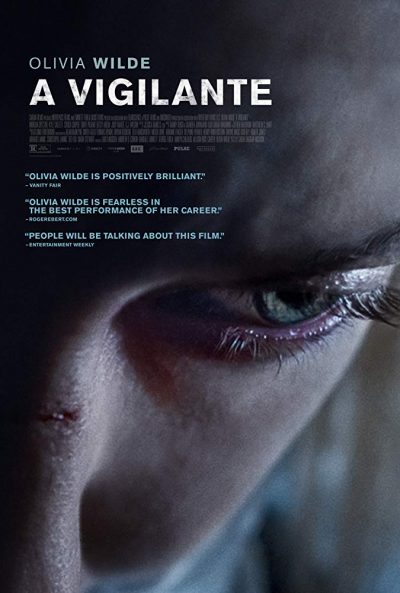 Sadie (Wilde) has escaped from an abusive relationship with her husband (Spector), but at a terrible cost: the death of her son. In an effort to come to terms with her grief, and make use of the survivalist skills forcibly imposed on her, she becomes a vigilante. Responding to coded messages left on her phone, she travels around to confront abusers and prove that there is someone tougher, willing to stand up for the victims against them. But this doesn’t give Sadie the closure or peace that she seeks. Before she can help others, she’s first going to have to help herself, and confront the man who made her what she is.
 Marginally competent, and just not very exciting, this low-budget offering is the story of December (Kurishingal). As a young girl, she watched as the rest of her family was slaughtered by Law (Ramsey) and his villains, the result of a debt owed by her father. A decade or so late, she has grown up and taken to the streets as a vigilante, seeking vengeance on those responsible. Or, until she finds them, any other perpetrators she comes across during her night-time ramblings through the mean back alleys of the city. Helping her mission, is that she now works for the police, which puts her in a prime position to ensure, for example, that any evidence pointing in her direction goes “missing”.
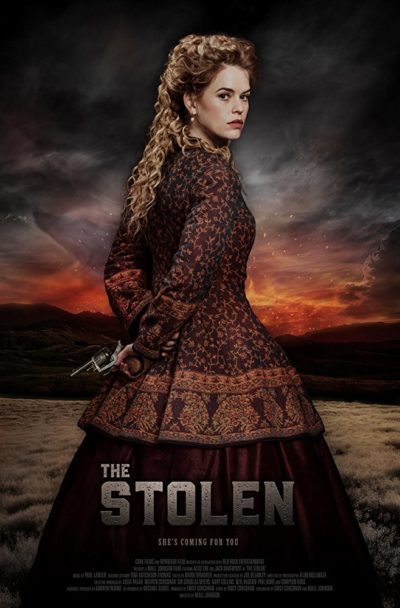 Rarely has such promise been so spectacularly and vigorously squandered. For this starts well enough. In 19th century New Zealand, English ex-pat Charlotte (Eve) is settling into a new life with her husband and newborn child. This is upturned when a midnight raid leaves her husband dead and the baby kidnapped. Months later, after everyone else has moved on, she gets a ransom demand in the mail, and she tracks its source to Goldtown. This remote outpost is truly an Antipodean version of the Wild West, a rough-edged mining town run by Joshua McCullen (Davenport). Braving all manner of threats – not least, that the only other women there are prostitutes – Charlotte makes the perilous journey to the frontier settlement in search of her son.
 I’m tempted to award this an extra half-star, simply for pissing off liberal film critics, upset by the fact that most of the film is devoted to a white woman killing Latino drug dealers. Of course, they completely miss all the points, instead complaining – and these are direct quotes – there is “not a word about corporate complicity in the opioid crisis” and that the heroine’s “true enemy is a system of income inequality driven by hyper-capitalism.” Because, of course, if was hyper-capitalism which gunned down the husband and daughter of Riley North (Garner) in the parking lot of a fun-fair. Oh, my mistake: it was Latino drug dealers.
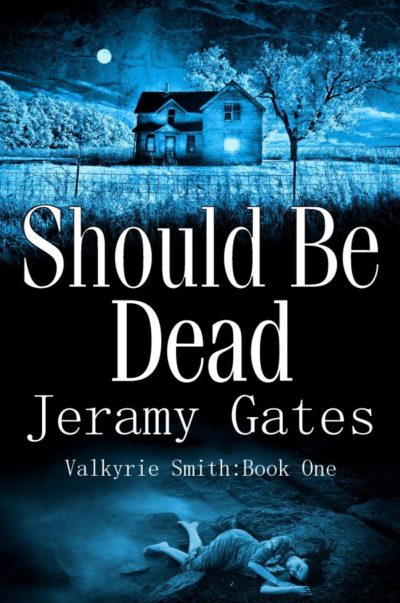 “Liberation, Val had learned, was not a simple matter of casting off stereotypes and social conventions. Nor was it a mere change in perspective. Rather, it was an evolution in state of being, a release not from consequences, but from fear.”