
★½
“That’s the thing about revenge. It’s messy.”
 And, unfortunately, in this case, it’s not messy in a good or even interesting way. It’s messy in a “What the heck is going on?” way, with a large side-order of, “Can somebody please explain this to me?”, and a garnish of “Anyone? Hello?”. To say this film poses more questions than answers would be incorrect. Because that would wrongly imply it offers any answers at all. I’m just glad the version I saw ran a mere 84 minutes, because the IMDb cites a running time more than half an hour longer. Maybe the thirty-five minutes removed for this cut were all of the explanation. Though I suggest it’d be improved by removing about the same again.
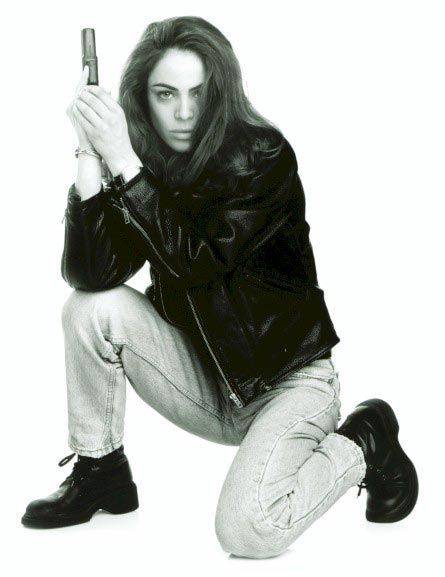
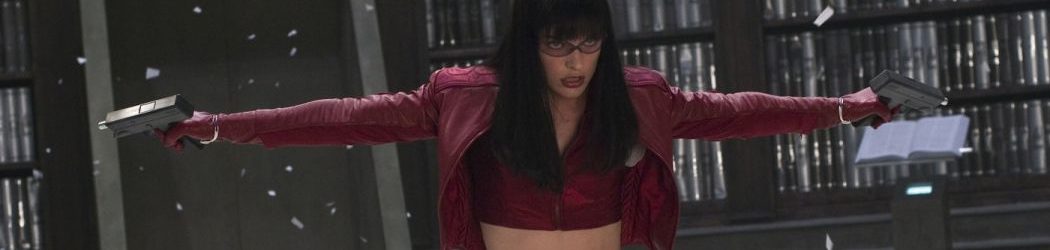
From what I could figure out, it’s about a vigilante with the faintly ludicrous name of Nemesis Knight, played by Bartlett who is sporting an even more flaky rural American accent. She seems to make a pact with the devil (Berkoff), which gives her certain abilities. However, this also puts her on the radar of a support group of like-minded individuals, who want her to join them, and the local sheriff (Cain), following the trail of dead bodies left in Nemesis’s wake. There’s also a guy called Dollos (Rowen), with a harem of both sexes, and a vested interest in proceedings, because… Well, like so much else here, it’s unclear, which makes it difficult to give a damn.
This is a first, but I mist give credit to casting director Helen Stafford, for pulling in a top tier cast of B-movie names. In addition to Cain and Berkoff, there is also Marina Sirtia, Vas Blackwood and a bloke off the British version of Gladiators. Most of whom are featured higher up the IMDb page than their role in the film would demand, though that’s par for the course in the low-budget realm. It’s basically the script, also by director Michael, which is easily the biggest problem here. I knew we were probably in trouble, when we don’t get any dialogue at the start, just a leaden lump of voice-over from Ms. Knight. This is always a red flag, and in this case, proved an accurate warning of story problems to come.
Basically, it’s almost impossible to care. It’s clear that the heroine is taking out bad people, but these are drawn in such a facile way, the resulting revenge has no impact at all. It builds to an invasion by the vigilante group of what seems to be a gangster dinner party, where everybody is doing their best Goodfellas impressions. These are about as good as my Goodfellas impression. You’re left to ponder why the whole production is set in a poorly-rendered simulation of the United States, adding unnecessary complexity e.g. finding cars with left-hand drive, to a production which doesn’t have the resources for it. A couple of bits of half-decent imagery – Bartlett looks okay, providing she keeps her mouth shut – are far from sufficient.
Dir: Savvas D. Michael
Star: Nicole Bartlett, Elijah Rowen, Dean Cain, Stephen Berkoff
 ★★★½
★★★½
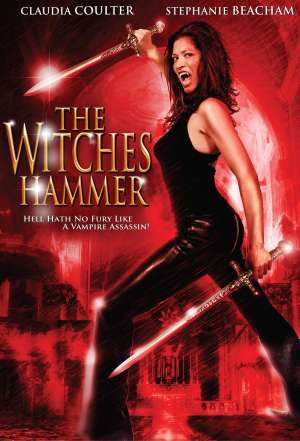 If never quite escaping its low-budget roots, or producing enough compensations or fresh imagination to make you forgive them, this is a robust enough vehicle and a decent entry in a sadly-small sub-genre: British girls-with-guns. It’s perhaps closest to the 1998 movie, Razor Blade Smile – which I really should get round to covering here, except it was pretty freakin’ awful. Similarly, Hammer involves a vampire assassin, though you can also lob in a shedload of other influences, conscious or otherwise, from Buffy, through Nikita to Bloody Mallory. If originality is not the movie’s strong suit, it is at least stealing from some of the best action heroines.
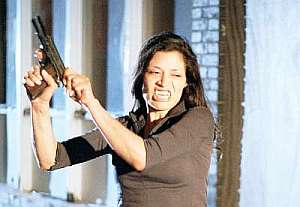 Minuses? There’s a certain unevenness of tone which doesn’t quite work. At various moments, the film wants to be exciting, poignant, self-aware, slapsticky and dramatic: these individual moments work with varying degrees of success, and the combination, with the frequent gear-changes which result, occasionally seem clunky. Camp also needs to be played completely straight to work, and that isn’t always the case here. Hayes is over-fond of flashbacks: there are at least four here, and that’s probably three more than are necessary, with the only truly significant back-story belonging to Kitanya, the Russian witch who supposedly wrote the Malleus Maleficarum, the magic book which everyone seeks. As noted above, Eaves doesn’t really bring much new to the show: if you can find a review that doesn’t mention, say, Blade, your Google-fu is stronger than mine, and it is a very obvious comparison.
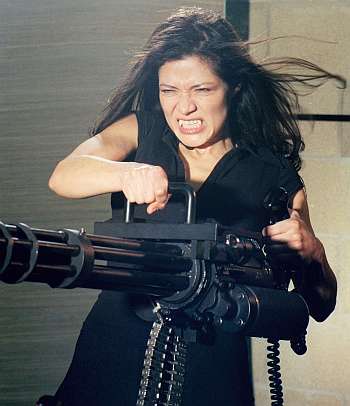 The action is solid, if generally short of spectacular. There doesn’t seem to be much doubling of Coulter – or if there is, it’s not obvious. She get to use a selection of weapons, which adds a nice sense of variety; from swords through staffs to the F-sized rail-gun pictured top left (even if the cartridges being ejected were rather too obviously digital), Kris Tanaka was the action choreographer, and also appeared as one of the vampires near the end; it’s clear he knows his stuff. I’m not quite so sure Eaves does, as the editing of the sequences – for which he is also responsible – seems to be choppy and occasionally difficult to follow, though not to the level of MTV-style editing, the bane of my life as a viewer.
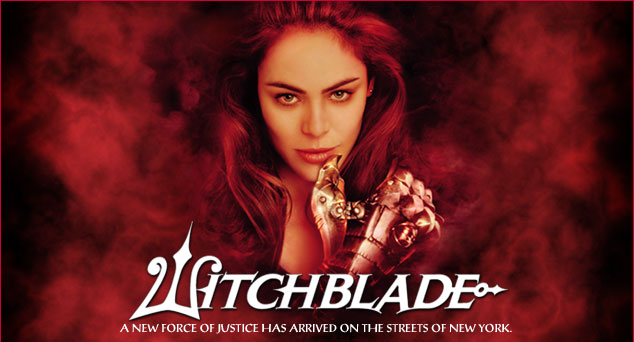
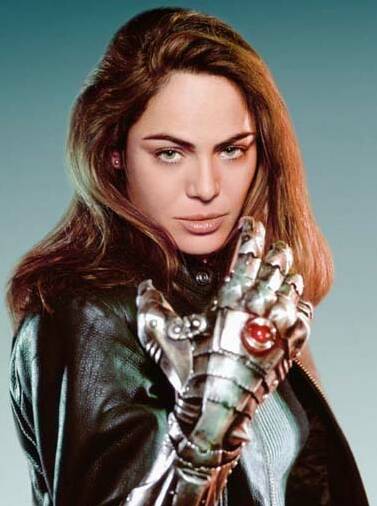 Much as in the first season, the second series of Witchblade brushed against greatness. Unlike the first, where you can point at the final episode as the key weakness, this time round it is a chronic rather than acute malaise that prevents it from getting the seal of approval. When it was great, it was fabulous – it just seemed that for every full, satisfying episode, there was a lame clunker to compensate. Particularly at the start of the season, there seemed to be precious little imagination on view.
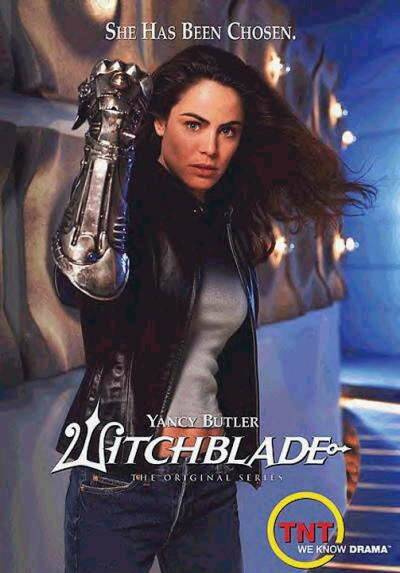 The finale, Ubique, also has to rate highly, for sheer perversity at the very least – Nottingham reaches new levels of creepiness in his final scenes with Lucrezia. Throw in a kicking soundtrack (Lords of Acid!), some spectacular deaths, and we’ll forgive a central plot device teetering curiously close to the main premise of feardotcom, which opened in cinemas the very same week. Among the interesting themes on view are the way both Pezzini and Nottingham both struggle to come to terms with the loss of their fathers, albeit temporarily in the latter’s case. This may be linked to one of the unresolved issues carried forward; who is the guy with wavy grey hair who always seems to be lurking round Sara? Indeed, the whole Nottingham/Pezzini relationship had perhaps more depth than any other in the show; veering between love, hate and obsession, with never a dull moment.
 ★★★½
★★★½ Put simply, having killed of most of the cast (a refreshing change from more cowardly shows, which refuse to let