




★★★
“Better the devil Kenau…”
 This feels a little like a Dutch cross between the stories of Joan of Arc and William Wallace. It’s a couple of centuries later than either, taking place (as the non-Dutch title states!) in the 16th century. The Spanish armies of the Catholic King Philip II were sweeping across Europe, reaching as far North as the Netherlands. Some cities capitulated; others resisted. Among the latter was Haarlem (to use the Dutch spelling), where legend states a woman called Kenau Simonsdochter Hasselaer led an army of 300 women in defense of the city. The more prosaic reality is that she may have helped in fortifying the defense, though the amount of reliable historical data about her is scant in the extreme.
When has that ever stopped film-maker – hence the Wallace comparisons, who is similarly lost in the mists of time. The Joan of Arc similarities are in the heroic defense of her homeland against foreign invaders, though there’s less of a religious subtext for Kenau. In this version, one of her daughters, Gertrude (Smit) is burned at the stake after being caught vandalizing a Catholic church, and it’s partly this which triggers Kenau into action: I guess that’s a little like Boudicea as well. Initially, she is reluctant to take action, and the city is almost sold out to the Spanish by its corrupt leader. However, it’s all almost too convenient in the subsequent events, which portray Kenau as a brilliant strategist, always one step ahead of the enemy.
To a certain extent, this is fair enough: it’s a heroic story, painted in bold strokes, without much subtlety. The Spaniards, especially, come over as borderline caricatures, all lecherous villainy. About Kenau’s sole weakness is being over-protective of her other daughter, Kathelijne (Harmsen), refusing to let her become her own person, romance a hunky mercenary soldier, or assist in some of the more dangerous missions, such as sneaking out of the city to hijack a supply convoy. Otherwise, there’s precious little resistance, with the wonderfully-named governor, Wigbolt Ripperda (Atsma), putting up only a token argument against Kenau running things. There are likely one too many heroic cliches, such as the rousing speech she gives, when the women have a chance to leave the besieged city.
If questionable from a historical perspective, I still have to admit I was entertained to a fine degree, with the production values being better than I expected – Hungary stood in for the Netherlands during shooting. There is no shortage of action, either on the battlefield, or in the shape of other incidents. Even as someone who knows almost nothing about the history of this period, it’s all rather rousing. Hendricks delivers a sufficiently committed performance, and this helps paper over some of the points where her character feels like it came from about 400 years later in history. Not a movie you want to think about too much, I suspect – especially since the truth is that Haarlem ended up surrendering, with thousands of its residents beheaded or drowned. Awkward.
Dir: Maarten Treurniet
Star: Monic Hendrickx, Sallie Harmsen, Barry Atsma, Lisa Smit
a.k.a. Kenau

 Up to a certain point (which I’ll get to in a bit), this low-budget post-apocalypse picture from the Netherlands has been solid if unspectacular. The limited resources have shown themselves in a world which almost entirely consists of running about sand dunes and light forest. The fight scenes have been grubbily realistic rather than impressive, with the kind of amateur flailing around with limited weaponry you’d probably actually see after armageddon has actually taken place. And the main focus of the plot has been the usual warlord type, Deacon (Bolt) who turns people into “supplicants” – drug-crazed pit-fighters for his personal amusement. Standard practice for a post-apocalyptic leader, really.
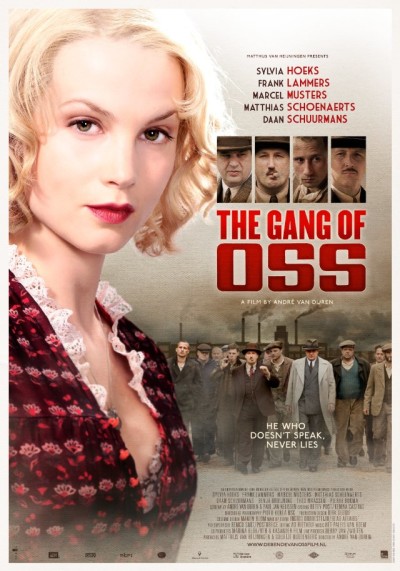 I never really think of the Dutch as the organized crime type, but this film convinces me otherwise, based as it is on actual events from just before World War II. Oss is a town in the Southern half of the Netherlands and, it appears, everyone there is on the take one way or another, from insurance scams to larger scale shenanigans, all the way up to the mayor and the local priest. The federal government has sent military police to the town to keep order, but that only rankles the locals, for the cops are Protestants and they are Catholics. Johanna (Hoeks) hopes to escape a life of crime, planning to open a restaurant when her husband, Ties (Schoenaerts), gets out of jail. But it’s not as easy as it seems. Her spouse is happy to pimp her out, and local boss and Ties’s uncle, Wim de Kuiper (Musters), drags him back into his old ways. When Ties tries to force Johanna to have an abortion, she hatches a plan to have him killed by her lover (and client), Jan, although the plan only puts her deeper in the clutches of de Kuiper. But when she discovers just how low he is prepared to go, she decides he and the rest of his cronies are going down.