

Bloodrayne 3: The Third Reich

★★½
“Probably just about the best of the series to date. Take that as you will.”

After the abomination that was Part 2, I’d filed the third entry under ‘watch whenever I have time’, until a spirited debate on its merits (or otherwise) broke out on over oun our GWG forums. That got this one fast-tracked, and I am here to pronounce the official word is… it’s alright, I s’pose. Malthe has improved markedly since she took over the role from Kristanna Loken. In #2, she was little more than a clothes-horse, but now possesses some genuine charisma, though in terms of fighting skills, still leaves a good chunk to be desired. The makers, apparently realizing this, offer distraction in the way of ample cleavage shots, and some gratuitous nudity – which, if your luck is like mine, is exactly when your wife will walk in. Admittedly, telling her I was going to be watching Schindler’s List was probably a mistake, in hindsight…

As you can likely surmise from the title, this takes place in World War II – if you’re playing along at home, that’s three different centuries for the movies now, so I guess the next one will have to be ‘Bloodrayne in Space’ [Uwe, send payment for this idea to the PO Box, please]. During an attack on a train taking ‘undesirables’ to the death camps, Rayne sinks her fangs into the local Kommandant (Pare). However, she doesn’t kill him, and with the help of the local resistance, has to clean up the resulting mess, before Der Kommandant and his mad doctor (Howard) can get to Berlin and turn Hitler into Der VampireFuehrer.

The main problem is that runs only about 70 minutes before the very slow end-credit crawl, and feels like a good hour is missing somehow, as the storyline leaps about, and rushes through a finale that seems completely unsatisfying and badly under-written. The result is a movie where the individual scenes are decent enough, yet you reach the end and find yourself thinking, “Is that it?” and wondering if you had dozed off someehere in the middle. The sense of unfulfilled expectations are likely down to this. If the movie is certainly a clear upgrade on its immediate predecessor, it’s hard to see how it could be otherwise. Still, I’d like to see what Malthe can do in a less apparently-hurried production.

Dir: Uwe Boll
Star: Natassia Malthe, Michael Pare, Brendan Fletcher, Clint Howard
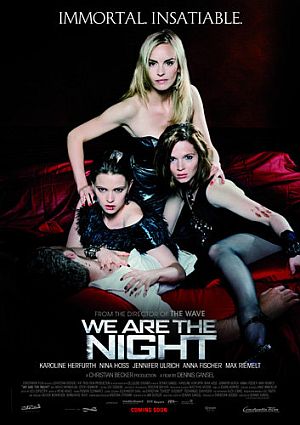
We Are The Night

★★★★
“German vampires – but the polar opposite of Werner Herzog’s Nosferatu.”

Lena (Herfurth) lives on the edge of society: stealing from other criminals, and running from the cops. But her life changes forever, when she comes to the attentions of Louise (Hoss), a rich socialite, who runs with her pack of friends. Louise is actually a centuries-old vampire, who sees something in Lena’s eyes, something for which Louise has been searching for many decades. She bites Lena, and her transformation into a creature of the night begins. It’s not without its issues: to force Lena to come to terms with her new-found strength and speed, she is handed over to a pimp, a scenario which turns into a blood-bath. While Lena does adapt, the police investigate the killings and Tom (Riemelt), who knew Lena from her street days, realizes there’s a connection between her and what happened.

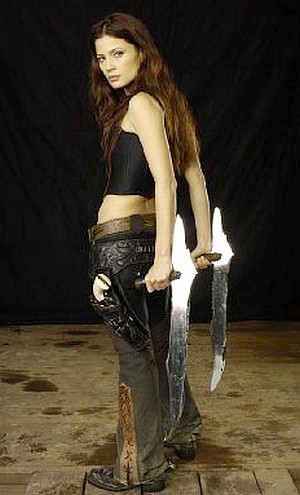
While there’s precious little new here, in terms of content, it’s really a film where the style is probably more important, and the makers nail this impeccably. It’s a glossy, shiny movie, set in a world that looks like a car advert [and, as an aside, there are some very nice cars here!], where the streets are perpetually wet and the only light is neon, with a perpetually thumping techno beat as the soundtrack. Of course, your mileage may vary as to how that translates into a cinematic experience, but I loved the attitude on view, despite the short attention span and focus on distracting the viewer with shiny, pretty baub… Ooh! Sparkly things! Sorry, where was I?

It’s the moments that you’ll remember: Lena’s bath-tub transformation with her old life literally melting off her, or the restaurant scene where one of the immortals proves exactly how hard-core a smoker she is, by stubbing a cigarette out in her eye. And the radical feminist philosophy is engagingly confident, espoused here as, “We eat, drink, sniff coke, and fuck as much as we like. But we never get fat, pregnant, or hooked.” Louise helped kill off the male vampires because they were a waste of undeath, and has deliberately avoided turning men since. It is, if you like, a distaff version of The Lost Boys, crossed with Daughters of Darkness, with some fine action set-pieces thrown in, that I wish they’d extended a bit. When you contrast this with lame vampire updatings like T*w*l*ght, there’s no doubt which is superior.

Dir: Dennis Gansel
Star: Karoline Herfurth, Nina Hoss, Jennifer Ulrich, Max Riemelt

The Baader-Meinhof Complex

★★★

Director Edel is probably best known in the West for the embarrassing Body of Evidence, though would rather be remembered for the much better, if incredibly depressing, Last Exit to Brooklyn. This is certainly nearer to the latter, depicting the rise and fall of the Baader-Meinhof group, also known as the Red Army Faction, the terrorist gang whose actions sent Germany into a state of nervous anxiety in the late 70’s. They started off at the end of the sixties, when Europe was in a state of political flux, but became more radical, engaging in bank robberies to fund their activities and then escalating to bombings, assassinations and kidnappings. The leaders were eventually caught – and I trust this isn’t much of a spoiler – dying mysterious deaths in jail, officially called suicide, but suspected by some as being extra-judicial execution.

It’s a generally interesting, but also flawed, approach to the subject matter, because it tries too hard to be even-handed, both humanizing the group, while also being sympathetic to the establishment they sought to bring down. It’s hard to do this, while still generating much emotion, because the viewer is left not really knowing for whom they should “root”. In addition, former journalist Ulrike Meinhof (Gedeck – the picture, above, is the real Meinhof) is initially the focus of the movie’s attention, but the way things unfold (and I’m manfully avoiding any spoilers there) mean that things inevitably have to shift away from her in the latter stages. The movie also faces the inevitable problem of any film based on actual events: reality rarely, if ever, follows a three-act structure, and as a result, either the facts or the drama have to suffer – here, it seems to be the drama, with the story not so much building to a climax as petering out.

That said, the performances are good, particularly Wokalek as Gudrun Ensslin, who has been described as the intellectual head of the RAF. What makes it suitable for inclusion here is the way that both Meinhof and Ennslin are depicted as the driving forces, the engine-room of the Red Army Faction. Andreas Baader (Bleibtreu – who was also the ineffectual boyfriend in Run Lola Run) is depicted as a hot-head, and something of a hypocrite, with a taste for fast cars. It’s clear that Ensslin and Meinhof are the ones that run the group – Baader was, in fact, a high-school dropout and one of the few RAF members who did not attend university. I have vague memories of hearing reports about the group as I grew up; while it was good to have the large blanks in my knowledge filled in, this felt more like a Discovery Channel re-enactment of the RAF’s history, rather than offering anything truly cinematic.

Dir: Uli Edel
Star: Martina Gedeck, Moritz Bleibtreu, Johanna Wokalek, Nadja Uhl

Bloodrayne II: Deliverance


“Ah, this is why people hate Uwe Boll.”

Look, I speak as one of the few people on the planet who found the original Bloodrayne other than unwatchable dreck. So when I say that the sequel is a soporific, poorly-constructed, badly-executed waste of time and effort for all concerned, including the viewer – for God’s sake, listen to me. There is simply no rhyme or reason present here, right from the setting which goes from Middle Ages Europe to the Wild West without any credible explanation. Billy the Kids (Ward) is a vampire, kidnapping the local kids, in some kind of half-baked plot device that makes no sense, involving him waiting for the railroad to reach town, to spread his curse. I guess going to a town that already has trains would be too much work. Rayne has to round up a posse to take on Billy and his blood-sucking cronies. Y’know? For the kids….
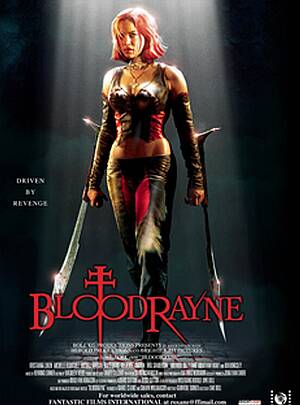
Malthe is not an adequate replacement for Kristanna Loken. While there are some settings in which she would make an appropriate Rayne, this isn’t it. I can do no better than reproduce goatdog’s limerick on this issue:
She’s entirely too soft-spoken.
She pales next to Kristanna Loken.
She’s not half as pretty,
her accent is shitty,
and her ass-kicking skills appear broken.

Beyond that, even my usually forgiving nature kept stumbling into holes of logic. For instance, Rayne’s posse is mostly there because she blackmailed or threatened them, yet this apprarently creates immediate loyalty, to the point they are prepared to die on behalf of a cause they know basically nothing about. Similarly, there’s a newspaper reporter (Coppola): his third scene explains his presence, yet mostly makes you wonder exactly what he was doing in his first two scenes. The film doesn’t even have consistency of vampire lore: can they, or can they not, be killed with regular bullets? The film says no, but then…

It’s not just a bad vampire movie. Probably worse, it’s a bad Western. Overall, it’s just bad: I generally have more time for Boll than most people [National Treasure was much, much worse than House of the Dead], but even I cannot defend this on any level. The original had a lunatic sensibility, heaving everything at the screen it could find: it may not have made much sense, but you did remember it. The sooner I can forget this, the better-off I will be.

Dir: Uwe Boll
Star: Natassia Malthe, Zack Ward, Michael Pare, Chris Coppola

Bloodrayne

★★½
“Don’t belief the hype: it’s not that bad.”

Director Boll has a rep as the worst filmmaker ever, making movies based on video games entirely for tax writeoff purposes. But have things got out of hand? I mean, Bloodrayne was in the IMDB All-time Bottom 50 before it opened. So cut him some slack – even though we may be the only folk on this planet who admit to liking bits of House of the Dead. Still, despite a fine cast [any film with Udo Kier is okay by us!], uniformly dire reviews meant we went in to this with low expectations – and made up most of the audience. Ouch. Yet, despite rumours of Madsen being drunk every day, Kingsley refusing to act with Madsen – something leftover from Species, I guess – and Rodriguez’ horrendous attempt at an English accent, this wasn’t entirely terrible.

Not great, sure; but as someone from Britain, I knew right off Rodriguez wasn’t even trying. I think all she did was limit her normal accent – wise for a Hispanic in a setting of Romania, circa 1700. Anyway, she and Madsen are hunting down Rayne (Loken), a human/vampire halfbreed seeking king of the vampires Kagan (Kingsley), who raped and killed her mother. Kagan, in turn, is after three artifacts to protect him from water, crosses and sunlight. Basically, imagine a period take on Blade with less actual imagination and more digital blood. There is certainly potential; Loken looks the part (dig her groovy swords!), as does the landscape.

However, the action borders on the incoherent, provoking little or no sense of awe or excitement. Gossip also states most of the stars signed on about two weeks’ notice, and that would certainly explain their apparent large unfamiliarity with pointy weapons. From the reviews, you’d think this was worse than Plan 9 From Outer Space, yet ignoring the anti-Boll hype, it’s largely only the poor staging of the fights which prevent this from being, at the very least, a credible rental. However, an action film with bad action is like a horror film with bad scares, rendering the other ingredients largely irrelevant.

Dir: Uwe Boll
Stars: Kristina Loken, Michael Madsen, Ben Kingsley, Michelle Rodriguez

Bandits

★★★½
“Bad Girls – the musical.”

Not the Billy Bob Thornton/Bruce Willis vehicle of the same name, this German film is several years older. Four girls, in the titular prison band, seize the chance to escape when playing at a police function. With freedom comes unexpected fame, thanks to a tape sent to an unscrupulous record company executive. There is plenty of potential for a Natural Born Killers-style hack at the media, manafactured celebrity: the Bandits could go after the exec for exploiting them, he could encourage the cops to shoot the fugitives and increase sales, etc. Von Garnier largely avoids this, in favour of unsuccessful chick-flick emoting, and a slightly surreal approach, like a long-format pop video. Add an irrelevant subplot in which the Bandits take a hostage, play with him for a bit, then dump him, and it’s clear the script is embarrassingly weak.
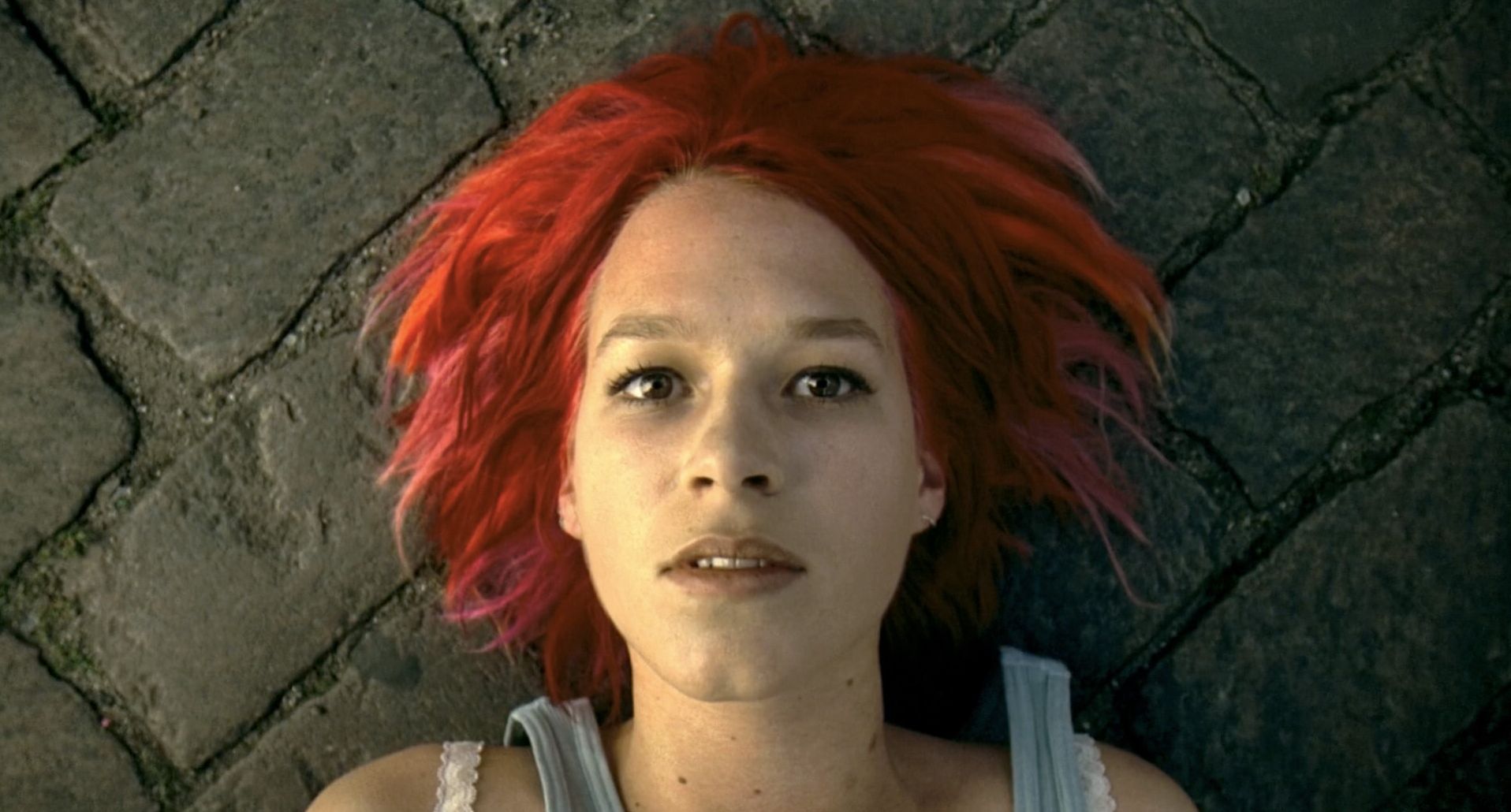

Fortunately the rest of the film holds the script up, aided by Von Garnier’s good visual style – albeit one perhaps more appropriate for MTV (one scene is in danger of turning into Fame!). The characters, too, deserve better, a fascinating mix of archetypes: the tough girl, the slightly mad oldie, the ditzy sexpot, etc. They could easily slump into shallow cliche, and it’s a credit to the actresses that they don’t. The music is a key element, and isn’t terrible, though personally, I’m a long way from going out and buying the soundtrack. In the end, all the elements combine with the unstated potential to create an engaging failure. Could have been, should have been, yet there’s still enough to make it worth a look.

Dir: Katja von Garnier
Star: Katja Riemann, Jasmin Tabatabai, Nicolette Krebitz, Jutta Hoffman

Run Lola Run

lola★★★★★
“She’s got legs… And she knows how to use them.”

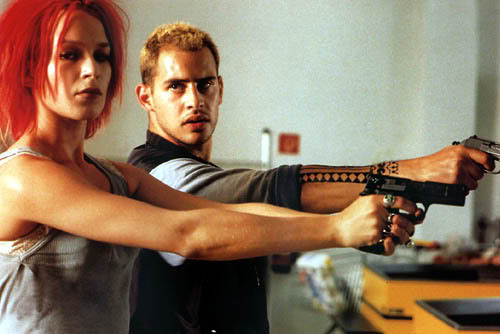
The term “action heroine” moves into a whole new dimension with this movie: no gun-battles, no fight-scenes, no explosions, but it still maintains a breathless pace for almost the entire 81 minutes. Lola (Potente) needs to find DM100,000 in 20 minutes, after her boyfriend Manni (Bleibtreu) loses a bag of money he was supposes to deliver to a highly dubious character. All this is set up in about five minutes, and then Lola is off, sprinting to try and get the cash.

The key twist is the film depicting three parallel stories; all start with her leaving her apartment, but they gradually diverge, and end in three radically different conclusions. One of the film’s myriad delights is seeing how they interweave, with the differing fates of the various characters, and how tiny changes in the decisions we make can have massive consequences.

Right from the start, when Lola lobs a phone in the air and it lands spot-on the cradle, we know she has unusual powers. Her screams can shatter glass, and there’s one moment, in the casino, when she turns to the manager and looks at him. “Just one more game”, she says, and as portrayed by Potente (an amazing performance, with “future star” written through it), her gaze comes across as a force of nature more powerful than a typhoon. Lola is someone absolutely determined to have what she wants – “love conquers all”, if you like – and she even seems capable of rewinding time through sheer will, when the results go against her.

Yet, curiously, certain experiences appear to carry forward: in run #1, she is shown how to use a gun, in run #2, she needs no such tuition. A security guard we see clutching his heart in #2, is met in an ambulance in #3. Tykwer sees no need to explain any of this (is it merely being played out in Lola’s mind?), yet spotting these things are part of what makes the film so incredibly rewatchable. Even after half-a-dozen viewings, I’m still finding new facets e.g. the number she bets on in the casino, 20, is also the number of minutes she has to save Manni, since there’s simply so much crammed in.

lola2Special mention needs to be made of the soundtrack, a pumping mix of techno co-created by Tykwer, which helps drive the film along at a blistering pace, and is one of the few soundtracks I will listen to on their own. Yet there are also tender moments (probably essential to prevent the audience from hyperventilating and going into shock), which Tykwer handles with skill and aplomb. Lola is something of an aberration in his filmography, stylistically: his other work such as Winter Sleepers are much more languidly-paced, but do cover similar themes of randomness and its effects. The end result is a film which manages to be shallowly entertaining and deeply satisfying at the same time. You can enjoy it purely on a “what happens next?” level, or appreciate it as something with so much depth that it can even be viewed as a retelling of the myth of Orpheus (the evidence pointing to such an interpretation is too lengthy to go into here). Truly a film with something for everyone, and for some, like myself, it has everything.

Dir: Tom Tykwer
Stars: Franka Potente, Moritz Bleibtreu, Herbert Knaup, Nena Petri