




★★½
“Opportunity Knox.”
 I was intrigued by this, mostly due to the presence of Penn, an Australian champion in karate who appeared (albeit, in minor roles) in a number of Hong Kong action movies of the nineties. Her blonde hair made her stand out, as one of the few gwailo women to be seen in the genre. This TV movie, intended as a pilot for a series appears to have been her swing at stardom in the West. After it fell agonizingly short, she seems to have given up on acting entirely. She now appears to be the CEO of Signal 8 Security, a private security company back in Hong Kong – the celebrity clients listed on the company’s website appear to include Jackie Chan, ironically enough.
This is, in some ways, art imitating life, as here she plays Niki Knox, who… runs a private security company. On her wedding day to Jackson (Chong), her father Darrell (Lee Majors) is put in a coma by the villainous Delicious Malicious (Kessell) – yes, that’s apparently her name – who is seeking a trio of gemstones which Darrell has been guarding. As a sideline, Malicious runs a PPV website that streams her blowing up buildings and other acts of mayhem. But the gems are the main thing, and Niki has to stop them from falling into the wrong hands, otherwise… bad things will happen. She has to manage that with the help of former cop Steve Hardman (Calabro), who is now her employee, and despite the betrayal of someone very close to her.
Just as Cynthia Rothrock’s American movies are not a patch on her Hong Kong ones, so Penn’s action here is a pale imitation of her work in things such as In the Line of Duty V. I don’t know why I expected any more from a TV movie though, especially one making a lackadaisical effort to pass the city of Sydney off as a generic American metropolis (an endeavour largely undone by Penn’s noticeable Aussie accent). It still might have managed to work if it had stuck to a simpler scenario, just pitting Knox against Malicious, the latter chewing scenery to entertaining effect. It’s definitely a case where the sidekick outshines the main villain.
Instead, there are too many supporting characters who serve little purpose, and Calabro in particular sucks the life out of any scene he’s in. There’s no chemistry with Penn at all, and I’d much rather have simply seen this sister doin’ it for herself. As noted, I’m not sure there’s much of a stretch in Penn’s role here, yet she’s reasonably engaging. I might have talked myself into watching the show, albeit only if Steve Hardman suffered a quick and painful death in an early episode. That will remain hypothetical. For while the pilot did get a positive reaction in the United States, it appears that sales in the rest of the world were so weak, the production company was unable to proceed to series, and the project was scrapped. I’d be hard-pushed to call it a great loss.
Dir: Peter Bloomfield
Star: Kim Penn, Thomas Calabro, Simone Kessell, Jason Chong
The whole film is on YouTube, as below
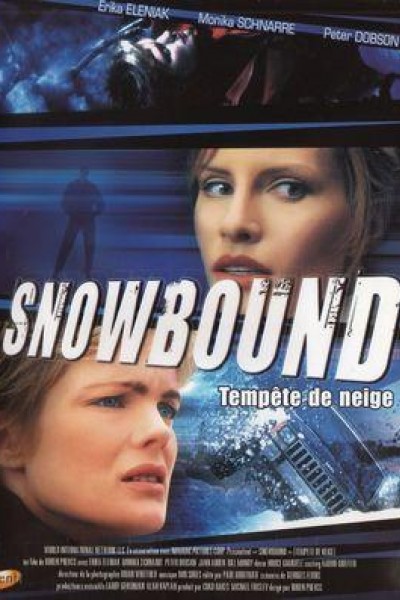 Though not formally listed on the IMDb as a made for television movie, it has all the hallmarks of one, down to what look suspiciously like pauses into which commercial breaks could be inserted. It’s the story of work colleagues, Liz Bartlett (Schnarre) and Barbara Tate (Eleniak). The former is attacked in the company’s parking garage one night, and confesses to her friend that her former husband is stalking her. She fears for her life, having helped put him behind bars. So what is the most sensible thing for the pair to do in these circumstances? If your answer is, “Head off to a remote mountain cabin, in the middle on an impending blizzard”, give yourself two points.
 After an incident where she shoots dead a woman armed only with a toy gun, Marie (DeCianni) quite the police force to become a housewife. However, her husband, Barry (Spadaro), has some dodgy friends, in particular, Nadi (Regina, who also co-wrote this), a man with ties to organized crime. Barry falls behind on payments, and an unfortunate car “accident” befalls him: a recent large life-insurance policy named Nadi as the beneficiary. It’s all very shady, as Marie’s old police captain (Session) admits. However, there is just not enough evidence for the authorities to take action. That’s not an issue for Marie, however, who decides to take revenge for the loss of her husband, against Nadi and his associates.
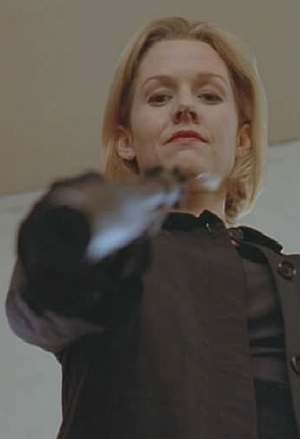 Ward (whom we’ll watch in anything, as payment for the enjoyment Tremors has given us) plays John McWhirter, a hard-bitten journalist with a fondness for the bottle, who is still trying to put behind him an incident when he was a young radical, that led to his friends being sent to jail for long terms, while John escaped doing time. He’s looking into the murder of an industrialist by Palestinian terrorists, when said friends show up, asking him to hide a woman (Ticotin) from the authorities for a few days, describing her as an activist in Shining Path, a Peruvian rebel group. Turns out she’s not who she seems, and it also turns out John had more to do with his friends’ arrests, thirty years ago, than it initially appeared. With enemies in the FBI, led by Robert Lecker (Plummer), an ally in the CIA, and a female assassin (Miller, right) out to tidy up all the loose ends, McWhirter has to decide whether to do what’s right, what’s easy, or what’s best for himself – and those might be three mutually exclusive options.
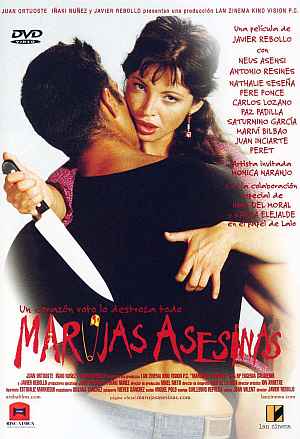 This tale of a Hispanic wife whose sanity disintegrates, beginning with the murder of her husband and ending with…well, you have to see it, had me shifting somewhat nervously, as
 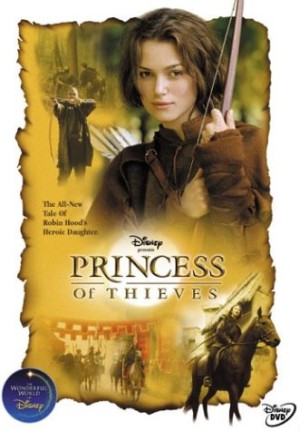 Back before Pirates of the Caribbean made Knightley a household name, and even before Bend It Like Beckham made her an
 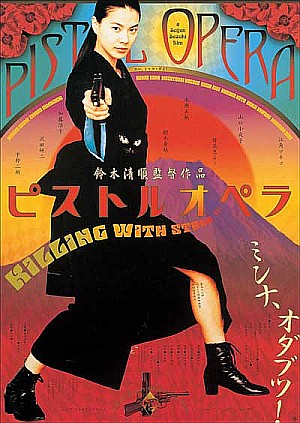 I don’t think I have ever been quite so
  It’d probably be best to watch the original film, Poly Matrix, immediately before this, as otherwise, you’ll be kinda hitting the ground running. After those events, Ross Syllabus and “Third” [a model of android which can reproduce] Armitage have set up home with their daughter, who doesn’t know her mother is anything by human; meanwhile Ross operates under an assumed name as a security guard. However, an incident turns him into an unwilling spokesman for robot rights once again, and when he is sent to Earth as a Martian delegate, his daughter Yoko is kidnapped by a faction seeking to reverse his vote. It’s time for Armitage to put aside her chores and kick butt.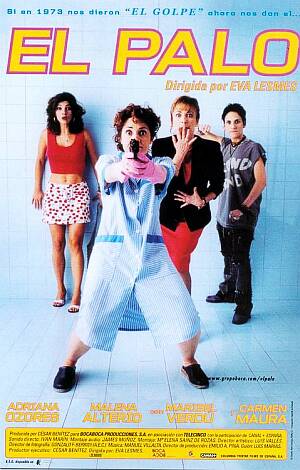
 Four unlikely women team up, for their own but unselfish reasons, in order to rob the bank where one (Ozores) works as a cleaning lady. There’s also a rich bankrupt, out to fund her daughter’s wedding; a slutty hairdresser who’s just found out she’s pregnant; and an antisocial punk orphan, who wants to be reunited with her father in Argentina. What makes this Spanish film work, is less the action, and more the characters – or at least, the women, since the men never become more than two-dimensional. The script is brisk and efficient, moving things along with swift abandon, and sucks the viewer in to a connection with the ladies, their problems, and the solution.
 Love story or wartime thriller? The script here tries to have it both ways, and as a result of this uncertainty, the undeniable potential in the idea is unfulfilled. Gray (Blanchett) is dropped into Vichy France during World War II as an agent, but her bosses don’t realise she is more interested in finding her pilot lover (Penry-Jones), who’s been shot down nearby. While conflict between love, and love of country, would have been interesting, the former is almost ignored, then disposed of in a thoroughly unconvincing manner. Not that this diversion is uninteresting; you get a real sense of the terrors of war, with people being “vanished” in seconds, and the tension of living your life on a knife-edge behind enemy lines.
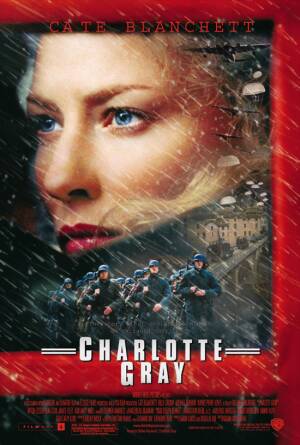 Mostly, the film is concerned with Charlotte’s protection of two Jewish children, and involvement in a resistance cell led by Julien (Crudup). They’re communists, so the British don’t really like them, but they’re convenient – and can be abandoned when necessary, the revelation of which provides the film with its most chilling moment. Blanchett has the right steely resolve for the role, and the cast is generally excellent; particular credit to Gambon (magnificently surly as Julien’s father), Ron Cook as Gray’s contact, and Anton Lesser, an oily collaborator who had us screaming “Die! Die!” at the TV set.