



★★★
“Historical accuracy? It’s vastly over-rated…”
 The story of Ma Barker, legendary leader of a bank-robbing gang consisting mainly of her sons, has inspired multiple movies, from relatively well-known (Roger Corman’s Bloody Mama) to obscurist (Ma Barker’s Killer Brood from 1960). They all play extremely fast and loose with the facts, upping Ma’s role from a travelling companion for her sons, who rarely if ever got involved in their crimes, to the undisputed leader, who wielded a mean tommy-gun. The FBI at the time leaned towards the latter, but that was perhaps because they ended up gunning down Ma and some of her sons. [Hey, I don’t regard historical fact as meriting a spoiler warning. At the end of Titanic, the ship sinks.]
This is a cheery enough romp, making up for in blood squibs what it lacks in historical accuracy, depth or significant character development. Russell holds the film together well at the center, but it’s all shallow – hints (totally unjustified, as far as I know) of an abusive childhood are about the closest we get to psychological insights. There’s also creepy hints of incest between Ma and her sons – which reminds me that, contrary to her prominent cover position, Alyssa Milano’s role is minor, as a “gang whore”. If the dramatic side is half-baked, the action is good, with a real sense of the FBI being out-gunned. They actually were in their early days, though the level of ineptness shown here, with regards to stakeouts and ambushes, is difficult to swallow.
Especially towards the start, the narrative is lumpen and certainly doesn’t grab you immediately. Once the main thread becomes apparent – agent Melvin Purvis (Cortese) tries, but fails, to capture Barker and her gang – the film can devote energy towards this, and becomes more successful. It’d have been interesting had the connection between Purvis and Barker been made more significant; there’s an interesting scene where a drunk Barker rails against her hunter on the telephone, hinting at the potential here. However, I doubt the director of Commando was really interested much in subtle underpinnings, and on the whole it’s probably for the best he doesn’t even try.
Dir: Mark L. Lester
Stars: Theresa Russell, Dan Cortese, James Marsden, Frank Stallone
 Another title in the ongoing Metropolitan Police Branch series, has much the same ingredients as the other entries: cheesecake and mildly competent action. I think this is the second entry, but as the three films have three different pairs of actresses playing policewomen heroines Mika and Rin (Hara + Iijima in this case), it’s clear continuity is less the purpose of the exercise than the aforementioned C + MCA.
 I’m still trying to work out what the title actually means; it certainly bears no relevance to the film. More generaly, the biggest point of interest is its similarity to Blade 2, which took the basic concept (hunt for the carrier of a virus that turns its victim into bald, psychotic bloodsuckers) and did a lot more with its Eastern European setting. Henstridge is Delon, a policewoman who has her partner dismembered while they search a house, and Lambert leads the backup team – they follow their target into some vents which connect to an old prison, and where they rapidly become the prey. All this is set just outside a post-apocalyptic (plague, specifically) Boston – though the cop cars have ‘POLICIA’ on them. There’s also a subplot about Delon’s son, and a black-market passport she bought for him, which is of no significance whatsoever, and is probably there only to get the running time up to feature length (and at 76 minutes, only barely!).
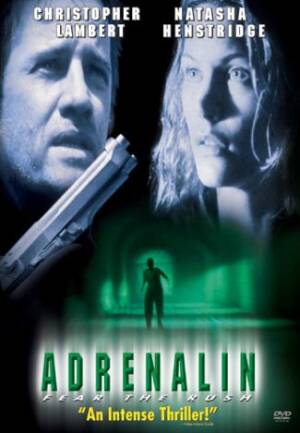 Shot in what looks like four rooms, it’s up to director Pyun to make the most of a higher-profile cast than he usually manages – unfortunately, he fails, though I liked the snap-zoom technique applied to bullet hits. This is straightforward ‘spam in a tunnel’ cinema, with little tension, character, or anything else that might elevate this above the mundane. Henstridge, bless her, does what she can, and comes over like a grubby version of Lara Croft; her undeniable action heroine potential has so far been wasted in stuff like this or the lame She Spies. Partly shot in the capital of Herzegovina, Mostar, the “just-bombed” look is likely genuine, from a conflict that only ended the previous year; it may be exploitative, but at least Pyun brought employment to the locals. I imagine he’s now scouting locations in Kabul and Baghdad.