




★★½
“Tea, polite conversation and cold-blooded murder, British ’70’s style.”
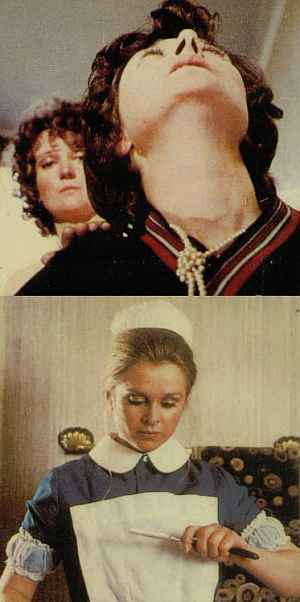 An intriguing premise is ground into the dirt, with execution which could hardly be more tedious. An agency of hit-women are run by an antiques dealer (Reed), taking on clients from all walks of life, who can use the skill-set of her assassinettes. Flaky business partner? No problem. Trapped in an unloving marriage? Will that be cash or charge? It’s imbued with a curious degree of social commentary, as the scenes are intercut with newspaper front-pages, intended to convey the impression that 1976 society is on the edge of collapsing into predatory carnage, anarchy and chaos. Which, in the post-9/11 world, really seems more quaintly ironic than remotely threatening.
The main problem is pacing which takes the simplest scene and stretches it far beyond the point of relevance, or even interest. The killers are clearly in absolutely no hurry to carry out their tasks: for example, one poses as a student carrying out a survey on housewives to gain entrance. Which would be fine, except that we then have to sit through a whole spiel on the survey, the target’s daily routine, a cup of tea and a tour of the house before the hit-lady appears suddenly to remember why she’s there, karate-chopping the victim and dropping her down the stairs. Similarly, the “nurse” who turns up to give a massage…actually does give the massage. And then a bath, all depicted in much more detail than remotely necessary.
It’s less a story, than a series of unconnected clients. The only real linking influence is an Italian assassin, whose weapon of choice is poisoned cigarettes. She shows up right at the start, and then vanished for almost the entire movie: it’d have been fun to have seen two “killer companies” fighting it out for business. That lady is played by Rula Lenska, a genuine Polish countess who achieved further 70’s fame in the UK TV show Rock Follies, and was the US spokeswoman for VO5 shampoo. I suspect most of the other people in this may be recognizable from British horror of the period, though perhaps more Amicus and Tyburn than Hammer. It would certainly have benefited from the presence of someone like Peter Cushing or Christopher Lee.
While the violence is mostly understated, on the exploitation front, there’s plenty of softcore flesh – and even some male full-frontal nudity, though it’s not what you’d call erotic. This is in part because people seem to spend an awful lot of time lounging around in bed, chatting with each other – or, more often, bitching at each other. This does not exactly present a flattering portrayal of British men; as Chris put it, “My god – how did you ever come out of such a place?” But it remains such a unique and cynical animal that I found myself unable to do anything but keep watching, even as this continued to plod on, in its mostly-tedious vein.
Dir: Donovan Winter
Star: Tracy Reed, Bernard Holley, Scott Fredericks, Heather Chasen
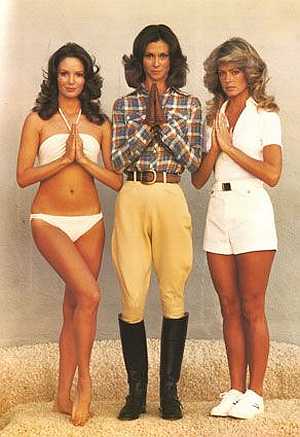 I suppose my main surprise is how pedestrian this was. Action? Hardly anything to speak of at all, despite the credit sequence which shows them training as police officers. The story has them going undercover at a vineyard, whose owner vanished seven years ago, and is about to be declared legally-dead: his ex-wife (Muldaur) and the sleazy foreman will clean up…unless the daughter, also missing, shows up. Of course, the Angels play both a fake daughter (Smith) and the ‘real’ thing (Jackson) – the former is designed to be exposed, in order to get herself involved with the wife and foreman, and reveal what’s going on. Quite cunning, really.
 Let’s be perfectly clear about this: at least one, possibly more, of the points awarded to this movie only apply if you, like us, are connoisseurs of the trash aesthetic. If you delight in bad acting, poor action and technical ineptness, this is for you. Otherwise…consider yourself warned. Not to be confused with Jeannie TNT Jackson Bell, this was Johnnie Hill’s only film – and when you’ve seen it, you’ll understand why. She plays Velvet, a private investigator brought in, along with her two female sidekicks (also adept in martial arts, even if we are redefining the word “adept” here), when someone starts encroaching on a crime lord’s territory. Who is behind this? And who is behind them?
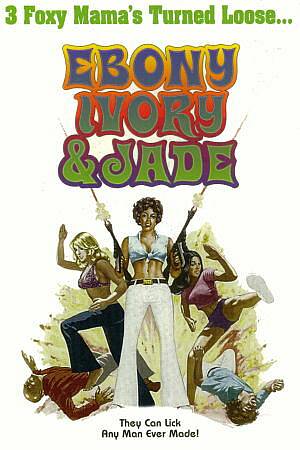 As well as its questionable use of the apostrophe, the cover kinda implies that three girls are involved here, which is only true for a small fraction of the running time. It starts off with