




 ★★½
★★½
“Like mother, like daughter.”
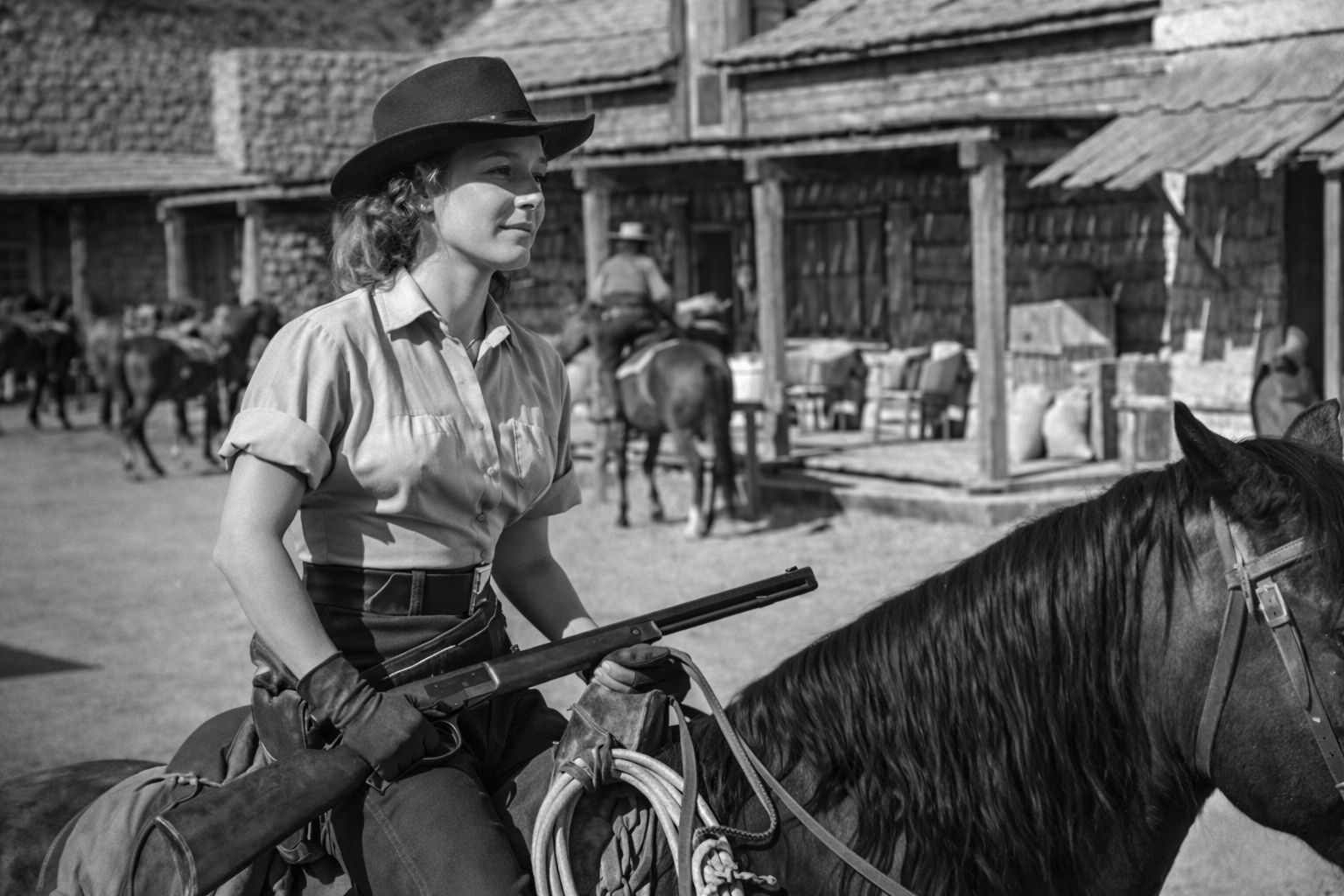
After one of her henchmen kills a local marshal, a posse is sent from Antioch to deal with outlaw Belle Starr, who had previously been in an uneasy truce with the town. However, when they arrive, they find Belle dead, and the gang subsequently scatters. Her daughter, Rose (Roman) mistakenly blames the new marshal, Tom Jackson (Montgomery), for her mother’s death. She apparently takes up honest work as a waitress, and Jackson falls in love with the young woman, initially unaware of her felonious ancestry. But Rose ends up leaving town with Bob Yauntis (Cameron) – he’s a former member of the gang who, unknown to her, was the actual killer of Belle and the previous marshal.
I guess this is something of a follow-up to Belle Starr – or maybe Badman’s Territory, since Isabell Jewell played Belle in both movies. This certainly has a similarly loose approach, taking historical fact as a jumping-off point for fictional adventure. Belle did indeed have a child: however, she was named Pearl Starr. Rather than an outlaw, she became a prostitute and ended up running several bordellos herself, and died in Arizona in 1925 (I’m a little surprised she wasn’t covered in Outlaw Women of Arizona). This appears to be taking another Western wild woman, Cimarron Rose, and making her Belle’s daughter. In reality, that Rose did hang with a criminal nicknamed ‘Bitter Creek’, as Bob is called here. She was supposedly involved in the Battle of Ingalls, an 1893 gunfight between outlaws and law-enforcement.
Back in the cinematic world, it’s a shame Belle doesn’t survive longer into the movie. Having her, not just be an outlaw, but being the leader of an entire gang, is not something you see much on Westerns, particularly from this era. Obviously, the apple doesn’t fall very far from the tree, but you don’t get the idea Rose is exactly the sharpest tool in the box, letting Bob manipulate her at every step of the way. She refuses to accept the truth, well beyond the point at which any sensible person would be going, “Wait a minute…” While Roman might not be Gene Tierney in Belle Starr, there is something of a resemblance. She passes muster in a “We have Gene Tierney at home” way.
It is a little disappointing how she ends up sidelined in the middle, in favour of Marshal Jackson hunting after Bitter Creek Yauntis and his gang. Rose just becomes one of the gang, though the way she isn’t treated particularly differently from anyone else, is somewhat refreshing. She does take the lead in trying to help an injured gang member, leaping off her horse to help him when he collapses into a river. Bob’s callous indifference here is what helps turn Rose against him, and she flees (across some very nice scenery), with Bob and his henchmen in pursuit. No prizes for guessing who arrives to save the day: having a woman who could save herself was still a little too advanced for Hollywood.
Dir: Lesley Selander
Star: Ruth Roman, George Montgomery, Rod Cameron, Wallace Ford
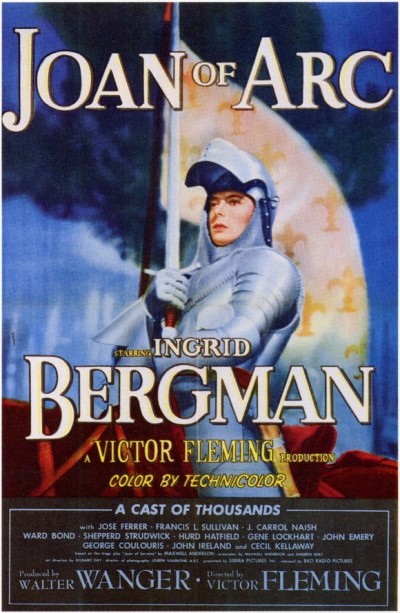 This film’s origins as a stage play are painfully apparent, and you can also see why the distributor’s felt it needed to have 45 minutes cut out before it could be released, as frankly, it’s a bit of a bore. The battle to recapture Orleans is the only action of note here, even though that represented the start of the Maid’s campaign to restore France to its proper ruler (Ferrer), rather than the end. After that, this more or less skips forward to his coronation, then Joan’s capture, spending the rest of the movie – and there’s a lot of it – going through the trial, and the railroading of the heroine into, first throwing herself on the church’s mercy, then recanting her recantation and returning to wearing men’s clothes, thereby sealing her fate. There’s not much here which you won’t have seen before, if you’ve seen any of the other versions of the story, touching the usual bases from Joan’s revelations that she’s going to be the saviour of France, through her trip to see the Dauphin, and so on. It does downplay the “voices” aspect, especially early on, perhaps a wise move since it’s difficult to depict, without making her seem like a religious fruitcake.