




Literary rating: ★★★★
Kick-butt quotient: ☆☆
This 1935 novella is only the second work I’ve read by pulp-era American SF author Stanley G. Weinbaum (the other is his first and best-known short story, A Martian Odyssey, which is included in The Science Fiction Hall of Fame, Volume One, 1929-1964). But despite dying at the age of 33, in his meteoric writing career (which spanned only about 18 months), he produced dozens of short stories and two posthumously published novels. (A number of the stories were published posthumously as well.) He earned a place in Sam Moskowitz’s Explorers of the Infinite: Shapers of Science Fiction (1974), and his stature in the genre’s history remains high more than 50 years later.
Though born in Louisville, Kentucky, as a child Weinbaum moved with his parents and sister (the family was ethnically Jewish, but to my knowledge there’s no indication that he was ever religiously observant) to Milwaukee, and lived there for the rest of his short life, except for study at the Univ. of Wisconsin at Madison from 1920-23, where he first majored in chemical engineering and then switched to English literature. (He left without graduating, after being caught taking an exam for a friend on a dare.) After his marriage in 1926, he worked at a variety of odd jobs, but began writing seriously in the late 1920s and submitting his work to magazines. A Martian Odyssey, published in July 1934, was his first sale, and brought him immediate acclaim in the small SF fandom of that day.
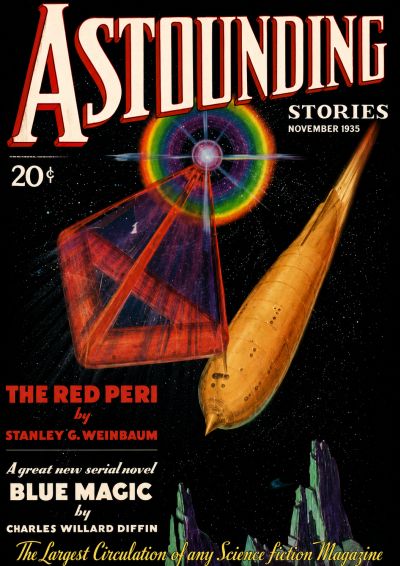 American SF between the World Wars was a sort of literary ghetto, disdained by critics, and found mainly in a handful of small-circulation niche magazines, dominated by editors committed to the genre’s “hard” tradition, in which the speculative element is strictly based on extrapolation from known science and scientific accuracy is a paramount concern. (Literary matters like character development, well-crafted prose, and original plotting, in that era, was sometimes of less concern.) Weinbaum, like many of the genre’s writers in his generation, had the scientific background and interest to write hard SF, but his English literature education/interest also gave him stylistic skills superior to those of a lot of his contemporaries. Both qualities are evidenced in this short work.
The Red Peri is set partly in space but mainly on Pluto (which had been discovered relatively recently, in 1930), in a future era in which humans use rocketry to travel to the planets of the solar system, but mostly to Venus and Mars; a small town on the Jovian moon Titan is as far out as their settlement goes, and the outer planets are rarely visited at all. (No date is actually given in the text, though the cover copy gives 2080; I’m not sure where that’s derived from.) Trade between these three middle planets is lucrative, but bedeviled by space pirates; and none of the latter are more feared than those of the pirate ship Red Peri. (Peri is Persian for imp or elf.)
25-year-old Frank Keene, our American viewpoint character and co-protagonist, a radiologist and physicist, has a brief run-in with a red-haired pirate (you can’t see much through a space-suit visor, but he did see that) when the freighter he’s traveling on is robbed by the Peri. A year later, he and an elderly fellow scientist, researching cosmic radiation in deep space, have to make an emergency landing on Pluto. That very cold world proves to hold a couple of secrets, one of which being that it’s the lair of the Peri –and it’s no real spoiler to reveal that “The Red Peri” is also the moniker of the pirate captain, who happens to be a very attractive young lady.
A Dr. Mike Goldsmith provides a reasonably spoiler-free page-and-1/2 Introduction and about five and a half pages of footnotes to this Grammaticus Books re-print. As this added matter reveals, despite Weinbaum’s determination to write “hard” SF, this book has its share of scientific inaccuracies (though it also exhibits some solid science as well in places). Some of these are simply the result of the limited scientific knowledge available in 1935: for instance, not much was known then about Pluto (and Weinbaum’s depiction of it was plausible at the time), and nobody back then realized that the range of radio signals is practically infinite. But (though Goldsmith doesn’t pick up on it), the author makes a MAJOR scientific error which his entire plot depends on, and which was clear to me even with my weak background in science. There’s also an “insta-love” factor going on here that’s not really credible (at least, to me). But on the plus side, our main characters are vital, nuanced and well-drawn, and Weinbaum creates a thought-provoking, morally complex situation which engages both the reason and the emotions of these characters, and of the readers.
While the ending of the tale wraps up the immediate plot here effectively, readers will probably want a continuation to the narrative; and Weinbaum in fact intended to write more about these characters. Sadly, that wasn’t to be. Less than a month after the story was published, he was dead of lung/throat cancer, brought on by his heavy smoking (and initially misdiagnosed as tonsilitis, resulting in a misguided tonsillectomy that just added uselessly to his pain). So readers will have to use their own imaginations to project future developments!
Author: Stanley G. Weinbaum
Publisher: Grammaticus Books; available from Amazon, both for Kindle and as a printed book.
A version of this review previously appeared on Goodreads.