



 ★★★★
★★★★
“The Land of Hope and Despair”
 I’ve to say this anime show is kind of unusual. While after the show there were some attempts to use the story as the basis for a manga series, it is not based on one – unlike what feels like 95% of all anime – but instead on a “visual novel”. I have absolutely no knowledge what a “visual novel” is. Wikipedia has this to say about them: “Visual novels are often associated with the medium of video games, but are not always labeled as such themselves. They combine a textual narrative with static or animated illustrations and a varying degree of interactivity. The format is more likely referred to as a visual novel game.” Well, so much for that. I guess it is similar to these old, “choose your own adventure” books of my youth, where you would make a choice at the end of the page, and depending on your decision would turn to a specific, other page, therefore creating an individual story narrative.
Canaan was inspired by a bonus on Wii visual novel 428 Shibuya Scramble. The game itself, I believe, featured live cut-scenes with real actors, but had extra content consisting of drawn anime-style images. As the game was extremely successful at the time of its 2008 release, it is unsurprising that an anime spin-off was produced in 2009. The original concept was by Type-Moon, with anime studio being P.A. Works. The original visual novel could go into different genres, depending on the protagonist the player chose. So it’s significant that the genre of the anime series also changes over time. In the beginning it can rightly be called a mystery, since you have no idea what happens here and why. Yet at the very end, it is full-blown action with a conspiracy plot sprinkled in, and elements bordering on science fiction. Albeit more “science fact”, because they are not far from possible reality, though quite exaggerated.
The new story starts two years after the “Shibuya event”, a viral attack on a train in Tokyo. Reporter Minoru Minorikawa journeys to Shanghai to find interesting stories, accompanied by young assistant photographer Maria Osawa. Osawa was involved in the event and came close to death, but was saved from the deadly virus by her father Kenji. Due to her trauma she has no clear memories of what happened there. In Shanghai, “there are a lot of stories, if people only opened their eyes to see them”, as Osawa puts it. A number of mysterious deaths lead her to meet Canaan again, a mysterious girl who once saved her life and that she longed to see once more.
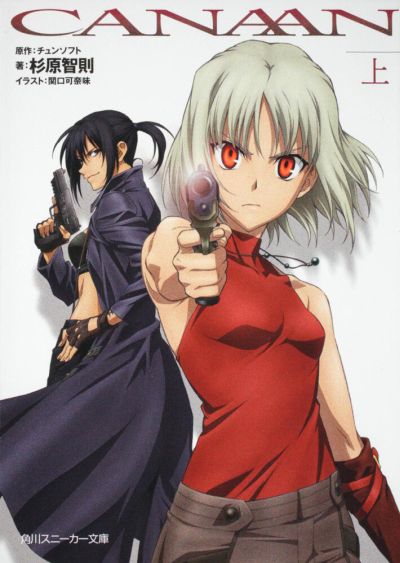 Obviously, the girls feel strongly for each other and there are traces of the so-called “yuri” genre (girls in love) here. But western audiences should be careful not to think this equates to lesbianism. Yuri is seen by many fan-girls in Japan as something “pure” and “cute”. Many fans would feel embarrassed if something so concrete and direct as sexuality were superimposed on such a relationship. I guess there are cultural particularities that cannot translate 1:1 into our Western cultural understanding, because they are so very different. Anyway, what’s at stake here is much bigger. One problem is, there are a lot of different things, elements and characters introduced at the beginning, which initially don’t make sense at all. Only slowly, as the story progresses, is it revealed how they connect with each other. I wonder if players of the game maybe had it easier?
We are introduced to all the main characters in the first episode (of 13), but they still have to meet each other and their knowledge is not the same. Minorikawa feels there is a story that he can’t quite grasp, Maria is happy to meet Canaan again, but after a key incident realizes that her friend is a trained assassin. Santana, the aggressive owner of a Karaoke bar, with his mute buxom employee and girl friend, Hakko, also doesn’t reveal his big, dark secret. There is a girl called Yunyun popping up in several different jobs around the city. And why are we being shown dangerous terrorist Alphard, who just escaped a prisoner transport and obviously plans something big, together with her companions, Lian Qi and her servant Cummings?
Then we are confronted with some words at the beginning that we do not yet understand, such as UA virus, borners and unblooms. I’m not really complaining, because I’m actually in favor of a movie or series not giving everything away too early. It’s fine if audiences for once have to work things out for themselves. I liked that aspect of the show very much, but can understand that those less impressed, or just here to see some battling babes, might be disappointed, or unable to connect with the show. Though, you don’t have to be an academic to understand the story. As the story progresses and the blanks are filled in, bit by bit, you start to see the whole. There is also more than one story being told. The characters all have individual parts and roles in the big picture, and are driven not exclusively by “the big thing”, but also more personal motivations.
It turns out there were secret viral experiments, conducted on the population of a small town by the CIA, through the criminal organisation “Snake”. This caused most inhabitants to die, while the survivors developed extraordinary abilities, but with downsides. For example, Hakko can’t speak anymore because her voice creates waves that affects the brains of those who hear her, and could kill them. Yunyun needs medication to not die before her time, and so on. The aim of the experiments was to create another Canaan. She is a natural synesthete (don’t worry, we’ll explain shortly!) who was brought up and trained, like Alphard, by the terrorist Siam. Alphard felt betrayed when Siam gave the new girl the same name as her – Canaan – and Siam started to change under the influence of positive-minded Canaan. So she killed Siam. This backstory was included as a bonus with the visual novel, but since you couldn’t assume viewers had played the game, it had to be mentioned in the anime, and becomes a key reveal here.
Synesthesia is a special condition some people are born with, meaning that some sensory perceptions can be “taken over” by other ones. For example, sound can be perceived as colours by these individuals. But it can take many different forms. In Canaan’s, she “sees the colour of people”, meaning she can tell how they feel right now, as every emotion has a specific color. When she loses this ability at one point in the story, she feels helpless. With that said, the series does not portray synesthesia realistically, rather like some kind of superpower, more or less.
A confusing element is that the characters sometimes do not act or speak as we in the West would. Therefore, it can be quite the task to figure out why they do what they do, and what their motivations are, as they do not necessarily express themselves in a clear manner. Take Alphard, who lets Canaan off the hook more than once. In the audience, we wonder why she does that. But if you listen carefully, it becomes clear: Alphard defines herself through her own hatred, and wants Canaan to feel the same. She needs Canaan to be at her best when they fight. She does not just want to overcome Canaan, but destroy what she sees as the embodiment of Siam’s spirit. In a way, they are fighting about the value of the philosophical legacy belonging to their stepfather and teacher. That’s no small thing for an action story.
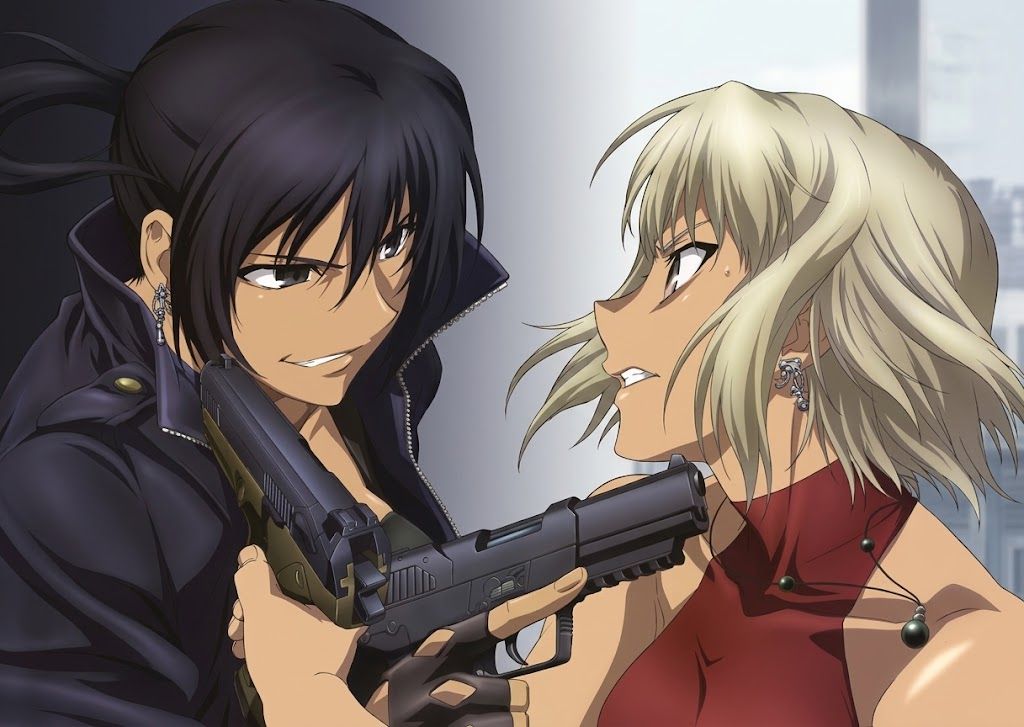 You could say that this is about two women finding closure with the past. Their different attitudes to deal with it become clear: While Canaan suffered as much from the loss of Siam as Alphard did, she was able to move on and establish a new positive relationship with Maria. While Alphard, despite becoming head of the terrorist organization “Snake”, has been eaten up by her hatred and suppressed feelings of guilt. She also can’t reciprocate the obsessive and essentially destructive feelings her “little sister” Lian Qi had for her. Oh, yeah: Lian Qi… She would be a feast for a psychiatrists’ conference! On a deeper level this is not really about bombs, anti-terrorist summits, political maneuverings (the US president and his VP don’t leave a good impression here), human experiments or even the big shoot-outs. It’s about the loneliness and isolation the individual characters suffer, and their hope of finding love and possibly redemption. There is a deep, poetic quality in the series, expressed in the dialogue, often less matter-of-fact but hinting at deeper meanings or feelings.
Some of the scenes depicted here are graphic and definitely not appealing. One scene involves a woman having sex with a dead man which, while you understand the intention behind it, is painful to watch. Another shows surviving town inhabitants that have lost their minds and appear very much like zombies in their behavior. The “unblooms” mentioned above, die a terrible death when they come into direct contact with sunlight. I definitely wouldn’t call this an appropriate show for younger teens. Tge grown-up storylines recommend it for older viewers, who can better appreciate the nuances it offers. At the same time, the drawing style is very beautiful – as to be expected, given those involved in the production – and the musical score gives the story a haunting, dynamic, sometimes even epic and melancholic feeling.
The final showdown between opponents – not necessary enemies – Canaan and Alphard is memorable. The audience wonder who will survive, the film makers having already demonstrated that they have absolutely no qualms about killing off main characters. While avoiding spoilers, I must say I have never seen a character exit a story in such an incredible manner! The very last scene, which is kind of an easter-egg, coming when the end titles play and after it, suggests a potential continuation of the story (similar to the open ending of Arcane) that never happened. That said, the resolution felt very fitting and “round”, so to speak.
Dir: Masahiro Andō
Star (voice): Miyuki Sawashiro, Maaya Sakamoto, Yoshino Nanjō, Kenji Hamada