This is the second in the tetralogy of novellas originally marketed as the Sheriff Bride series, from the small press Lovely Christian Romance, and each written by a different author. It follows the fortunes of the four firearms-capable Hardin sisters; the first book explains how they came to share the position of “sheriff” (actually, town marshal) in the fictional western Texas community of Waterhole in the later 1870s. From the beginning, it was predictable that each book would focus on one of the sisters’ finding her life partner; and the identity of those partners for the middle two sisters, Jo and Dan, was already adumbrated in the series opener. (The books definitely need to be read in order.)
Our story here takes place a bit over six months after the preceding one. In terms of both general literary vision and prose style, the two have a lot in common, although the editing and proofreading is much better here –there were no continuity issues, and no bracketed editorial comments surviving into the printed text. There’s little information available online about Brooksie Cox, but this seems to have been her first publication, and one of only two (Goodreads lists four, but two of those are omnibus editions that apparently each include one of the other two). With no author’s or publisher’s note(s), we don’t know the genesis of this series and its unusual multiple-author structure; but I’d hazard the guess that the idea may have come from the much more prolific author of the first book, Teresa Ives Lilly (who seems to be the publisher’s mainstay house author, and maybe the actual owner), and that Cox modeled her own prose style on that of the more experienced Lilly. Given that the latter’s is verbally repetitious and averse to using pronouns where they would make the text smoother, the reproduction of both of these features here isn’t felicitous. :-(
Second-oldest sister Jo (Josephina) is an avid animal lover, and the most tender-hearted of the sisters. (Though she’s a good shot, her hunting was often hampered, to her father’s great displeasure, by her reluctance to pull the trigger on an animal.) Waterhole’s storekeeper, Tom, is similarly soft-hearted (the first book let us know that he prefers to catch a fly by hand and release it outside rather than swat it!), and it wasn’t surprising that he and Jo were attracted to each other. By the time of this second installment, she’s running an impromptu amateur animal hospital from the back room of the store. Here, there are two intertwining plot strands: one involving Tom’s younger (and much more spoiled and self-centered) brother Henry, who’s been a trapper in Canada for years, but shows up early on with a young Indian woman, Morning Glory, in tow as his personal slave, and the other involving a pair of not-very-bright would-be train robbers.
My rating for the first book was two and ½ stars. Several aspects of this second one, though, don’t work as well for me in terms of realism, and I wasn’t able to give it more than two stars. First, while (for at least some Native American peoples) tribal law may have allowed the fathers of young women to sell or gamble them away as slaves, by the late 1870s U.S. law didn’t countenance that. So the community’s project of buying Morning Glory’s freedom was unnecessary. Given the long warfare between Texans and the Comanches, and the ill-feeling of many whites in that era towards Indians, as well as Texas’ secession in the previous decade with defense of slavery as one of its officially-avowed reasons, the community’s unanimous sympathy with Morning Glory also seems a bit of a stretch. Though it’s true that slavery was much less entrenched in arid west Texas than in the east Texas cotton country; and Jo’s mother was apparently Northern-born, since her two brothers died fighting for the Union.
Second, it’s a standard romance-genre trope that at least one party to the romance has hang-ups to overcome, but Tom’s here seem sort of contrived. Yes, his previous fiancee broke their engagement because she didn’t want to live in a place like Waterhole; but it’s patently obvious that Jo doesn’t have that problem, and by now the community is becoming more female-friendly than it was then. His fear for her safety in a potentially violent job is more credible (if she has a problem shooting a deer, might she not also have a fatal hesitancy in shooting a human, even with her life on the line?), but the denouement here doesn’t actually discredit that fear. That brings me to some issues with the denouement.
In the first book, I had no trouble believing that a sober woman with quick reflexes, who’s trained and experienced with a pistol, could outdraw a partly-drunk male, even if he and a bunch of cowed townsfolk thought he was pretty hot stuff with his gun. It was said in the Old West that, “God created men and women, but Col. Colt made them equal.” But here, I did have trouble believing that a woman could tackle and physically overpower a presumably bigger and stronger armed male; and not much respect for her intelligence in trying it, when she could easily have covered him with her own gun from behind and demanded his surrender. Her two armed sisters didn’t display much smarts there, either.
If I were Tom, that incident would have exacerbated my concern for her, not laid it to rest. The outcome of the tale here also depends on believing (which I’m not certain that I do) that it can automatically be assumed that every cave in west Texas is inhabited by a swarm of bats which will emerge at sunset; and we’re also asked to believe that Jo’s love for animals makes her the only Hardin sister who would know this, when all of them are wilderness-wise. I also had a problem with our heroines letting an arrested petty thief just walk out of jail, even on the condition that he leave the area, in exchange for a tip leading to the arrest of bigger prey. Finally, although I give Cox credit for treating inter-racial romance positively, the secondary romance here came across to me as implausible and unconvincing.
All of this said, I did finish the book (my wife and I read it together – and she liked it much better than I did, her taste in Westerns not being nearly as critical), and it held my interest. Cox’s characterizations aren’t deep, but most of the characters are likable. Like the author, the main characters are evangelical Christians, and there’s a positive portrayal of the role of faith in their lives. We also see the effects of Christian conversion in a couple of cases, though we’re not privy to the scenes/conversations where those conversions take place (so there’s no lengthy evangelistic exposition). The series can appeal to fans of Westerns, Western romance and “Christian fiction” who don’t expect much depth and just want some harmless, time-passing entertainment.
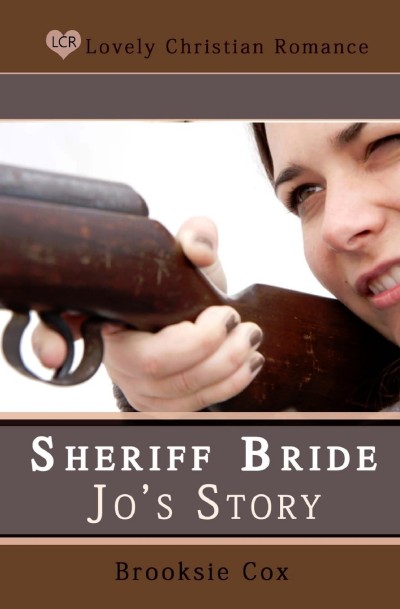
A brief word about the cover art is in order. It’s a nice bit of action-heroine iconography, and does depict an actual scene from the book (a rifle-shooting contest). But while the young lady here has lovely brown eyes, we’re told in the books that Jo and all of her sisters are green-eyed; and the kind of colored nail polish this markswoman is wearing didn’t come into vogue until the 1920s. So, no awards for accuracy here!
Author: Brooksie Cox
Publisher: Lovely Christian Romance Press, available
from Amazon, both as an audio book and a printed book.
A version of this review previously appeared on Goodreads.