



★★★
“Whip it good.”
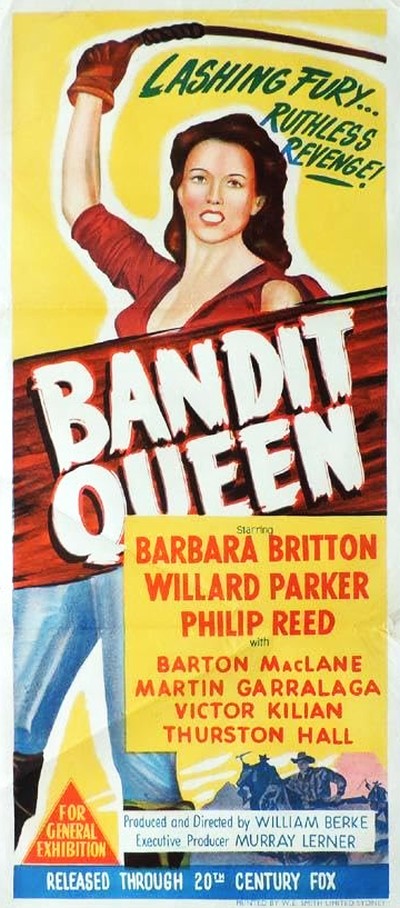 There can’t be many Westerns of the fifties where the Yankees are the bad guys. Yet here we are. In mid-19th century California, to be precise, just after it became part of the US. The new owners enthusiastically threw the existing, Mexican inhabitants off their lands, in the search for gold, using harsh taxation as a weapon against them. And worse, if this is to be believed. For it begins with the callous murder of the Montalvo family, but the legalized thugs responsible don’t realize daughter Zara (Britton) has survived. She takes on two false identities out of necessity: white girl Lola Belmont for Detroit, but also Zara, masked, whip-wieldiing outlaw. As the latter, she seeks justice for her parents, and also “Robin Hoods” the stolen gold back to its rightful owners.
There’s another outlaw, Carlos del Rio, a.k.a. Joaquin Murietta (Reed), also operating along similar lines. But also complicating matters is the local tycoon for whom “Lola” falls, Dan Hinsdale (Parker). Because it turns out his wealth largely stems from being the acceptable face of these legalized thugs. When Murietta is captured, it’s Zara who has to break him out, and the pair them team up, both romantically and in their causes. Their predations have caused enough problems to merit the army getting called in, but there’s also a movement to repeal the tax laws at the heart of the land grabs: which will succeed in their goal first?
It’s obviously a feminine knock-off of Zorro, to the extent in Germany it was released as Zorro’s Daughter. Given the obviously Hispanic leanings, it’s a shame the players involved are so thoroughly and obviously non-Hispanic. The honourable exception is Garralaga as local priest Father Antonio, who for much of the film is the only person to know the truth about both Zara and Joaquin. I wouldn’t expect too much from the heroine here: riding a horse and cracking a whip is about the limit of the on-screen action. Though she is responsible for the (off-screen) deaths of those present when her parents were killed, and does shoot the big villain in the final showdown. If unconvincing as a Mexican, Britton has a righteous intensity about the situation that is effective, and held my interest throughout.
She is certainly more interesting than Parker or Reed, who are blandly handsome in the way leading men of the time typically were. Making a bigger impression in the supporting cast is little person actor Angelo Rossitto, whose career spanned sixty years, including both cult classic Freaks and Mad Max: Beyond Thunderdome. Running barely over an hour long, this is probably a case where less is more: the narrative is generally slight, but good enough. I particularly enjoyed the heroine switching from Lola to Zara, then back again, in order to free Joaquin without causing suspicion. Despite the obviously low budget, this was not a chore to watch, and is as good as some of the other Zorro-related entries we’ve covered here, such as Zorro’s Black Whip.
Dir: William Berke
Star: Barbara Britton, Willard Parker, Phillip Reed, Martin Garralaga
