



 ★★★★
★★★★
“ScandiNoir – made in Germany…”
 Murder by the Lake is a TV crime series co-producted between the second public German TV channel ZDF and the public TV channel of Austria ORF. It started in 2014 with a 90-minute long TV movie, followed by a further movie each year until 2017, when the yearly output was doubled. Since 2024, there have been three movies each year. So far, 22 episodes have come out, with #23 scheduled for later this year. The German title Die Toten vom Bodensee translates as “The Dead of Lake Constance” – “Bodensee” is literally “Ground Sea”, but is called Lake Constance in English. When I saw the first movie I was struck by its surprising quality. If you have read my reviews here, you know I usually don’t think much of the quality of German film productions. This is different: not only is it a show that I always watched, but one where I bought the DVDs.
German crime shows tend to be boring and tedious, though I admit some have become much much better in the 20-odd years. This is one of those exceptions: The series captured my attention from the get-go; I found the single episodes remarkable and was quickly invested in the characters, who were very well portrayed by the actors. In short: It had a different dynamic and feel than most German shows. I wondered why it felt like that until I realized something: The creators of the show have borrowed heavily from successful recent Scandinavian TV crime series, so that you easily could call this “Scandinavian Noir, German style”.
It starts with Lake Constance, which is split between Germany, Austria and Switzerland. When a crime happens that falls under the jurisdiction of Germany and Austria, the commissariats of both countries decide to work together. A new special commission of “German-Austrian Crime Prevention” is formed, headed by German chief inspector Micha Oberländer (Matthias Koeberlin) and Austrian detective inspector Hannah Zeiler (Nora Waldstätten). Also involved, though more in secondary functions, are Austrian chief detective inspector Thomas Komlatschek (Hary Prinz), as well as a pathologist.
Sounds familiar? Well, then you probably have seen The Bridge. It had a Danish and Swedish inspector working together, in a concept used for many remakes around the world. Then there is the Swedish-German-Norwegian crime series The Sandhamn Murders, perhaps the first show to adapt ScandiNoir for a warm summer environment, rather than the usual harsh, cold surroundings of typical Scandinavian shows. The same goes for Lake Constance, whose beautiful surroundings immediately inspire viewers to plan their next holidays there. And last but not least is the character of Hannah Zeiler who is unlike any ever seen in any German TV show, let alone as a police investigator. With her hair combed back tightly, a nice Lara Croft braid, and a Spock-like mind, she moves like a cat. Unless she’s driving her 1971 Moto Gucci Nuovo Falcone motorcycle.
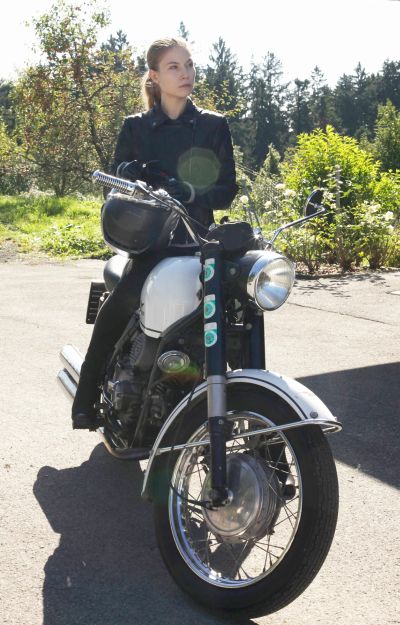 But most interesting is her behavior. When she first appears, she is strictly business. She says hardly a word otherwise, with no interest in getting to know the wife and daughter of her new colleague. She lets no one in emotionally, and shows an aversion to personal connection. Her behavior feels awkward, even upsetting, until you get used to it. Some watchers complained she mumbled her lines, but then, most characters here speak with an Austrian accent which can be a bit difficult to understand for Germans. It might also have something to do with the idea of a character who only slowly reveals her secrets to the audience. Because what I realized after a while, was that Hannah Zeiler is actually a more clinical, streamlined and slightly tamer Austrian version of Lisbeth Salander. Or at least her distant relative.
Similar to Lisbeth, Hannah has childhood trauma, as the sole survivor of a boat accident 20 years ago, where she lost both parents. While her mother died, her father’s body was never found. Hannah was raised by her adoptive father and now boss, Ernst Gschwendner (August Schmölzer), who plays an important role here. But in contrast to her Swedish predecessor, Hannah was never physically or psychologically abused, though the accident has left her with a fear of taking to the water. Also, the idea her father might still be alive has not entirely left her. This is a larger story arc that concludes four years later in episode 6, “The Returner”. It’s fascinating to realize how the “MCU method” of preparing a story arc over years, can pay off handsomely in the end.
Like Salander, Zeiler is a social recluse, and lives in a big house inherited from her parents. Her controlled external demeanor is in contrast to the chaotic life of Oberländer. He has family problems, with a wife who feels chained to the house and their child. He is constantly on the job, driving an old Volkswagen bus: he sometimes even spends the nights there, drunk, and it’s usually not very clean. Zeller and Oberländer are bound to clash; for a long time, it was the main reason for me to watch the series. Initially, their characters seem to come from different planets – the comparison of “like cats and dogs” is very fitting. Yet they learn to respect and rely on each other. It is touching to see Zeiler start to trust Oberländer, slowly open up to him, and their relationship develop.
There was a lot of personal development around the duo, which kept the audience coming back every year, and these were good storytelling moves. The original idea was to have cases with some kind of mystic or mythological touch, although after the first movie, it was then entirely forgotten for the next nine. Mind you, this isn’t The X-Files. The angle is more related to folk customs, superstition or single elements. For example, in the first episode a murder seems related to a Celtic mask found in the lake. In another, a dead girl is found in a mermaid costume. One episode happens during a traditional and ancient local parade. Another has a belief that a house is cursed because it was built on a former path. Or there’s a film that begins with finding a baby in a basket in the lake – was this meant to be a reference to Moses?
However, these serve only as local colour for the stories, and not much more. The stories themselves are often very complicated, with the present crimes related to ones in the past. There is a common theme of how the sins of the fathers (or mothers) are visited on the sons and daughters. Very often the results are tragic. Though thanks to the officials, these family stories are revealed and there might be a chance for a better future. For example, one episode involved two men swapped at birth by accident, and brought up by the other’s mother; when one of them finds out, it leads to tragedy. Another theme through the show, is the inability of characters to communicate with each other. and say what they feel or know. That begins with Zeiler, who is so tight-lipped in the beginning, you could get the impression that she keeps state secrets, though a logical and understandable explanation emerges later.
Yeah, tragedy is very much ingrained in the lives of the show’s protagonists. Oberländer in particular is faced with this a lot: An old love returns and tries to kill him with the rabies virus(!). His wife cheats on him, only then to die in a car accident. He has significant problems with his teenage daughter Luna, who doesn’t stay the lovely little girl she was in the first episodes. What Zeiler and Oberländer have in common, is that they are essentially both lone wolves whose main focus is their work, with Komlatschek in the middle as the well-meaning and warmhearted successor of Gschwendner. He partly balances out the behavior of Oberländer, who often appears overtly aggressive and angry, and Zeiler, who especially in the beginning seems cold-hearted, odd and a bit inhuman.
Action-wise, the show isn’t anything special, though for a German TV crime show, it moves with surprising narrative speed. Guns are drawn quite often, but shooting remains a last resort, even if a rabid dog roams the woods. But I really got to enjoy Zeiler driving her fast motorcycle over long empty roads, through beautiful landscapes. I will say, over time the show lost a bit of its attraction, after her epic arc finished; I cared less and less for Oberländer’s private problems. That said, I still watched every episode. Then in 2022, Zeiler left on a motorcycle trip, never to return. What had happened? Nora Waldstätten (seen in movies such as Carlos the Jackal, and next to Kirsten Stewart in Personal Shopper) had other projects she wanted to take precedence. Since the ZDF had endured a bad experience with an actress in another crime show, resulting in no new episodes for 4 years, they moved quickly to replace Waldstätten, though no-one directly admitted the actress was fired.
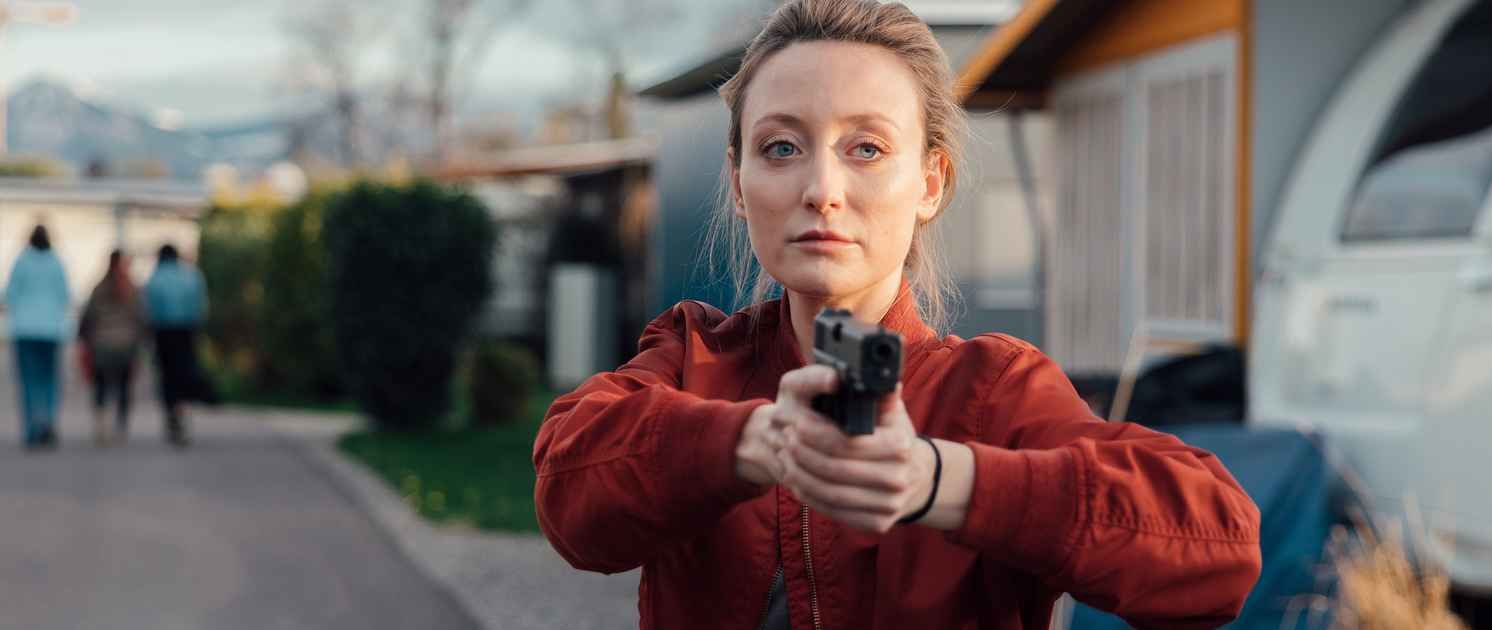
In episode 16 (“Nemesis”) Oberländer got a new Austrian partner in Luisa Hoffmann (Alina Fritsch, above). Zeiler was declared dead in the final scene, Oberländer getting a phone call informing him she had a fatal motorcycle accident – strangely in Spain. Honestly, I felt quite cheated by this cheap way to write a character out of a show. The powers that be could have come up with a better, more fitting and respectful way to get the character out of the series, especially considering she was the main reason to watch in the first place. I did get a strong feeling the writers and producers chickened out from what would have been the next logical step, after the relationship building over all those years: making Oberländer and Zeiler a couple! For let’s face it: both were so special, in their own way, that any relationship with a “normal” person was doomed. Yet, they connected with each other and always understood that “the job comes first”.
But the powers that be again ignored their own character and story build-up completely – see my review for Arcane season 2 – and pulled a former girlfriend of Oberländer out of nowhere. Unfortunately, she was a criminal that betrayed him and would be shot later by Komlatschek. I gave the new actress one quick glance and, without condemning her performance, realized that special… strangeness, charisma, aura, call it whatever you want, her predecessor exuded en masse, just wasn’t there at the slightest. You won’t be surprised that I didn’t watch any of the subsequent episodes.
Oddly, while Waldstätten lasted 15 episodes, Fritsch threw in the towel after 6 (her last one, “Medusa”, was shown January 2025). The final episode I saw had Oberländer and Komlatschek becoming the new investigative couple, and it apparently stays like that for the new episodes. It’s kind of sad when I think of how Waldstätten has been getting guest roles in other, definitely inferior TV crime shows since her dismissal. I wonder who will be the next woman colleague to turn up? After all, I think TV audiences like to see a good-looking interesting female character next to the boorish, angry Oberländer. As the films usually (and still) have between 6-8 million viewers for each new episode, it would be quite risky to change the recipe for success.
Creator: Sam Davis et al
Star: Matthias Koeberlin, Nora Waldstätten, Alina Fritsch, Hary Prinz
a.k.a. Die Toten vom Bodensee
English-speaking audiences can watch the series with subtitles, on MHz Choice, also through Amazon Prime.