



★★★
“S_e _o_s t_ W_r”
If the above doesn’t make much sense, there’s good reason for that. Things tend not to, when half of them are removed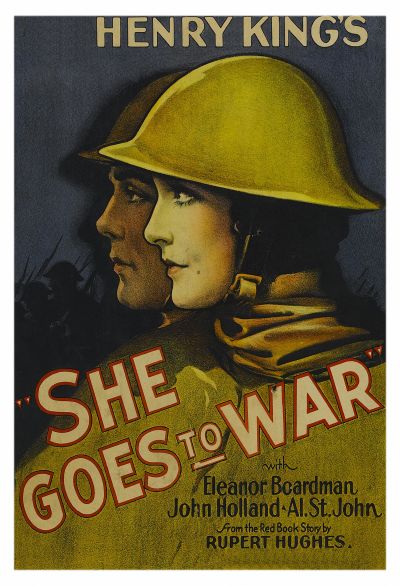 . Albeit for reasons that are largely not the makers’ fault, because this film only partially survives. Originally released in 1929 with a running-time of 87 minutes, the only version that remains is one re-released about a decade later, which has been chopped down to under fifty minutes, including new opening captions which comment on the looming second global conflict. What remains still packs quite the wallop, as an anti-war movie which doesn’t shy from the brutal nature of World War I. It’s a part-talkie, with sounds for some of the music and dialogue, and it’s very effective when used.
For example, we hear Rosie (Rubens, in one of her last roles before dying tragically young) sing a jaunty little number called “There is a Happy Place (Far, Far Away)” to cheer up the troops. A few minutes later, she sings it again to a dying soldier, as heroine Joan Morant (Boardman) watches from the shadows, and it’s utterly heart-breaking. Joan is there for reasons which have largely been lost in the edit down to the shorter version. But they seem to be related to her boyfriend, Reggie (Burns), who has gone off to war – he has a drinking problem, though whether this is a result of the conflict is similarly hard to determine. She disguises herself as a man in order to replace him after his drinking renders him unfit for active duty. This exposes her to the true horrors of trench battles, which go far beyond what she could possible have imagined.
It’s an area where the poor quality of the surviving print work for the film, because the battle re-enactments (including some impressive model work for the nineteen twenties) almost look like grainy newsreel footage. Of course, Boardman is as convincing a man as most cross-dressing soldiers are i.e. not very. You have to accept that conceit as a given, and not ask awkward questions about things like bathroom facilities. After about the half-way point, the dialogue all but stops, and things unfold thereafter accompanied only by music and some sound effects. Some sections are truly the stuff of nightmares, such as when the soldiers have to advance, only to be driven back by the enemy unleashing a tidal wave of liquid fire against them.
Seeing the men trudging back, as the entire skyline burns behind them, or (the then newly-invented) tanks driving into the same fiery hell, are images which feels like they could easily come out of 1917, or any modern war movie. The chaos of warfare is reflected in the way it’s almost impossible to tell friend from foe, in the flames and the smoke and the near-darkness. The troops advance again, coming under withering fire from a German machine-gunner. Joan shoots him in the head, after running away from a would-be rapist (!). But it’s all too much for the poor girl, and she has to be carried back to safety by the truly heroic (and non-alcoholic) Sergeant Pike (Holland), whose entire back story was another victim of the editing. It’s all frustrating, and makes it very difficult to judge, because I’m basically watching half a movie. What there is, however, packs considerably more of a punch than I expected.
Dir: Henry King
Star: Eleanor Boardman, John Holland, Edmund Burns, Alma Rubens