



★★½
“You can take the girl out of the jungle…”
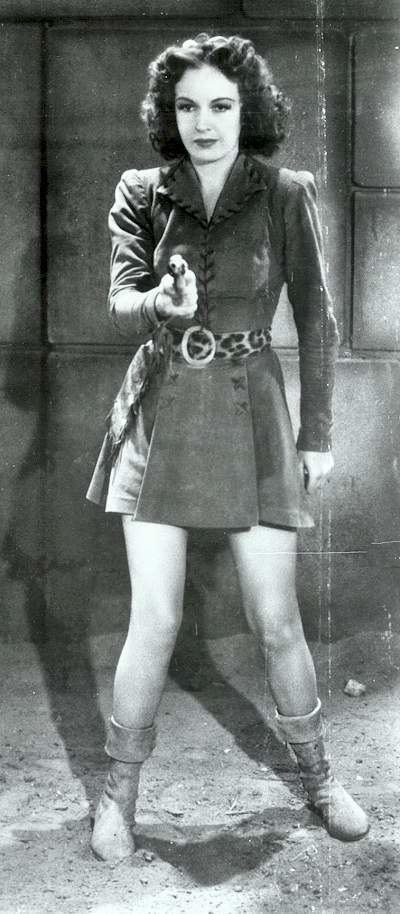 This is nominally based on Edgar Rice Burroughs’s 1932 novel of the same name, also known as The Land of Hidden Men. Though there’s very little beyond the title in common. The book was set in Cambodia, and told the story of explorer Gordon King, who finds a civilization which has been lost for a thousand years. This… isn’t. It is instead the story of Nyoka Meredith (Gifford), the daughter of a doctor working with the Masamba tribe in the middle of Africa. “Nyoka” is Swahili for snake, and she seems to spend most of her free time swinging through the forest on vines.
But there’s trouble in paradise, as ne’er-do-wells Slick Latimer (Mohr) and Bradley Meredith (Bardette) show up, hoping to get their hands on the tribe’s stash of diamonds. Their plan involves Dr. Meredith’s twin brother, who just got out of jail. They knock off the doctor, replacing him with his sibling, who feigns “amnesia” to explain the holes in his memory. They also team up with disgruntled witch-doctor Shamba, who was displaced from his tribal position by Western medicine. But Nyoka, along with Jack Stanton (Neal) and Curly Rogers, stand in the way of the villains. Though naturally, they will have narrowly to dodge death – I’m guessing, fourteen times, give or take.
While this was the first serial in the sound era to have a female lead, it’s a little disappointing in this regard. It feels like, over the course of the 15 episodes, Nyoka is more rescued than rescuing, though it does work both ways. In terms of getting into the action, there’s more than one occasion where she just yells “Look out!”, then lets the menfolk get on with punching each other. However, Nyoka still has her moments, such as in Episode 5, where she dives into a gorge and goes hand-to-hand with a crocodile, in order to save a native child. I did appreciate the lack of any romance here. Despite the obvious candidacy of Jack, everyone is too busy narrowly dodging those deaths, I think, for emotional entanglements.
Considerably less progressive is the portrayal of the natives. I guess we should be happy Shamba is at least played by a non-American, Frank Lackteen being Lebanese-born. But the native boy saved from the crocodile? Born in Minnesota (the actor, Tommy Cook, was still active almost eighty years later, playing a senator in an episode of Space Force!). Even aside from the blackface, add patronising lines like “It took a white man to figure it out,” and there are a lot of elements which have not aged well, to put it mildly. Some of the plot threads are also a bit implausible, such as Jack and Curly building an impromptu refinery in the native village, to convert crude oil into airplane fuel. I’m fairly sure it’s not that easy.
One of the stunt co-ordinators on this was the legendary Yakima Canutt. He would go on to choreograph the chariot race in Ben-Hur, though there’s none of his renowned equine stuntwork here. Helen Thurston was the main double for Gifford, though for the scenes where she’s swinging from vine to vine, a male stuntman (David Sharpe) took over. Apparently, Gifford said he looked better in the costume than she did! The series was so successful it became the first Republic serial to be re-released, six years later. A lot of the action footage from this was reworked into 1955’s Panther Girl of the Kongo, but we’ll talk more about that in its own review.
Dir: William Witney and John English
Star: Frances Gifford, Tom Neal, Trevor Bardette, Gerald Mohr
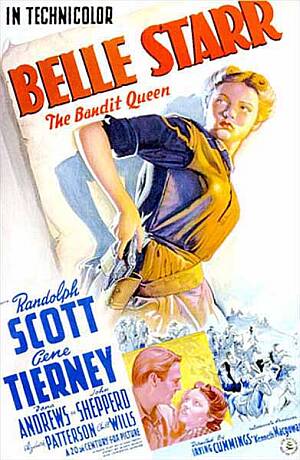 There’s something startlingly incorrect about this 1941 film, which makes its heroine, Belle (Tierney), an unrepentant Confederate mansion owner. She regrets the end of the Civil War and joins a rebel group who keep fighting, marrying their leader Sam Starr (Scott), only to find their morality may not quite live up to her own. It’s interestingly even-handed, with neither side being “good” or “bad”; Belle blames the Yankees for the death of her father and the burning of her home, but the leader of their forces, Major Grail (Andrews) is a sympathetic character who carries a torch for Belle. Naturally, given the era, Belle is more of an assistant, loading Sam’s rifles during a gun-battle, rather than firing them herself and it’s remarkable how her hair and dresses remain impeccable, even when she’s livin’ la vida outlaw. However, she’s a fine, independent-minded heroine, prepared to take decisive action to support her beliefs – highly dubious though they may be.