
 |
 |
 |
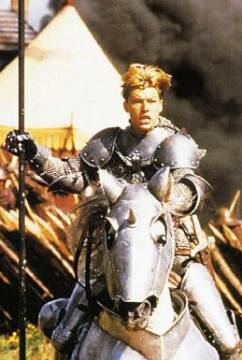 |
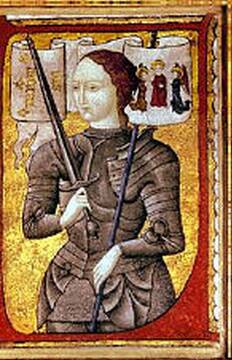
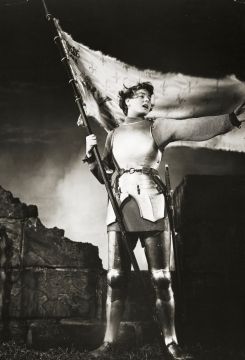
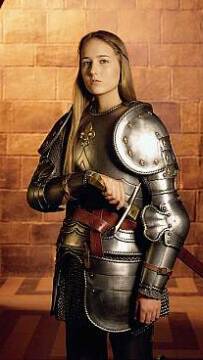
| Joan of Arc | Ingrid Bergman | Leelee Sobieski | Milla Jovovich |
“Art imitating Arc?”
Isn’t it always the way. You wait six hundred years for a bio-pic, then two come along at once. Though actually, France’s patron saint has been the subject of films since the very earliest days of cinema – George Melies made a 12-scene reconstruction of her life in 1900 – but for no readily apparent reason, 1999 saw both a feature and a TV miniseries covering the topic. Before we discuss those, and some other related works, some background is probably wise, as when ever you deal with movies based on historical events. Real life is rarely cinematic, and any conflict is liable to leave factual accuracy in the dirt, going “Did anyone get the number of that truck?” So, here is a potted biography of the Maid of Orleans
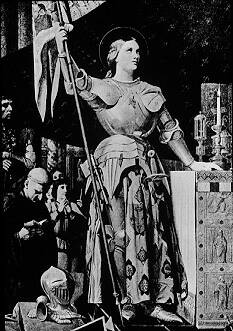 Born in the French province of Champagne in 1412, to a peasant farmer, Joan (or Jeanne – I’ll largely stick to the Anglicization) never learned to read or write, but was regarded by her contemporaries as a highly pious child. It was at the age of 13 that she first heard voices, but it took several years before they convinced her to leave home and help the French king, who was engaged in a battle to liberate the country from England. She presented herself to the local commander, who was skeptical at first, but was eventually convinced after Joan reported news of an English defeat before official confirmation arrived. Joan, clad in male attire to protect her modesty, travelled to see the king, and convinced him of the legitimacy of his claim to the throne, despite a faction of the court strongly opposing her influence. Her faith, simplicity and honesty won the day, and she acquired her sword, found buried behind an altar, in the exact spot she said it would be.
Although she did not engage in actual combat, her presence in the thick of battle acted as a unifying and galvanising force to the French, and she also imposed a pious attitude among her soldiers (no mean task, given they included the infamous Giles de Rais!), for example, driving away the camp whores. Joan’s soldiers raised the siege of Orleans, despite her being shot in the shoulder by an arrow, and subsequent successes led to the coronation of their king in July 1429. Had she gone home at this point, as she wanted to, her life would undoubtedly have been longer and happier. Instead, she continued her efforts to free her nation, and was injured again during an abortive assault on Paris, this time in the thigh. The following May, she was captured by John of Luxembourg, who sold her to the English. Charged with heresy, Joan continued to make a good impression, eventually causing the case to be held in camera.
 This was nothing more than a show trial, despite the efforts of those in charge to find support: according to biographer Jules Michelet, one jurist said “that everything about the trial was wrong; that it failed to respect the proper forms; that the assessors were not free; that the sessions were held in secrecy; that the accused…could not be expected to argue with learned doctors” and finished by declaring that it “was a trial to impugn the honour of the prince whose cause this girl is supporting; you should frankly say so.” Perhaps wisely, the holder of these opinions opted to leave France immediately for the safety of Rome.
Inevitably, her visions were declared diabolical in nature, and she was told to recant or face the stake. Initially, she refused, but faced with imminent death, her courage understandably failed and she gave in. Her death sentence was suspended, to the chagrin of the English, who wanted her disposed of permanently. However, shortly afterwards, she resumed her wearing of male clothes – perhaps to prevent her guards from raping her, or because her normal attire was taken away. This was sufficient to have her condemned as a relapsed heretic; she was burned at the stake on May 30th, 1431. Joan was just nineteen years old. Twenty-four years later, however, a new trial overturned the verdict (albeit rather too late), beginning the process of rehabilitation which would conclude with her canonisation in 1920.
So much for the historical record. What of these subsequent productions telling her story? Are they accurate to the facts? And, perhaps more importantly, do they work as entertainment?
Joan the Woman
By Jim McLennan★★★½
“The first second* action heroine?”
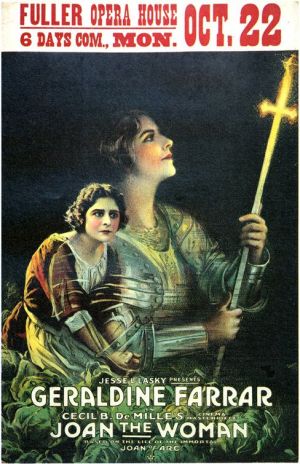 I don’t watch many silent films: it’s such an entirely different experience, obviously, much less driven by dialogue and more by gestures, leading to a style that can look extremely over-theatrical to the modern viewer. My efforts to enjoy the likes of Nosferatu, for example, have usually ended in my providing an accompaniment of snoring, to be honest. This was much better. Despite a running time of over two hours, this 1916 DeMille epic successfully held my interest, as it told the story of Joan of Arc. The framing device uses the then-contemporary World War I, and an English soldier (Reid) finds Joan’s sword in the trenches, the night before a dangerous mission [Interesting how the English are the enemy in the back-story, but the good guys “now” – at the time of release, America was still several months from entering the war, on the British side]. He then experiences a flashback vision, taking him to medieval France, where he is an English soldier saved by Joan (Farrar) in her milkmaid days. We follow her for the story you know, becoming the inspiration for the French army to defeat the English, before her capture, trial for heresy and – I trust I’m not spoiling this – burning at the stake.
Now, don’t expect Joan to go hand-to-hand with the English army here. Still, she’s no nominal figurehead, instead leading her forces from the absolute front, as they break the siege at Orleans. She’s first into the breach, waving the standard to encourage them on, until she takes an arrow in the shoulder. Certainly, there’s no denying her heroic credentials: she’s portrayed as brave and committed to doing the right thing. The film probably does a better job of establishing her as a credible leader than the Luc Besson adaptation: you can see why people would follow her, and it plays the religious elements relatively soft. And the action sequences demonstrate why DeMille’s reputation for epics is well-deserved, with the battle for Orleans impressively-staged, capturing the chaos of war, without needing to resort the the blender-style editing or shaky camerawork, too often seen in modern war movies.
It’s a shame there isn’t more of that. Instead, after Orleans, the rest of her war campaign is covered in a caption, and the film is, understandably, less successful, when it comes to the more talky aspects of her life. In particular, Joan’s trial and incarceration becomes a lengthy sequence of meaningful stares and dramatic flailing. Still, I liked the way it all wrapped around, Joan’s story giving the soldier the courage to go on his mission, though the ending is more mournful than I expected. All told, for something approaching its one-hundredth birthday, this certainly didn’t feel like it, and DeMille deserves credit for laying some foundations for film-makers to come.
Dir: Cecil B. DeMille
Star: Geraldine Farrar, Wallace Reid, Raymond Hatton, Theodore Roberts
* = I’ve since discovered a 1915 Italian film, Filibus, which predates this. A review is here.
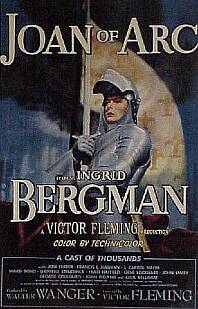
Joan Of Arc (1948)
By Jim McLennan★★
“Joan of Talk”
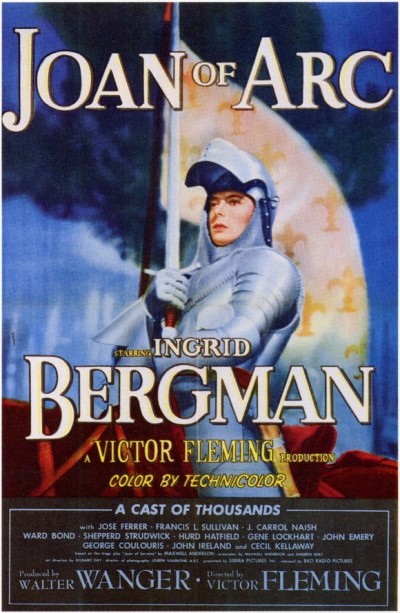 This film’s origins as a stage play are painfully apparent, and you can also see why the distributor’s felt it needed to have 45 minutes cut out before it could be released, as frankly, it’s a bit of a bore. The battle to recapture Orleans is the only action of note here, even though that represented the start of the Maid’s campaign to restore France to its proper ruler (Ferrer), rather than the end. After that, this more or less skips forward to his coronation, then Joan’s capture, spending the rest of the movie – and there’s a lot of it – going through the trial, and the railroading of the heroine into, first throwing herself on the church’s mercy, then recanting her recantation and returning to wearing men’s clothes, thereby sealing her fate. There’s not much here which you won’t have seen before, if you’ve seen any of the other versions of the story, touching the usual bases from Joan’s revelations that she’s going to be the saviour of France, through her trip to see the Dauphin, and so on. It does downplay the “voices” aspect, especially early on, perhaps a wise move since it’s difficult to depict, without making her seem like a religious fruitcake.
The other problem I find is Bergman. It’s not so much her performance here, which is actually very good, and help hold the film up when things get particularly static: she hits her emotional marks well, and the Oscar nomination she received was not undeserved. However, she was solidly into her thirties by this point, probably close to twice the age of the actual Miss of Arc [hat-tip to Bill and Ted!]; there’s only so far make-up can go in taking years off someone. It does seem to have been a character to whom she related: she’s play the role again later, for Roberto Rossellini in Joan at the Stake, when she was nearly forty. The other problem is Bergman’s Scandinavian origins, which poke through her dialogue persistently, also damaging the illusion; it might have been fine in forties Hollywood, where one European accent was considered much the same as another, but now, it sounds too much Joan was a Swedish exchange student or au-pair – especially when she’s wearing her headsquare, and looks ready for a spot of light dusting.
But there’s no denying it looks the part, with production value seeping out of every frame – the Oscars this actually won, for cinematography and costume design, are hard to argue. However, there’s only so far this can take a film, along with Bergman glowing her way through her scenes, in such a way you could probably read a newspaper by her incandescence. That distance is considerably less than 145 minutes, and by the time this is over, you might find yourself guiltily cheering for her arrival at the stake, knowing this means the end is nigh.
Dir: Victor Fleming
Star: Ingrid Bergman, Francis L. Sullivan, José Ferrer, J. Carrol Naish
Saint Joan
By Jim McLennan★★
“Joan of Inaction”
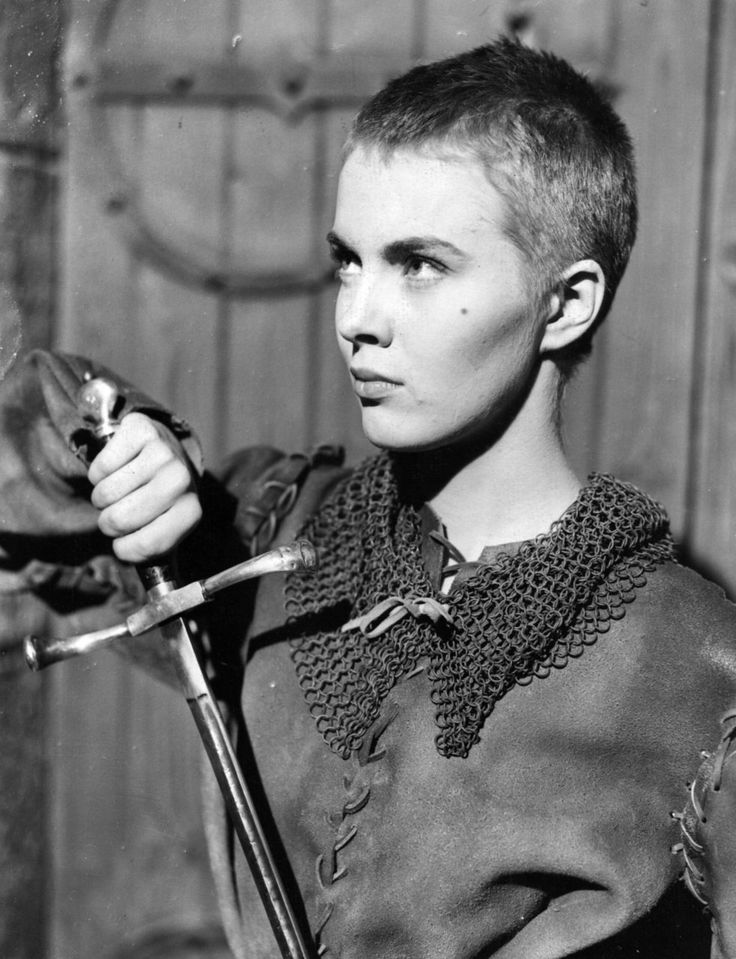 An adaptation by noted playwright Graham Green of George Bernard Shaw’s 1924 play, this is most famous for the extensive search undertaken by director Preminger to find the “right” Joan for the job, which involved testing over 18,000 candidates before settling on Seberg. whose only previous acting to that point had been in school plays. That’s in sharp contrast to the experience in the rest of the cast, which included Widmark as Charles, the Dauphin enthroned by Joan’s actions, and Gielgud as the Earl of Warwick, whose schemes lead to the heroine’s death at the stake. But what’s most notable here, in contrast to some of the other versions of the story we’ve written about, Preminger and Greene seem entirely disinterested in the process which brought the Dauphin to the crown. We see Joan’s rise to command, but the film then skips over everything from her approaching the fortress of Orleans, to the coronation of King Charles. In other words: the fun bits.
The framing story has Joan as a specter, visiting the aged king, along with the ghost of the Earl and other participants in her life, such as the English soldier who took pity on Joan at the stake and gave her a makeshift cross to hold. The adaptation whacked out, it appears, close to half the running-time of the play, and one had to wonder whether it is any more faithful to the work’s spirit. For in the preface to his work, Shaw explicitly wrote, “Any book about Joan which begins by describing her as a beauty may be at once classed as a romance. Not one of Joan’s comrades, in village, court, or camp, even when they were straining themselves to please the king by praising her, ever claimed that she was pretty.” This is in sharp contrast to Seberg, who even after giving up her long feminine locks for the almost compulsory crew-cut, looks more like Audrey Hepburn’s tomboyish little sister than someone, in Shaw’s words, “unattractive sexually to a degree that seemed to [contemporary writers] miraculous.”
It’s not entirely without merit; some of Shaw’s text still retains its impact, such as Joan’s explanation of why the French are losing: “Our soldiers are always beaten because they are fighting only to save their skins; and the shortest way to save your skin is to run away. Our knights are thinking only of the money they will make in ransoms: it is not kill or be killed with them, but pay or be paid. But I will teach them all to fight that the will of God may be done in France; and then they will drive the poor goddams before them like sheep.” The sheer certainty in Joan’s mind that’s she’s right, and will accept no arguments to the contrary, is impressive. Unfortunately, it’s not enough to sustain the film overall, and you’re left without much insight into either the history, or the personalities who created it.
Dir: Otto Preminger
Star: Jean Seberg, Richard Widmark, Anton Walbrook, John Gielgud
The Messenger: the story of Joan of Arc
By Jim McLennan★★★
“Joan’s eminent originality was her common sense”
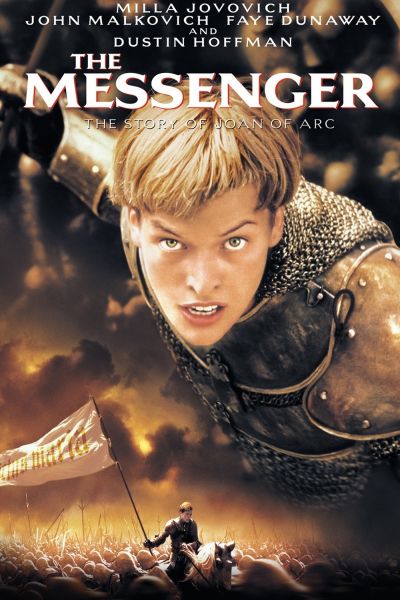 This was the the very first sentence of Michelet’s classic biography, published in 1853, but you’d be hard pressed to recognise the same person in Besson’s portrayal. A more accurate summary of this Joan would be the line spoken to her as she languished in prison: “You didn’t see what was, Jeanne – you saw what you wanted to see…” Besson comes down firmly in the school of thought which has Joan as a mentally deranged religious loony. While this is a viable theory, it doesn’t work as played by Jovovich – all twitchy, rolling her eyes and staring off into the distance – since it becomes impossible to see why anyone would have followed her. Unless we assume the 14th century French population were entirely gullible, she should have spent her life quietly as some village’s idiot. This cripples the film irreperably, since we feel little or no sympathy for a heroine depicted as a frothing zealot.
Historically too, it gets off to a bad start – an entirely fabricated incident in which Joan sees her sister first killed, then raped by an English soldier. This provides a spurious ground for Joan to hate the invaders, when contemporary accounts tell of her concern being almost equal for both sides. Also made-up is her finding a sword in a field, and there is a sudden leap, with Joan arriving to an audience with the King – in truth, she talked her way up the hierarchy. A rather lurid scene (missing from the US theatrical release) where Joan’s virginity is verified, marks the end of a troubling first act. Once her campaign begins, though, the film improves drastically, with excellent (if somewhat implausible – did they really use something resembling helicopter rotors as weapons?) battle scenes, that are at once enthralling and grim. It’s understandable when they unhinge Joan’s sanity even more; another of the themes seems to be that her mission was really non-Christian, in that it led to the deaths of so many people. Something about “thou shalt not kill”, though given the bloody history of Christianity, singling her out seems somewhat unfair. Tcheky Karyo delivers a fine performance as the leader of Joan’s army, facing the difficult task of balancing her expectations, with prosaic things like, oh, not getting killed.
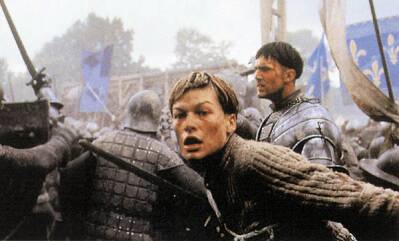 Joan’s capture, trial and execution are fairly close to the truth, though in reality, the King was less involved and more concerned for Joan than shown. It certainly is reasonable to suggest that a naive innocent such as Joan would have been used for political ends. Once she’d outlasted her usefulness – and with the king on the throne, she quickly became more a hindrance than a help – she would have needed to be disposed of. Must confess, I quite like the concept of Joan as a medieval version of Lee Harvey Oswald. Dustin Hoffman’s appearance as Joan’s conscience is another neat touch, and his sarcasm works well. Indeed, the film is one good performance from being excellent. The bad news is, it’s Jovovich who is the culprit (a messenger who deserves to be shot?), though Besson and co-writer Andrew Birkin perhaps warrant most of the criticism for twisting facts and characters in order to fit a predetermined goal. Their Joan is so far from the historical record, they’d have been better off placing their character in an entirely fictitious setting.
Dir: Luc Besson
Star: Milla Jovovich, John Malkovich, Faye Dunaway, Tcheky Karyo
Joan of Arc (1999)
By Jim McLennan★★★★

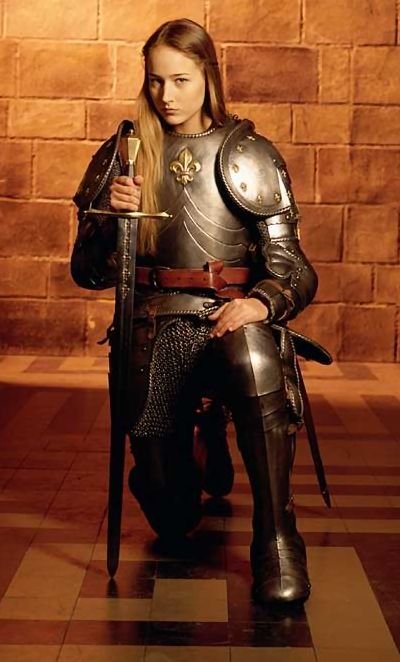 One problem with history is that viewers likely know how it ends: if you want to surprise them, why bother making a historical drama? Joan of Arc knows this, so starts with her burning at the stake. It’s a bit of a double-edged sword: it robs the climax of its striking power, yet acknowledges without doubt, that this is a tragedy. The theme of manipulation is again strong here, with Joan discarded after having outlived her usefulness, despite an odd character change in the second half, where she drifts for a jarring moment into petulant bitch mode. It’s almost as if the makers hinted at a megalomaniacal side, crazed by power, and her fatalistic approach to her capture rings false – probably because it is nowhere near the truth. There’s more fabrication early on, with Joan an unwanted daughter who sees a friend (blind, no less) killed by enemy soldiers – must she always be some kind of post-traumatic stress survivor?
Once it hits its stride, however, there is rarely a wrong step, at least dramatically speaking – the French king again comes off as far more implicated in Joan’s death than evidence suggests. Neil Patrick Harris is convincing as Charles, who moves from self-doubt to certainty in his divine right to be king, then on to using that power against the one who put him there. Peter O’Toole too turns in a fine performance as Bishop Cauchon, though more facts are tampered with, allowing him to act as Charles’ spiritual advisor when he was actually always on the English/Burgundian side. That it’s a TV miniseries is apparent, with 15th century France populated by remarkably clear-skinned and straight-teethed people. There’s even hints of romance between Joan and her companion, Jean de Metz, which serves little purpose. The battle scenes, too, are all but bloodless – I wasn’t expecting the decapitations and arterial spurting seen in Besson’s film, but I didn’t really want the Middle Ages, sanitized for my protection. Even the guy dying of plague looks pretty good. [Chris noted a glaring continuity error at the end: on her way up to the stake, Joan is wearing shoes, but by the time she gets there, she’s barefoot!]
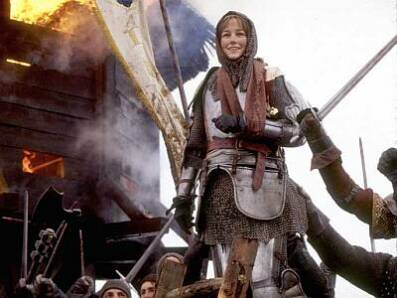 However, the main difference between this and The Messenger is that Joan of Arc is convincing. Perhaps with the advantage of having extra time (the DVD of the miniseries runs 189 minutes), they make the effort to show her interacting with other characters, and Sobieski’s calm, complete assurance is a striking contrast to Jovovich. The viewer can see why people would believe her, and it naturally follows they will too – Sobieski’s Emmy nomination was entirely well-deserved. Despite playing fast and loose with the facts (another example: Joan’s brother was not killed in battle, but lived to see her trial verdict overturned), this strong central performance holds the film together and, with the aid of the other fine actors, makes it eminently watchable. It may not be historically accurate, but it does a fine job of explaining why her myth is still honoured in the third millennium, without coming down in one camp or the other regarding the source of her visions. There are few TV miniseries worth watching, and fewer still worth owning, but this one comes highly recommended.
Dir: Christian Duguay
Star: Leelee Sobieski, Neil Patrick Harris, Peter O’Toole, Chad Willett
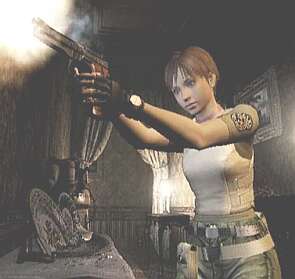 Romero is most – indeed, almost
 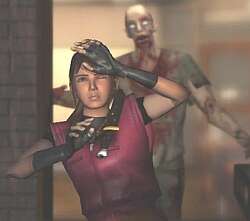 Romero’s problems are, as ever, plot and dialogue. Chris literally stumbles into a secret entrance, yet apparently played there as a child. Chris and Jill get one brief scene, are separated for 30 pages, then come perilously close to having a quickie between kills. Then there are speeches like, “They made you believe you were doing a good thing when it wasn’t good at all. It was evil! The kind of evil that resides in all of us. Makes us greedy, uncaring. The kind of evil that will wipe us out, in the end. Unless we stand up against it.”
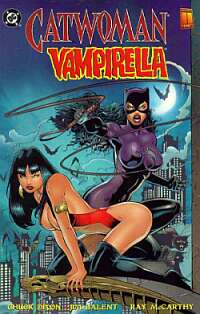
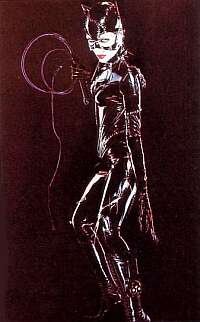 Daniel Waters’ career has been one of ups and downs. For every brilliantly-observed piece of satire, such as Heathers, there has been…well, Hudson Hawk. However, also on his resume is perhaps the best Dark Knight movie yet made, Batman Returns – though, let’s face it, with a supporting cast including Christopher Walken, Michelle Pfeiffer and Danny DeVito, a telephone directory would likely have made compelling viewing.
 This is, very clearly, a parody of the superhero genre, playing with the conventions of secret identities, powers, merchandising and so on. The part of Spooky, one of the CoG members who is a woman masquerading as a male superhero, looks to have been written for Michelle Yeoh – one move is described as “a famous maneuver of renowned Hong Kong actress Michelle Khan — hint, hint” which puts Waters several years ahead of Hollywood in recognising her talents.
 Few films had as twisted a path to the screen as Tomb Raider. [For a three-part history of some of the rumours since August 1997, see
  Once they enter the El Dorado complexes, the script reads like a description of levels from the game, with levers to pull, gaps to jump, tunnels to swim through, and keys to rooms located in other places. It’s hard to see how this could have been brought to the screen without feeling like you were watching someone playing the game. In addition, the trick used to locate an entrance is a painfully direct steal from the textbook of Dr. Jones – as is the massive, rolling boulder that forms one of the traps inside.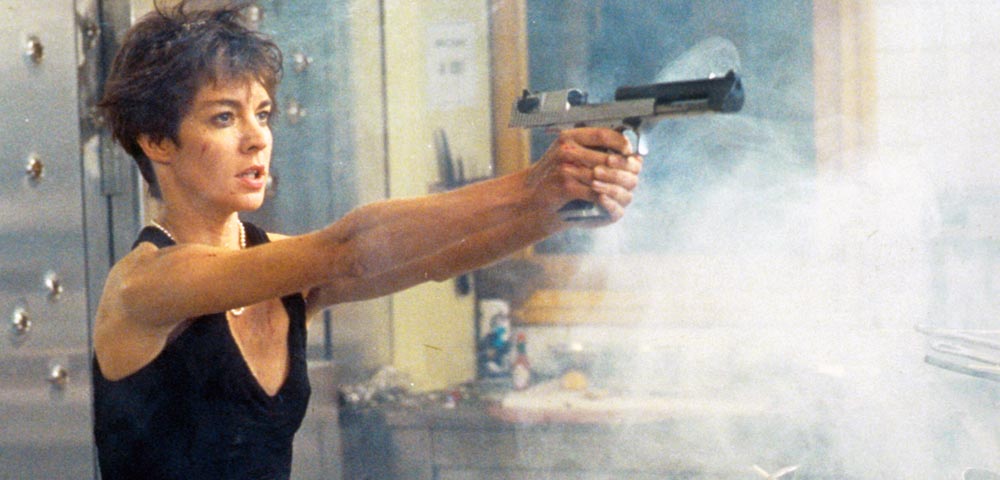
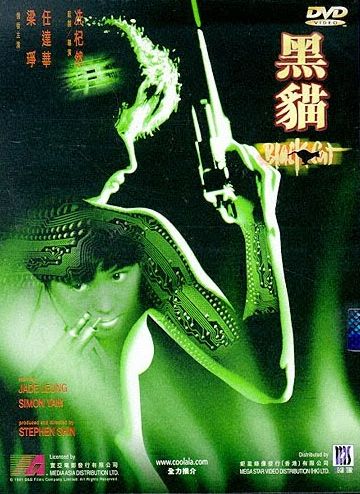
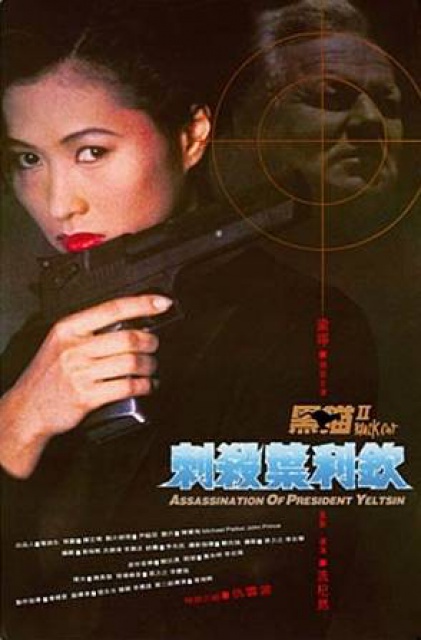
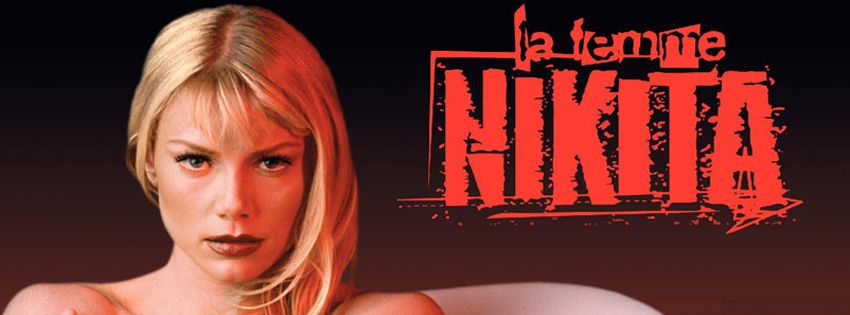 ★★★
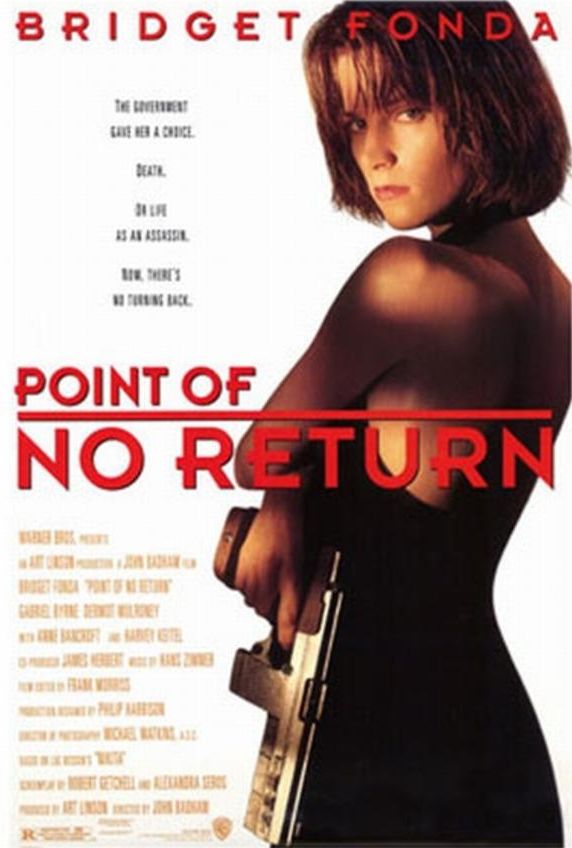
★★★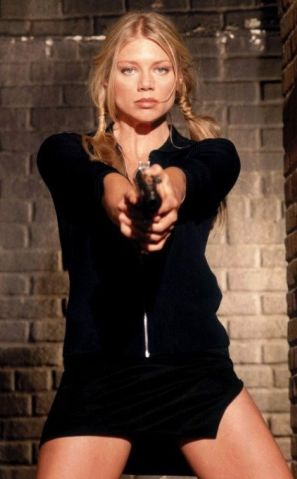 The other chance is that Section One, their version of Division, is not malicious – at least not in the same way. It’s certainly a heartless organization, which is utterly ruthless, and prepared to dispose of anyone who may interfere with their actions, but it’s more an awareness that when you’re dealing with terrorists, organized crime or other threats to the country and world, you can’t be unwilling to get your hands dirty. It leads to a significant bleaker overall tone, and is amazingly prophetic, given this was screened well before 9/11 led to this attitude become a necessary part of national security. Early on, it’s established that you can never trust Section heads Operation (Glazer) and Madeleine (Watson, who was also part of the remake, playing Senator Pierce – her given name there was also Madeleine), to the extent that their deceit becomes almost a cliché.
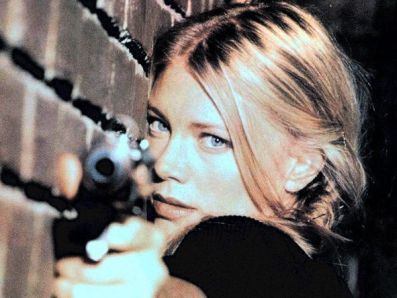 On the other hand, apart from the lack of action, the angle I liked least was the relationship between Nikita and her handler/fellow agent, Michael (Dupuis). I’ll come right out and say it: I hate ‘shippers, and storylines that pander to them are nothing more than an irritant to me, especially in shows which I watch for action, where they do little except interfere with the good stuff, in my humble opinion. [We’ve seen this in the new incarnation, where the show has disintegrated from one of the best shows on TV, into little more than Mr. and Mrs. Smith And Friends.] I’m definitely a “noromo”: If I wanted unresolved sexual tension and relationship nonsense, I’d watch daytime soap operas. Right from the first time Nikita and Michael meet, it’s doe-eyed heaven, even though there is obviously little or no honesty, trust and anything else on which a genuine relationship could ever be founded.
 ★★★★
★★★★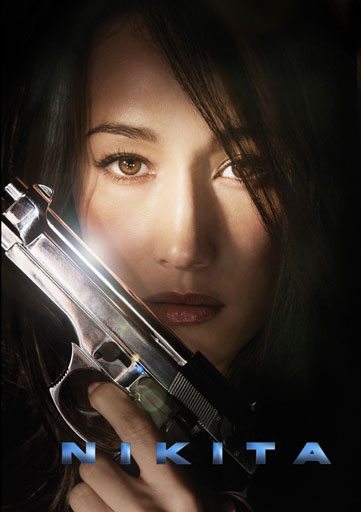 I was reassured by the casting of Maggie Q as the lead, who has a solid action pedigree, both in Hong Kong (Naked Weapon) and the West (Live Free or Die Hard and M-I:3). While its source material was clear, it took a different approach. Instead of telling Nikita’s story from the beginning, with her recruitment into a shadowy semi-official organization and training as an assassin, it starts later, after she has mutinied and left them. Now, she is working to bring down the organization known as Division, its leader, Percy (Berkeley), and his right-hand man, Michael (West), who trained Nikita before she went rogue. Her ‘secret weapon’ is Alex (Fonseca), a new recruit going through training, while acting as Nikita’s mole and feeding her information, allowing her to sabotage and obstruct Division’s missions.
 They even crammed in nice nods to the original movie and its TV predecessor too, with a dive down a chute to escape, and a cameo from Alberta Watson, one of La Femme Nikita‘s actors, as part of the intelligence committee supposedly in charge of Division. By the time the dust has settled, Nikita was driving off into the sunset with a surprising ally, and Alex was also teamed up in a new way, setting things up nicely for the second series. Whether it was going to get one or not seemed in doubt for a while, as the rating did sag mid-season, dropping the show onto the ‘bubble’. However, it was announced in May that the CW would pick it up for another series, moving the show to Friday nights to play along with Supernatural.
 “Twin towers”
 The obvious point of comparison for Smith would be Pamela Anderson, another Playboy playmate who moved into films of doubtful quality, but any such comparison would be unfair. To Anderson, that is, who given the right role, is not actually too bad. With Smith, you get the feeling she simply has no talent, and any character would be a stretch, let alone the Shakespeare-aware, ace helicopter pilot and crackshot she is supposed to portray in this shameless Die Hard clone.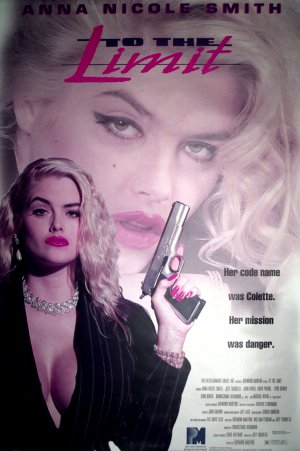
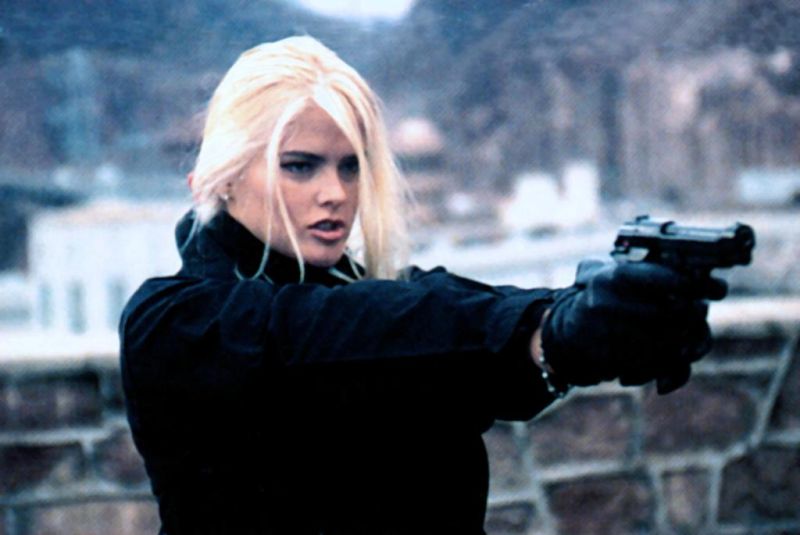
 Okay, her swansong won’t be up there with James Dean’s or Bruce Lee’s, but this does at least sense its own idiocy, rendering the movie somewhat bullet-proof, critically speaking. It’s supposed to be dumb, wildly implausible and hideously over-acted. So condemning it for these flaws is complaining because your hotdog tastes of meat. A trio of shape-shifting aliens land on Earth to protect it from the scum of the universe. Thanks to their first encounter with our culture coming in the shape of a porno mag, they opt for the form of attractive women. Two end up getting jobs as FX/stunt people in Hollywood – a sadly underexplored angle – while the third is…Anna Nicole Smith. Then their nemesis (Laurer, the actress formerly known as Chyna) turns up, taking over the body of a mobster’s wife, and prepares to bring about the end of the world. Can she be stopped?
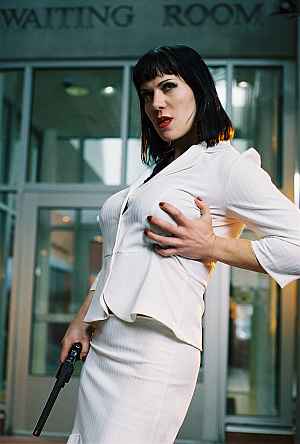 There’s no doubt this film is, if not cashing in on her death, certainly shrugging its shoulders and taking advantage of an unfortunate situation. I don’t really blame them for that, even if anyone looking for skin will be wasting their time here. In sharp contrast to her previous, ah, body of work, AN’s clothes remain on; as exploitation goes, this is tame and restrained. And that may be the main problem: a failure by the makers to decide which way to go. SF/action or all-out comedy? There’s enough of each to suggest, with greater commitment, either might have worked better. Instead, it comes off as somewhat lukewarm – can’t say we were ever bored, yet I can’t say I was ever more than mildly amused.
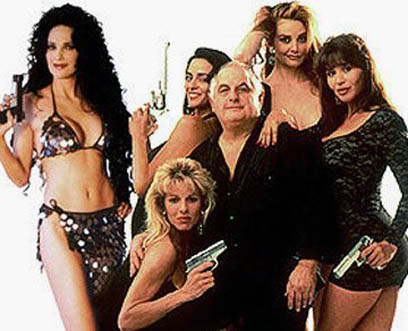 It’s perhaps no surprise that Sidaris gravitated towards the action genre, having for many years been a TV sports producer, winning seven Emmys in the process. He also was responsible for the football scenes in M.A.S.H., though director Robertn Altman stiffed him out of credit for that, to Sidaris’s lasting disdain; more than 30 years later,
 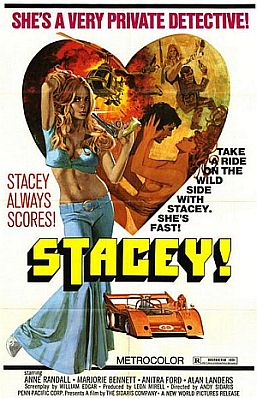 While this wasn’t Sidaris’s first feature – he’d done The Racing Scene, with James Garner in 1967 – this was likely the prototype of the BB&B (Blood, Bullets & Babes) flicks that would become his trademark. If all the elements do not quite mesh in the way they eventually would, they are all present, mostly in the shape of Anne Randall, a former Playboy playmate who plays private investigator Stacey, and looks a bit like Heather Graham.
 Female action fans would be well advised to give this a wide berth. Actually, so should everyone else, unless they’re fans of crass sexism, extremely clunky exposition and hideous country & western. Cody Abilene (Hinton) is a PI hired by Countess Luciana (Danning) to look into the export of illegal computer technology to the Russians, centred on the home of Lady Lillian Chamberlain. Who is responsible? Oversexed chauffeur Shane? Daughters Lisa and Anita? Or the maid, Marion? [groan…]
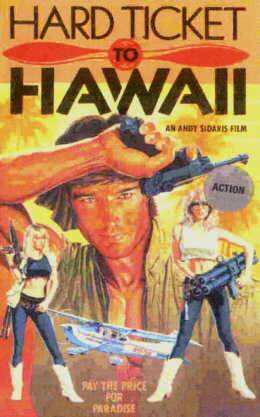 Also known as Hard Titties in Hawaii – at least in this house – it’s a big step forward as far as the evolution of Sidaris’ work goes. After the flailing around that was Malibu Express, he’s now firmly settled on Hawaii as a location, and jiggly action/adventure as the genre. However, he still unfortunately seems to want to cram lame comedy in there, such as clunky references to his previous films, while many of the actors appear not to have been chosen for their thespian ability – to their credit, Speir and Carlton aren’t particularly the worst offenders.
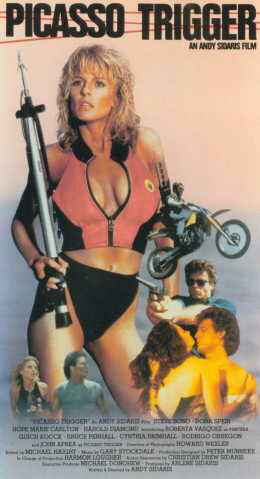 Salazar (Aprea) is a famously devious assassin who gets shot by a sniper just after he donates a painting (of the emblematic ‘Picasso triggerfish’) to a Parisian art gallery. This sparks a series of lethal attacks on undercover federal spy teams who are Salazar’s enemies. But are the various bad-guys, who use all manner of tricks to eliminate government agents, all working for a criminal mastermind?
 This one doesn’t really get going until the second half, when the search for a lost hoard of Japanese wartime gold, looted from the Philippines, leads to a remote island. There are CIA agents, revolutionaries, a left-behind Japanese soldier and, of course, our lovely heroines Dona and Taryn (Speir and Carlton) who end up there after their plane crashes in a storm. Or rather, “storm” – you can get a cheap laugh by seeing the bright blue skies as they land in the middle of a clearly hose-supplied downpour. Sidaris probably felt the need to justify their otherwise implausible strip-tease shortly after departure. Or do FAA regulation stipulate pilots must remove their tops in emergencies? Two take-offs for the price of one…
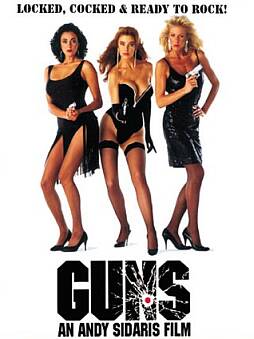 Two federal agents (Speir and Vasquez) are hot on the trail of South American gangster Degas (Estrada), after one of their friends is shot during one of his hits – but perhaps that’s really what he wants? Zipping around from Hawaii to Arizona to Las Vegas, this was the first Sidaris movie I saw, and was probably better than I expected. While obviously not shot on an unlimited budget, most of the deficiencies are made up for in energy and a host of interesting characters.
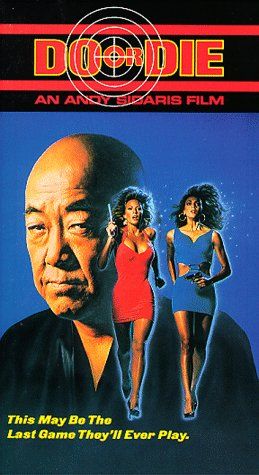 In a filmography not exactly noted for thought-out plots, this maybe counts as one of the thinnest. Donna (Speir) and Nicole (Vasquez) are targeted by death for Kane (Morita) for their interference in his illegal business ventures. But rather than simply bumping them off, as any sane criminal mastermind would do, he informs them of his intentions to send six separate pairs of assassins after them, beginning the next morning. Our pair of federal lovelies head out of Hawaii, little knowing that a tracker has been placed on them, allowing Kane’s to follow them, while their master sits in his apartment and follows the progress of his “game” on a computer display resembling a bad TRS-80 game [younger readers can Google “TRS-80” if they need specifics], as they proceed from Las Vegas to Louisiana, with a motley crew of associated agents in tow, including infamous Meyer model, Pandora Peaks. No prizes for guessing her role.
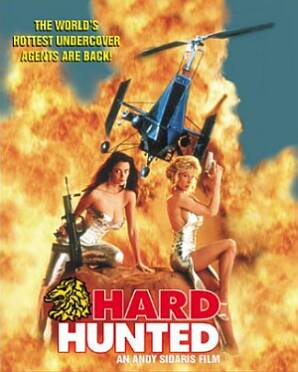 It’s very easy to mock a film, when the lesbian necking starts before the meaningful dialogue, and is immediately followed by a musical number where Cynthia Brimhall channels the spirit of Jimmy Buffett. Yet the endearing loopiness on display here did a better job of keeping my interest throughout than many movies made with far larger budgets. The plot centers on a jade Buddha, containing a nuclear trigger, which starts off in the hands of Kane (Moore), only for it to be swiped by an undercover agent: she is gunned down, but passes it to Donna (Speir), who has to try and keep it out of Kane’s clutches. However, an unfortunate bout of amnesia leaves her partner Nicole (Vazquez) and the other agents trying to find her first.
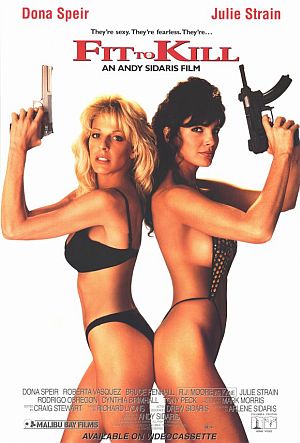 Hang on, two movies ago, criminal mastermind Kane was Japanese – now, he’s the son of a Nazi officer who went on the run after the war with a diamond stolen from the Russians? I know I’m watching these all of our order, but still… They even refer to a pendant with a tracking device in it, given to the Japanese version of Kane, even though Moore now appears to be channeling Julian Sands, not Pat Morita. I’m so confused. Still, logic, continuity and coherence are not really the point here, are they?
 While containing many of the same elements as usual e.g. boobs and bombs, this does at least throw in a new angle, in the shape of some Confederate gold buried in the woods since the Civil War – I can only presume Sidaris must have befriended a Civil War re-enactment battalion. Out enjoying a bit of off-road action, amusingly-named federal agent Becky Midnite (Simpson) and her two co-workers stumble across a diary written by one of the soldiers transporting the gold. However, their plans to search for the treasure are disrupted by efforts to kill them, courtesy of mob boss Santiago. He is upset after they shut down his operation that involved shipping drugs in hollowed-out watermelons. Fed up with the ineptness of his minions, he hires even more amusingly-named assassin Jewel Panther (Strain) to carry out what they have failed to do.
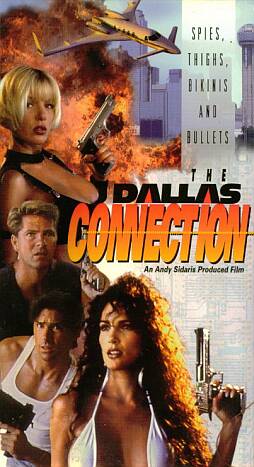 Among Sidaris fans, I imagine arguments over whether this one counts, much like the Never Say Never Again debate among 007 lovers. For this was directed not by Andy, but son Drew; Dad and Mom were merely executive producers. However, the content is much the same, though (and I can’t believe I’m writing this) Drew lacks the subtle touch of Sidaris Sr. Case in point: the very first shot is of the Eiffel Tower, establishing that this is Paris. However, the point is then rammed home with footage of the Arc De Triomphe, Place de la Concorde and Notre Dame. Similarly before the ‘South African’ scenes; we get so much wildlife footage, it feels more like the Discovery Channel.
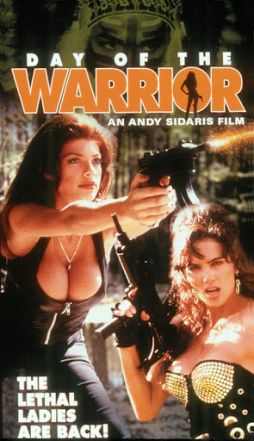 Andy was back on the helm for this one, but appears to have opted to go beyond subtle self-referential digs into full-blown camp, and I tend to think this takes away from the overall experience. The intent is clear when we are brought into the office of Willow Black, the head of L.E.T.H.A.L. (The Legion to Ensure Total Harmony and Law), and find her exercising on a treadmill in an outfit more suited for an exotic dancer. Which makes sense, because if you’re a female agent of LETHAL, you can bet you’ll be going undercover as a stripper or a porn actress – not quite the empowering government job one might expect. It also appears that breast enlargement surgery is required for all such operatives.
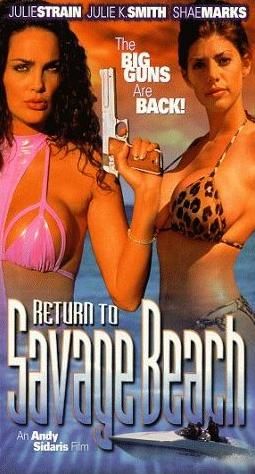 This was Sidaris’s last film, and after the disappointment of Warrior, it’s nice to see him return to a more straightforward approach, with little of the post-modernity attempted there. It is largely a sequel to Savage Beach, with a raid on the LETHAL offices puzzling Willow (Strain) and her agents, because the only thing accessed was the files on that case, which have long been closed. However, it turns out the villain there, Rodrigo (Obregon) did not die in a fiery, explosive-tipped crossbow bolt explosion as thought, and now sports a nifty mask, apparently lifted from a production of Phantom of the Opera. He sends his blonde minion in her submarine(!), along with his ninjas(!!), back to the island to claim a priceless Golden Buddha buried there, and it’s up to Cobra (Smith), Tiger (Marks) and their himbo colleagues, to stop him.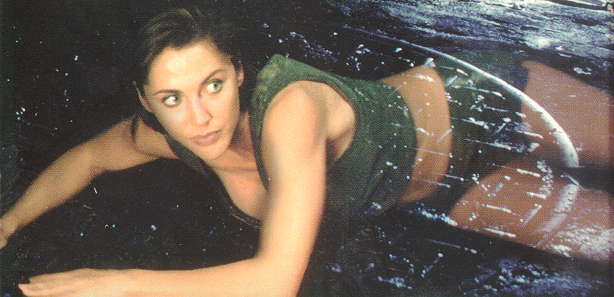
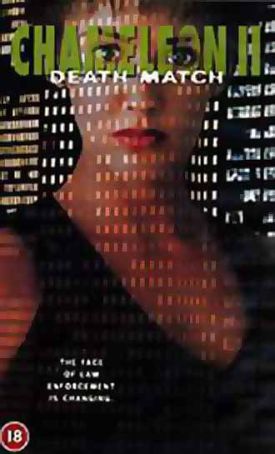
 The setting is the near-future, when corporations have taken over, and even the FBI is now the Incorporated Bureau of Investigations. The star is Bobbie Phillips, who plays Kam, a creation of the IBI. She was made as a special agent, with mostly human DNA, but also traces of cougar, falcon and chameleon. This gives her an interesting power: she can make her skin match her surroundings almost perfectly. Fortunately – or not – this skill is also possessed by her clothes, which is a bit of a plot clunker, designed to avoid both the traditional Invisible Man-styled floating shirts, and gratuitous nudity.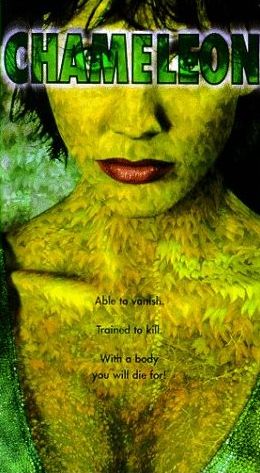
 There’s one sequence with Kam scurrying, lightning-fast, up a ventilation shaft (left) and a rather good brawl involving her that made me sit up and pay attention, offering hope for the rest of the movie. It’s a red herring. The last twenty minutes finally stop slavishly cloning Bruce Willis, with the villain not being who you’d expect (though if you think about who played the bad guys in the Die Hard trilogy, it’s not hard to work out). One good twist at the end is Kam recovering the “loot” and using it for her own ends, which extends her nicely amoral attitude. There’s also a nod to Kam’s not-entirely human origins, and how they affect her emotions, which would be a good avenue for future exploration.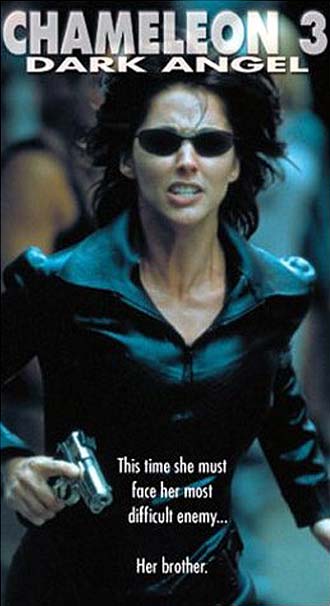
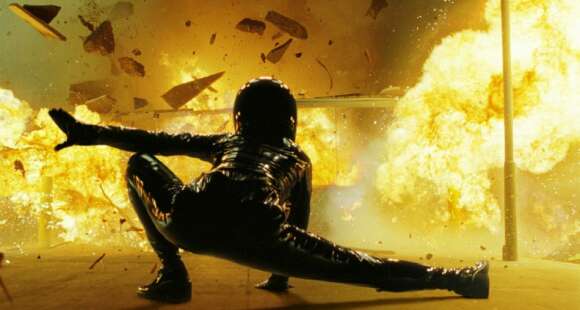
 I imagine no-one genuinely doubts the answer, but this adds a whole new plot twist, especially as the last time the Mongoose activated his weapon, its impact was pretty heavy. What happens when it’s used here is never really shown, and there is some scientific handwaving about the black hole absorbing all the energy, but it would be gratifying to think that it became necessary to destroy the city in order to save it. Not least because Cameron’s Dark Angel
  Police Officer: “I think we can handle one little girl. I sent two units. They’re bringing her down now.”
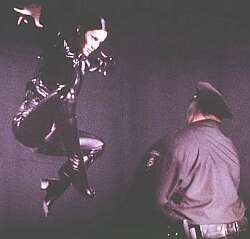 Few movies have been so influential as The Matrix, with its seamless combination of elements from Hong Kong action, anime, and science-fiction, to which the Wachowski brothers added a sprinkling of semi-original thoughts and some very cool sunglasses. One of the key pieces in the jigsaw is Trinity, played by Carrie-Anne Moss – normally, supporting characters fall outside our realm here, but Trinity transcends the usual bounds imposed on such roles. Along with Lara Croft, she has become one of the most important action heroines of the past decade.
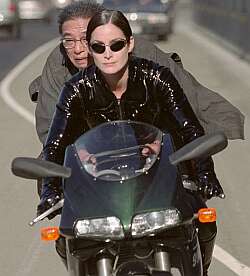 However, she is still more than capable of independent action, such as when she, Morpheus and Neo seek the Keymaker, and are led to him by Persephone. This leads to a battle, first against the Twins, two dreadlocked, white brothers who can pop in and out of physical existence at will. Then, as if this wasn’t enought, there’s the highway chase, where Trinity whizzes
 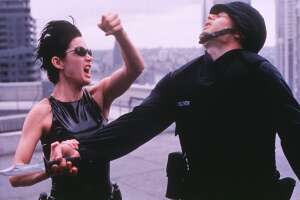 Trinity’s feminine side does show through occasionally, however, most obviously in the nurturing way she initially cares for Neo. She brings him food, causing the traitorous Cypher to comment, “I don’t remember you ever bringing me dinner.” Trinity just rolls her eyes, but Cypher’s jealousy is perhaps a factor in pushing him over the edge into treachery and an alliance with the Agents.