


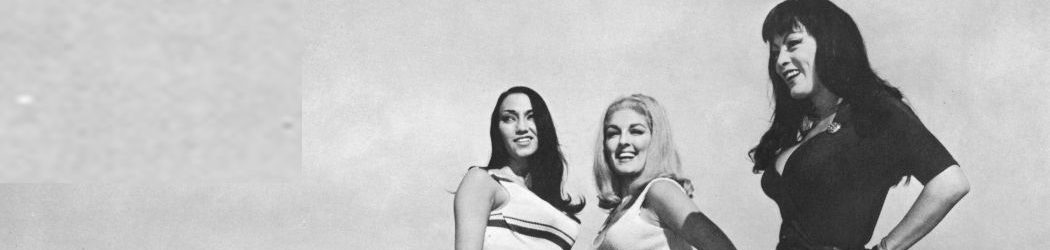

In 1990, Luc Besson made Nikita – known as La Femme Nikita in the United States – one of the most influential action heroine movies of all time. It inspired one official remake, an unofficial Hong Kong version, a TV series that ran for 96 episodes, and elements of it have cropped up ever since, in a huge range of creative endeavours, from The Long Kiss Goodnight through Prisoner Maria to Dangerous Prey and Phantom: The Submarine. With the release of the original movie in a “Special Edition” DVD (albeit one that, by most accounts, isn’t very special), and the first season of the TV show also coming out in a box-set, it seems like a good opportunity to take a look at the films and series which owe the most direct debt to Besson’s creation.
- Nikita (film)
★★★★½
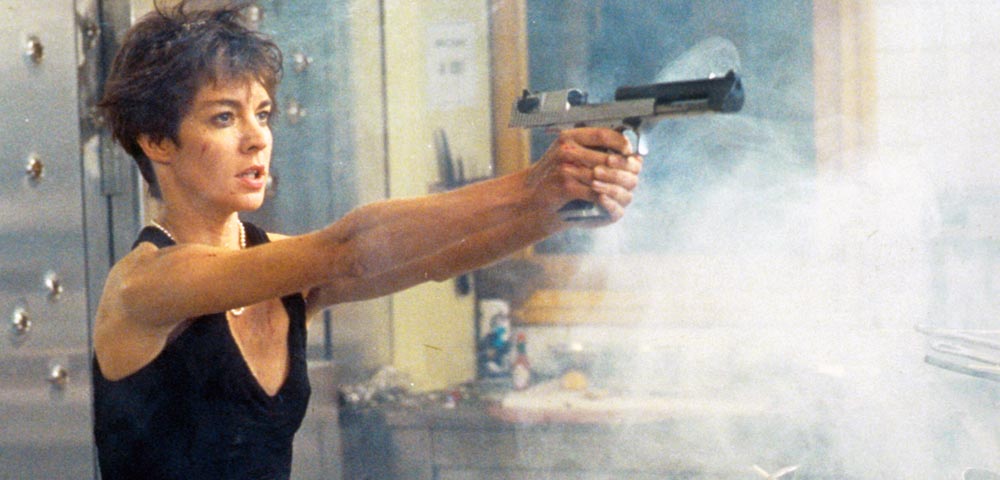
 Luc Besson’s original contains all the necessary elements which would become standard for the field. A criminal is “killed” by the government, only to be resurrected into a new life as an assassin for the authorities. Initially resistant, she eventually embraces her new life, but a romance reminds her of the world she left behind, and becomes a potentially lethal threat to her existence when it starts to interfere with her professional capabilities.
This kind of thing has been done so often since, in one form or another, it’s hard to remember how fresh and invigorating it seemed at the time. Even so, not many movies since have had the courage to make their heroine a junkie cop-killer, and it says a lot for both Parrilaud and Besson that Nikita still comes over as sympathetic. She’s a victim of circumstance, her only use to the state as a trained killer, but the film strongly makes the case that she remains a person, with feelings and emotions like the rest of us.
It is these that eventually prove her downfall, when she encounters Victor the cleaner (Jean Reno), and realises that he is what she will eventually become. Seeing him kill people, as easily as we would swat a fly, it’s clear that, no matter how lengthy her indoctrination and training, she still kept her essential humanity and there is a line she won’t cross. Mind you, the original ending was rather more explosive, with Nikita turning her skills to exact revenge on her creators. Whether through a lack of resources, or a desire for a less confrontational finale, this was dropped in favour of a softer, more ambivalent ending which was also copied by subsequent versions.
Though this might have been nice from an action heroine point of view – as is, you wonder why they bothered with all that specialized training – I’m more than prepared to settle for the actual version of the film. The performances are all sound, Parillaud’s in particular (her “singing” voice is a stroke of genius!), and Besson’s style shines through a bluish haze of raindrops, wet streets and car headlights. Avoid, at all costs, the English dubbed version: that’s what Point of No Return is for. Even if you can’t or won’t read subtitles, you will have little difficulty in understanding the film, such is the raw emotion the actors put into their portrayals.
At two hours long, there is perhaps a slight deficit of actual action, not least in comparison to the hyperkinetic pace of contemporary genre entries. Some facets of the film, such as the romance, seem overplayed, albeit largely because the actors get the significance over so well. However, it’s not as if you’ll find yourself looking at your watch, and – if you’ll pardon the pun – the execution here is almost flawless.
Dir: Luc Besson
Continue reading →
Star: Anne Parillaud, Tcheky Karyo, Jean-Hugues Anglade, Jeanne Moreau - Point of No Return
★★★
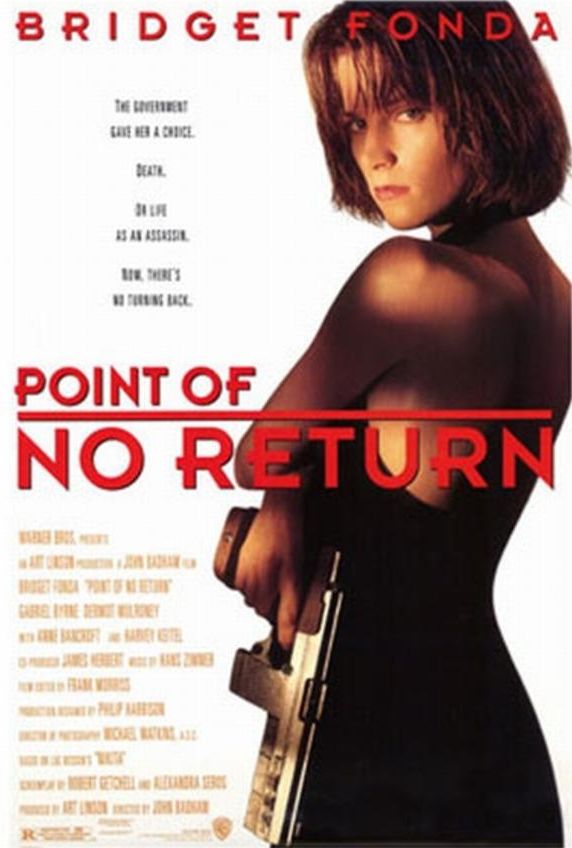 This was called The Assassin in Britain, though a more fitting title would be Remake of No Point. I hadn’t seen this since it originally came out, and it was a quite deliberate choice to watch it first for this article, hoping to escape the sense of deja-vu. Unfortunately, I couldn’t: its strengths are exactly those of Besson’s original, while the weaknesses are largely its own.
I can see the purpose of remakes, be they of old movies or foreign ones, when you bring something new to the table. However, it’s entirely understandable that Luc Besson passed on directing the American version, pointing out that he’d already made the movie he wanted. For Venice, read New Orleans. For Nikita, read Nina. For Jeanne Moreau, read Anne Bancroft. About the most significant difference in the storyline is that Fonda listens to Nina Simone.
Balancing the cast off, most are fractionally less effective than their French counterparts, although not so much that you’d notice. There are two exceptions: Dermot Mulroney fails miserably as Maggie’s boyfriend, J.P, to the point where I would have run screaming out the door, and that was after less than two hours in his company. Their relationship fails to convince, and since Badham places it close to the centre of the film, it’s a major flaw.
On the other hand, Harvey Keitel comes perilously close to stealing the whole show as Victor the Cleaner. Jean Reno was good in the original, yet Keitel brings a whole new dimension of menace, and clearly inspired Tarantino for Pulp Fiction. They missed the chance for a spin-off of genuine inventiveness there.
But what little originality actually is brought to the film, largely doesn’t work, in particular a sappy romantic montage between Maggie and J.P. As a director, Badham does a good job with the action sequences – you’d expect nothing less given his track record in the likes of War Games – even when all he’s really doing, is recreating scenes such as the kitchen shoot-out (watch those desserts fly!). There does seem to be rather more Fonda underwear footage too… :-)
Relocating everything to the States is not such a bad thing. While I don’t know about the French government, a school for psychotic murderers is by no means beyond the bounds of possibility – the infamous School of the Americas does much the same for Latin American death squads. And, taken on its own, this is not a bad film. But if you have ever seen the French original, then the American remake becomes entirely superfluous and, as mentioned above, it feels more like you’re watching an English dub, albeit a credibly well-voiced one.
A remake was supposed to be necessary because American audiences wouldn’t watch a subtitled film, but when the box-office spoke, Point took only $30m. The original was a French take on a mostly-American genre, but something is definitely missing when it comes home. Perhaps Badham should have slept with Fonda during production, as Besson did with Parillaud.
Dir: John Badham
Continue reading →
Stars: Bridget Fonda, Gabriel Byrne, Dermot Mulroney, Anne Bancroft - Black Cat
★★★½
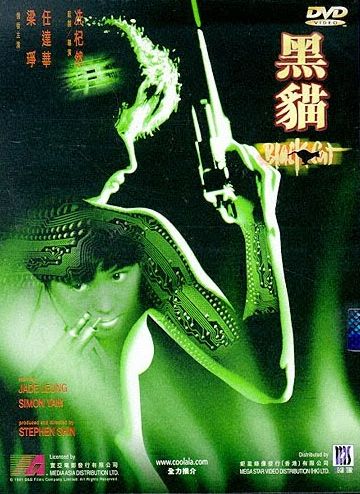 Before the official remake of Nikita came out, Hong Kong had already delivered its take on the matter. The film starts in New York, and a large part of this is in English, though the acting there is so woeful as to make you lean towards the Chinese dubbed version. The heroine, Erica, is made more sympathetic: while she still kills a cop, she’s not a junkie, and is “shot” while trying to escape. She wakes up under the watchful eye of Simon Yam, in the “Uncle Bob” role (though here, he’s a ‘cousin’).
From here, the plot is similar to Nikita – missions, qualms, romance, escape attempt, etc – and interestingly, her boyfriend (Thomas Lam) is a photographer, an idea also used in the later Point. There are, however, significant differences in the details. For example, Erica has a chip implanted in her brain, supposedly, to help her achieve her full potential, but all it seems to do is give her raging headaches [admittedly, a potentially useful control mechanism]. They also skip the etiquette lessons, which seemed irrelevant to me anyway – how do good table manners help, when your mission solely involves the use of a sniper rifle?
The specifics of her missions are also altered. The final test, rather than an assassination in a restaurant, is to kill the bride at a Jewish wedding, for reasons left unexplained – but given the heavy weaponry carried by a lot of guests, it’s perhaps no bad thing! Others involve shooting an executive of the WWF (the nature group, not the wrestling federation!), a throat-slitting at a Japanese hot spring resort, and, in the best-staged sequence, dropping a lot of metal from a great height onto the roof of her target.
However, the movie’s main strength is Jade Leung, who fully deserved the Best Newcomer award she won at the 11th Hong Kong Film Awards. Every facet of her character is consistent and believable, certainly more so than Bridget Fonda – it’s at least the equal of Anne Parillaud, and arguably may be even better. Yam is perhaps a kinder, gentler handler: he doesn’t shoot his protege in the leg, for example, yet the relationship between them is missing the romantic spark which lurked in the original. As for Thomas Lam, he’s not Dermot Mulroney, and that alone is an improvement.
The film is undeniably flawed, not least in a soundtrack that is often wildly inappropriate, and seems to have been pulled at random from easy-listening CDs. But its core is solid, and in a lot of ways, this is a more justifiable movie than Point of No Return. While the story remains the same, Black Cat does at least bring a bottle to the party, adding enough new twists to make it interesting (and avoid a lawsuit). Leung’s fine performance is an unexpected bonus.
Dir: Stephen Shin
Continue reading →
Star: Jade Leung, Simon Yam, Thomas Lam - Black Cat 2: The Assassination of President Yeltsin
★★★
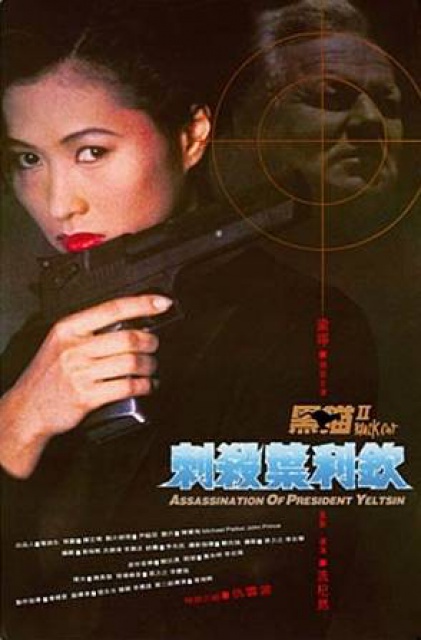 While neither Nikita nor The Assassin ever resulted in a sequel, the success of Black Cat lead, immediately to a follow-up. This is both good, in that it forced D&B Films into coming up with some new concepts, and bad, because what they came up with is a barely coherent mess. They take Leung – who had won the ‘Best Newcomer’ award – and give her a role where she gets to speak twice. The real star is Robin Shou, well before his Mortal Kombat days, and with a much better haircut too.
He plays a CIA operative – the laserdisk subs say this stands for Central Intelligent Agency, clearly dating this before 9/11 – who is investigating a group out to assassinate President Yeltsin. Their chosen hitman has been beefed up with some kind of ill-explained technological wizardry, but luckily, one person can detect the radiation he gives off: Black Cat, who now has a chip in her head (to match the one on her shoulder, hohoho). This leads to an amusing sequence where Black Cat heads off on her own, charges into a mall, and shoots an old lady because – wouldn’t you know it? – the senior citizen just happens to be giving off the same kind of radiation, courtesy of her medical treatment. Well, I found it amusing, anyway; there’s something about a head-shot which spatters the face of a nearby clown with copious amounts of blood. Er, just me, then? :-)
Okay, the movie may never be dull, and is certainly not short on action. Yet it doesn’t make any sense. Why would the CIA send operatives into Russia to save their president? And what are they doing operating in America? Isn’t that illegal? Oh, I forgot – it’s the CIA we’re talking about here. Leung’s robotic performance – even though entirely appropriate, since she now comes with an remote-control off switch – also feels like a terrible waste of her talents. There’s a lot of wire-work in the action sequences, but it’s not badly done; the highlight is probably a fight in a steel-works where both Robin and Jade have to take on large numbers of adversaries. The final battle, when Black Cat fights the assassin around the wreckage of a crashed plane, is cool too, with the two antagonists bouncing off the debris.
However, the overall impact is bitty and sporadic. While there are some nice ideas, they are poorly thought-out and developed, and the script doesn’t meld them into any kind of satisfactory structure. The action sequences feel equally bolted-on, though I did like the use of a President Yeltsin lookalike (at least, one presumes it was a lookalike, though I recall the real ex-President Gorbachev did appear in a Wim Wenders film). After the critical acclaim that greeted her debut, Jade Leung could have turned her skills in any direction; unfortunately, this disappointing follow-up is largely symptomatic of the poor choices that seem to have dogged her subsequent career.
Dir: Stephen Shin
Continue reading →
Stars: Robin Shou, Jade Leung, Zoltan Buday, Patrick Stark - La Femme Nikita: season one
 ★★★
★★★
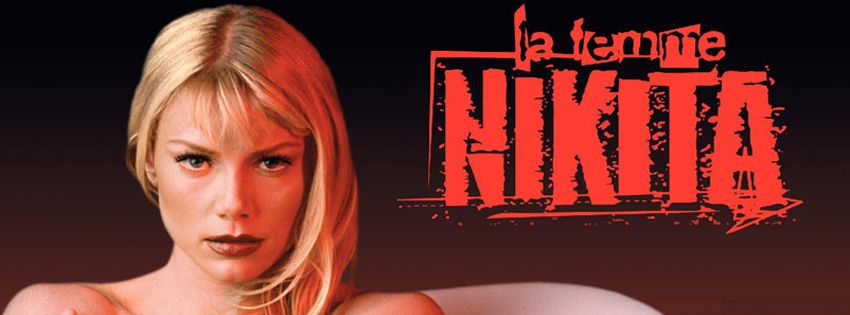
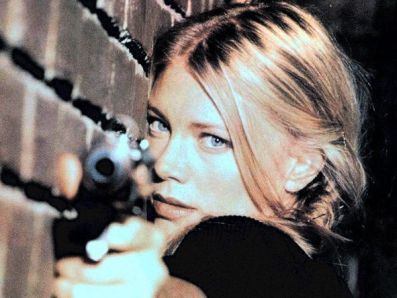
“French kissing in the USA”To say I approached this show in a roundabout way would be an understatement. 15 years after its original screening, after three separate movie versions and two seaseons of the largely unrelated version of the story starring Maggie Q, I finally got round to it. So, bearing tht in mind, it’s a different beast from what I expected – mostly because it’s a lot less action-oriented. Peta Wilson, as lost soul turned government operative Nikita, looks like she could potentially kick your arse, but (largely for budgetary reasons, I believe) there’s only token moments of hand-to-hand action: the focus is much more on spycraft, undercover work and deceit, rather than full-on assaults. There are still occasional sequences, but even these tend to involve relatively brief gun-battles, not the martial arts brawls which are one of the new version’s trademarks.
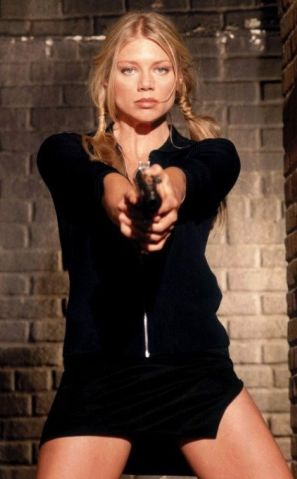 The other chance is that Section One, their version of Division, is not malicious – at least not in the same way. It’s certainly a heartless organization, which is utterly ruthless, and prepared to dispose of anyone who may interfere with their actions, but it’s more an awareness that when you’re dealing with terrorists, organized crime or other threats to the country and world, you can’t be unwilling to get your hands dirty. It leads to a significant bleaker overall tone, and is amazingly prophetic, given this was screened well before 9/11 led to this attitude become a necessary part of national security. Early on, it’s established that you can never trust Section heads Operation (Glazer) and Madeleine (Watson, who was also part of the remake, playing Senator Pierce – her given name there was also Madeleine), to the extent that their deceit becomes almost a cliché.
There are some direct nods to Besson’s movie: her first assignment is to murder a target in a crowded restaurant, and the bathroom assassination crops up in a later episode. On the other hand, there is one significant difference from the original film, in that Nikita here is genuinely innocent of the crime for which she is sentenced, simply happening to be in the wrong place at the wrong time. Her refusal to engage in the actions Section demands of her is a strong thread of the first season, with a reluctance to compromise her moral code being pitted against Section’s desire to control her for their own ends. Early on, she risks “cancellation” (termination with extreme prejudice) more than once, by disobeying orders, usually to protect others from Section action.
Another area in which this show differs from the current version, is a much more pronounced use of music. There are fairly lengthy sequences, several minutes on occasion, where scenes unfold over almost all of a song. A soundtrack CD was about the only piece of merchandise given any wide-scale release by Warner Bros, including the title track by X-Files composer Mark Snow, as well as songs by Depeche Mode and Morcheeba. Also popping up in the first season, are Morcheeba, P.J. Harvey, Sister Machine Gun and several tracks by neo-classical/industrial band In The Nursery, whom I coincidentally went to see in Hamburg, back around the time these episodes first aired. It’s certainly a trademark of the show, and is an aspect I consistently enjoyed.
 On the other hand, apart from the lack of action, the angle I liked least was the relationship between Nikita and her handler/fellow agent, Michael (Dupuis). I’ll come right out and say it: I hate ‘shippers, and storylines that pander to them are nothing more than an irritant to me, especially in shows which I watch for action, where they do little except interfere with the good stuff, in my humble opinion. [We’ve seen this in the new incarnation, where the show has disintegrated from one of the best shows on TV, into little more than Mr. and Mrs. Smith And Friends.] I’m definitely a “noromo”: If I wanted unresolved sexual tension and relationship nonsense, I’d watch daytime soap operas. Right from the first time Nikita and Michael meet, it’s doe-eyed heaven, even though there is obviously little or no honesty, trust and anything else on which a genuine relationship could ever be founded.
There are also a number of aspects of the show which now seem undeniably dated, which is always going to be an issue when a series is trying to be “cutting edge”. Most obvious is the technology – an early episode has tech wiz Birkoff explaining about IRC, something now so passé, an explanation would probably be needed again! – but the opening credits always get a chuckle, especially the final “morph” at the end, which looks incredibly cheap. Meanwhile, Wilson’s accent drifts in and out without rhyme or reason: at times, she seems straight off Bondi Beach, while at others it’s almost entirely subdued.
The episodic nature of this, with less concentration on an over-riding story arc, is both a strength and a weakness. It frees the creators up for some really good stories, but there’s not much incentive to plug in the next episode – I largely watched them in double-bills, but it took me more than seven months to get through the first season’s 22 shows. I enjoyed the bleakness and emotional chilliness depicted here, which as noted above, is probably more relevant now than then, but the obviously lower production values, and its replacement of high-energy action with dramatic angles that Wilson isn’t quite up to handling, brought its overall entertainment value down significantly. I’m probably just about interested enough to pick up the second season at some point: however, that is not likely to be for a while.
Star: Peta Anderson, Roy Dupuis, Eugene Robert Glazer, Alberta Watson
Continue reading → - Nikita: season one
 ★★★★
★★★★
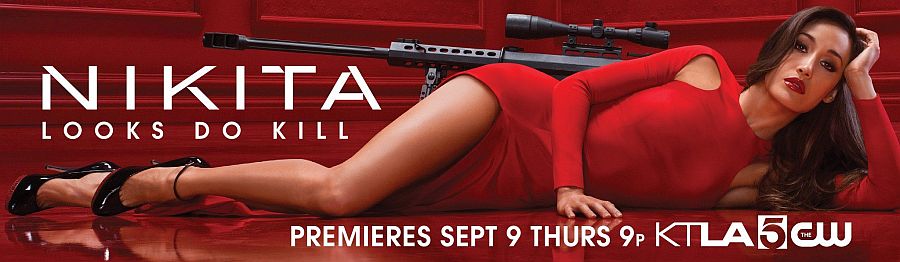
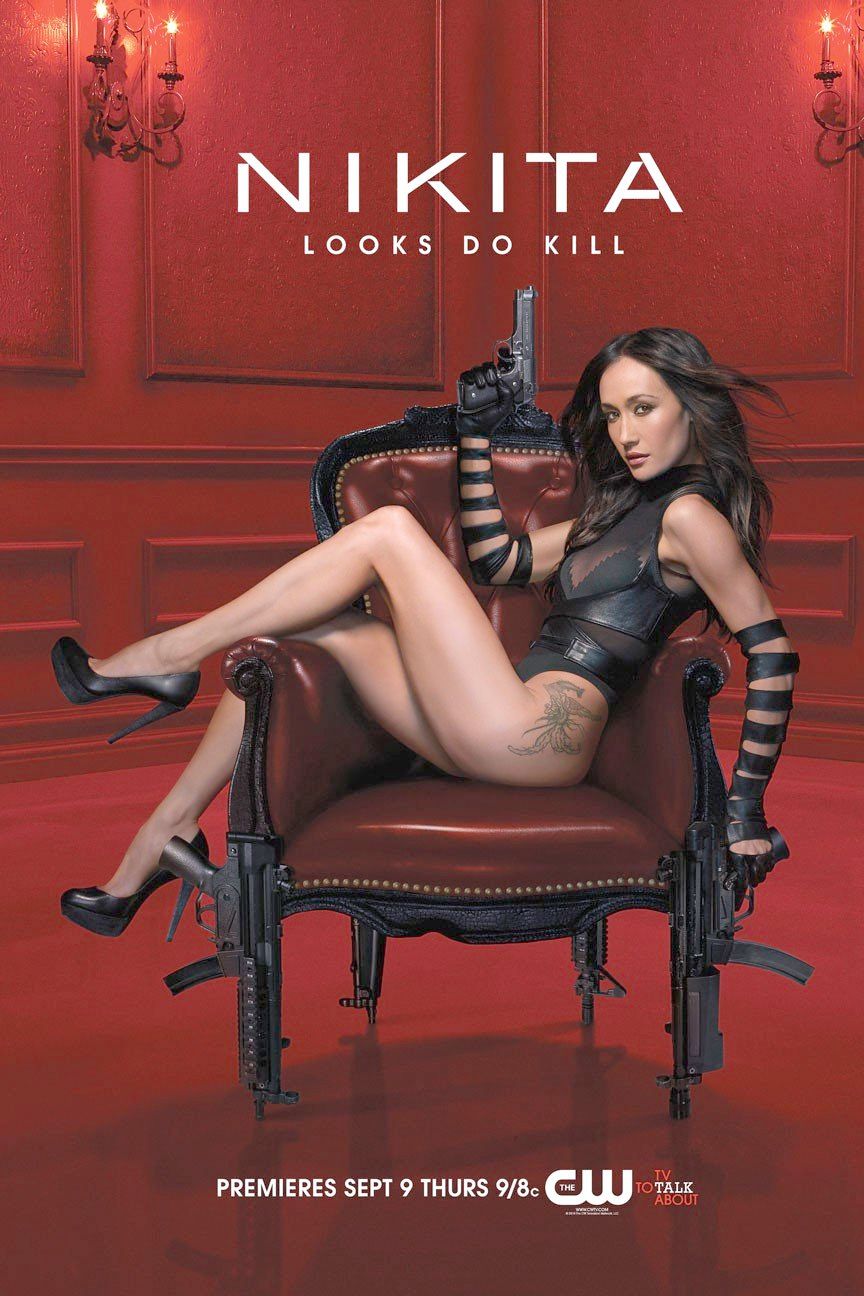
“TV Sinners”Most action-heroine fans will know that this was not the first TV series inspired by Luc Besson’s classic GWG film. Between 1997 and 2001, La Femme Nikita ran for four full seasons, plus a shorter fifth one, with Peta Wilson playing Nikita. In early 2010, the CW Network announced it was developing a pilot to try out a new version of the show, and this was picked up for a series in May. The CW seemed a bit of an odd choice: their idea of an action heroine tends more towards shows like Gossip Girl and the 90210 reboot, with a target demographic of 18-34 year-old women. So was this version going to showcase a kinder, gentler Nikita? I was reassured by the casting of Maggie Q as the lead, who has a solid action pedigree, both in Hong Kong (Naked Weapon) and the West (Live Free or Die Hard and M-I:3). While its source material was clear, it took a different approach. Instead of telling Nikita’s story from the beginning, with her recruitment into a shadowy semi-official organization and training as an assassin, it starts later, after she has mutinied and left them. Now, she is working to bring down the organization known as Division, its leader, Percy (Berkeley), and his right-hand man, Michael (West), who trained Nikita before she went rogue. Her ‘secret weapon’ is Alex (Fonseca), a new recruit going through training, while acting as Nikita’s mole and feeding her information, allowing her to sabotage and obstruct Division’s missions.
The results have generally been pretty impressive, probably the closest thing to a true kick-ass heroine on network TV since the demise of Alias [which may have have happened some time before the end of Alias, if you get my drift]. If not quite as dark as the Wilson incarnation, it is certainly satisfactory on this level, with death, torture and treachery lurking in just about every episode. The characters arcs certainly have their twists and turns: the alignment of loyalties at the end of the series is radically different from where they started, with people on both sides crossing over. It’s easy for a show like this to get into a rut – Division sets up an operation, Nikita foils it, or whatever – and the generally avoided this pitfall.
In what one suspects was a nod to the target demographic, this was as much about Alex as Nikita, who has her own past to contend with. There is, probably inevitably, the love interest, in the form of a blandly attractive next-door neighbour, who is basically the first man she meets after Alex completes her training and goes into the outside world. There was something similar for Nikita, though this first looked to be heading in one direction, then swerved in another during the second half of the show. That was one of a number of changes made mid-season: it seemed as if the makers needed to fine-tune things on the fly; I was concerned where this might lead, but it didn’t hurt the show.
One particular improvement was the appearance of Amanda (Melinda Clarke). Initially Division’s psych evaluator, she took a much more prominent role, and the relationship between her and Alex made for an interesting dynamic, not unlike Sidney Bristow/Irina Derevko [hmmm…]. We also enjoyed Berkeley’s portrayal of Percy: remembering him as the heroic, if inept George Mason in 24, this was a real change. The final couple of episodes had some epic twists, though I was a bit peeved with the “deaths”, which proved not to be terminal. I find it a cheat: as we saw with Buffy, once a character has come back from the grave, death tends to lose its sting, though the execution here was not as clunky or contrived.
 They even crammed in nice nods to the original movie and its TV predecessor too, with a dive down a chute to escape, and a cameo from Alberta Watson, one of La Femme Nikita‘s actors, as part of the intelligence committee supposedly in charge of Division. By the time the dust has settled, Nikita was driving off into the sunset with a surprising ally, and Alex was also teamed up in a new way, setting things up nicely for the second series. Whether it was going to get one or not seemed in doubt for a while, as the rating did sag mid-season, dropping the show onto the ‘bubble’. However, it was announced in May that the CW would pick it up for another series, moving the show to Friday nights to play along with Supernatural.
However, all the plot is perhaps secondary; we want to see ass being kicked. I have largely to agree with Maggie Q, who said, “In terms of action, I don’t see our quality of action on any other show right now. I’m sorry. They may have bigger explosions, but our fights are genius.” For TV work, it’s certainly well above average, and she was apparently instrumental in getting the original co-ordinator fired: “This is my genre, what I’ve been doing for 14 years. I know it well. There’s a level of quality I will not let dip, ever, when it comes to the action… I said, he’s gotta go. It’s dipping. It hasn’t dipped enough in a way that audiences have recognized yet, but it will. I know his style. He’s not innovative. He doesn’t have what it takes to take the show to the next level. And we’re done. We’re done here. We need to bring someone else in.”
What stands out in particular is how much of her own work Q is doing [and, to a lesser extent, Fonseca]. As she also pointed out how much things have changed: “I remember seeing bad wigs on doubles. Then they cut to a close-up, then there’s a wide shot and you know the actress is not doing it. When I fight, you’re right there in our faces – very Bourne. You expect that from that calibre [of film], so why wouldn’t you expect it on TV?” That’s what I think probably impressed me most about the show: at its best, you could stand it beside Salt, and it would not suffer in the comparison. Here’s an example:
Player loading
Yep. I think it’s safe to say that the series has delivered copious amounts of high-quality action, combined with mostly interesting characters, and sufficient plot twists to keep us thoroughly entertained. Overall, it ranks among our favourite five shows of the year to date, of any genre, and comfortably leads the pack as far as action heroines go. We’re already looking forward eagerly to its return, so we can find out what lies in store for Nikita, Alex and Amanda. Oh, and some of the non-heroines too. I guess. :-)
Star: Maggie Q, Shane West, Lyndsy Fonseca, Xander Berkeley
Continue reading → - Nikita – Sexy Killer
★★
“French kissing… And rather more…”[Note. This is a XXX-rated film, so while I’m being very restrained, the discussion of it is, of necessity, still for mature readers.]
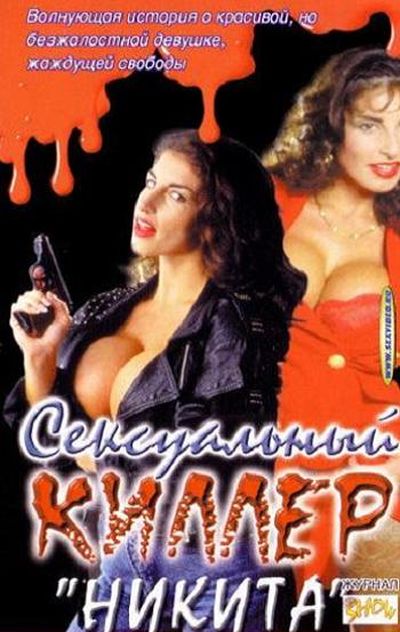 I don’t have any problem with pornography, but the concept of porn with a storyline leaves me somewhat baffled: it’s a combination that doesn’t seem to make sense. Personally, I either want to watch people having sex or a movie with actual characters and a storyline; I don’t think I’ve ever been in the mood where I’ve thought, “I want 2 1/2 hours that combine hardcore pornography with more traditional elements of cinema,” but that’s what you have here. Actually, 2 1/2 hours of hardcore pornography alone, seems like serious overkill, by a factor of somewhere between five and ten. I certainly didn’t get through this in one sitting.
But I was intrigued by the concept. The porn parody has a long, disreputable history, from Skinemax fluff like Lord of the G-Strings through to hardcore entries like – and, I swear, I’m not making this up – Naporneon Dynamite. But this, dating from somewhere between 1996 and 1999, depending on which source you believe, is the first I’m aware of which was based on an action heroine. [Subsequent investigation turned up what appear to be multiple entries involving Lara Croft-alikes. I wouldn’t hold your breath waiting for reviews here] The star here, Sarah Young, got her start doing Page 3 shoots at the age of 14 (!), and transitioned to hardcore later, under the care of her future ex-husband, Hans Moser. Last I could find out, she had quit the adult industry, and was studying to be a lawyer.
Anyway. This film may simply be titled “Sexy Killer”, going by the print – this would make more sense from a “not having Luc Besson sue your ass off” front, but the IMDb begs to differ, so I’m going with that. It certainly does follow the basic storyline of Nikita, particularly early on, though the crime which gets the heroine, Sarah Lester (Young) on her journey into Nikita, is a home invasion – albeit one which turns into a group sex scene between the actual invading of the home and the cops showing up. Then, as in the original, she shoots a cop while high, but is bailed out of the resulting life sentence, by Serge (Clark), who offers her an alternative: wet work and other operations for the organization in which he works. There’s a restaurant scene where she has to assassinate another diner, and another mission involves sniping from a window, both of which will be familiar to fans. But the film does divert at the end, where – and I trust I’m not spoiling this for anyone – Nikita lifts some incriminating documents she’s supposed to be recovering, and uses this as leverage to break free from her employers. Which is actually a kinda cool idea, I have to admit. I also appreciated the cat-fight between Nikita and her mentor/colleague, Jeanette (Sartori). Besson missed a trick there, I feel. And the subsequent lesbian canoodling.
Mostly, though, it’s about the sex. Lots and lots of sex, with the ratio of that to plot being approximately 3:1. And, since the running time is 152 minutes, that is an awful lot of multiple aardvarking, as Joe Bob Briggs used to call it. As for what happens in the remaining 38 minutes (approx), you have to cut the performances some slack, given dubbing where the voice actors are far more enthusiastic with regard to moaning and groaning, than the actual dialogue. But, actually, the actors aren’t bad: in particular, Clark is spot-on, as the world-weary agent tasked with keeping his rebellious underlings in line, and a good equivalent to Tchéky Karyo (or Gabriel Byrne, if you prefer the remake). But the action scenes are perfunctory, and little more than a token gesture – admittedly, it’s an entirely different kind of action in which the makers are interested, so criticizing them for this seems irrelevant. It is possible to make films that mesh hardcore sex with narrative in an interesting way: Caligula is perhaps the best-known example, and Lars Von Trier’s Nymphomaniac, by reports, also does so. Here? Not so much, and it’s probably of interest only to Nikita completists.
Dir: Mario Bianchi (as “Nicholas Moore”)
Continue reading →
Star: Sarah Young, Christoph Clark, Stefania Sartori